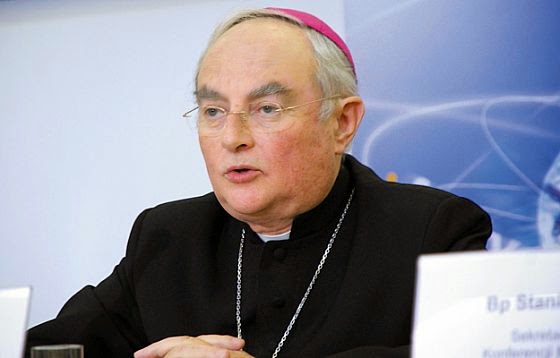
Polish Archbishop predicts ugly confrontations at Synod: “innovators have not been idle”

At the blog Witness for Church and Pope I saw this (my emphases):

BREAKING NEWS from POLAND: Archbishop Henryk Hoser: “The Church has betrayed John Paul II…they did not follow his voice, they did not acquaint themselves with his teaching”

Today’s Niedziela, from Poland, carries an interview with Archbishop Henryk Hoser of Warsaw-Praga, about the recent acts of treachery against Our Lord, His Church and our recently sainted Pope, St. Pope John Paul II. These acts of treachery were committed by an assortment of innovators at last October’s Synod of the Family. These innovators have not been idle, and neither have the defenders of the truth about the sanctity of holy matrimony. I predicted to a friend recently that the upcoming Synod will be an ugly confrontation, that (for example) the Polish Episcopate will never surrender to the innovators. We now have conclusive evidence that this is true. When an archbishop has to publicly proclaim that a canonized saint Pope has been betrayed, then we can see the depth of the rebellion, and the “filth” (c.f. Pope Benedict XVI) that has infiltrated the Mystical Body of Christ.

Key highlights from Archbishop Hoser, which I have translated, include:

On the delegates who seek to overturn the doctrine of the Church:

At the Synod there will be a confrontation with delegates from countries where there is already a majority of pathological families – broken families, patchwork families, with only a small percentage of unbroken marriages – and the demand for the provision of Holy Communion for the divorced. In this lies an erroneous assumption, the postulate that God’s mercy is without justice, when you must begin by saying that married and family life must be founded in justice, which as a whole is not taken into account….

On the influence of the media on sexuality:

…All personal relationships are eroticized, and this is an extremely dangerous phenomenon. Sexualization of friendship has destroyed male and female friendship…the texts of various theorists of this trend [genderism] proves that the world is ruled by sexual satisfaction…

…Genderism is not a struggle for equality between women and men: it is a fight with all constitutive social structures, referred to as stereotypes; in the first place with the “traditional family.” It has created a society of independent individuals. A society both asexual and pansexual.

On the Church:

The church is a prophetic voice in this world. This is not to be understood as some sort of soothsayer forecasting the future. The function of the prophet is the attitude of the consequence of enlightening the situation form God’s perspective, reading the sign of the times.

On Pope John Paul II and marriage:

I will tell you brutally. The Church has betrayed John Paul II. Not the Church as the Bride of Christ, not the Church of our Creed, because John Paul II was an expression, an authentic voice of the Church; but it is the pastoral practice that has betrayed John Paul II.

It is a thesis [theory] to which I subscribe because 40 years of my priesthood has been devoted to marriage and the family, during which time I promoted the theme of “the evangelization of marital intimacy”. In Poland it is and was better in this respect.

In many other countries, due to the contestation to the teachings of the Church, as expressed by Blessed Paul VI, the pastoral care of families was stopped.

[…]

Read the rest there.

¡Hagan lío!

Posted in ¡Hagan lío!, Francis, Hard-Identity Catholicism, Liberals, New Evangelization, One Man & One Woman, Our Catholic Identity, Si vis pacem para bellum!, The Coming Storm, The Drill, The future and our choices | Tagged , , , , , ,
16 Comments

Pope Francis condones beating children

Pope baby zuchettoThe catholic Left hangs on every word that the Pope has, might, could utter about global warning and redistribution of wealth.  They can’t wait to see the next airplane presser or daily off the cuff fervorino, which they hold to have virtually magisterial authority.   When he says something about not talking about abortion or not judging a homosexual, he can’t possibly be wrong.  Pope Francis! The first Pope ever to smile or kiss a baby, the first Pope ever to preach mercy can’t possibly be wrong about anything… except perhaps anytime he mentions anything about women… but I digress.

During his Wednesday audience today Pope Francis endorsed that fathers beat their children.  HERE  Italian text HERE

Una volta ho sentito in una riunione di matrimonio un papà dire: “Io alcune volte devo picchiare un po’ i figli … ma mai in faccia per non avvilirli”. Che bello! Ha senso della dignità. Deve punire, lo fa in modo giusto, e va avanti…. Once during a marriage meeting I heard a father say: “Sometimes I have to beat the children a little… but never in the face, so as not to humiliate them.”  How beautiful!  He has an understanding of dignity.  He has to punish, but he does in the right way, and he goes forward.

15_02_04_Francis_audience_01So, Pope Francis thinks it is good that fathers beat their children.  Che bello!

I look forward to discussions among the catholic Left about the proper way to beat children.  Should fathers use a stick?  A belt?  Just the hand?   How about mothers and a wooden spoon?   Just make sure to avoid hitting them in the face and you are good to go, and maybe watch your strength.  Right?

I am confident we will learn a great deal from their unhesitating support for Pope Francis’ comments today about beating children.

The moderation queue is ON.

Posted in Francis | Tagged ,
45 Comments

ACTION ITEM! Send Fr. Z Christmas cards from around the world – UPDATE

UPDATE:

Don’t send mail to the address I had posted for Christmas Cards.  That was a temporary address.

ORIGINAL Published on: Dec 22, 2014

xmas card 01Do people still send Christmas cards?  I have fewer this year than usual.

Some one remarked to me, jokingly, that I didn’t have a lot of Christmas Cards.

First, he couldn’t know that and, second, he wasn’t being serious.

Still, his remark got me thinking.

I am not impressed by email Christmas greetings.   Not at all.  If someone wants to send me Christmas greetings, they can send a card by snail mail.

So, let’s try something.  

Send me Christmas cards from all over the world with cool stamps.

I’ll save the interesting stamps and see if there is a home school group that might be into stamp collecting. 

I’ll let you know along the way how the card count is going.  Sometimes I look at the blog’s stats and I see, coming and going, people from all over the world.  Hopefully, you will take a moment or two to send a card.

UPDATE 26 Dec:

Cards are starting to come in. Among those which arrived today … from…

14_12_26_cards

  • Cleveland, OH
  • St. Louis, MO
  • Indianapolis, IN
  • Fort Wayne, IN
  • Alton, IL
  • Lincoln, NE
  • Yellowstone National Park, WY (How cool is that for an address? And the card was made in India, so they took me literally)!
  • Dallas, TX
  • Mt. Clemens, MI
  • Denton, TX

UPDATE 31 December:

I had a couple days away of down time.  I returned to find a huge stack of cards!  It took me an hour and a half to open them and extract stamps and read the contents.  Some people included family photos and their annual letter to friends and family.  Most people added written comments of appreciation for this blog.  A few people included donations.  Some people asked for prayers.  It was quite touching.

Cards came from all over the country and a few from beyond the borders, including…

  • Rochester, NY
  • Cheyenne, WY
  • Berekely, CA
  • Fresno, CA
  • Houston, TX
  • Holyoke, CT
  • Forest Hills, NY
  • King of Prussia, PA
  • Fredricksburg, VA 2x
  • Lake Worth, FL
  • Mt. Laurel, NJ
  • Thousand Oaks, 2x
  • San Jose, CA 2x
  • Aptos, CA
  • Southhampton – UK
  • Dundee, MI
  • San Diego, CA
  • Orlando, FL
  • San Rafael, CA
  • Irving, TX
  • Catskill, NY
  • Glen Burnie, MD
  • La Honda, CA
  • Arcadia, OK
  • Atlanta, GA
  • Jacksonville, FL
  • Kingston, ON
  • Meadville, PA
  • White Plains, NY
  • Lewiston, ME
  • Marshfield, MA
  • Summit, NJ
  • Camarillo, CA
  • Williamsport, PA
  • Madrid – SPAIN
  • Dorchester, MA
  • Millers Tavern, VA
  • Kansas City, MO
  • St. Paul, MN
  • Hudson, WI
  • Indian Trail, NC
  • Waldport, OR
  • Westchester, NY
  • Worchester, MA
  • New York, NY

Also, I have to share two shots of things that came in cards. Fun!

First, a bunch of old stamps.

IMG_4324.JPG

And then there was this!  I think that’s a biretta at the top!

IMG_4325.JPG


A few more cards today from…

  • York – UK
  • Austin, MN
  • Zebulon, NC
  • Northlake, IL

 UPDATE: 2 Jan 2015:

More cards are coming, now also from overseas!

  • Calgary, Alberta (not overseas for me)
  • Stockholm, Sweden
  • Guilford, CT
  • Sydney, Australia
  • Lansdowne, VA
  • Fritch, TX

Here is a nice card I received:

15_01_02_card

UPDATE 3 Jan 2015:

More cards have come in!

Today from

  • Quaker Hill, CT
  • Southwick, MA
  • Sheffield, England
  • Nottingham, Emgland
  • Somewhere in Ireland
  • Houston, TX (with Vietnamese)
  • Washington DC (I think)
  • Parrish, FL
  • Mount Laurel, NJ
  • Tambaram East, Kanchipuran – India
  • Franklin, MA
  • Wichita, KS
  • Bonita Springs, FL

I start the first round of travel for the new year as of tomorrow.  So, it’ll be a while before I can pick up more cards.  I hope for more.  The Christmas cycle ends conclusively with Candlemas, after all!

UPDATE 28 Jan:

More cards have come in. It took me a while to dig out from under my mail after my travels. I like to read the cards and the notes that are included. Some of them are quite touching. They give me a glimpse into the lives of readers. Many people asked for prayers for their families. DONE!

This round…

IMG_4673.JPG


Only one piece of hate mail this time, typically anonymous. Ho hum.

Your cards came from….


  • Spokane, WA
  • Charlotte, NC
  • Winder, GA
  • Koln, Germany
  • Huntersville, NC
  • France
  • USS Carl Vinson (CVN-70)
  • Malta
  • Eltopia, WA
  • Glasgow, Scotland
  • Christchurch, NZ
  • Harvard, MA
  • Muskegon, MI
  • Emsdetten, Germany
  • Miami, FL
  • Gibraltar
  • St. Peters, MO
  • Monticell, MN
  • Albuquerque, NM
  • Langhorne, PA
  • Simpson, PA
  • Destrehan, LA
  • Czech Republic
  • Chula Vista, CA
  • South Jordan, UT
  • Cuyahoga Falls, OH
  • Manchester, NH
  • Citta del Vaticano
  • Philadelphia, PA
  • Shelton, CT
  • Bellingham, WA
  • Markt Schiebe, Germany
  • Indianapolis, IN
  • Vadnais Heights, MN
  • Raleigh, NC
  • Eden, NC
  • Columbus, OH
  • Ponte Vedra, FL
  • Grand Rapids, MI
  • Voorhees, NJ
  • Albany, NY
  • Carol Stream, IL
  • Arlington Hts, IL
  • Orlando, FL
  • Mililani, HI
  • Lawrenceburg, TN
  • Gerocery West, NSW
  • Westminster, CO
  • Calgary, Alberta
  • San Antonio, TX
  • Tiverton, RI
  • Issaquah, WA
  • Tacoma, WA
  • Washington, DC
  • Menoken, ND
  • Breese, FL
  • Poland
  • Turku, Finland
  • Columbia, IL
  • Fresno, CA
  • Wichita, KS
  • Burnwood, Vic
  • Huffman, TX
  • Palmyra, WA
  • Richmond, VA
  • Nogales, AZ
  • Trinidad & Tobago
  • Paicineo, CA
  • Suffield, OH
  • Nogent-sur-Marne, France

Here’s one, making reference to my desire to write more by hand and my nostalgia for old school correspondence, that came nicely penned in Latin.

IMG_4674.JPG

UPDATE 4 Feb:

A few more have trickled in.  Thanks!

  • Burley, ID
  • Brentwood, TN
  • Halifax, NS
  • Dörfli, Switzerland

With the Feast of the Purification (Presentation) and I collected the cards and, alas, out they go.   It is with regret, since so many have great messages inside.  These things are, by their nature, ephemeral.   I look forward to next year, when we can get an earlier start.

Some final shots.

As the cards came in, I put them out on the shelf below the windows in the hallway here at the Steam Pipe Distribution Venue.

(null)


I received so many that the shelves rapidly filled up.


(null)


Their final resting place.   Note that, on the top, is an image of my home parish in St. Paul, which I miss.

(null)


I have also taken down now the black, tactical stocking…. until next year.

Thanks, everyone!

Posted in "How To..." - Practical Notes |
33 Comments

ISIS burned Jordanian Pilot – alive – in a cage

Jordanian_pilotIt seems that ISIS/ISIL put the Jordanian pilot, Lt. Muath al-Kaseasbe, in a cage, doused him with some flammable liquid, trailed some out of the cage, and lit him on fire.    HERE

The video is slick, carefully made.  The video cuts to slow motion as the flame goes into the cage as they burned the pilot… alive.

Sts. Nunilo and Alodia, pray for us.

St. Lawrence of Brindisi, pray for us.

Posted in Si vis pacem para bellum!, The Coming Storm, The future and our choices | Tagged , ,
89 Comments

ASK FATHER: Blessing of Throats by a nun

st_blaiseFrom a reader…

QUAERITUR:

Father Z you are one of the very few people I can go to when I have a question about our faith (I’m still learning) and I had my head bitten off today when I asked if this was ligit: Our priest blessed the candles after mass then had a nun administer the throat blessing for St. Blaise day alongside him. He did one side of the aisle, she the other. Is the blessing from the nun just as efficacious as from the priest? Thank you Father Z for all you do, I pray for you regularly.

Thanks for the prayers.  I need them.

Traditionally that is unthinkable.  Thus, I don’t know what a “blessing” from a nun does.  I don’t have to wonder what a blessing from a priest does.

The problem here is that the new rites are in line with the theology of the Book of Blessings, or De Benedictionibus, which in its preliminary comments, radically departs from the Church’s perennial understanding of blessings and their distinction as constitutive (making something a blessed thing) and invocative (calling down God’s blessing).

In The Book of Blessings (which I think ought to be eradicated) we find a difference in what priests or deacons do and what all laypeople (including all women religious):

PRAYER OF BLESSING

1647 A minister who is a priest or deacon touches the throat of each person with the crossed candles and says the prayer of blessing. Through the intercession of Saint Blase, bishop and martyr, may God deliver you from every disease of the throat and from every other illness:

In the name of the Father, and of the Son, + and of the Holy Spirit. [The “+” indicates that the priest or deacon makes the sign of the Cross.]

Each person responds: Amen.

During the blessing suitable psalms or other suitable songs may be sung.

1648 A lay minister touches the throat of each person with the crossed candles and, without making the sign of the cross, says the prayer of blessing. Through the intercession of Saint Blase, bishop and martyr, may God deliver you from every disease of the throat and from every other illness:

In the name of the Father, and of the Son, and of the Holy Spirit.

Each person responds: Amen.

1649 After receiving the blessing each person may depart.

1650 If all cannot be blessed individually, a minister who is a priest or deacon, without candles, may extend his hands over the assembly and say the prayer of blessing. A lay minister says the prayer proper to lay ministers without making the sign of the cross.

Other than the fact that the priest makes the sign of the Cross, or extending a hand, does this look different?

But… something is different here.  It’s just not easy to put one’s finger on it.

On the one hand, anyone can ask God at anytime to pour His blessings down on anyone or anything.  When a priest does that, however, as a man whose soul has been ontologically conformed to Christ the High Priest, who acts in persona Christi capitis, I think something else happens than when a lay person does it.  What is that “something else”?  First, I think it has to do with our assurance that the petition for blessing has been heard.  In an analogous way, though this limps, we can all earnestly pray to God to forgive our sins and, we hope God will do so.  We can even tell a friend about our problems and receive consolation and advice.  Great!  On the other hand, in sacramental confession, when the priest gives you absolution, you don’t have to wonder if your sins are forgiven.

On the other hand, it must be noted that the Rituale Romanum indicated that a lector (in the older sense, not the installed modern lector) could bless bread and first fruits… but he wouldn’t be ordained as either a deacon or a priest!  So, apparently Major Orders are necessary.

Moreover, lay people are baptized, which means that they do participate in the priesthood of Christ, though not in the way that priests and bishops do.  Laypeople have vocations which, frankly, call on them to call down blessings.  I have especially in mind the duty of a father to bless his own children.   In the ancient Church, catechists would bless catechumens (cf Traditio apostolica).  There is clearly a hierarchical distinction that must be observed: If a priest is present, the priest should give blessings before a deacon would, or layperson.  Keep that in mind in the family home: perhaps the father of the family customarily begins the meal blessing… if a priest is your guest, he should do it.

CCC 1669 says:

Sacramentals derive from the baptismal priesthood: every baptized person is called to be a “blessing,” and to bless. Hence lay people may preside at certain blessings; [However…] the more a blessing concerns ecclesial and sacramental life, the more is its administration reserved to the ordained ministry (bishops, priests, or deacons).

Does the St. Blaise blessing have a great deal to do with the ecclesial and sacramental life of the Church?  I don’t think so.

In the final analysis, we have to accept that the efficacy of blessings depends on the authority and authoritative prayers of the Church.  Furthermore, we have to admit that the efficacy of the blessing must rely in large part on the will, disposition and desire of the recipient.

Keep in mind that the St. Blaise Day blessing isn’t efficacious because of the candles… this isn’t magic.

In sum, I think there is a difference between what Father does and what Sister does.  I think Holy Orders matters.   What that difference is…. I don’t know.

But if it were up to me I’d get in the line with the priest.

Posted in "How To..." - Practical Notes, ASK FATHER Question Box, Hard-Identity Catholicism, Liturgy Science Theatre 3000, Our Catholic Identity |
27 Comments

POLL: St. Blaise Day Blessing of Throats

Today we traditionally have the blessing of throats in honor of St. Blaise.  Since yesterday was Candlemas it is logical to associate the blessing with candles.

Did you receive a St. Blaise Day blessing of the throat?   The combox is open to those who are registered and approved.  You don’t have to be registered to vote.

Did you receive a St. Blaise Day Blessing of the Throat?

View Results


Posted in Liturgy Science Theatre 3000, Our Catholic Identity, POLLS | Tagged , ,
18 Comments

WDTPRS: Candlemas

Today is the final “peak” arising from the liturgical cycle of Advent/Christmas/Epiphany.  Today, called in the traditional way and according to the older Roman calendar the Feast of the Purification of the Blessed Virgin Mary, Holy Church would cease to sing the Marian antiphon associated with Christmas,

It is forty days since Christmas.

In the physical world, we in the Northern hemisphere are beginning to notice more and more the growing of the light of day.  The seemingly endless darkness of the short days has finally in a noticeable way been attenuated. Today’s feast is also about light, in the broader symbolic sense.

This feast has its name from the Blessed Virgin, because the Law in Leviticus required her to go to the temple for purification after giving birth.  The Lord did not need to be baptized by John in the river, for He had nothing to repent.  Mary did not need purification, for she was spotless.  But they desired to fulfill the Law.  This feast also reminds us of the beautiful tradition of the “Churching” of women after childbirth, a special blessing given by the Church, which has alas fallen into desuetude.  “Churching” was done in honor also of this moment in the life Christ’s Mother.

This is, however, really a feast in honor of the Lord: He is being offered to the Father in a foreshadowing of His greater Sacrifice for our salvation.  The theme of offering, of sacrifice draws our eyes away from looking back at Christmas and Epiphany forward to the Passion and Easter.

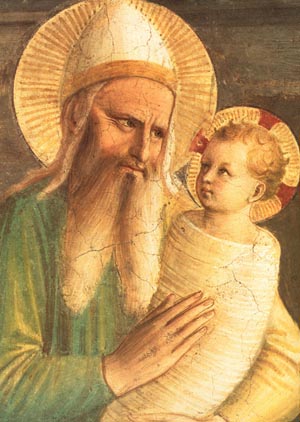
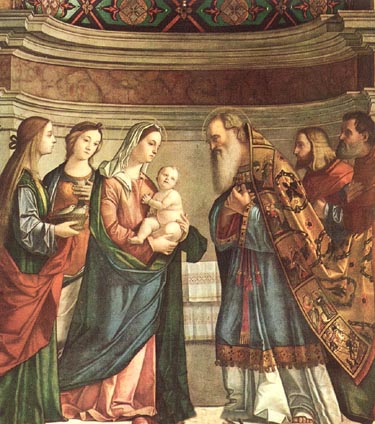
You remember the story from the Gospel, in Luke 2.  Mary and Joseph come to the temple in Jerusalem to fulfill the Law.  Firstborn males had to be dedicated to the Lord. The old woman Anna and the old man Simeon had the special grace from the Lord to have their dearest desires fulfilled before they died: to see the Messiah. It is in this moment that Simeon makes the prophecy about the sacrificial sufferings Mary will endure and he speaks his great Nunc dimittis, which Holy Church sings in the darkness at the end of the day for Compline.

In the traditional Roman liturgy today in larger churches there would be a special blessing of candles and a procession before Mass would begin.  The chants sung for the rite contain many references to light.  Also, a lighted candle is to be held during the reading of the Gospel and during the Roman Canon.  The candle brings to mind also our baptism.

In a way, the faithful really ought to have candles at all Masses.  But now, in High Masses, the “touchbearers” fulfill this role for the congregation.  Remember that the next time you see the candles come in: that’s you up there.

Remember: Holy Church gives us candles so that we will use them When I baptize, I suggest to people that they save the candle, with a label indicting what it is and who was there, the name of the priest, etc.  Perhaps then they could save that candle against the day when, perhaps, it might be used as one of the candles on the altar for their wedding, or with a home Communion set, for when they need Last Rites.  The candle you receive on other days of the year, the Vigil of Easter for example, or for Eucharist processions, could be burned in times of trial or danger, as when storms are coming or there is social upheaval.  These candles remind us that we too out to be filled with light for others, in their darkness and difficulties, to see and be guided by.

Candles are beautiful symbols of our sacrifices.  They are like living things.  They eat and drink the wax from the bees, made collectively in association with sweetness.  They breath air.  They move in their flames as they flicker.  They communicate to our eyes a beautiful light and give contrast to their surroundings by illumination.  They burn out at the end of their span.  So do we.  They are consumed for the Lord in the liturgy.  So should we be.  We do all these things.   And so, using candles in important times is a very wholesome and Catholic practice.  Leaving one of these little candles in a Church, as a symbolic sacrifice of your prayers and petitions is entirely natural.

For Holy Mass on Candlemas we hear some splendid prayers.  Let’s look at a couple.

Here is the third of several prayers recited by the priest for the blessing of the candles.  In older days, the priest would be wearing a purple cope and would switch to white for Mass.  By the time of the 1962 Missale Romanum all the rites are in white.

Domine Iesu Christe, lux vera, quae illuminas omnem hominem venientem in hunc mundum: effunde bene+dictionem tuam super hos cereos, et sancti+fica eos lumine gratiae tuae, et concede propitius; ut, sicut haec luminaria igne visibili accensa nocturnas depellunt tenebras; ita corda nostra invisibili igne, id est, Sancti Spiritus splendore illustrata, omnium vitiorum caecitate careant: ut, purgato mentis oculo, ea cernere possimus, quae tibi sunt placita, et nostrae saluti utilia; quatenus, post huius saeculi caliginosa discrimina, ad lucem indeficientem pervenire mereamur. Per te, Christe Iesu, Salvator mundi, qui in Trinitate perfecta vivis et regnas in saecula saeculorum.
R. Amen.

Daily Missal and Liturgical Manual (Baronius Press):

O Lord Jesus Christ, the true Light who enlightenest every man that cometh into this world: pour forth Thy blessing + upon these candles, and sanctify + them with the light of Thy grace, and mercifully grant, that as these lights enkindled with visible fire dispel the darkness of night, so our hearts illumined by invisible fire, that is, by the splendor of the Holy Spirit, may be free from the blindness of all vice, that the eye of our mind being cleansed, we may be able to discern what is pleasing to Thee and profitable to our salvation; so that after the perilous darkness of this life we may deserve to attain to neverfailing light: through Thee, O Christ Jesus, Savior of the world, who in the perfect Trinity, livest and reignest, God, world without end.

Presentation-of-the-LordThere is an adage that sin makes you stupid. Note the connection between vice and blindness and darkness.  The visible fire is not just a symbol of the indwelling of the Holy Spirit.  It also signifies life properly lived, a fact seen by others.

At the beginning of the procession an wonderful antiphon is sung.  Remember the Gospel.  Mary would have been brought within, carrying the Lord, the Light of the World, and led to a place of sacrifice, the offering of her Firstborn.  In the Churching of woman after child birth, they are met a the entrance to the church and then led forward.

Adorna thalamum tuum, Sion, et suscipe Regem Christum amplectere Mariam, quae est coelestis porta: ipsa enim portat Regem gloriae novi luminis: subsistit Virgo, ad ducens manibus Filium ante luciferum genitum: quem accipiens Simeon in ulnas suas, praedicavit populis, Dominum eum esse vitae et mortis, et Salvatorem mundi.

Adorn thy bridal-chamber, O Sion, and welcome Christ the King: with loving embrace greet Mary who is the very gate of heaven; for she bringeth to thee the glorious King of the new light: remaining ever a Virgin yet she bearest in her arms the Son begotten before the day-star: even the Child, whom Simeon taking into his arms, declared to the peoples to be the Lord of life and death, and the Savior of the world.

At Christmas we receive the Lord.  At Candlemas we offer Him.

In addition to the theme of light functioning throughout the rite there is also another echo of Christmas and Epiphany.  God meets man.  God comes to us, and we go to Him.  Today there is another meeting of God and man, expectant man, symbolized by Anna and Simeon.  The hymn sung in the procession frames our meeting, our Encounter as the liturgy of the Greek East calls this say, in nuptial terms.

In the Mass itself, we have the

COLLECT (1962MR):
Omnipotens sempiterne Deus,
maiestatem tuam suppliciter exoramus:
ut, sicut unigenitus Filius tuus hodierna die
cvm nostrae carnis substantia in templo est praesentatus;
ita nos facias purificatis tibi mentibus praesentari
.Presentation MantegnaThis is an ancient prayer, going back at least to the 9th c. and is found Liber sacramentorum Romanae ecclesiae ordine excarpsus.

You will see what is happening quickly, if you are a student of Latin, by taking careful note of the ut in the second part, which leads to a subjunctive down the line.  Also, there is a typical sicut…ita constuction, the ita part having the subjunctive result of the ut.  There is a nice turn of phrase at the end, using a trop hyperbaton, whereby that tibi separates the two elements of the ablative absolute purificatis … mentibus.  I also like that use of praesentatuspraesentari, a trope called, if memory serves, polyptoton.

The word maiestas is associated with gloria, a divine characteristic which transforms us who encounter it.  Thinks of the transformation of Moses’ face after he met with the Lord in the tent or on the mount: he had to wear a veil because his face was too bright to look at.  Also, Romans liked addressing people in indirect ways.  We still do this in some formal discourse and letters.  It is courtly, courteous.  Here maiestas can be heard as a form of address: Your Majesty.  So, maiestas has layers on layers of meaning.

Note the philosophical language of substantia.  Some times people will argue that the switch from Greek to Latin, the spoken language in ancient Rome, is justification for using the “vernacular” today.  The problem with that argument is that the Latin used in the Church for prayer, was not the language spoken by the people. It had technical vocabuary (e.g., maiestas, substantia) and turns of phrase nothing like everyday speech (e.g., hyberbaton, polyptoton).

See what happens?  It all seems straight forward.  Then you start to drill.

Candlemas is a beautiful feast full of meaning and symbols.

Holy Church puts candles in your hands today, to remind you of your gifts and your duties.
Posted in Liturgy Science Theatre 3000, Our Catholic Identity | Tagged , , , , , , ,
14 Comments

PRINCETON U: 3 Feb – Sung Mass in the university chapel

I received news that tomorrow, 3 February, there will be a Missa Cantata, Extraordinary Form, at the chapel of Princeton University at 9 pm. HERE

If you are nearby, it would be good to give support to this initiative.

I don’t know if they will be also imparting the traditional St. Blaise Day blessing of throats or not.  I hope so.  It would make sense to do so.  Thus, you would have an opportunity to get your throat blessed if you didn’t make it earlier in the day.

Brick by brick.

Posted in Brick by Brick, Events, The Campus Telephone Pole | Tagged
1 Comment

ASK FATHER: What sort of candles can be blessed at Candlemas?

Here is an oldie question from a reader…

QUAERITUR:

If I bring personal candles to the EF mass on Candlemass, must they be made of beeswax? Can they be entirely made of non-beeswax (paraffin)?
Not sure if the old regulations about things like this still apply to the EF.

We had a really good discussion about candles and what they can be made of HERE.

Given that discussion, and based even on the modern rules, my opinion is that it is far better for the candles to be wax candles, at least in part.  That is certainly the case for anything to be used in church.  I suppose it could be less strictly applied to candles not for use in church.

Still… let those candles be wax candles if at all possible.

Posted in "How To..." - Practical Notes, ASK FATHER Question Box, Linking Back, Liturgy Science Theatre 3000 | Tagged , ,
3 Comments

Your Sunday Sermon Notes

Was there a good point or two from the sermon you heard at Mass on Sunday?

Yes, you should be paying attention, even to the extreme of being able to remember what was said on Monday!

You might also indicate if your Mass was Ordinary or Extraordinary Form. In the EF we had Septuagesima.

Posted in SESSIUNCULA |
14 Comments