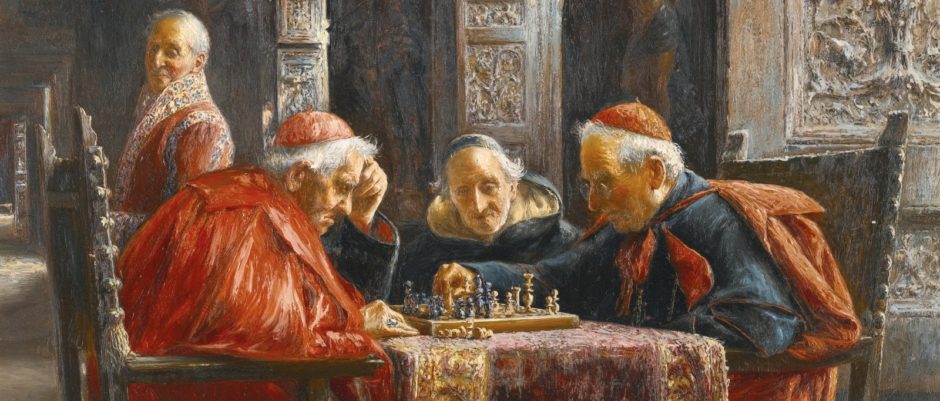
Card. De Paolis on communion for divorced, remarried: “If approved, the consequences would be of unprecedented gravity.”

2000px-Coat_of_arms_of_Velasio_De_Paolis.svgThe outline of features for the next Synod of Bishops in October 2015, or Lineamenta, has been released.  The Lineamenta is based on the last Synod’s final document, the Relatio Synodi.  For the Relatio, the members of the Synod voted on each paragraph.  According to the Synod’s own rules, established and approved by those appointed by Pope Francis to run the Synod, in order to be included in the Relatio each paragraph had to receive a 2/3’s majority of voting members.  Some paragraphs, on Communion for the divorced and civilly remarried and on homosexuality, very controversial paragraphs, did not receive 2/3’s as a sign of “consensus”.  They received 1/2, but not 2/3’s (therefore, not “consensus”).  That means that they shouldn’t have been included in the Relatio Synodi.  However, Pope Francis decided that they should be included anyway.  He overrode the rules of the Synod.  The only way you can tell that those particular paragraphs were not supposed to be included is a) to know the rules (which most people don’t) and b) look at the voting stats included in the Relatio (which most people don’t).

Many have the sense that those who are guiding the activities of the Synod are trying, like border collies, to drive the members of the next Synod to a predetermined position.

There is a precedent.  For example, during the last Synod, there was the midpoint report on what was discussed in the first phase, the Relatio post disceptationem.  Some paragraphs appeared in that midterm report, apparently written by Archbp. Bruno Forte.  They concerned, for example, homosexuality.  However, the paragraphs seem not to have resembled anything that was actually said by the members during the first part of the Synod.  In am amazing and, for the Holy See, unusual feat of efficiency, somehow the organizers of the Synod managed – mirabile lectu – to get the midpoint Relatio translated into five languages, bound, and distributed to the members.  By way of contrast, the final Relatio was released in Italian only, and then there was a provisional English version published not by the Synod office but by the Press Office.  It is hard to find and riddled with translation errors.

It is hard to watch this and not wonder about manipulations that aim at a specific outcome.

In any event, the Left has not been idle since the close of the Synod last October.  Watch the catholic media.

A great deal is going to take place on the rhetorical battlefield between now and the opening of the next phrase, next October.

For example, much is going to be made of the questions that are woven into the Lineamenta, questions that go to conferences of bishops for their subsequent exploration.

Among the questions…

Concerning communion for the divorced and remarried is no. 38:

“Sacramental pastoral practice with regard to the divorced and remarried requires further examination, also with the evaluation of the Orthodox practice and taking into consideration ‘the distinction between an objective sinful situation and extenuating circumstances.’ What are the perspectives in which to act? What are the possible steps? What are the suggestions for avoiding undue or unnecessary forms of impediments?”

One concern homosexuality is number 40:

“How does the Christian community turn its pastoral attention to families that have within them persons with homosexual tendencies? Avoiding all unjust discrimination, in what way can it care for persons in such situations in the light of the Gospel? How can it present them with the requirements of God’s will in their situation?”

These are the most hotly debated questions partly because they have significant impact on other foundational dimensions of the Church’s doctrine and practice.

Here is an authoritative reaction.

Today at Sandro Magister’s place, one of the Cardinals who contributed to the Five Cardinals Book, His Eminence Velasio Card. DePaolis delivers some blunt words.  The book was called, by the way,  Remaining in the Truth of Christ: Marriage and Communion in the Catholic Church.

Card. De Paolis wrote, and I am jumping in medias res and adding my emphases and comments:

The proposition, to the extent to which it provides for the possibility of admitting the divorced and remarried to Eucharistic communion, in fact constitutes a change of doctrine. [That’s it!] And this [get this…] contrary to the fact that it is said that there is no intention to modify doctrine. Moreover, doctrine by its very nature is not modifiable if it is the object of the authentic magisterium of the Church. Before talking about and dealing with any change in the discipline in force, it is necessary to reflect on the nature of this discipline. In addressing this matter one must, in the first place, reflect on this doctrine and on its level of firmness; there must be careful study of what can be modified and what cannot be modified. The doubt has been insinuated into the proposition itself when it calls for exploration, [get that?] which must be doctrinal and prior to any decision.

We can also ask ourselves if it is the competency of a synod of bishops to deal with a question like this: the value of the doctrine and discipline effective in the Church, which have been formed over the course of centuries and have been ratified with statements on the part of the supreme magisterium of the Church. Moreover, who is competent to modify the magisterium of other popes? [NB…] This would constitute a dangerous precedent. Furthermore, the innovations that would be introduced if the text of the proposition were approved would be of unprecedented gravity: [That’s code for “total disaster”.  So, what are we talking about here?  Perpend…]

a) the possibility of admitting to Eucharistic communion with the explicit approval of the Church a person in a state of mortal sin, with the danger of sacrilege and profanation of the Eucharist; [Which, if you believe in what the Church teaches about the Eucharist, is bad.  Alas, many people approach the Eucharist as “they put the white thing in your hand, we sing the song, and we all feel good”.]

b) doing this would bring into question the general principle of the need for the state of sanctifying grace in order to receive Eucharistic communion, especially now that a generalized practice has been introduced or is being introduced[get that?  did you?] into the Church of receiving the Eucharist without previous sacramental confession, even if one is aware of being in grave sin, with all of the deleterious consequences that this practice involves; [For consequences see St. Paul’s 1 Cor 11.]

c) the admission to Eucharistic communion of a believer who cohabits “more uxorio” would also mean bringing into question sexual morality, particularly founded on the sixth commandment; [Which is GOD’s positive law.]

d) this would also lend support to cohabitation or other bonds,  [guess what kind] weakening the principle of the indissolubility of marriage.

Blunt language for important questions in troubled times.

Be sure to get the Five Cardinals Book™ and see what DePaolis says there!

UK link is HERE.

UPDATE:

Card. Walter Brandmuller, one of the Five Cardinals, right now has a piece in the German language Vatican Magazin.  He argues that we must not conform the sacred to the worldly.

Posted in Liberals, One Man & One Woman, Our Catholic Identity, Si vis pacem para bellum!, Sin That Cries To Heaven, The Coming Storm, The Drill, The future and our choices | Tagged , , , , , ,
34 Comments

E cineribus resurgit! The restoration of a church that burned on Christmas Eve

Here is a great story.  A little church, St. Mary’s in Brussels, IL (Diocese of Springfield in Illinois) burned down on Christmas Eve a few years ago.  It just reopened.  The restoration looks wonderful.

Stories, with video, HERE and HERE

Here is a video.  Alas, in the story there is a lot of talk and little to see of the church’s interior other than glimpses.  Also, please forgive the wretched music in the video.  The parish priest is to be highly commended for the wonderful building project.  But… Gather Us In?  Blech.  I hope we will be able to commend him about a renewal of music!

Interesting story about the stained glass windows.

Use those links, above, to get to a video story about the rebuilding. The video starts automatically, so I won’t post it here, especially so that you won’t have to listen to “Gather Us In” each time you load a page here until it scrolls off.

Posted in Fr. Z KUDOS, Just Too Cool | Tagged ,
9 Comments

Catholic League on anti-Catholic Minnesota Public Radio

From the Catholic League:

Minnesota Public Radio Is A Scam

December 10, 2014

Bill Donohue comments on Minnesota Public Radio:

National Public Radio is no friend of Catholicism, but usually it tries to hide its bias. By contrast, Minnesota Public Radio (MPR) is so thoroughly anti-Catholic that it makes no attempt to be fair. Truth be told, it is a scam: its politics is pervasive. Here’s the latest proof.

On December 8, a jury acquitted Father Mark Huberty, a Twin Cities priest, of criminal sexual conduct; a woman claimed he took sexual advantage of her during counseling sessions.

Three media outlets in Minnesota have been tracking this story from the beginning: the Pioneer Press, the Star-Tribune, and MPR. When news reports surfaced clearing Father Huberty of wrongdoing, the two newspapers gave the jury verdict complete coverage. But not MPR.

For many years now, MPR has specialized in issuing lengthy reports on alleged priestly abuse; it ran a long story last week about a former priest. When a priest is found not guilty, however, that is of no interest to MPR. To wit: In 2013, MPR did four lengthy stories on salacious accusations against Father Huberty, but when he was exonerated this week, the best it could do was to offer a 134-word AP story. It had no motivation to recount its previous reporting, or to present its own story.

This is yellow journalism: the only Catholic news that excites MPR is dirt.

Contact MPR honcho Morris Goodwin: mgoodwin@americanpublicmedia.org
Phone: 212-371-3191
E-mail: pr@catholicleague.org

Posted in Biased Media Coverage, The Campus Telephone Pole, The Coming Storm, The future and our choices | Tagged ,
9 Comments

Fr. Z to priests going to Rome for the Jan ’16 CCC conference (or other reason)

I have wanted to attend the Confraternity of Catholic Clergy conference in Rome from 5-9 January.  I’m doing travel arrangements right now (and I sure could use some donations for it… I don’t get C.Ed. allowances, etc.  The wavy flag will help you to help me).

The line up for the Conference looks pretty good.  I am not sure about registration at this date and I believe the hotel/conference center where it is taking place no longer have rooms, but there are short let apartments and other, clerical places and convents.

Anyway… perhaps there is the chance of a blognic in Rome.

Also, I am thinking of a short let apartment.  I could be persuaded to share a 2-bedroom with a priest whom I know.  But the window is closing.

Posted in Events, On the road, What Fr. Z is up to |
3 Comments

NEW:Manual for Spiritual Warfare

I received this note from TAN, which sent me a PDF of the new book from Paul Thigpen:

Manual for Spiritual Warfare by Paul Thigpen, PhD, new from TAN Books. I have also sent a hard copy in the mail, so that you can fully experience the beauty of this book. Its striking ultrasoft cover is both attractive and functional, making it a perfect tool for prayer.

In a time where the Enemy is at work all around us, and yet so often unrecognized—or even, at times, embraced—by the culture at large, Spiritual Combat has perhaps never been so important. Here, Paul Thigpen helps us to see the work of Satan, bolster ourselves against him, and use the many tools we have been given—prayer, Christ, and the example of his saints, to name a few—to fight the Enemy.

Not a terribly interesting cover, but here is a screen shot of the table of contents.


We [TAN Books] have also just released Memoirs of a Happy Failure by Alice von Hildebrand, chronicling her thrilling escape from Nazi Europe through her teaching career at an institution hostile to truth and the faith. It is a compelling and ultimately uplifting glimpse at one of the most extraordinary and important Catholic lives of the past century.

Posted in "How To..." - Practical Notes, Our Catholic Identity, The Coming Storm | Tagged , ,
10 Comments

Latin American Catholicism, the jury is still out

If we Catholics don’t know our Faith, we can’t live it. If we don’t know it, we can’t share it. As the old phrase says, “Nemo dat, quod non ‘got’!” If we are not knowledgeable, articulate and forthright in expressing our views on issues in the public square, in the light of our Faith, we will have little or no impact on society. That’s what a lot of people want, both inside and outside the Church: a Church silenced, Catholics cowed, Faith reduce to the realm of the private merely. If we don’t know what we believe, as Catholics, and won’t or can’t express it, nobody will listen to us. Not even other Catholics. And why should they?

My friend Samuel Gregg has a thought provoking piece at Catholic World Report.

Catholicism’s Latin American Problem

It’s hardly surprising that the election of Latin America’s Pope Francis has focused more attention on Latin American Catholicism since the debates about liberation theology which shook global Christianity in the 1970s and 1980s. The sad irony, however, is that this renewed attention is highlighting something long known to many Catholics but which non-Catholics are now becoming more cognizant: that Latin America’s identity as a “Catholic continent” is fading and has been doing so for some time.

By that I don’t mean that most Latin Americans no longer identify as Catholic. That’s still the case. Indeed, in many countries south of the Rio Grande, it remains overwhelming true. But what’s clear is that Catholicism’s ability to shape Latin America’s religious context is in decline, or, from another perspective, faces some significant competitors: and not just from Evangelicals but also agnosticism and atheism.

Two recent surveys of religion in Latin America have underscored this point. The more noticed survey, conducted by Pew, illustrated that the percentage of people identifying as Catholic in almost every Latin American country has fallen significantly. And even among those who identify as Catholic, significant numbers describe themselves as being at odds with Church teaching on some key faith and morals questions. Indeed, 60 percent of converts to Evangelicalism say that one reason they left the Catholic Church was that they were looking for more assertive teaching on moral questions. This matters in societies in which, as the Pew survey indicates, most people say they adhere to what would be conventionally called conservative positions on all the usual hot-button issues.

It is true, the survey notes, that regular Mass-goers in Latin America cleave much more closely to Church teaching than those Catholics who don’t. That pattern is more-or-less universal in global Catholicism. It’s also the case that the practicing rate of Latin American Catholics puts your average Western European country to shame. That said, the survey also states that Evangelicals are generally more committed to a life of prayer, regular worship, and other church-based activities than even church-going Catholics.

[…]

Read the rest there.

Well… there’s also this bit.

With regard to Latin American Catholicism, the jury is still out on whether the on-going disintegration of its once near-monopoly will result in a more energized and committed church. As the sociologist Rodney Stark illustrated in his book The Victory of Reason (2006) many of the Catholic movements that focus on solid formation and foster greater commitment—Opus Dei, Communion and Liberation, Catholic Charismatics, etc.—are flourishing in many Latin American nations. They are the ones who open new churches, have vocations, build universities, and actively evangelize people. They understand the error in simply assuming “the culture” will naturally incline people to Catholic faith.

A second fact worth further contemplation is that Evangelicals (a phrase which covers many theological positions) are, well, more evangelical than Catholics. That’s often the case of religious minorities, especially converts, and most Latin American Evangelicals are converts from (usually a very nominal) Catholicism. But Latin America’s Evangelicals, the survey indicates, are far more willing to speak about Christ than Catholics. The latter by contrast tend to prioritize various forms of social outreach to those in need.

I reiterate here the need for tradition-minded Catholics to be the first in their parishes to help with projects involving spiritual and, especially, corporal works of mercy.

Do read the whole thing.

I am reminded of the claim that it will be, must be, the Latin American Church to breathe life into the tired old Church in the old Northern Hemisphere.

Yeah, right.

Posted in Our Catholic Identity, The Coming Storm, The Drill, The future and our choices | Tagged ,
22 Comments

Pontifical Mass in Madison for the Immaculate Conception

An image…

Despite the horrid weather, and despite the Packers playing Atlanta on Monday Night Football (the Packers won), we still had quite a good attendance.

These happy people were able to fulfill their Mass Obligation with a Pontifical Mass at the Throne.

Posted in "How To..." - Practical Notes, Liturgy Science Theatre 3000 | Tagged , ,
10 Comments

ASK FATHER: Lighting Advent wreath during Mass

From a reader…

QUAERITUR:

Father, is it appropriate to replace the penitential rite with the lighting of the advent wreath?

No.

Just… no.

The longer explanation is, course, Nooooooooo.

I think there is a blessing for a wreath that can be used during Mass in the Ordinary Form on the 1st Sunday of Advent only, and only in countries where it has been approved.  That doesn’t apply to other Sundays of Advent.  Also, in no way does it substitute for the penitential rite of Mass.  You bless the thing, light the candles, Mass goes on as it should according to the book.

This sounds like the triumph of low information sentimentality over good Catholic common sense.

Posted in "How To..." - Practical Notes, ASK FATHER Question Box, Liturgy Science Theatre 3000 | Tagged
15 Comments

Vestment Prayers – A Modern Update

Tonight in Madison, the Extraordinary Ordinary, His Excellency Most Reverend Robert C. Morlino, Bishop of the same Madison, will celebrated a Pontifical Mass at the Throne in the Extraordinary Form of the Roman Rite. The Mass will begin at 7 PM at the Chapel of the Bishop O’Connor Center. (BTW… there is no Cathedral in Madison at the moment, for, sadly, it burned down some time ago).

Tonight His Excellency will use a new set of pontifical vestments I recently obtained. HERE

His Excellency will have to put on an array of vestments, each of which have their particular significance and prayers. The bishop, before saying Mass, symbolically puts on the full armor of God.

For example, when the Bishop puts on his gloves, he says:

Circumda, Domine, manus meas munditia novi hominis, qui de caelo descendit; ut, quemadmodum Jacob dilectus tuus pelliculis hoedorum opertis manibus, paternam benedictionem, oblato patri cibo potuque gratissimo, impetravit; sic et oblata per manus nostras salutaris hostia, gratiae tuae benedictionem mereatur. Per Dominum nostrum Jesum Christum Filium tuum, qui in similitudinem carnis peccati pro nobis obtulit semetipsum.

Place upon my hands, Lord, the cleanliness of the new man, that came down from heaven; that, just as Jacob Thy beloved, covering his hands with the skins of goats, and offering to his father most pleasing food and drink, obtained his father’s blessing, so also may the saving victim offered by our hands, merit the blessing of Thy grace. Through our Lord Jesus Christ, Thy Son, Who in the likeness of sinful flesh offered Himself for us.

The biblical references are Genesis 27 and Romans 8.

He has prayers for his cross and the shoes he wears, etc., all beautiful and packed with meaning.

However, in these modern times, we have a new vestment that bishops, and priests for that matter, put on: the wireless microphone.

I can’t stand these things, by the way. But I digress.

We came up with a prayer for the Vesting of the Microphone:

Concede, Domine, virtutem labiis meis et prudentiam ad Tuam proclamandam veritatem, ut per indigni servi Tui vocem, vox Tui tonitrui in rota contremat terram.

I will let you, dear readers, render this into your own perfect, yet smooth, English version.  Extra credit for identifying the allusion.

BTW… the prayer in its original version, composed by another, was offered first to His Excellency Archbishop Sample of Portland. I tweaked it for style and a couple points of syntax.

Finally…  His Excellency Bp. Morlino hasn’t used the mic for the last several Pontifical Masses and I have no reason to think he will this time.

Posted in Lighter fare, Liturgy Science Theatre 3000 | Tagged , , , , ,
15 Comments

The Blessed Virgin compared to the Air we Breathe

The Blessed Virgin compared to the Air we Breathe
Gerard Manley Hopkins

Wild air, world-mothering air,
Nestling me everywhere,
That each eyelash or hair
Girdles; goes home betwixt
The fleeciest, frailest-flixed
Snowflake; that ’s fairly mixed
With, riddles, and is rife
In every least thing’s life;
This needful, never spent,
And nursing element;
My more than meat and drink,
My meal at every wink;
This air, which, by life’s law,
My lung must draw and draw
Now but to breathe its praise,
Minds me in many ways
Of her who not only
Gave God’s infinity
Dwindled to infancy
Welcome in womb and breast,
Birth, milk, and all the rest
But mothers each new grace
That does now reach our race—
Mary Immaculate,
Merely a woman, yet
Whose presence, power is
Great as no goddess’s
Was deemèd, dreamèd; who
This one work has to do—
Let all God’s glory through,
God’s glory which would go
Through her and from her flow
Off, and no way but so.

I say that we are wound
With mercy round and round
As if with air: the same
Is Mary, more by name.
She, wild web, wondrous robe,
Mantles the guilty globe,
Since God has let dispense
Her prayers his providence:
Nay, more than almoner,
The sweet alms’ self is her
And men are meant to share
Her life as life does air.
If I have understood,
She holds high motherhood
Towards all our ghostly good
And plays in grace her part
About man’s beating heart,
Laying, like air’s fine flood,
The deathdance in his blood;
Yet no part but what will
Be Christ our Saviour still.
Of her flesh he took flesh:
He does take fresh and fresh,
Though much the mystery how,
Not flesh but spirit now
And makes, O marvellous!
New Nazareths in us,
Where she shall yet conceive
Him, morning, noon, and eve;
New Bethlems, and he born
There, evening, noon, and morn—
Bethlem or Nazareth,
Men here may draw like breath
More Christ and baffle death;
Who, born so, comes to be
New self and nobler me
In each one and each one
More makes, when all is done,
Both God’s and Mary’s Son.
Again, look overhead
How air is azurèd;
O how! nay do but stand
Where you can lift your hand
Skywards: rich, rich it laps
Round the four fingergaps.
Yet such a sapphire-shot,
Charged, steepèd sky will not
Stain light. Yea, mark you this:
It does no prejudice.
The glass-blue days are those
When every colour glows,
Each shape and shadow shows.
Blue be it: this blue heaven
The seven or seven times seven
Hued sunbeam will transmit
Perfect, not alter it.
Or if there does some soft,
On things aloof, aloft,
Bloom breathe, that one breath more
Earth is the fairer for.
Whereas did air not make
This bath of blue and slake
His fire, the sun would shake,
A blear and blinding ball
With blackness bound, and all
The thick stars round him roll
Flashing like flecks of coal,
Quartz-fret, or sparks of salt,
In grimy vasty vault.
So God was god of old:
A mother came to mould
Those limbs like ours which are
What must make our daystar
Much dearer to mankind;
Whose glory bare would blind
Or less would win man’s mind.
Through her we may see him
Made sweeter, not made dim,
And her hand leaves his light
Sifted to suit our sight.
Be thou then, O thou dear
Mother, my atmosphere;
My happier world, wherein
To wend and meet no sin;
Above me, round me lie
Fronting my froward eye
With sweet and scarless sky;
Stir in my ears, speak there
Of God’s love, O live air,
Of patience, penance, prayer:
World-mothering air, air wild,
Wound with thee, in thee isled,
Fold home, fast fold thy child.

Posted in Poetry | Tagged , ,
4 Comments























