ASK FATHER: What’s with all the kissing in the Extraordinary Form?

ASK FATHER: What's with all the kissing in the Extraordinary Form?From a reader…

QUAERITUR:

I was wondering what is the point of kissing in the Extraordinary Form? Such kisses include kissing the priest’s hand after handing the server or deacon his biretta or kissing the celebrant’s hand after handing him the thurible, kissing the water and wine cruets? None of the altar boys do this at the Traditional Latin Mass I serve, including me and none of the celebrants ever mention that we have to kiss their hands, etc. How did this liturgical kissing catch on?

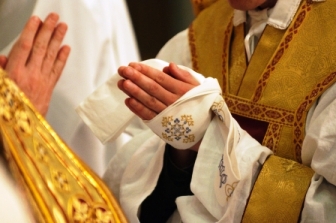
The kisses given to objects handed to the priest, and the priest’s hand itself, serve to show respect to the priest who is alter Christus… another Christ…, to show respect to the sacred things being used and the One to whom they refer us, to show joy in the occasion and action, and to lend decorum and solemnity to the moment.

For those who don’t know about this, in the Extraordinary Form of the Roman Rite, always in Pontifical and Solemn Masses and sometimes at Low Masses, objects are kissed as they are given to the celebrant, as is his hand. The rule is when giving, kiss the object first, then the celebrant’s hand and when getting kiss the hand first, then the object. However, when receiving a sacramental, such as a blessed palm on Palm Sunday or a blessed Candle at Candlemass, you kiss the sacramental first, and then the hand. Also, because the kiss is a sign of joy, they are omitted on Good Friday and during Requiem Masses. (Our Church is very cool.)

The kissing of objects and hands surely spread to Holy Mass in a courtly context.  There’s nothing wrong with that, by the way. There is nothing wrong with respect and decorum. Liberals accuse traditionalists of clinging to the useless bowing and scraping of ancient court practices.  They won’t kneel! No! They’ve evolved beyond all that. Liberals would rather has us, as they do, kneel and bow and scrape to the world, the flesh and the devil.

Also, note that in the rubrics sacred ministers such as deacons and subdeacons are directed to give the “usual kisses” or Latin solita oscula. Other ministers and the altar, laymen or boys, may give them. Much depends on local custom.

The giving of solita oscula ties into the style and quality of vestments and vessels used for Holy Mass, as well as the music and the architecture. Be clear about something! When we dress our priests and bishops in gold and lace, and place gold onto and into their hands, and kiss their hands because they were anointed to serve us, we aren’t honoring the priest or bishop the man, however worthy and admirable he may be. We are honoring him and giving our best because we honor Christ at work in them and because we are grateful for the merits of the Cross and our pathway to heaven.

The priest and bishop are our mediators for the one Mediator. They are, during Holy Mass, both priest who offers the Sacrifice, and also the Sacrificial Victim. The lambs prepared for the day of sacrifice were taken great care of and fussed over… right up to the time the knife slashed their throats open. When you see the priest and bishop in fine vestments, remember the love and gratitude and care with which we treat sacred things and persons and places. We look to them and through them as Moses look, straining, to glimpse the Mystery as God passed by on the other side of the cleft in the rock (cf Exodus 33). They are signs that facilitate the encounter with mystery that is simultaneously frightening and alluring, hard to prepare for and yet vital for our spirits. They help us to prepare, through their beauty and challenge for our own deaths.

This is why is wrong for a priest or bishop to refuse the kissing of his ring and hand. People want to give honor and show love for Jesus, the King and Eternal Priest present before them in their person. They instinctively, and also by instruction, seek to reverence what brings them the ordinary means of salvation.

I am reminded of a poem from yesteryear which, though to our ears today it rings a bit saccharin and sentimental, it conveys perennially valuable clues about the attitude we must adopt in the present of the Lord’s anointed. I don’t say that any of us should cringe or fawn (as liberals do before their precious Molochs). Rather, we should reflect on how Christ Himself established the means of our salvation and His holy priesthood. You might know the poem.  Think about the moments that the poem describes:

The Beautiful Hands of a Priest

We need them in life’s early morning,
We need them again at its close;
We feel their warm clasp of true friendship,
We seek them when tasting life’s woes.
At the altar each day we behold them,
And the hands of a king on his throne
Are not equal to them in their greatness;
Their dignity stands all alone;
And when we are tempted and wander,
To pathways of shame and of sin,
It’s the hand of a priest that will absolve us,
Not once, but again and again.
And when we are taking life’s partner,
Other hands may prepare us a feast,
But the hand that will bless and unite us
Is the beautiful hand of a priest.
God bless them and keep them all holy,
For the Host which their fingers caress;
When can a poor sinner do better
Than to ask Him to guide thee and bless?
When the hour of death comes upon us,
May our courage and strength be increased,
By seeing raised over us in blessing
The beautiful hands of a priest.

Yes, I think the solita oscula are entirely appropriate.  When we choose to jettison practices like this, we jettison helps for our Faith, Hope and Charity.

Posted in "How To..." - Practical Notes, ASK FATHER Question Box, Hard-Identity Catholicism, Liturgy Science Theatre 3000 | Tagged , ,
25 Comments

ASK FATHER: 58 years old, never confessed, given Communion or confirmed. What now?

From a reader…

QUAERITUR:

I am 58 years old and was baptized as RC I was never confirmed /never made first holy communion and rarely attended church. I was drawn back to attending church about a year ago and as I am self employed and work in different ares each day I am attending Mass just about every day and receiving a great deal of satisfaction and comfort from doing so. I don’t take communion as I am not entitled to but would dearly love to do so. I don’t belong to any parish as I visit many different churches and would not be able to attend the same one due to my work. As someone who is parish-less how can I get confirmed,no one seems able to help me.

God bless you.  It sounds like the Holy Spirit is doing some wonderful things in awaking in you the Faith you received in baptism so many years ago. Keep at it, even if it gets difficult… and there will be times when it gets difficult.  In the meantime, enjoy the graces you are being given.

Also, kudos to you for wanting to respond to that grace and participate more fully in the Church by receiving the sacraments. God will richly reward your interest and your efforts.

Now, to work!

Even if you are not registered in any parish, the good news is that you DO have a parish. Even if you work all over the place and attend Mass at different places,  you nevertheless have a parish based on where your primary residence is.  Mind you, parish boundaries are not always easy to figure out, but if you call the nearest parish and inquire, someone be able help to yo, if not on the spot, then in short time.

Those who do not have a permanent home are called vagi in Latin, meaning “wanderers”.  They have a right to the sacramental services of the pastor of the church where they are at any given moment.

In addition, if you make inquiries at any Catholic parish, you would surely be welcomed with open arms, given the instruction you need, and placed on the proper path for making a good confession, getting confirmed, and being admitted to receive our Eucharistic Lord in Holy Communion.

If you have found unhelpful people at a parish, place a call in to the local diocese and explain the situation.

If, after this, you still meet resistance or roadblocks, drop me a line again and let me know where you are.  Perhaps I might manage to knock some heads together.

Meanwhile, welcome home!  I imagine that many of the readers here will stop – RIGHT NOW – and say a prayer for you.

Posted in "How To..." - Practical Notes, ASK FATHER Question Box, Fr. Z KUDOS, Just Too Cool, Liturgy Science Theatre 3000 | Tagged
12 Comments

ASK FATHER: Is it okay to have an Armenian Apostolic member as godparent for a Catholic?

From a reader…

A friend who was baptized, confirmed and received Holy Communion as an infant in the Armenian Apostolic Church regularly assists and receives Holy Communion at Mass, in both the ordinary and extraordinary forms of the Roman Rite.

She has been asked to be the godmother for a Catholic baby, and a protestant friend is wanted as a “witness” in lieu of a godfather.

(This may be less than ideal. Nevertheless, she might be one of the only people in the parents’ life who goes to Mass regularly.)

Nevertheless, can one seek a dispensation, or is there some provision that would allow for such an arrangement?

This requires a dispensation.

According to the Directory for the Application of Principles and Norms on Ecumenism 98, a member of an Orthodox or Oriental Church may serve as a godparent, but only if there is a Catholic godparent of the opposite sex.  A dispensation from this norm should be sought.

As a friend, I would ask this Armenian Apostolic woman why, if she regularly assists at the Catholic Mass and receives Holy Communion (which she is able to do because of can. 844), does she not take the plunge and become an Armenian Catholic?

Perhaps she would be moved by an invitation.

Never underestimate the power of an invitation.

Posted in "How To..." - Practical Notes, ASK FATHER Question Box, Liturgy Science Theatre 3000 | Tagged ,
3 Comments

ASK FATHER: Does drinking alcohol before wedding affect validity of marriage?

bride 01From a reader…

QUAERITUR:

Would one of a couple going to a bar for a moderate amount of alcoholic drink before a nuptial Mass have any effect on the validity of a marriage?

Marriage is a serious thing. Matrimony should be entered into seriously and soberly.

For most people, the decision to marry is the most important decision of their lives.

Matrimonial consent must be freely given by persons capable of positing such a momentous juridic act.

Christian marriage is a sacred, indeed usually sacramental, act. By its very nature it requires clarity of mind and purity of intention.

Why someone would want to take such a serious step with senses dulled by intoxicants is beyond me.

However, for consent to be invalid, a person would need to be so intoxicated that she was truly incapable of using reason in a manner proportionate to marriage. Someone who was merely tipsy, however stupid that would be, would not be unable to marry.

BONUS QUESTION:  

Apart from why someone would get drunk before her wedding, why would someone want to marry someone who would get drunk before her wedding?

Posted in "How To..." - Practical Notes, ASK FATHER Question Box, Liturgy Science Theatre 3000, One Man & One Woman |
16 Comments

ASK FATHER: I made a hasty promise to God. Now what?

ASK FATHER: I made a hasty promise to God. Now what?From a reader…

QUAERITUR:

At one time in my life I hastily made two promises to God:

1-) Never commit a certain sin;

2-) Never drink coffee again.

Certainly, promise 1 should never have been made, but I digress. My question is twofold:

Is it possible to be commute those two promises?

How should I proceed?

First, let’s get some definitions straight.   We have to consider promises and vows.  Also, you mean dispense, not commute.

A mutual promise, the breaking of which would harm the other party, is binding in justice.  Breaking it would be at least a venial sin.  Simple promises, proposed and accepted, bind only under pain of venial sins unless the the one making the promise also intended to bind himself in justice.  However, the promise ceases if the circumstances under which the promise was made change significantly.  A promise, furthermore, must be distinguished from a mere intention to do something.   Diocesan priests make promises at the time of their ordination to their diocesan bishops.

A vow, on the other hand, is a promise to God made freely and deliberately to perform some good work or to embrace a higher state of life.  The fulfillment of a vow is an obligation of the virtue of Religion (i.e., what we owe to God, rather than to men).  Vows can be public (e.g., of monks and nuns) or private, simple or solemn (e.g., religious vows), personal or real (i.e., concerning property).  A vow binds only the one making the vow.  Vows made under grave extrinsic fear inflicted unjustly are null and void.

It sounds like you made a private vow to God.

Vows should not be undertaken lightly. It is a good idea to consult with one’s pastor or spiritual director or trusted priest before making a vow of any kind. Often in moments of despair or intense spiritual fervor, people make vows which they later come to regret. Some people simply “walk away”, ignore what they vowed.  Vows should not be blown off, lightly.

Canon Law and moral theology remind us that a vow is a serious thing.

Can. 1191 says that: “A vow is a deliberate and free promise made to God, concerning some good which is possible and positively good. The virtue of religion requires that it be fulfilled.”

Can. 1196 tells us that a private vow can be dispensed (as long as dispensing the vow does not injure the rights of another) by the Roman Pontiff (i.e., the Pope), the local Ordinary (i.e., the diocesan bishop or his vicar general) or the parish priest (with respect to his subjects), a religious superior (with respect to his subjects, any novices, or residents of his house), or someone who has been duly delegated by the Holy See or the local Ordinary.

At the time the 1983 Code was put together, a suggestion was made to the Holy See that this power to dispense from vows be given to all confessors (i.e., priests with proper faculties to receive sacramental confessions and to give absolution validly).  This was rejected.   It remains today that only the Pope, ordinaries, and pastors have this authority.

I believe that in some dioceses, bishops delegate this authority to all confessors, or at least all parish priests, including parochial vicars.  NB: Priests should occasionally review their faculties and remind themselves of what they can and cannot absolve, dispense, commute, etc.

So, if you are now ready to start ordering lots of Mystic Monk Coffee, I would make an appointment with your parish priest, or the vicar general or the bishop of the diocese.  Explain the situation.

Don’t just blow this off!  Vows bind under pain of sin.  People harm themselves and weaken the whole Body of Christ when they screw up their relationships with God through sin and the breaking of vows.

BTW… Mystic Monk also has TEA.  I’m just sayin’

ASK FATHER: I made a hasty promise to God. Now what?

CLICK FOR TEA

Posted in "How To..." - Practical Notes, ASK FATHER Question Box | Tagged , , ,
8 Comments

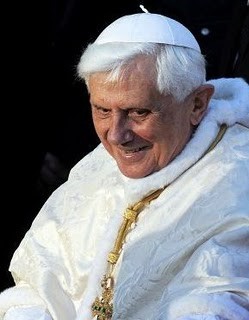
Happy Birthday Holy Father! Benedict XVI – 88 yrs

His Holiness Benedict XVI turned 88 today!

Ad multos felicissimos annos!

Please stop and say a prayer for him.

benedict xvi white mozzetta 01

Posted in Benedict XVI |
18 Comments

ASK FATHER: Marriage in “another suitable place”

From a reader…

QUAERITUR:

My grandson will be married in a year. He has not been baptized but raised in a Christian home. His wife to be is Catholic. He insists their marriage can take place in a hotel and witnessed by a deacon. I have researched this and concluded that can only happen with the permission of the Ordinary. Your comments will be appreciated.

Ah, weddings always bring out the most interesting questions.

When a Catholic marries an unbaptized person, the Catholic party needs a dispensation from the local ordinary (can. 1086. 1, and can. 1129).  If the ordinary (the diocesan bishop or vicar general) grants this dispensation, then the wedding may be celebrated either in a church or “in another suitable place” (can. 1118. 3).  No further special permission is required. Permission would be required if two baptized persons wanted to marry in a place other than a parish church.  The wedding of a couple in which only one party is Catholic should not take place within the context of a Mass.

Posted in "How To..." - Practical Notes, ASK FATHER Question Box, Liturgy Science Theatre 3000, One Man & One Woman | Tagged , , , , , ,
20 Comments

Card. Rodriguez Maradiaga: ongoing synodal process until result is obtained?

At the Italian site Nuova Bussola, we find the observations of Oscar Card. Rodriguez Maradiaga about the possibility of Communion for the divorced and remarried.

Impossible? “No!”, says the Cardinal.

And if the upcoming Synod rejects the proposal, the Kasperite Solution, hey!… maybe there could be a third synod on the question!

And His Eminence seems to be putting a great deal of stock in polls.

I’m in my car in a parking lot, so I can’t do the translation at the time of this posting.

In tutto il mondo, aggiunge Maradiaga, “i sondaggi dicono che la gente non vuole sposarsi, né in Chiesa, né civilmente, e il Vangelo della famiglia deve essere annunciato, perchè è il progetto di Dio e deve essere sommamente considerato dalla Chiesa”.
Il problema “non è, come alcuni media hanno detto, sulla possibilità dei divorziati risposati di accedere all’eucaristia, no, ci sono cose molto più profonde e che devono essere affrontate nel Sinodo”.
Secondo il Card. Maradiaga il medoto del sinodo, che sarebbe quello di “vedere, giudicare e attuare”, potrebbe anche portare alla convocazione di una terza tappa. “Non sappiamo se alla fine del sinodo di ottobre si chiuderà il processo [sinodale], o se il Papa ne convocherà un terzo, potrebbe essere, perchè si tratta di cose molto importanti…”

Ongoing synods until the desired result is obtained?

Posted in Liberals, One Man & One Woman, Synod, The Coming Storm, The future and our choices | Tagged
54 Comments

Card. Brandmüller speaks bluntly

Over at LifeSite there is a post about remarks made by His Eminence Walter Card. Brandmüller.

Cardinal Brandmüller: Advocates for changing Catholic teaching on marriage are ‘heretics’ – even if they are bishops

April 14, 2015 (LifeSiteNews.com) — Cardinal Walter Brandmüller has been among the leading voices critical of proposals stemming from the Vatican’s Synod on the Family

Card. Brandmüller speaks bluntly

CLICK TO BUY!

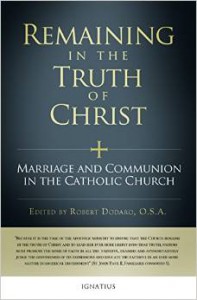
that risk subverting Catholic teaching on the sacraments and morality. He was one of five cardinals who contributed to the book Remaining in the Truth of Christ, which focused on criticizing Cardinal Walter Kasper’s proposal to open up Communion to those in irregular sexual unions.

LifeSiteNews contributor Dr. Maike Hickson interviewed Cardinal Brandmüller last month.

LifeSiteNews: Could you present once more for our readers clearly the teaching of the Catholic Church, as it has been consistently taught throughout centuries concerning marriage and its indissolubility?

Cardinal: The answer is to be found in the Catechism of the Catholic Church no. 1638-1642.

Can the Church admit remarried couples to Holy Communion, even though their second marriage is not valid in the eyes of the Church?

That would be possible if the concerned couples would make the decision to live in the future like brother and sister. This solution is especially worth considering when the care for children disallows a separation. The decision for such a path would be a convincing expression of the penance for the previous and protracted act of adultery.

Can the Church deal with the topic of marriage in a pastoral manner that is different from the continual teaching of the Church? Can the Church at all change the teaching itself without falling herself into heresy?

It is evident that the pastoral practice of the Church cannot stand in opposition to the binding doctrine nor simply ignore it. In the same manner, an architect could perhaps build a most beautiful bridge. However, if he does not pay attention to the laws of structural engineering, he risks the collapse of his construction. In the same manner, every pastoral practice has to follow the Word of God if it does not want to fail. A change of the teaching, of the dogma, is unthinkable. Who nevertheless consciously does it, or insistently demands it, is a heretic – even if he wears the Roman Purple. [That is the red color that Cardinals wear.]

Is not the whole discussion about the admittance of remarried to the Holy Eucharist also an expression of the fact that many Catholics do not believe any more in the Real Presence and rather think that they receive in Holy Communion anyway only a piece of bread?

Indeed, there is an indissoluble inner contradiction in someone who wants to receive the Body and Blood of Christ and to unite himself with Him, while in the same time he disregards consciously His Commandment. How shall this work? St. Paul says about this matter: ‘Who eats and drinks unworthily, is eating and drinking his judgment…’ But: You are right. By far not all Catholics believe in the Real Presence of Christ in the consecrated host. One can see this fact already in the way many – even priests – pass the tabernacle without genuflection.

Why is there nowadays such a strong attack on the indissolubility of marriage within the Church? A possible answer could be that the spirit of relativism has entered the Church, but there must be more reasons. Could you name some? And are not all these reasons a sign of the crisis of Faith within the Church herself?

Of course, if certain moral standards that have been valid generally, always, and everywhere are not any more recognized, then everybody makes himself his own moral law. That has as a consequence that one does what one pleases. It can be added the individualistic approach to life which regards life as a single chance for self-actualization – and not as a mission of the Creator. It is evident that such attitudes are the expression of a deeply rooted loss of Faith.

[…]

You can read the rest there.

Posted in One Man & One Woman, Our Catholic Identity | Tagged
10 Comments

Regarding recent repasts

It has been some time since I’ve posted about interesting food.

I am presently in my native place, which also happens to be a great food city. Yesterday I was delighted to go to one of my favorite Chinese spots in these USA (they have the best Shanghai xiao long bao I’ve had anywhere) with a old priest friend.

Pan fried noodles with chicken.

Regarding recent repasts

Shredded pork in garlic sauce.

Regarding recent repasts

I don’t remember exactly what this was called.  It may be san xian.  In any event it had both shrimp and scallops and, I think, squid or octopus.  I didn’t have much of it, alas.

Regarding recent repasts

I was happy to get an actual fortune in my fortune cookie, rather than a platitude or admonishment.  The poor cookie got this wrong, I think, but you can’t have everything, I guess.

Regarding recent repasts

Yah… right.

And since I am in an Asian jag, I found a really good ramen place.  Not quite on the same level as Tokyo, but this his the spot.  I’d go back any time.  (They need to put more effort into that egg, however.  It was a bit anemic.)  The dumplings were also super.

Regarding recent repasts

Now, off to a museum!

Posted in Fr. Z's Kitchen, On the road, What Fr. Z is up to |
9 Comments