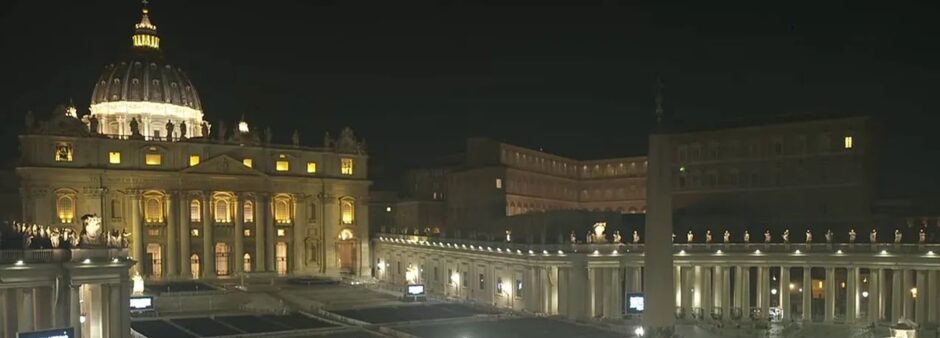
In the San Diego Union-Tribune there is a piece about the Traditional Latin Mass sure to thrill the local ordinary.
Opinion: I’m a Catholic who prefers Latin Mass. For my family, it’s about handing on tradition.
BY LUKE HEINSTSCHEL
Shortly before the COVID-19 pandemic, my wife and I received a diagnosis for our son as on the autism spectrum. This helped us to understand him better and gave us a deeper appreciation for some of his behaviors and developmental delays. We had been having trouble with getting him to behave in church. Though we had some experience of the traditional Latin Mass, we more often attended the “ordinary form” in English. The latter, also known as the “Novus Ordo,” is the form of the Catholic Mass that is far more widely accessible, so that’s where we usually went.
As the world shut down during the pandemic, it became difficult to get to Mass. When we finally were able to return to regular Sunday worship, our son’s behavior and tolerance for the liturgy had worsened. We tried different parishes and different Mass times to accommodate him, but it wasn’t until we consistently attended the Latin Mass that our boy began to develop a healthy pattern of behavior in Mass. We noticed that the attraction to ritual and routine that is built into human nature was magnified in the experience of our son on the autism spectrum.
The differences between the Latin Mass and the Novus Ordo extend far beyond language and translation. The traditional Latin Mass is more solemn. In the new, the practices are more focused on modernizing the experience of the worshiper rather than simply offering sacrifice to God. The orientation and postures are often directed toward the congregation rather than the crucifix or tabernacle. A great many of the prayers themselves were changed, rather than just translated.
That ancient liturgy has a sort of beauty to it that is otherworldly. Life is saturated with all that is new, relevant and flashy, but this form of worship seems set apart from the rest of life. My family has come to appreciate this silent order as a retreat from a chaotic world of sensory overload.
Unfortunately, though, those Catholics like my family who find themselves attracted to this liturgy are often thought of as divisive. Some even think that we have animosity or distrust toward the pope and the Second Vatican Council. It seems obvious to me that nothing could be further from the truth.
As a father of three, I try to know my children (albeit, imperfectly) better all the time, that I might love them better and improve in my ability to discern what is good for them. Those Catholics who love the traditional Latin Mass seek the same thing from our spiritual fathers. We don’t want to be seen as rebellious teenagers. We have a filial love and respect for our priests and bishops. I find that sort of posture toward our priests, bishop and the Holy Father in my traditional Latin Mass community.
Catholics who are attracted to this form of worship are not worshiping ashes. We hope to preserve the fire of our living tradition. Many parents have a desire to hand on a Christian way of life that seems to be disappearing from today’s society. That is what tradition is: handing on. The rituals and forms of worship of our forebears are important in that handing on.
The way we worship is not meaningless. It informs — and is informed by — what we think is important. Belief in transcendent and objective truth means we need a solid anchor of continuity in worship. That is not merely the Latin language, but all the trappings and ceremonial extravagances of the traditional Latin Mass. The Catholic conviction that beauty is not relative to cultural or personal preferences requires a deep solemnity in the music, postures, art and architecture that accompanies our worship. That tradition of worship impacts what we believe.
Tradition, in both belief and practice, can be freeing. A dear friend of mine is a priest who celebrates both the traditional Latin Mass and the Novus Ordo. He told me that the older form of the Mass liberates him to just be a priest, whereas there is a pressure in the new Mass to engage the congregation like a talk-show host. If our worship makes a priest feel as if he needs to entertain, what are we saying about the nature of worship and of our relationship with God?
The Catholic Church makes the radical claim that it has the fullness of truth. If we believe that claim, then we should strive to preserve the most important aspect of the church’s life and activity, a lived experience that developed slowly and organically over 1,900 years. Some Catholics are uncomfortable with replacing that organic development with dramatic changes crafted by a committee in just a single generation.
My constant prayer is that in God’s mercy, my family will have continued access to our traditional form of worship. I know my son needs it. The brokenness and weakness of my own heart needs it. The church and the world need it, too.
Heintschel is headmaster of a classical academy and lives in Escondido. He attends the Latin Mass at St. Anne Catholic Church in Logan Heights.
 On this Easter Sunday the sun rose at 0638 and will set at 1946. The Ave Maria is still in the 2000 cycle.


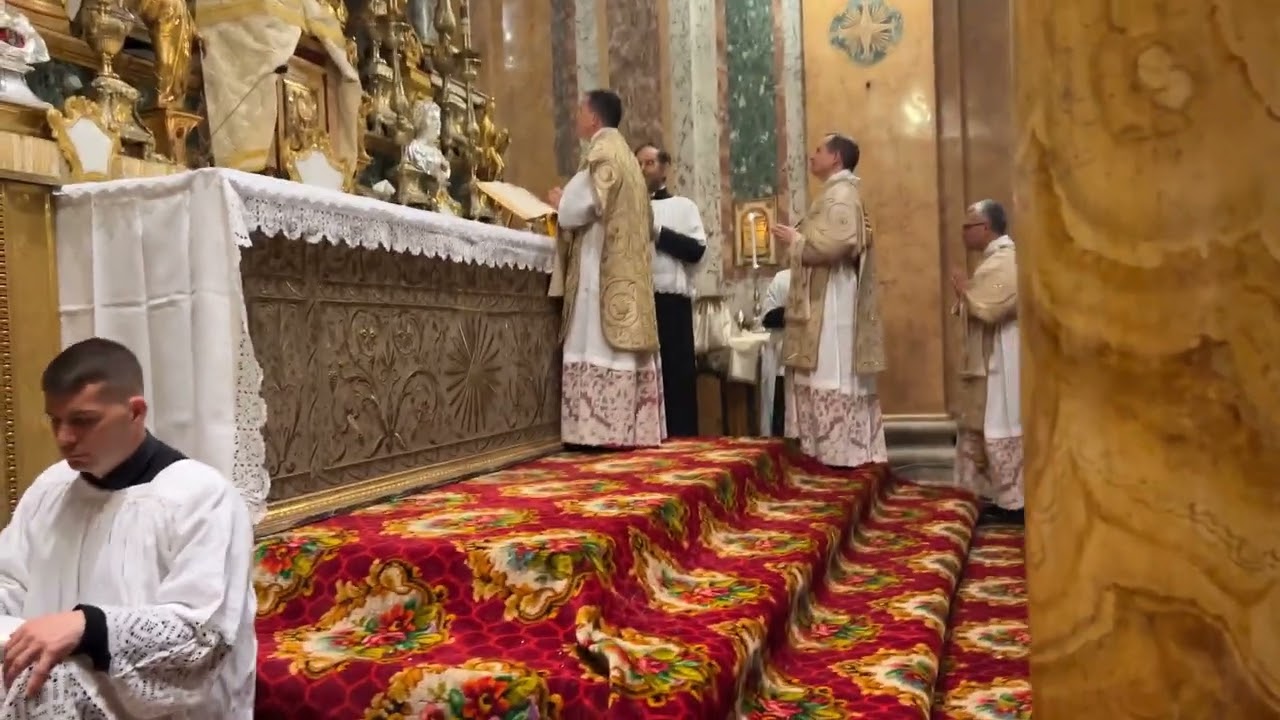


 On this Holy Saturday, the Station should be at St. John Lateran, where centuries in and centuries out the aspiring catechumens were brought into the fold in the mysterious rites of the Vigil.



 I received this note today:


 Since we are Unreconstructed Ossified Manualists, we pay attention to old manuals. Prümmer suggests that for the morning snack a piece of bread and 2 ounces of nourishing food is sufficient, and that for the afternoon or evening snack, 8 ounces of nourishing food is permitted to all. “Sufficient” for what is not entirely clear. There is a difference between working construction and working at a computer. This is greatly simplified by taking Good Friday off… if possible.
 It’s Good Friday. The sun rose at 6:42 and will set at 19:44. The Ave Maria is at 20:00. The Roman Station is, of course, at Santa Croce in Gerusalemme. It is the Feast of St. John Baptist de la Salle.


 April 6th 2023
 The term “Maunday” or “Maundy” Thursday refers to Christ’s mandate (mandatum) in John 13:34 to His apostles in the service of the Church. It is also called sometimes “Shere” Thursday, perhaps from “shere” indicating “tolerance” and “remedy”, in the sense of “wiggle room”. This “shere” was, according to the OED the difference or error permissible in a measure of something, such as the deviation from the standard in minting a coin.
 On this anniversary of the Eucharist and Priesthood, the Roman sunrise was at 6:43. The sunset will be at 19:43, when we will be deep into our solemn rites and then Tenebrae. The Ave Maria should ring at 20:00. The Moon is full. The Roman Station is St. John Lateran. It is, among others, the feast of St Galla.































