It’s ‘ad orientEm’ not ‘ad orientUm’ and it’s what we need right now.

The great liturgical scholar Klaus Gamber said that the de-orientation of the altar was the more destructive change after the Council.

To make that clear: The priest celebrating Mass facing the people did more damage to the Faith than anything else, even changing the Rite.

I will add to that, right up there is Communion on the hand.    For background on the permission for Communion on the hand, go HERE.

Fr. Raymond de Souza brings up ad orientem worship as a remedy for much that is going one.  I have bashed away at this for decades but, oddly, not recently.  It is good to see Father tackle it.

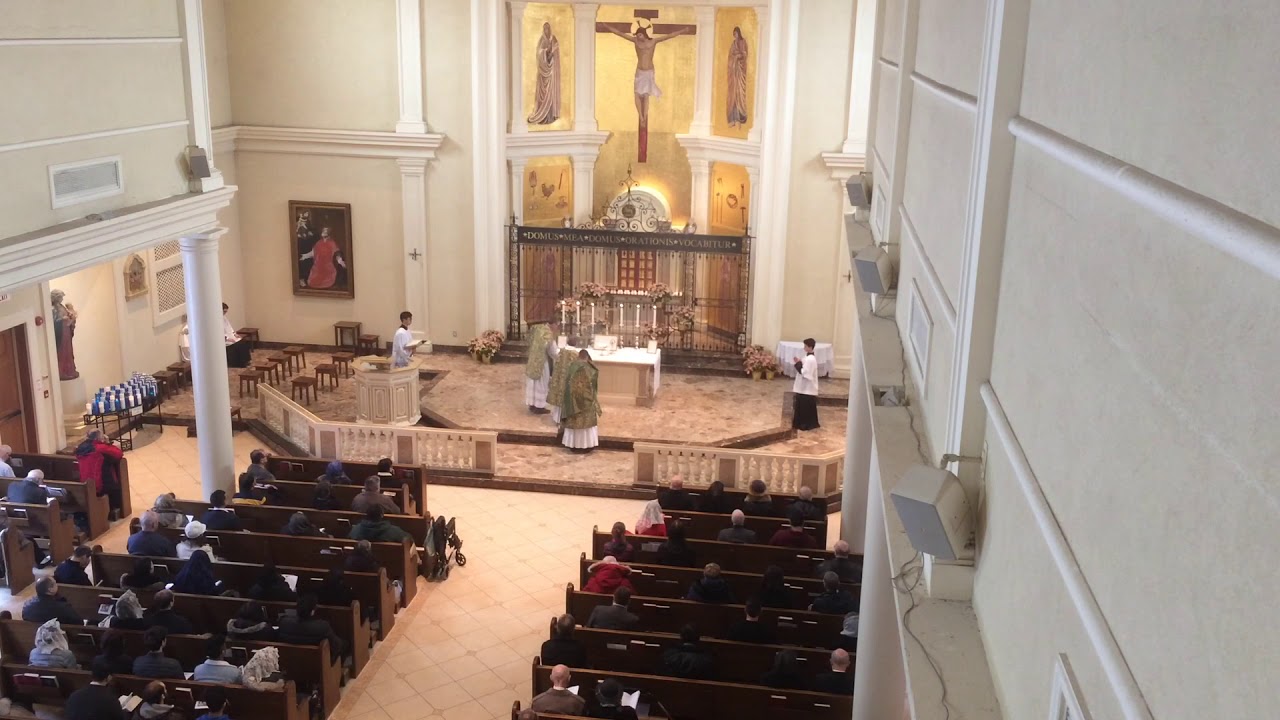
Celebration of Holy Mass ad orientem.

It’s ad orientem not ad orientum.

CLICK for “AD ORIENTEM” stuff!

The first part of Father’s piece recounts the massive growth of liturgical abuses after the Council and the vain attempts of Popes to get things under control (even though, I add, it was their permissiveness and obtuse view of the Novus Ordo that contributed to the problem).

Here’s the last part of the article.

[…]

After the turbulence in some parts of the Church arising from Traditionis Custodes, Pope Francis issued a letter on the liturgy this past June 29, Desiderio Desideravi, which is in rather remarkable continuity with John Paul’s final encyclical on the Eucharist. [Some of it, perhaps.]

“There is no aspect of ecclesial life that does not find its summit and its source in the Liturgy,” writes Pope Francis (37). He speaks about the need to recapture an experience of “amazement,” “astonishment” and “wonder.” And he reiterates, like his predecessors:

Let us be clear here: every aspect of the celebration must be carefully tended to (space, time, gestures, words, objects, vestments, song, music …) and every rubric must be observed. Such attention would be enough to prevent robbing from the assembly what is owed to it; namely, the paschal mystery celebrated according to the ritual that the Church sets down” (23)”

Back to the Back

[QUAERUNTUR:] How then is the desire of Pope Francis in Desiderio to be achieved? Can an authentic “liturgical formation” be achieved? After all these efforts over these many years, can abuses be curbed and lead anew to wonder and amazement? The nearly 50-year complaint about arbitrary license being taken with the liturgy has not, evidently, been corrected entirely, even if the scale of the problem has diminished.  [It is possible, but the RX is going to be hard.]

There is one step, a powerful short-cut, to the liturgical discipline that Pope Francis is demanding: ad orientem.

Sometimes derided as the priest “with his back to the people” — as if a drum major has his back to the marching band which he leads — it is surely true that nearly all liturgical abuses cease when the priest is not facing the people. It always remains possible to celebrate Holy Mass in a slipshod or sloppy manner, hurriedly or distractedly, but ad orientem removes most of the opportunity for taking liberties with the liturgy.

The abrogation of Summorum Pontificum means that Benedict’s strategy for “mutually enriching” forms of celebration is no longer an easily available option for liturgical reform. It also means that, practically, much of the energy that was absorbed in developing the extraordinary form will need another outlet. Ad orientem will absorb some of those energies.  [Do NOT discount the spread of the TLM.  It will keep spreading.  It cannot be stopped.]

And after three popes over 40 years have attempted to correct abuses in the liturgy and restore a sense of wonder and awe, it is evident that another papal document or congregational instruction will do little good[Repeated legislation shows that the law is ineffective.]

It’s time try something different, to go back to the liturgical future.

Posted in Liturgy Science Theatre 3000, Our Catholic Identity, Save The Liturgy - Save The World, SESSIUNCULA, Turn Towards The Lord | Tagged , ,
17 Comments

A “perpetual synodal” (“walking together”) Church? What could go wrong?

From the National Catholic Register (the Catholic paper, not the other one, the Fishwrap).

Pope Francis announced on Sunday that the Synod (“walking together”) on Synodality (“walking together”) will be extended to 2024.

Speaking in his Angelus address on Oct. 16, the Pope shared his decision to divide the Synod of Bishops into two sessions that will meet in Rome in October 2023 and October 2024.

Pope Francis explained that he made the decision “in order to have a more relaxed period of discernment.”

“The fruits of the synodal process underway are many, but so that they might come to full maturity, it is necessary not to be in a rush,” Francis said.

“I trust that this decision will promote the understanding of synodality as a constitutive dimension of the Church and help everyone to live it as the journey of brothers and sisters who proclaim the joy of the Gospel,” he said.

Also from the NCReg by the best English language Vaticanista these days Ed Pentin. My emphases and comments.  This is from 2021!

Permanent Synodal Church — A Progressive Jesuit Cardinal’s ‘Dream’ Come True

Today’s announcement of a two-year process for the upcoming synod on synodality (“walking together”) appears to reflect the ideas of Jesuit Cardinal Carlo Maria Martini, who viewed synodality as a vehicle for questioning Church teaching.

May 21, 2021

The Vatican’s announcement today that Pope Francis has changed his plans for the next Synod (“walking together”) of Bishops and made it into a multiphase process over two years comes closer to fulfilling a “dream” of the late progressive Jesuit Cardinal Carlo Maria Martini. [Domine salva nos, perimus: impera, et fac Deus tranquilitatem!]

The former cardinal-archbishop of Milan, a favorite of those pushing for heterodox reforms in the Church, had envisioned a permanent synodal Church in which the idea of collegial governance introduced at the Second Vatican Council could be better realized.

The Jesuit biblical scholar, who died in 2012, “had a dream” in 1999 of a Church capable of being in a permanent synodal state, with a “collegial and authoritative exchange among all the bishops on some key issues.”

For Cardinal Martini, those key issues comprised “the shortage of ordained ministers, the role of woman in society and in the Church, the discipline of marriage, the Catholic vision of sexuality, penitential practice, relations with the sister Churches of Orthodoxy and more in general the need to revive ecumenical hopes, the relationship between democracy and values and between civil laws and the moral law.”

In a later interview in 2004, he said he also saw the Synod of Bishops — as Pope Francis does — as an important element in a less centralized form of Church governance[It’s ironic that the more this “walking together” stuff is ballyhooed, the more autocratic the higher ups are becoming.]

Rather than argue for a Third Vatican Council, he believed his vision of a permanent synodal Church would not only be more in line with the Second Vatican Council’s call for collegial governance, but an effective vehicle for introducing the key issues he mentioned.  [Vatican III would be too abrupt.  Instead, incrementalism is needed, the “frog in the warming water” approach.  That’s how you change the Church into something that is conformed to the “wisdom of this world”, like an NGO that goes with the visions of the trendsetters, such as population control for the sake of climate change, etc.]

Echoing a similar kind of synodal permanence, Pope Francis’ upcoming synod will be entirely devoted to synodality for two years (the official theme is “For a Synodal Church: Communion, Participation and Mission”) and follows almost-annual Vatican synodal assemblies during Francis’ pontificate.

Originally scheduled for October next year, the upcoming meeting will now consist of a “diocesan phase” running from this October until April 2022, a “continental phase” from September 2022 to March 2023, and a “conclusive phase” for the universal Church in October 2023. It will have two working documents (instrumentum laboris) instead of the usual one[‘Cause that won’t be confusing at all.]

Referring to the extended synodal period, the general secretary of the Synod of Bishops, Cardinal Mario Grech, said in an interview with Vatican Media on Friday that it was consistent with Pope Francis’ 2018 apostolic constitution on the Synod of Bishops, Episcopalis Communio, which transformed the synod from being an “event into a process.

That process, he added, is aimed at ensuring the “wider participation of the People of God” and, according to the Synod of Bishops’ announcement today, listening to what “all of the baptized” have to say. [Does anyone… anyone… really believe that?]

Given the tensions and acrimony associated with recent synods, and especially the national “Synodal Path” underway in Germany, which critics say could lead the country’s Church into schism, apprehension is growing about the disunifying effects of this kind of governance and its tendency to be used to introduce heterodoxy into the Church.

These concerns have also grown in view of the fact that so many of the faithful, especially in the West, have been poorly catechized for the past 60 years[Bad catechesis or non (which could be better) and bad liturgical worship (liturgy is doctrine), the squandering of nearly all their moral capital by the bishops and many priests… all have created a crisis which, under the constant pounding of the world, the flesh and the Devil, have resulted in (in many places) a demographic sink hole.  If people do not know who they are as Catholics, how can they affect the world around them, as Catholics?  Why should anyone in the public square listen to us, as Catholics, if we can’t articulate what we believe and why?  This is why Benedict XVI was so concerned about the “dictatorship of relativism” and why he tried – in my opinion – to spark a Marshall Plan against the same including liturgical renewal.  Do we hear about concerns over “relativism” these days?  No, quite the opposite.]

Cardinal Grech sought to allay such concerns in his interview, asserting that, for Pope Francis, “the sensus fidei [the sense of the faithful] best characterizes this people [of God] that makes them infallible in credendo.   [Stop right here.  The problem with this is that for the sensus fidei fidelium, the faithful’s sense of the faith to be operative, they first have to be the faithful.  They have to know their Faith and live it.  Is that what we see in the Church in the northern and western hemisphere? If people do not know who they are as Catholics, how can they affect the world around them, as Catholics?  Why should anyone in the public square listen to us, as Catholics, if we can’t articulate what we believe and why?  This is why Benedict XVI was so concerned about the “dictatorship of relativism” and why he tried – in my opinion – to spark a Marshall Plan against the same including liturgical renewal.  Do we hear about concerns over “relativism” these days?  No, quite the opposite.  And what as the response rate been to the “synodal” (“walking together”) process actually been?  1%?]

“This traditional aspect of doctrine throughout the history of the Church professes that ‘the entire body of the faithful … cannot err in matters of belief’ by virtue of the light that comes from the Holy Spirit given in baptism,” he said.

“The Second Vatican Council teaches that the People of God participate in the prophetic office of Christ. Therefore, we must listen to the People of God, and this means going out to the local Churches.”

“The governing principle of this consultation of the People of God is contained in the ancient principle ‘that which touches upon all must be approved by all’ (Quod omnes tangit ab omnibus approbari debet),” he said. “This is not about democracy, or populism or anything like that. Rather, it is the Church that, as the People of God, a People who by virtue of baptism, is an active subject in the life and mission of the Church.”  [Omnes?  Sure.  Except for people who want traditional liturgical worship and tried and true teaching from standard sources.  Omnes!  Right.  This is straight from Yves Congar who meant it to be for all Christians in matters of faith, not all Catholic Christians.  How is that going to work?  The principle he invokes might just provoke.  To be fair, Protestants were invited to the Council of Trent!  I just learned that.  (Trent: What Happened at the Council ]

Read:

THE ST. GALLEN MAFIA – Exposing the Secret Reformist Group Within the Church by Julia Meloni.   US HERE – UK HERE

It is published by ever-faithful TAN Books.

One section that caught my close attention was a later chapter on the patience of the machinations and the individuals, wherein there popped in an important name: Yves Congar, an powerful influence at the Second Vatican Council and part of the Concilium group.

When Francis announced the Synod (“walking together) about Synods (“walking together”) he quoted Congar, saying:

“We must not make another Church, we must make a different Church”(Vera e falsa riforma nella Chiesa,Milan 1994, 193). And that’s the challenge. For a “different Church”, open to the newness that God wants to suggest to her, let us invoke the Spirit with greater strength and frequency and humbly listen to him, walking together, as he, creator of communion and mission, desires, that is, with docility and courage.

As Meloni points out, Congar “was obsessed by time”.

Congar wanted a patient transformation of the Church without rushing, causing breaks or schisms, moving in stages, patiently waiting through delays.

For his part, Francis has several guiding principles that he laid out in Evangelii gaudium which he in turn took from an Argentinian caudillo.  I am not making that up.  HERE for an explanation.

One of those principles was “time is greater than space”.   It sounds vacuous, but it in essence means, “patience overcomes resistance”.

In this section, Meloni connects the influence of Card. Martini with the projects of Francis.  They line up.

I am reminded of the patience that certain groups such as Masons, Communists, and Homosexualists had over decades of slow but steady infiltration of the Church at many levels, keeping relatively quite until the “tipping point” was finally attained.  We are seeing the results now being played out before our horrified eyes.

This is a hard book to read, much as an autopsy is hard to watch.  They are simultaneously fascinating and repulsive.

YouTube thumbnailYouTube icon

Posted in Our Catholic Identity, Pò sì jiù, Synod, The Coming Storm, The Drill, The future and our choices | Tagged , , ,
17 Comments

ASK FATHER: Does a short homily or no homily invalidate the Mass?

From a reader…

QUAERITUR:

One would think having the bishop allow a diocesan priest to do the Tridentine Mass would fill the faithful with joy. However this priest (who strongly objects to the NO) also is angry with his TLM parishioners. The list of abuses is growing but today he — at the homily — took off the maniple, turned at the altar and said one sentence, then continued with Mass. He refuses to use a mic and has a deep accent which combined with the rapidity of his words and my hearing loss means I don’t have a clue what he said. I decided not to let it bother me. However a friend was livid, asked me if there was a minimum time limit for a homily for Mass to be valid. I said I didn’t think so. But the question of validity did flash through my and another friend’s mind. Going to the bishop is tricky and I hoped you could reassure me|us the Mass is indeed valid. I have no doubt whatsoever the priest intends consecration, btw. Since there aren’t any other priests and we live hours from the nearest TLM we are at his mercy. I’d like to know that at least the Mass is valid. Thank you in advance for any help you can give.

There is so much going on in this that I had to respond.

Good preaching is important.

At this point, you may be saying: Fr. Z… Master of the Obvious.

Firstly, I am sorry for your hearing loss.  I imagine that is really frustrating.  Experiential knowledge from after Masses confirms this.  Not a few times has a little old lady approached me after Mass to thank me for my “message”.  Often, it goes, “Oh Father, thank you for that message.  I didn’t understand it, but I could hear every word!”

The rudiments of good preaching have sometimes been summarized as The Three B’s: Be good, be brief, be gone.

Priests need to learn the basics of forensic speaking, including, in these sadder anti-McLuhan years, how to use a microphone, how to ‘hear yourself’ coming back in the space you are in, etc.

Refusal to use a mic.  Well, that’s a hard thing to respond to.  Some priests have big voices and know how to project.  Some don’t.  The aforementioned Marshall McLuhan had strong words about the corrosive effect the microphone had on the sacredness of Mass and the sense of the faithful.    I think he was right.  More HERE.  And we have heard the “open mic” anecdotes.  I once MC’d for a bishop who, over my protest, insisted on using a clip on transmitting mic for a live streamed Mass.  He had to use the bathroom and left the mic on, which resulted in a whole new meaning of “live stream” for the congregation and those online.   And there’s the famous confessional scene from Bless Me, Father (about min 19:00). I hate those mics.

The book I’ve been reading on the Council of Trent, which I have been repeatedly going back and rereading in parts (Trent: What Happened at the Council by John O’Malley. [US HERE – UK HERE]), describes how one of the important reforms undertaking by the Council Fathers was the teaching about and legislation about the importance of preaching, at least on Sundays and feasts: diebus saltem dominicis.  That also meant other reforms: the bishop had to be in his diocese, the priest had to be in his parish, they had to have basic training and formation.  The Council would eventually mandate a Catechism that they could use for Sunday preaching.

Ignorance of the faith on the part of the laity (and clergy) was a significant factor in the Protestant Revolt that incited the Council in the first place.   I suspect it is an even worse problem now, frankly.  And by that I DON’T mean that I want another Council!  QUOD DEUS AVERTAT!  I don’t think even the Lord would allow the Church to survive in any visible presence after a Vatican II2.

Here’s what the 1983 Code says in Can. 767

§2. A homily must be given [habenda est] at all Masses on Sundays and holy days of obligation which are celebrated with a congregation, and it cannot be omitted except for a grave cause. [nec omitti potest nisi gravi de causa]

§3. It is strongly recommended that if there is a sufficient congregation, a homily is to be given even at Masses celebrated during the week, especially during the time of Advent and Lent or on the occasion of some feast day or a sorrowful event.

§4. It is for the pastor or rector of a church to take care that these prescripts are observed conscientiously.

Vatican II’s Sacrosanctum Concilium 52 says: “at those Masses which are celebrated with the assistance of the people on Sundays and feasts of obligation, [a homily] should not be omitted except for a serious reason.”

Look familiar?  Can. 767 §2 was taken from SC 52.

So, Father may not, except for a grace reason, omit preaching on Sunday.  The Canon says, “all Masses” on Sundays.  Not some.

What could be a grave reason?

What would good reasons be?  Father has laryngitis or a broken and wired jaw.  A flaming cat ran screaming through the church setting pews on fire.  There was an earthquake.  Locusts.

Another reason might be that Father is a little stupid and the bishop has removed his faculty to preach without removing his faculty to say Mass.  There used to be a use of ordaining a man as simplex, a “Mass priest”, who didn’t have permission to preach or to receive sacramental confessions because he was too poorly formed to deal with those tasks or perhaps for some other reason.

Your feedback is different from the complaint Augustine received from some preaching in his day. To wit:

“You have had to acknowledge and complain that often, because you talked too long and with too little enthusiasm, it has befallen you to become commonplace and wearisome even to yourself, not to mention him whom you were trying to instruct by your discourse, and the others who were present as listeners.”

Augustine addresses preaching in Book IV of De doctrina christiana.   For some priests it just flows. For others it’s like pulling your own teeth.  I have known priests who suffer from real “stage fright”.  They have to man up.  But put yourself in their shoes when you think their sermon should have been longer.

Anyway, not having a sermon does not invalidate Mass.

While on the topic, today there is among many priests a strong impulse, nay rather, fixation, on preaching every day. Thanks Vatican II.  This seems to me to be a good impulse, born from the palpable hunger of the faithful to be formed and the fervor of the priest for the Faith he is engaged to form.  However, this can have a downside.  We can run the risk of shaping people’s notions that Mass is a didactic moment instead of a sacral moment.   This “didacticism” crept in after Vatican II and the expansion of Lectionary, especially in respect to having three readings in the Novus Ordo on Sundays (a mistake).

Fathers, it is okay not to preach. “Strongly recommended”? Sometimes we must just let Mass be Mass.

Not have a sermon might be a blessing.

There is a wonderful word in Italian for irritatingly dopey things: stupidate (stu-pi-dá-te).  This precisely characterizes the majority of homilies I have heard in pulpits of priests with whom I am not friendly.  That said, even though the priest might be less than sharp or may be a poor speaker, there is invariably some good point you can extract from his “message”, no matter how ham-fisted it was blurted.  This is one of the reasons why I post the “Your Sunday Sermon Notes” posts: to help people find the gold dust.

So, if Father doesn’t preach or just utters a sentence or two, count your blessings and work with what he said.

Meanwhile, if Father continues in this way, you might share with him what you find in Trent, Session 24, the 1983 Code, and Sacrosanctum Concilium 52.

You might jot down what you find in Trent, Session 24 – look it up in English, the 1983 Code, Sacrosanctum Concilium 52, and…

And for weary preachers, here’s the approach of St. John Chrysostom:

“Preaching improves me. When I begin to speak, weariness disappears; when I begin to teach, fatigue too disappears. Thus neither sickness itself nor indeed any other obstacle is able to separate me from your love….For just as you are hungry to listen to me, so too I am hungry to preach to you. My congregation is my only glory, and every one of you means more to me than anyone of the city outside….Oftentimes in my dreams I see myself in the pulpit speaking to you.”

Now, lest I go on and on and on… like some sermons, I’ll stop.

Posted in "How To..." - Practical Notes, ASK FATHER Question Box | Tagged ,
11 Comments

Your Sunday Sermon Notes – 19th Sunday after Pentecost (N.O. 29th Sunday)

Too many people today are without good, strong preaching, to the detriment of all. Share the good stuff.

Was there a GOOD point made in the sermon you heard at your Mass of obligation for the 19h Sunday after Pentecost (29th Ordinary in the Novus)?

Tell about attendance especially for the Traditional Latin Mass.  I hear that it is growing.  Of COURSE.

Any local changes or (hopefully good) news?

Posted in SESSIUNCULA | Tagged
3 Comments

ROME 22/10 – Day 16: Fountain famous and fountain found

The sun rose at and will set at and the Ave Maria should call at 18:45. It is the 19th Sunday after Pentecost.

And there’s this…

Sites and sounds.

An homage to friends in Chicago.

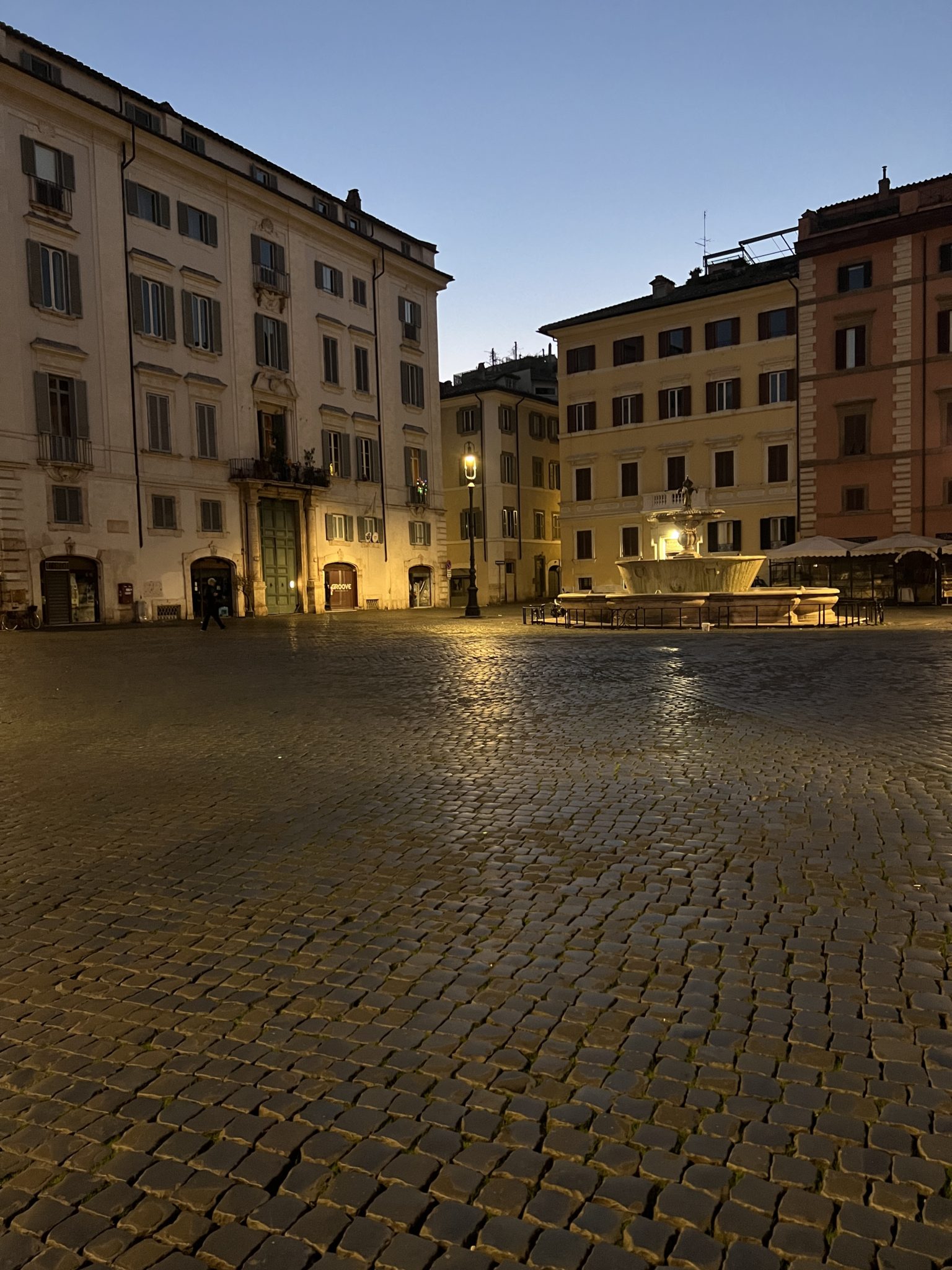
The other day I wrote about the change of from the Julian Calendar to the Gregorian on the night that St. Teresa of Avila died.   I mentioned a pair of fountains (one by San Salvatore in Lauro) that were made in the time of Gregory and a Latin inscription that can still be see in the entrance to a palazzo at the intersection of the Via dei Prefetti and the Via della Lupa (no. 17).  One of the participants here posted a Gold Star comment about the Latin text.  HERE

I went to find that inscription, and the old fountain, which I had not seen for many years.

At the Piazza del Popolo I spotted this, which says just about everything about Rome.

A lime green Lamborghini in front of a Vespa in front of a garbage truck in front of a church.

And at the Piazza…

Posted in SESSIUNCULA |
Comments Off on ROME 22/10 – Day 16: Fountain famous and fountain found

ROME 22/10 – Day 15: Flowers and glasses and clams

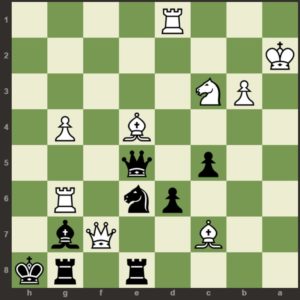
In Rome today the sun rose at 7:20 and it will sink beyond the western horizon at 18:31. The Ave Maria is scheduled for 18:45. It is the Feast of St. Teresa of Avila, Doctor of the Church and Patron of Chess Players. I wrote about her use of an image from chess in her spiritual writing HERE.

In her honor let’s have the puzzle first.   Black to move.

Interested in learning?  Try THIS.  This fellow has helped my game.

There is an interesting story about St. Teresa and our present, modern Julio-Gregorian calendar.

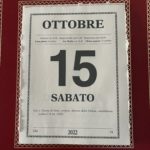
In 1582, the ancient Julian calendar (organized by, yes, Julius Caesar and still observed by many Orthodox Christians) officially was terminated on Thursday 4 October by the command of Gregory XIII (1572–1585, Ugo Boncompagni) via the papal bull Inter gravissimas.

At midnight of 3-4 October the calendar skipped automatically to a day named Friday 15 October.

The famed Jesuit mathematician Christopher Clavius (+1612) worked out the calculations for this change.  He chose October for the moment of the jump because it had the fewest feast days.

He also did his calculations without the use of the decimal point!

St. Teresa of Avila died on the very night on which His Holiness had commanded that the calendar shift from 4 October to 15 October, which is why her feast is celebrated on the 15th rather than the 3rd or 4th.

If you are in Rome, stop at San Salvatore in Lauro and look at the chewed up little fountain to the left of the main doors of the church. It will probably be obscured by parked cars.  On this little fountain is what’s left of a lion.  Over the fountain there is an inscription which inter alia speaks of a draco or “dragon” who, dutiful (pius), masters the whole world (draco qui toti pius imperat orbi). This is a reference to Pope Gregory XIII whose coat of arms bore a dragon with wings outstretched.  This is the Pope who ordered the change in the calendar and after whom we call our modern calendar Julio-Gregorian.

Here is the inscription on the fountain, for those of you who want to take a crack at it.  You will need to know that virginea here refers to a famous Roman water source, called Acqua Vergine (which also flows over the coins in the Fontana Trevi). That lupus (“wolf”) and that angus (“lamb”) refer to other fountains, which – though now lost – were part of a set, this fountain being the “lion”.  These are called “Elegiac couplets”:

VT LVPVS IN MARTIS CAMPO MANSVETIOR AGNO
VIRGINEAS POPVLO FAVCE MINISTRAT AQVAS
SIC QVOQVE PERSPICVAM CVI VIRGO PRAESIDET VNDAM
MITIOR HIC HOEDO FVNDIT AB ORE LEO
NEC MIRVM DRACO QVI TOTI PIVS IMPERAT ORBI
EXEMPLO PLACIDOS REDDIT VTROQVE SVO
MDLXXVIIII

In the cortile of Via dei Prefetti 17 is the inscription that was on the fountain of the “wolf”, where the Via della Lupa joins.  There was a family near there called the Capilupi (or some such).  The fountain is gone but the inscription survived.  I saw it once, many moons ago.  And, in that same courtyard, another fountain inscription warned that hands that had done violence or tongues that had uttered blasphemy were not permitted to touch the pure water of “the Virgin”.  Also, in Elegiac couplets.

BTW… Via dei Prefetti 17 is where Samuel Morse, the inventor of Morse Code, stayed in Rome.  If memory serves there is a plaque there.

How cool is Rome?

I should hike over there today, if my knee allows some hiking.

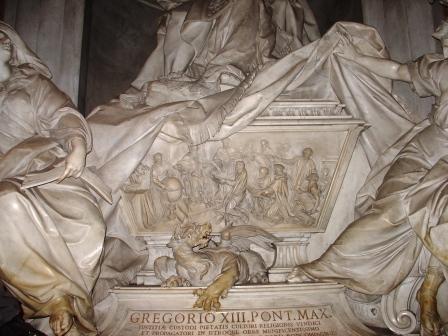
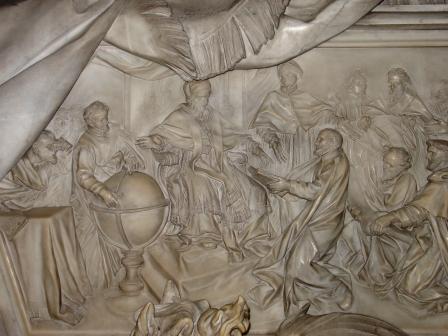
Going across the river to San Pietro in Vaticano, we search in the right side aisle for the tomb of Pope Gregory XIII and the interesting relief by Camillo Rusconi on his tomb.

It portrays the moment he was so proud of in his pontificate: when Clavius gave him the plans for the new calendar.

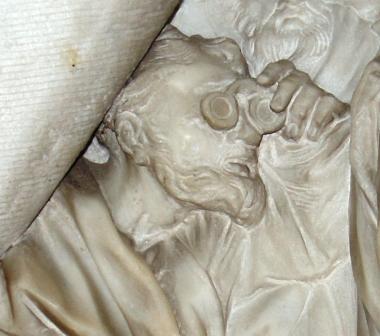
One of the things you must learn to do in Rome is pay attention to details, which are funny at times.  These people had a wonderful sense of humor.

What is interesting is the style of spectacles, and that the sculptor included it.  I haven’t gotten to the bottom of who this fellow might have been.  The sculptor himself?  The biographer of Gregory?  Who knows?

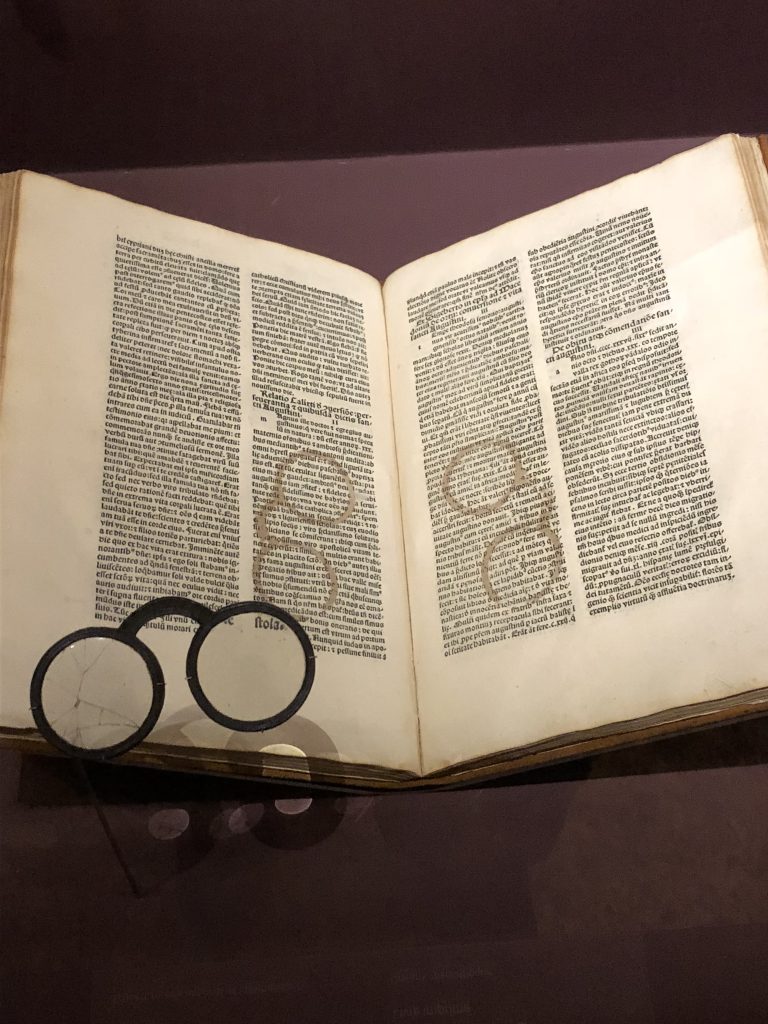
As for the spectacles, I recall that in the rooms of St. Philip Neri at the Chiesa Nuova, there are preserved a pair of Pippo’s cheaters.  And, some time ago, in Paris I saw a book in the Museum of Cluny that had been stored away for centuries with some guy’s glasses in the pages, leaving a mark.

By the way, one of my favorites Popes, Sixtus V (1585-1590 Peretti) said: “Had the Jesuit order produced nothing more than this Clavius, on this account alone the order should be praised”.  Clavius was an incredible mathematician who solved some of the most difficult problems of his day and who produced the essential textbooks of the era.  Even the way we all learned Euclidian geometry when we were children is due mostly to the presentations of Clavius.  His works were translated into Chinese by Matteo Ricci and others so that missionaries could connect with scholars in that far away land and thus bring them to the Gospel of Jesus Christ.

Now for some important things.

Pre-dawn mornings are so tranquil.

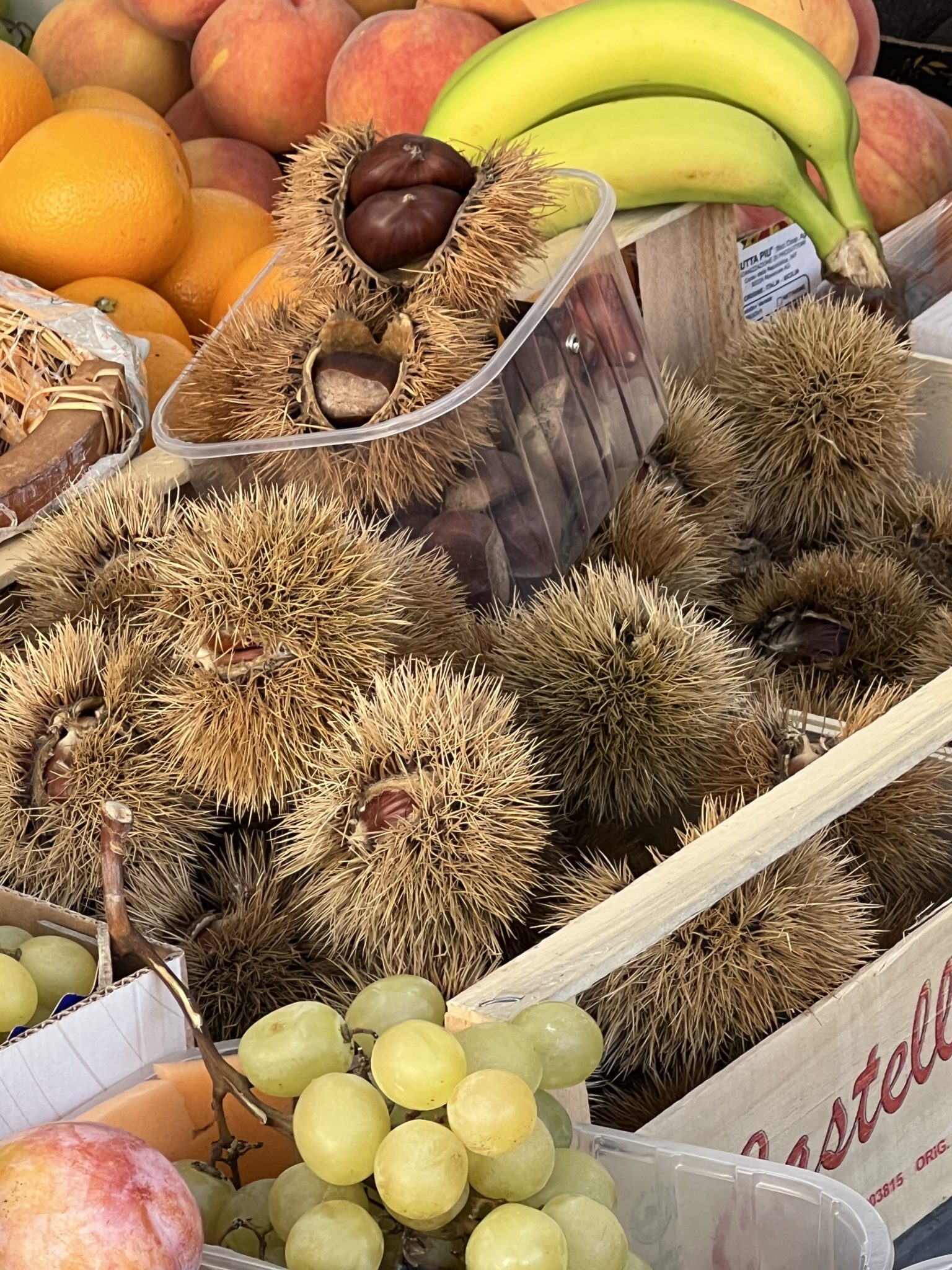
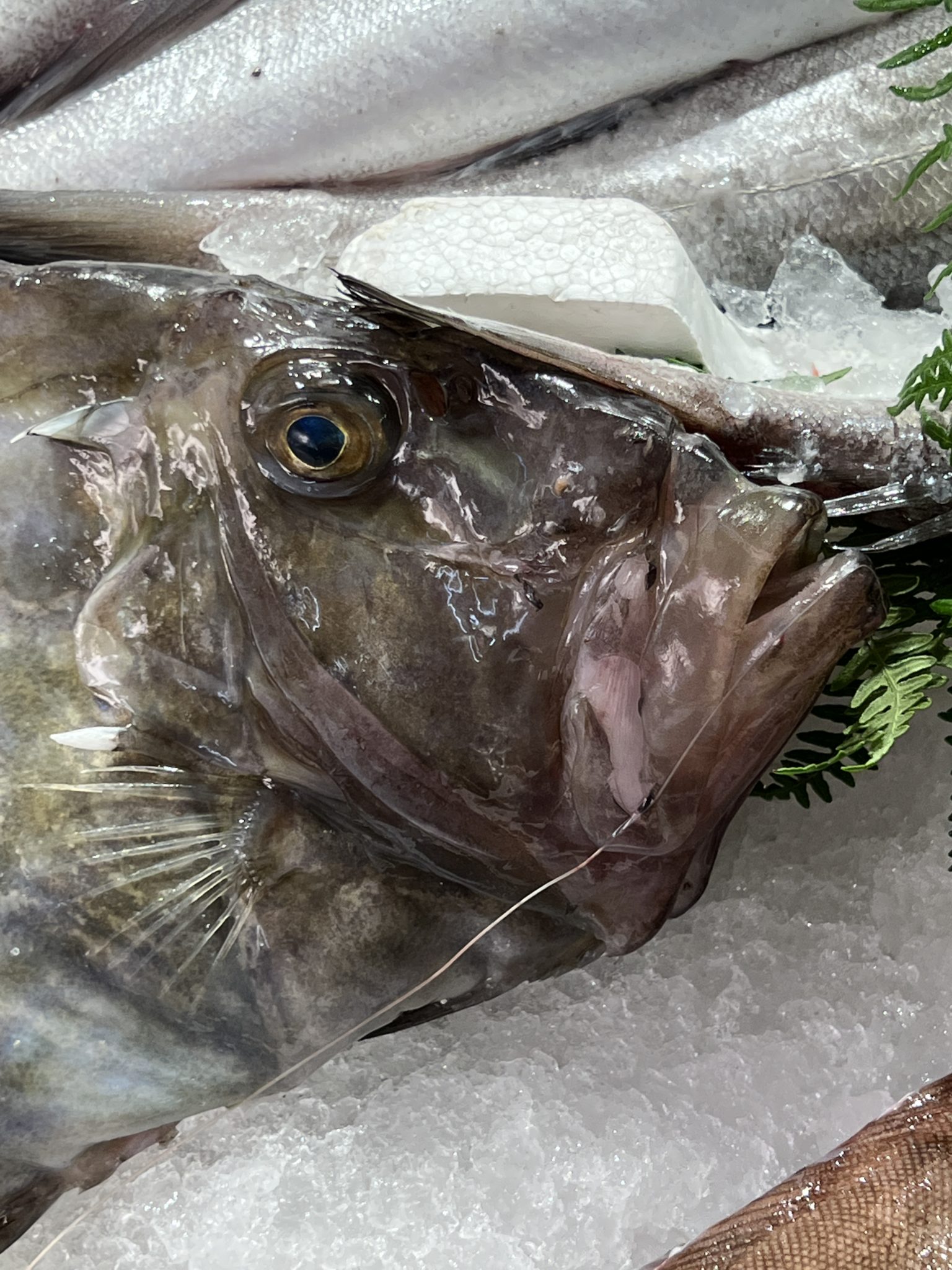
Sights from the market.

He’s still thinking about the consistory list.

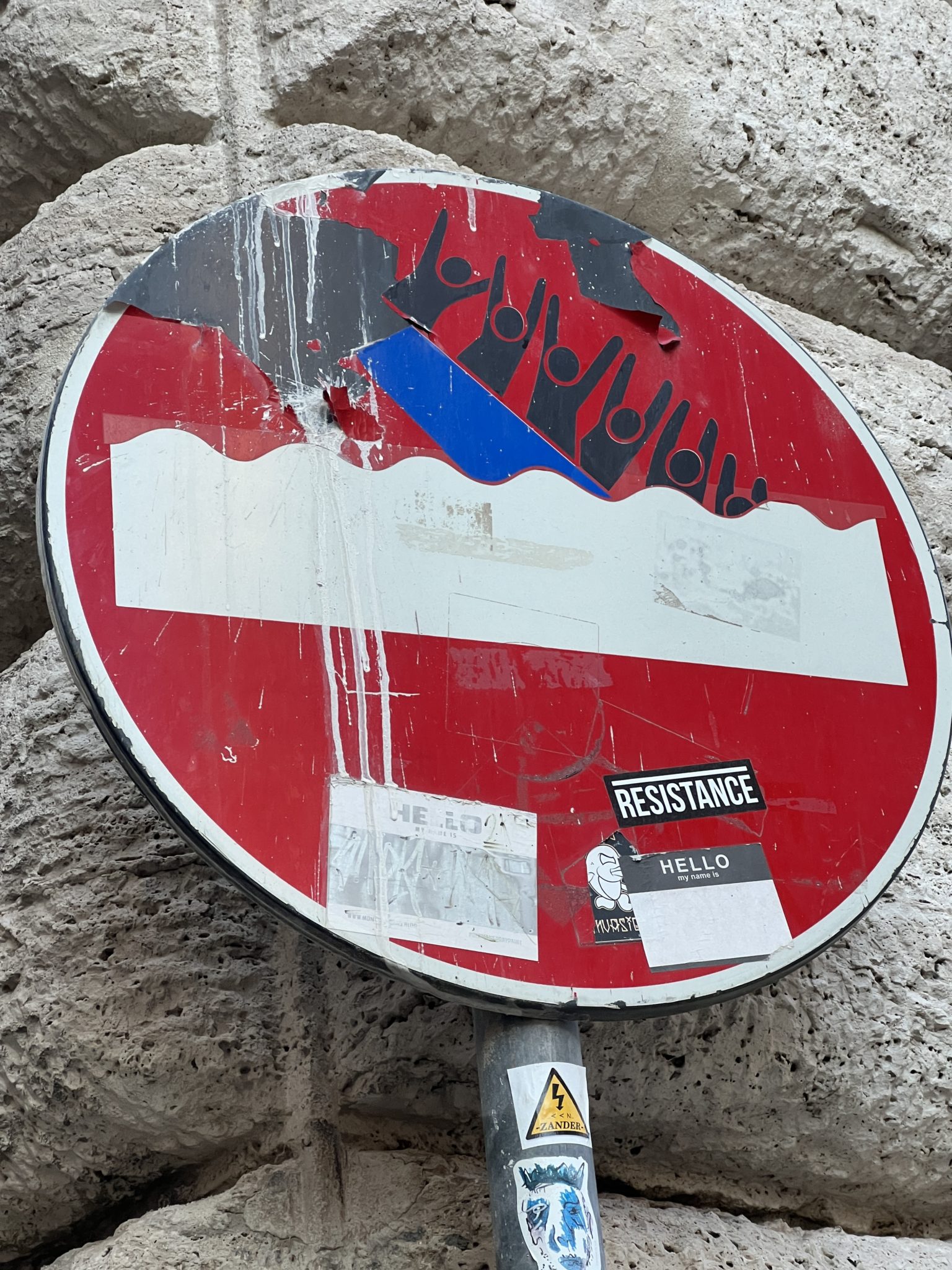
Somehow this “Do Not Enter” sign says it all.  Your metaphorical interpretations are appreciated.

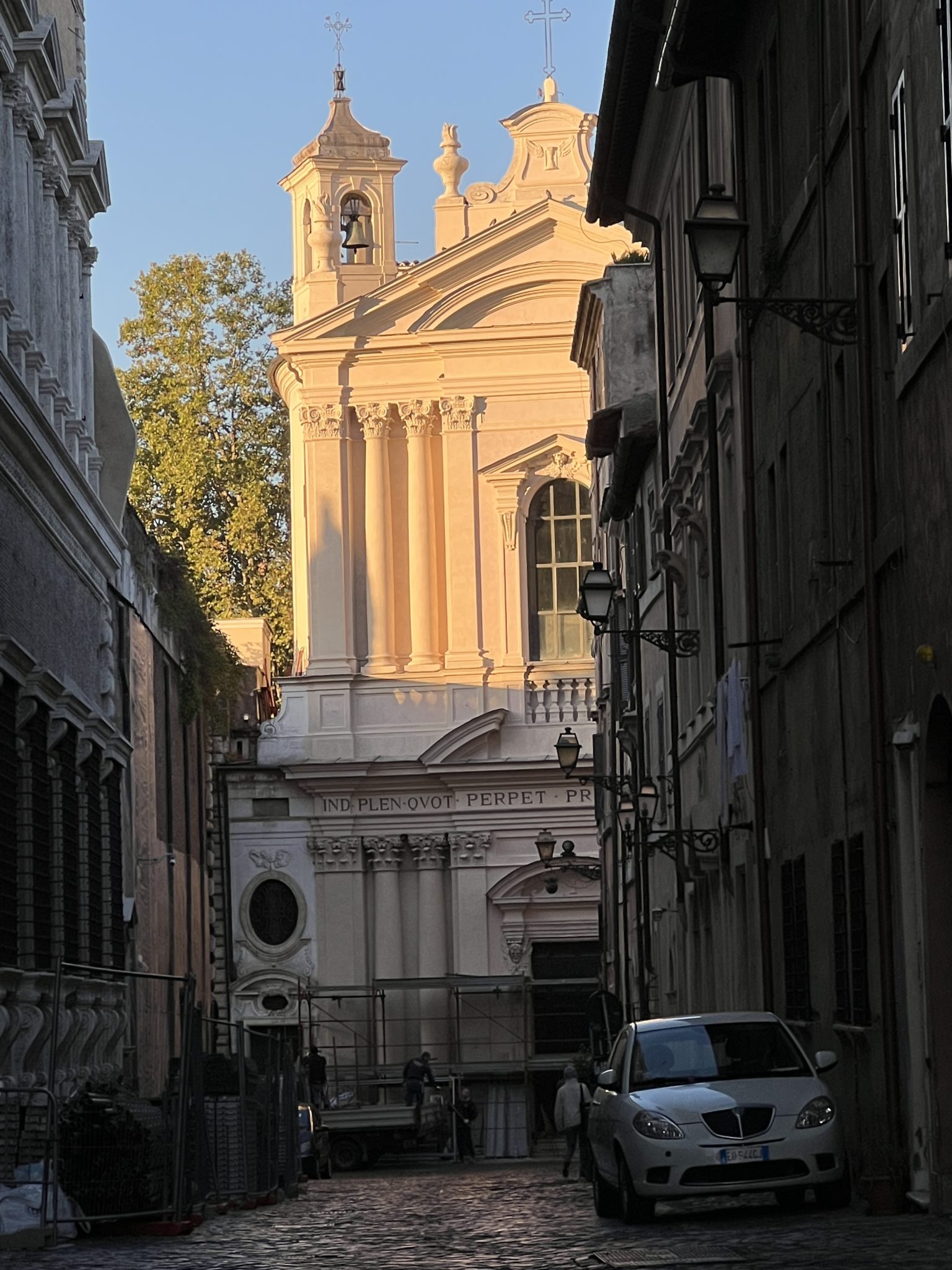
They are taking the scaffolding down from the Hungarian church! 

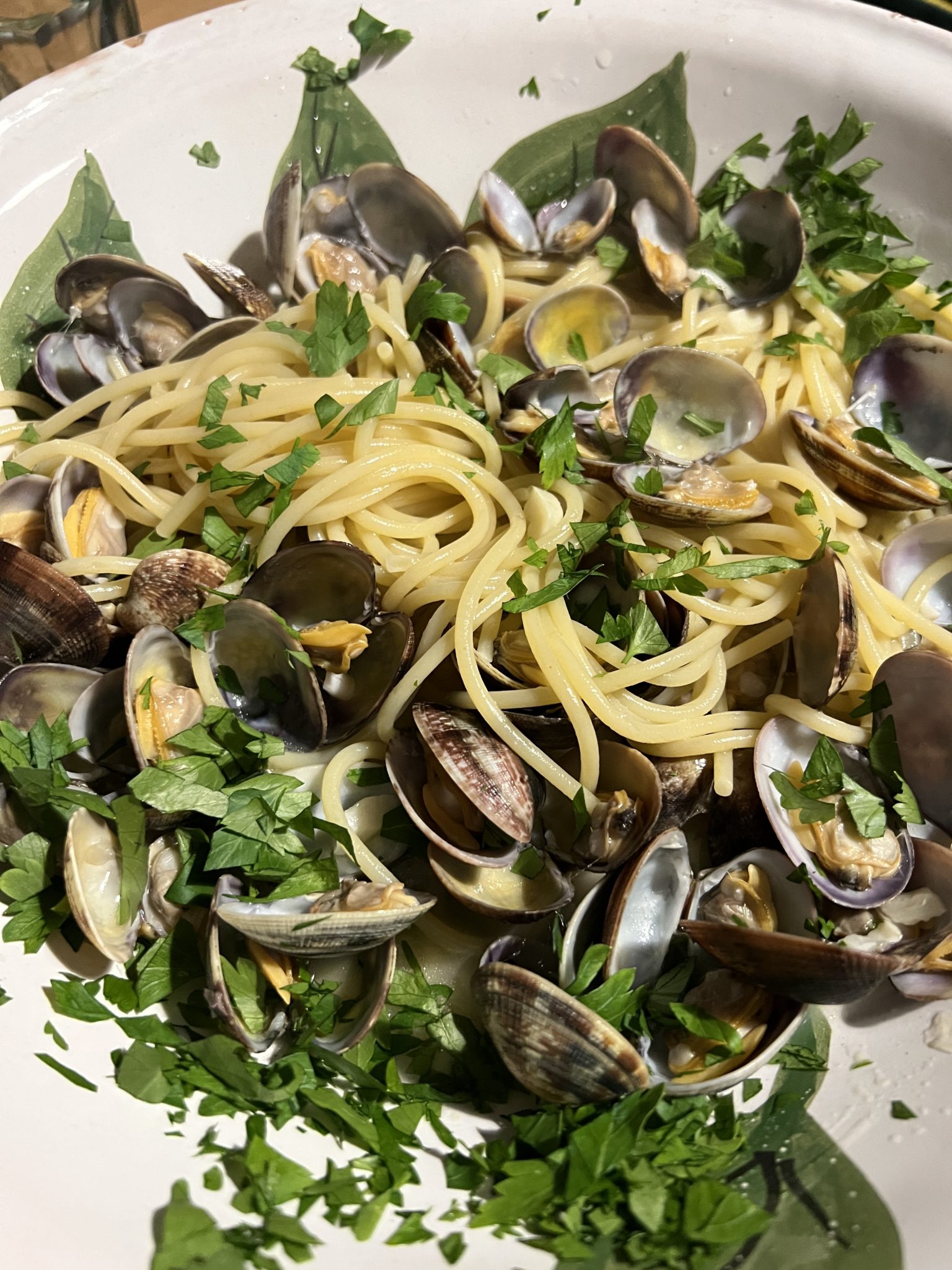
Last night spaghetti alle vongole.   The fishmonger says that the clams had already been purged.  Last time, however, … well… I should have given them another round.  Then, it was okay but there was some fine sand.   This time, a few hours in salty water did the trick.

I’m getting better and better at this one.

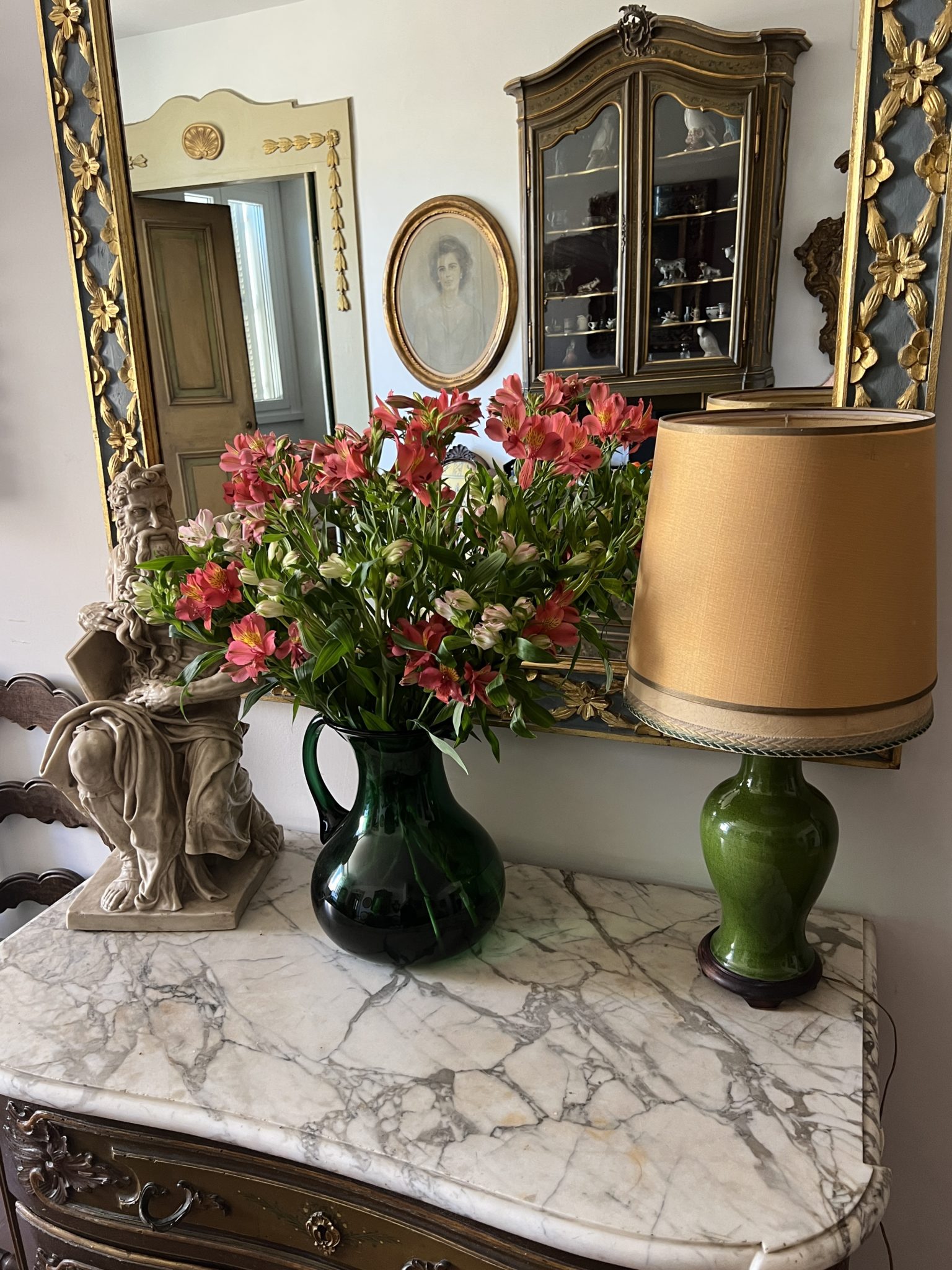
And at the request of a long time reader and very kind donor, a shot of the alstroemeria!

Posted in SESSIUNCULA |
8 Comments

DIEBUS SALTEM DOMINICIS – 19th Sunday after Pentecost: You might not have a tomorrow.

When this Sunday comes around, with its snappy Collect, I am minded of the early 4th c. martyr St. Expeditus.  Here is the Latin and my own slavishly literal version.

Omnipotens et misericors Deus, universa nobis adversantia propitiatus exclude: ut mente et corpore pariter expediti, quae tua sunt, liberis mentibus exsequamur.

Almighty and merciful God, having been appeased, keep away all things opposing us, so that, having been unencumbered in mind and body equally, we may with free minds accomplish the things which You command.

You spotted “expediti” of course, in this prayers clearly military language.   This is from expedio, “to extricate, disengage, let loose, free up from impediments, liberate any thing entangled.”  When applied to persons, it means “to be without baggage, unimpeded, free”.  Thus, the noun expeditus, i, m., is “a soldier lightly burdened, a swiftly marching soldier.”

St. Expeditus, whose feast day is 19 April, is a patron saint of procrastinators and computer programmers… for reasons which are perfectly clear. (The CSC excepted, of course.)

Expeditus is appropriately depicted as an ancient Roman soldier holding aloft a Cross upon which is written HODIE or “today” as he treads on a crow or raven croaking by means of a speech ribbon the corvine sounding Latin for “tomorrow”, CRAS.

In our prayer, expediti refers to our freedom from the chains of sin which entangle us and doom us to eternal hell.  St. Expeditus reminds us to keep moving forward swiftly in the face of the enemy and not to rely on tomorrow in dealing with immediate problems.  Like being in the state of mortal sin.

God wants your heart and service NOW.  Hodie.

Not cras. 

You might not have a tomorrow.

The Earl of Chesterfield advised his son in 1749, “Know the true value of time; snatch, seize, and enjoy every moment of it. No idleness, no laziness, no procrastination: never put off till to-morrow what you can do to-day.”

He wasn’t talking about going to confession… but I am.

GO TO CONFESSION!

Speaking of “putting off”, our Epistle reading from St. Paul to the Ephesians has admonishments which only the inveterate sinner will find off putting. The context, in chapter 4, is Paul’s plea to the Ephesians to treat each other properly, to “grow up” into the Christian life and to embrace the behavior such an identity entails. In particular, Paul tells them to put off, like dirty garments, the “old nature”, their former manner of life, and to put on, like beautiful new clothing, the “new nature, created after the likeness of God in true righteousness and holiness.” (4:24) As your trusty Douay-Reims Bible puts it, “put off the old man… and put on the new man.”  The Greek verb is endúo, “to sink into a garment, invest, array, clothe”.

For you who are close to the altar in liturgical service, or for those of you who are close through keeping the gear of the altar boys in good shape – thank you! – this image from Paul in Ephesians 4 is at the core of the prayer that boys and men, priests too, are to pray when donning the abbreviated form of the white baptismal garment, the surplice, worn over the cassock:

Indue me, Domine, novum hominem, qui secundum Deum creatus est in iustitia et sanctitate veritatis. Amen.

Invest me, O Lord, as a new man, who was created by God in justice and the holiness of truth. Amen.

Think of that, gentlemen and boys, as you carefully, reverently put on that surplice.  Think of that, ladies and girls, ,as you lovingly, generously extract wax, wash and iron.  Put on the new nature, as you are intended to have, God’s image renewed in Christ, no longer a slave burdened under the old ways of sin, but freed and “sealed unto the day of redemption”.   Expediti.

Putting off the old man and clothing with the new happens in baptism and in the confessional.  Those are but the starting points.  We have a lot of hard work and suffering afterward, a lot of falling and getting up again with the essential hand of God.

Speaking of suffering, the same image from Ephesians 4 of putting off the “old man” is to be prayed by bishops when they remove the cappa magna. Once very common.  Now, not so much.

St. Jerome (+420) commented on this very section of Ephesians with a stark image of the exchange of the old for the new.  The “old man” is aged in wickedness, gone astray and acting like a beast.  Along comes the Word of God.   “The Word of God,” says Jerome, “kills in such a way as to make the dead one come alive.  He then seeks the Lord whom he did not know before his death.  He does not corrupt but kills the old man. … As the outer man decays the inner man is renewed.”  (Commentarii in iv epistulas Paulinas, II in PL 26:540)

Note the distinction of “interior” and “exterior”.  This same theme is in the Collect of the Mass, above: “ut mente et corpore pariter expediti… unencumbered in mind and body equally”.

There should be a harmony, integration of the whole person who is renewed in Christ, who wears the “new man”.  What’s the old phrase?  “Clothes make the man”?  It isn’t by accident that the Latin word habitus means both a person’s “attire” and his “disposition, character”.   So, the Apostle to the Gentiles gets concrete.  For example, “Therefore, putting away falsehood, let every one speak the truth with his neighbor, for we are members one of another” (v. 25).   In other words, “Stop lying!”  He adds, “Stop stealing!” and “Stop being lazy!”, “Stop being greedy!” and, one of the most practical things ever penned, “Be angry but do not sin; do not let the sun go down on your anger, and give no opportunity to the devil” (vv. 26-27).

Treat each other well.  Let you all be exedititi together, unencumbered swift foot soldiers.  No baggage.

Circling back to St. Jerome on this chapter, the great Western Doctor underscores the dignity of a person who is established in Christ.

The metaphors of creating and establishing are never spoken of in Scripture except in great works.  The world is created.  A city is established. But observe that a house, however grand it may be, is more commonly said to be built than established or created.  Note then that it is a great work of God when it is said that the new person is created by God in Christ.  This creature towers over the other creatures.  This creature alone is said to have been established in the same way as the world was established, from the beginning of God’s ways (Prov 8:22), when all the elements first came into being.

What an awesome thing is it to be baptized, to receive the sacraments of the Church.

Allow me to bring this expeditiously to the Sunday Gospel and a brief comment from another of the Western Doctors, St. Gregory the Great (+604).

The Gospel is a continuation of Matthew, the parable of the Lord about the Kingdom of God – which is where we all want to wind up – being like the wedding banquet that a king held for his son.   Many were called to the banquet but didn’t come.  That’s part of the odd parable “twist”, or nimshal: people don’t turn down invitations to royal banquets.  Moreover, they kill the servants who brought invitations.  And if that isn’t extreme enough, the king them kills all of the them and burns their cities.   Eventually, the king invites every Titius, Caius and Sempronius to come in off the streets.  No pressure!  He spots a man without his wedding garment and has him tied up “hand and foot” and thrown out into the darkness, which seems a little extreme, considering that he was just invited to come in.  The garment, the wedding garment, is important, of course.  In the Old Testament garments signal various things, such as deeds of righteousness, God’s favor or, in the case of angels, he glorious light of Heaven.   St. Gregory says of this second twist:

“What then must we understand by the wedding garment but love? That person enters the marriage feast, but without wearing a wedding garment, who is present in the holy Church. He may have faith, but he does not have love. We are correct when we say that love is the wedding garment because that is what our Creator himself possessed when he came to the marriage feast to join the Church to himself.”  Forty Gospel Homilies 38:9

The Lord prepares a heavenly banquet and all are invited.  However, some, many even, prefer their worldly concerns, their farms or businesses or whatever.  The king’s reaction is a confirmation of their choice.

As the Gospel passage concludes this week: “Many are called, but few are chosen” (22:14)

The invitation is given, God prepares all that you need, the choice is made, and the separation takes place.  Those who choose well and who are worthy are within the messianic royal banquet, and those who are not are in the outer darkness, bound “hand and foot”, in their state of mortal sin and old man habits.

Impediti, not expediti.  It is up to you.

Faith alone is not enough.  Faith must be united with charity, sacrificial love of God.

Remember the words of Christ in Matthew 7:

“Not every one that saith to me, Lord, Lord, shall enter into the kingdom of heaven, but he that doth the will of my Father who is in heaven, he shall enter into the kingdom of heaven.”
 

Posted in GO TO CONFESSION, SESSIUNCULA, WDTPRS |
2 Comments

ROME 22/10 – Day 14: And old frenemy and a new dish

You know how this goes.

7:19

18:33

18:45

After Holy Mass and a holy hour – there is something special about the quiet of a large space – I was after something to break my fast.  Off to the famous Antico Forno at the Campo de’ Fiori.

On the way I stopped to chat with a couple of the flower vendors I’ve used for years.  Yesterday one of them made a call and got some alstromeria for me.  Knowing that, the next day another flower vendor called me over and he had it too.  He had previously said that he didn’t like it so he didn’t stock it.  I got a small bunch of a different color to incentivize and to boost my apartment’s bouquet.  I digress.    But it is the Campo de’ fiori after all.

Please remember me when shopping online via Amazon. Thanks in advance.  US HERE – UK HERE   This really helps me out.

There was a line at the bakery, as one would expect in the morning.

At the check out counter, there is a bottle of “extra virgin doggy oil”.  Just kidding.  Canino is a spectacularly beautiful place north of Rome.

Heading home with my score.

I bought a part of a loaf of casareccio and, instead of cornetti, I bought an old frenemy, a Roman rosetta.

In a couple of the clerical houses I’ve been in in Rome, breakfast always includes, invariably, a rosetta.  If fresh, they are good.  If not, they can be used for bocce or boules or, filled with explosives, combat, with lead, anchors.

They are hollow.  You approach them by pulling out the center.

I like mine with butter and jam.  It was a blast from the past.  The occasional rosetta is great!  Everyday for months on end… variety summons.

This confraternity church on the V. Giulia is getting help.   What I cherish above all is the papal coat of arms over the door.  That’s the custom in Rome: the pope’s arms and, if the church is assigned to a Cardinal, his arms.

Recognize this guy?   Superb.  I hope it is never removed except to be cleaned, preserved and put back into place.

A sad sight on the Via Giulia.  You would think that, as venerated as St. Philip Neri is in Rome – co-patron with Peter! – as omnipresent as are his images and objects in Roman churches, there would be a church dedicated to him.  Right?  There sort of is/was.

This had the misfortune of standing between a bridge over the Tiber and the straight street leading to the Corso in front of the Chiesa Nuova. It had been a plan to bash down everything and connect them.  The area between the river and V. Giula has been converted into  parking lot.

While there is some interior space, I think being used by an architect, the façade is pretty much all there is.

Lunch with a friend at one of my usual places.   This was spectacular.  A pasta much like strozzapreti (actually ferretti) in a sauce of cream, zest of citrus fruits, salmon, shaved fennel and dill.   Simple and superb.  This is definitely on my to do list.  The only problem to overcome at home will be the absence of panna da cucina, which is sort of like crème fraiche but… not.   I have a cunning plan that will involve the reduction of heavy cream, perhaps with some of the agrumi zest.  I have a couple of zesting tools that I bought in Tokyo that will do the trick.  A drop of black truffle oil will not hurt this preparation at all.  This is a great way to handle some left over salmon that isn’t – quod Deus avertat! – cooked to invincible insipid fibers.

This was a treat.

Interested in learning?  Try THIS

Black to move.

Meanwhile, the bloodbath continues, which is discouraging.

If you are looking for alternatives to PayPal, try Zelle (which most US banks offer), Continue to Give (continuetogive.com – less preferred), and Wise (wise.com – terrific for international operations, though it takes a bit to set up, very low fees).  Chase QuickPay also works. There are other options, too, including snail mail which is forwarded to me.

To receive a link to donate via Continue To Give using your smart phone, use your phone’s camera to activate the Q code (below) or text 4827563 to 715-803-4772 (US) for a link.

Posted in SESSIUNCULA |
7 Comments

13 Oct 1917 – Anniversary of the “Miracle of the Sun” at Fatima – POLL about the “3rd Secret”

Today is the anniversary of the Miracle of the Sun that occurred in 1917.   Thousands of people saw it.   It had been raining and, after, clothes and ground were dry.  Pius XII saw it in Rome in the Vatican gardens.

Such an anniversary prompts the question.  The “the Vatican” reveal everything about the so-called 3rd Secret from Our Lady to Sr. Lucia?   In the case of the first two secrets there were visions and then explanations from Our Lady.  In the case of the third, we have been given the description of the vision.  We have not been given an explanation from Our Lady.  Yet we have been told that all has been revealed.   That also seems inconsistent with evidence that there are two parts of what Sr. Lucia communicated to the Pope.

Let’s have a poll.  Anyone can vote, but you have to be registered and approved to post a comment.

Regarding the revelation of the 3rd Secret of Our Lady of Fatima...

View Results

Posted in SESSIUNCULA |
16 Comments

ROME 22/10 – Day 13: Do not despair!

It was the Feast of St. Edward the Confessor in the Vetus Ordo of the Roman Rite, that bastion against nonsense. We would have seen the sunrise at 7:18 had it not been cloudy and raining. Would we see the sunset at 18:34? Rain or not, we wouldn’t hear the Ave Maria ring except in one place that I know of, at 18:45.

It was the 60th anniversary of the 1st full day of the Second Vatican Council.  We are called to reflect on the great fruits that that Council produced and is still producing.  Enjoy the springtime.

Ss. Trinità dei Pelegrini is so tranquil in the morning before sunrise.  The magnificent Reni seems to have its own internal light source.

I had a walk yesterday.  Must keep moving.  Just a couple of views for now.

I spotted a couple of old chalices in an antique store.

I think this one is 17th c.

S. Salvatore in Lauro is jammed with so much stuff that it is among the more erratic and distracting church interiors in Rome, every side altar location being used to display something.  Annoying.  Mind you, the stuff is great.  It’s just… cluttering.  Too much of a good thing is too much, I’m afraid, and those altars are ALTARS, not shelves for display objects even if they are sacred things.   St. Pio stuff….

In a byway…

Black to move and win material.

This fellow helped my game.   Check his courses.  I am an affiliate (an amazing 50%).

Posted in SESSIUNCULA |
4 Comments