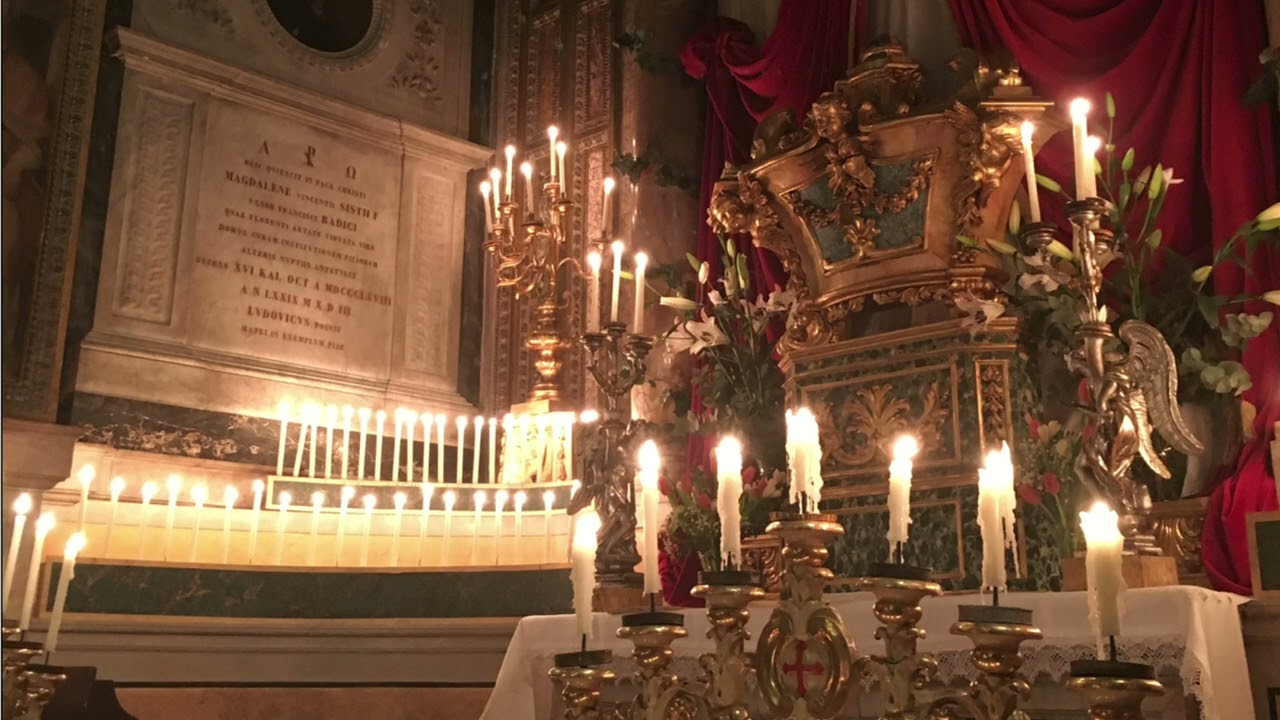
Good Friday Tenebrae: Rome, Trinità dei Pellegrini
Follow along: HERE

I am really happy to inform you that the wonderful nuns of Gower Abbey, the Benedictines of Mary, Queen of Apostles, have a new disc and digital download:
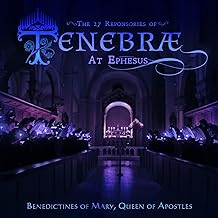
These are the RESPONSORIES of Tenebrae for all three days of the Triduum. They are, arguably, the most beautiful chants of the entire liturgical year.
You can order from the sisters directly also: HERE
I had the digital cuts a few days ago thanks to Mother Cecilia and I have included little tastes of them in my last few LENTCAzTs, e.g. for Spy Wednesday at the end. Ethereal.
When I did my canonical retreat for ordination, I went to the largest monastery of Benedictine nuns in Italy at Rosano. It was Holy Week and they sang Tenebrae. There were over 60 nuns and it was glorious. In these recordings, you can have a sense of what it is to be in a chapel live with these chants sung by women.
Imagine… this is what certain people want to suppress.

Photo by The Great Roman™

In May I will be with a prolife pilgrimage group in Italy. I would like to stay longer after it is concluded (since I’ll already be there). So, I have my tin cup out in the form of the wavy flag. Click! (Full disclosure: I may have to go again in October.)
SO FAR… thanks to: ME, DH, WH, KG, FC, TG, AH, HL, AB, DS, MB (MI), MB (CA), LD, IG, Fr. PV, GR, MP, PO’F, JL, AR (OH), AR (MA), DD, AN, PG, DD (NY), RW, PT, HB, MT, JL, JS, TS, JR, GG, RG,

PS: Thanks to the kind person who sent the ironing board. It finally arrived – without a packing slip – with four different shipping labels as it bounced around from place to place (TX… MI… NJ…). I have no way to write to you privately.
I won’t say that I will enjoy using the ironing board, but I will say that you’ve made a task I really dislike a good deal easier.
Did you know that there are proper table blessing, meal prayers for great feast days and for the Sacred Triduum?
I made a post and podcast about this some time ago.
However, seeing that it is Holy Thursday, I thought you might want to be ready for the evening meal and perhaps give these prayers a try.
In the aforementioned post, I wrote about these little booklets from a budding monastic community in S. France, the Monastère Saint-Benoît. They are doing great things there, including rebuilding an old Abbey.

Here are pages for the Triduum.


On another note… speaking of prayers and meals….
… our Jewish friends are getting ready for Passover, which begins Friday evening.
Just as we have a time before which the Easter Vigil must NOT begin, fixed by sunset, so too Jews have a time for the lighting of candles for their Shabbat meal. This time is special because at dawn of 14 Nissan – Friday, 15 April, it is Ta’anit Bechorot of the Hebrew Year 5782. This is the Fast of the First Born, and only firstborns must fast. You remember the fate of the firstborn at that first Passover who were not in houses marked with the blood. The portion of Torah to be read is from Exodus 32:11-14 and 34:1-10.
In the evening on Friday for Erev Pesach, where I am (the timing depends on your location on the planet because sunset differs) candle lighting is 19:28 and on Saturday evening 20:23 for Pesach. The Portion for Saturday is Exodus 12:21-51 and Numbers 28:16-25.
Pesach, Passover of Unleavened Bread, lasts an Octave, like our Easter Octave.
BTW… this is important to know if we want to figure out the timing of the Last Supper and the Crucifixion of the Lord. The Gospel accounts seem to give different timelines. However, they can be resolved if we understand how Passover and the Shabbat work together in different years. In John 19:13, Christ is brought before Pilate on the day of Preparation for Passover which sounds as if it is before the sacrifice of the lambs. However, it is the preparation for the sabbath, the Friday during that “octave” of Passover. So, Jesus and the Apostles eat the Passover, Last Super meal and the next day, a Friday, He is crucified. And the Jews wanted to get the bodies of the men down from the crosses before sunset because it was preparation for the shabbat within the observance week of Passover, hence it was the Preparation Day for the SHABBAT within the Passover “octave”, not Preparation Day for PASSOVER. So, both the Synoptic Gospels and John are right. You just have to understand the terms. If you don’t get that, then non-Catholic scholars like Joachim Jeremias accuses John of changing the timeline so that Christ was crucified at the time of the slaughter of the lambs. This same guy, by the way, was the Lutheran whom the modernist liturgists leaned on to distort the translation of Latin “pro multis” into “for all”.
But that’s another story.
And, for the sake of completeness, the Vigil of Easter is to be celebrated “noctu… at night”.
The rubrics for this rite, as found in the 2002MR says this is “nox“, night.
3. Tota celebratio Vigliae paschalis peragi debet noctu, ita ut vel non incipiatur ante initium noctis, vel finiatur ante diluculum diei dominicae.
The whole celebration of the Paschal Vigil ought to be completed at night, both so that it does not begin before the beginning of night, and that it finishes before dawn of Sunday.
The 1988 Circular of the CDW, called Paschale solemnitatis (Notitiae 24 [1988] pp. 81-107) dealt with the time of the beginning of the Vigil,
78. This rule is to be taken according to its strictest sense. Reprehensible [!] are those abuses and practices which have crept in many places in violation of this ruling, whereby the Easter Vigil is celebrated at the time of day that it is customary to celebrate anticipated Masses.
You can work this out if you understand when the end of Astronomical Twilight occurs in your location. Adjust for daylight savings and think through it.
 From a reader…
QUAERITUR:
Father, if the confessor forgot say “IN THE NAME” in absolution formula, is the sacrament VALID? But, the confessor makes the sign of the cross.
Again we have some jackass who doesn’t use the proper “form” of a sacrament and, by fooling around with it, causes confusion and anxiety among the faithful.
Now for an answer to the question.
A confessor says the first part of the form of absolution “I absolve you from your sins” and the OMITS “in the name of” and goes straight to “Father Son and Holy Spirit” while making the sign of the Cross.
I think this stupidly sloppy but it is valid.
I find in Fundamentals of Catholic Dogma by Ludwig Ott.

Click to enjoy.
“In the Latin Church the words are: Ego te absolvo a peccatis tuis in nomine Patris et Filii et Spiritus Sancti. Amen. The words” in nomine Patris et Filii et Spiritus Sancti” are demanded neither by the ordinance of Christ nor by the nature of the judicial sentence for the validity of the form. The prayers preceding and following the Absolution are not essential to the form, and may be omitted for a grave reason.”
There it is.
A grave reason could be an pressing emergency. A man is trapped under rubble in a burning building and the firefighters are dragging the priest away as they strive to save everyone’s lives.
There is no possible grave reason when you are in a parish confessional during regularly scheduled confessions.
No, wait. Another scenario, in a parish confession during regular hours: The priest tries to finish the form of absolution while having a heart attack and, in his pain, omits that part of the form.
FATHERS! SAY THE BLACK! Just say the words as they have been given. Do NOT fool around with people according to your insignificant whims.

Photo by The Great Roman™

In May I will be with a prolife pilgrimage group in Italy. I would like to stay longer after it is concluded (since I’ll already be there). So, I have my tin cup out in the form of the wavy flag. Click! (Full disclosure: I may have to go again in October.)
SO FAR… thanks to: ME, DH, WH, KG, FC, TG, AH, HL, AB, DS, MB (MI), MB (CA), LD, IG, Fr. PV, GR, MP, PO’F, JL, AR (OH), AR (MA), DD, AN, PG, DD (NY), RW, PT

From a reader…
I was the gentleman that called you in February and thanked you for harping on getting the Apostolic Pardon for the dying. I did that for my father, Daniel, and left a message after he passed. You even did a post on it! Thank you!
Well, I am a ham, KE8IBH too. I wrote a study guide for the 2022-2026 Technician Exam. I was hoping you could post it on your website, instead of my competitor. LOL!
Technician Class Test 2022-2026
God bless you for your kindness to my dad and me!
73!
Thanks for that. It does my heart good when I get notes from people to say that, because of something they read here, they knew to do A, B or C… such as get a priest and make sure the Apostolic Pardon was imparted.
 From a priest…
QUAERITUR:
I thought this might be a question you would be interested in answering. The Prayers for the Dying in the modern ritual are brief, and rather weak. The alternative of course is the prayers from the 1962 Rituale. I know you are stickler on using the Latin for all blessings in the Rituale. I have followed your advice. However, I do not see how what you say relates to prayers for those who are dying, since these are intercessory prayers as I understand them. And, I find reciting all the beautiful Latin prayers to be pastorally impossible in some situations. When people are weeping over their departed mother, it is hard to insist that they listen to a language for five minutes that they unfortunately cannot even identify.
These prayers were not authorized in English in 1962. However, there are three (slightly different!) English translations provided by Weller, by the 1964 Priest Ritual, and by the English provided in the footnotes of the recently printed Parish Ritual. I have also been tempted to use the Ordinariate version (Divine Worship: Pastoral Care of the Sick and Dying); the instruction for that book say that they are only for Ordinariate members, but they also say that even lay people can say the prayers for the dying.
Do you have any advice?
Father, if we can with your question and this post change the trajectory of a single soul and bring about a serious conversion through consideration of this solemn topic, then we have done our job today.
There are layers to this.
Firstly, as in can. 1752 of the Code of Canon Law, “The supreme law of the Church is the salvation of souls.” The greatest thing that a priest can accomplish by his ministry to souls is to help them make a good death and go to Heaven, hopefully and by the grace of God, straight away. Aiding the soul of the dying with the last sacraments and the Apostolic Pardon is a moving experience.
Let’s make a few distinctions.
To begin, you wrote: ” I know you are stickler on using the Latin for all blessings in the Rituale.” Nooooo. It’s in the Rituale. Explicitly. I’m not the stickler. Blame the one who promulgated the Rituale.
Next, does this apply to the “Commendation of the Dying/Soul”? That’s what I think you are talking about. I see that in the Collectio and the recently reproduced 1962 Benzinger Parish Manual the Commendation and subsequent prayers are in Latin. The introduction of the later confirms that the format of the printing indicates when English can be used. In the PM it is confirmed that Latin is to be used, not English, for the Commendation.
My heart urges me to write: “This is a special moment, so just go ahead and use the English. After all… can. 1752!”
My head tells me, and my experience as a priest tells me, that this maybe isn’t a very good idea.
Why?
Neither my heart nor my head can come up with something that the Church (in sane times, at least) doesn’t know and hasn’t worked out. The Church understands full well that the moment of death of a person is “special”, which is such a weak word that it almost demeans the gravity of the moment.
Where am I going with this?
We have to beware of sentimentality. That doesn’t mean that ice must run in the veins of all priests, just because that’s what runs in mine. What we are dealing with here is the commendation of a soul to God at the time when that soul is separating from the body and going to Particular Judgment. I’m reminded of the fearsome description that St John Henry Newman was able to attain in his Dream of Geronitius. And let’s not kid ourselves about the role of the Holy Angels in their protection of the souls of the dying as the Enemy strives for a last destructive temptation to despair or uncharity or impenitence. The medieval manuscript depictions of demons trying to drag souls away from God as they separate from the body are genuine if naïve expressions of a real struggle that we cannot perceive with our senses.
I write this out of the conviction that our ministry to the dying must focus on the dying, not the feelings of the living. That might sound a little callous, though it isn’t meant to be. That doesn’t mean treating others present with disregard but, really: this moment isn’t much about them. It’s about the person who is about to go before God for judgment.
Our part in this awesome “vita mutatur” event – if we have the honor to be there – is crucial. We have to play the role that only we can play with the grace of Orders and the priestly character, the authority of Christ as alter Christus, who told the thief that he would be with Him in paradise.
Beware sentimentality that can creep in with thoughts like, “reciting all the beautiful Latin prayers to be pastorally impossible…”. Sure they are beautiful. But they are beautiful because they say something. An advantage to having Latin in your bones for years is that a flip takes place: comfort with the prayers makes the content of the prayers to have logical priority without losing the aesthetic of the prayer. It is a matter of decus, what is decorous. Just as a beginner or learner or even veteran participant at the TLM can be still be giving logical priority to how cool it is to move the book from one side to the other, but knowing there is a reason for it, at a certain point there is a shift in the logical priority. It is hard to describe, briefly. But being focused on the shift of the book, the signs of the cross and additional genuflections, the sound of the Latin and its poetry is like being stuck in the abc’s without reading, being mesmerized by the apparent rise of a fast ball without learning to hit it, fiddling with the strings of a piano without learning to play.
And… pastoral? Okay. Whatever that is. It seems to me that there is a dying person in front of me and I want that soul for God. I’m not just some guy off the street with a pleasant manner and kind regard for the whole room. THAT person, there, is about to be judged by God. Let me do what I alone in this place can do even while my heart is breaking for the pain of the people around me.
Again, it is not that we don’t care about those others. Concern for the dying doesn’t mean ignore everyone else. But… priorities. And I don’t think “pastoral” means what a lot of people have come to think it means. For example, true “charity” isn’t coterminous with “being nice”. True charity looks to the true good of another. That discernment of the true good is an antidote to sentimentality. Rather, it tears through sentiment to a deeper respect for others.
Back to the Latin.
I think that at the root of the Church’s insistence on Latin in this moment – and why Latin has been attacked constantly by modernists – is because there is a spiritual realm that we cannot see. Modernists don’t want that world. They want to drag everything supernatural down to the natural. Hence, they fear Latin because it reminds them that they, too, one day are going to die and encounter that supernatural realm. They know that Latin reminds people of the transcendent, while they want people mired in the immanent.
The soul, separating from the body, is entering into a state rather like that of an angel, without the physical senses and without the appetites that drive and permit humans to change their minds. Just as angels cannot change their minds about anything, so too the newly separated soul is at last in a state where it cannot repent of sins, etc. They are “baked”, just as a clay form goes from malleable to unchangeable through the effect of the kiln.
In the prayers of Commendation during the “final suffering”, we speak to the soul of the dying person not to the person. A distinction without a difference? Remember: this soul is separating from the body now but isn’t separated yet. There is a spiritual battle engaged. And so the priest says,
Proficiscere, anima Christiana, de hoc mundo,… Go forth, O Christian soul, from this world…
This is a command form of the deponent proficiscor.
And here is the foundation of my thinking.
Not a few times it has happened when I have been with a dying person that, at the very words “Proficiscere, anima Christiana, de hoc mundo…” he or she died. It was as if, at the command of the alter Christus, all was complete and that last bond was loosed. The soul, mysteriously, received the command and slipped the bonds of Adam’s dust.
Of course, some take longer to die. The prayer goes on to bring the entire court of Heaven to that that soul by naming them… “in the name of… in the name of…. in the name of….” the Persons of the Trinity, Mary, Joseph, all the different types of saints and angels. “GO FORTH… in the name of… ” all these.
Then the prayer switches gears and no long addresses the soul. The priest addresses God directly on behalf of the dying person, again bringing all of heaven to bear.
After this, it is “Libera ANIMAM…” in a litany. Etc.
What the understanding of the moribund and the onlookers may not grasp, the detaching soul seems to grasp.
It could be that an interjected comment about the flow of the prayer could help…. BUT… this is not a DIDACTIC moment, it is a SACRAL moment, as holy a moment and decisive as there can be in one’s life.
Save the liturgy, save the world is, by the way, an extension of this topic.
Mind you… I am trying to untangle the inner logic, the foundation of why the Church would so insist on Latin in such a moment. Of COURSE the Church knew that people didn’t know Latin. But they knew that something really important was being done and said in Latin. The soul perhaps preternaturally grasps the meaning. The angels and demons at war over the person sure get it.
And the Devil really hates Latin. Even bad Latin. As a matter of fact, even dreadful Latin makes them suffer enormously.
About the use of the Ordinariate Prayers, I really get that. However, let us be who we are: Latin Rite priests of the Roman Catholic Church with our own heritage. Sometimes I see priests decorating or building new LATIN RITE churches with all sorts of Eastern elements. That bothers me. We have our own patrimony which is NOT second to theirs. It’s just that since Vatican II it has been systematically so dumbed down, ornamentation of buildings music and prayer texts… the rites themselves… that it is understandable that some people turn to the East for elements that hark to the transcendent. They’ve been obscured or eradicated in the Latin Church to the point that the very identity of Catholic is shaky. So, I get the desire to use the beautiful Ordinariate texts. And I am pretty sure you won’t be put into Ordinariate prison by the “jailers of (their) tradition”.
BUT… pace Leo, “Agnosce, O sacerdos Romane, dignitatem tuam!”
I’ll stop here having given these poor points for your consideration.
This was a great question because it also prompts those reading to think about serious things.
So, Father, if we can with your question and this post change the trajectory of a single soul and bring about a serious conversion through consideration of this solemn topic, then we have done our job today. If by this we can help a single person to a good death, we’ve done something today.


In May I will be with a prolife pilgrimage group in Italy. I would like to stay longer after it is concluded (since I’ll already be there). So, I have my tin cup out in the form of the wavy flag. Click! (Full disclosure: I may have to go again in October.)

Thanks: ME, DH, WH, KG, FC, TG, AH, HL, AB, DS, MB (MI), MB (CA), LD, IG, Fr. PV, GR, MP, PO’F, JL, AR (OH), AR (MA), DD,
From a reader…
QUAERITUR:
Do personality disorders prevent a marriage from being valid?
For example, if a couple married in the Church, and one and/or both of them are later diagnosed with a personality disorder (such as Obsessive Compulsive Personality Disorder, or Narcissistic Personality Disorder), would their marriage be considered valid?
I ask because my spouse was recently diagnosed with OCPD, and I am concerned about validity.
“Later diagnosed…”.
A first principle: Marriages enjoy the presumption of validity. That is, they are presumed to be valid unless sufficient proof to the contrary is offered.
To prove invalidity, the person raising the doubt or making the allegation about the possible invalidity of his or her own marriage bears the burden of proof. He or she must supply either 1) evidence either of incapacity to contract marriage on the part of one or both of the parties, or 2) proof that one or both of the parties simulated matrimonial consent, either totally or partially.
There are a few other grounds for nullity, but the main grounds are incapacity or simulation.
A diagnosis of a mental illness at some point after the wedding does not automatically render a marriage null on the spot.
Remember: it is the condition of the people at the time of the marriage that matters. Something that is diagnosed after doesn’t necessarily mean that one or both of them were in that condition at the time of the marriage.
Moreover, the process to investigate a matrimonial bond (as to its possible invalidity or nullity) can take place only when the Tribunal has arrived at certainty that there is no longer 1) hope of reconciliation between the parties, 2) nor is there hope of 2) reestablishing common life as spouses.
Typically, at least in these United States, the proof that there is no longer any hope of reconciliation between the parties is when one of the parties produces a divorce decree from a civil/secular court.
No longer any hope.
Note that there is a difference between “there is no hope” and “it would be really difficult”.
This quote from Pope Benedict XVI’s 2009 Allocution to the Roman Rota is helpful (my emphases and comments:
In our meeting today, I wish to draw the attention of those engaged in the practice of law to the need to handle cases with the depth and seriousness required by the ministry of truth and charity proper to the Roman Rota. Indeed, responding to the need for procedural precision, the aforementioned Addresses provide, on the basis of the principles of Christian anthropology, fundamental criteria not only for the weighing of expert psychiatric and psychological reports, but also for the judicial settlement of causes. In this regard it is helpful to recall several clear-cut distinctions. First of all, the distinction between “the psychic [psychological] maturity which is seen as the goal of human development” and, on the other hand, “the canonical maturity which is the basic minimum required for establishing the validity of marriage” (Address to the Roman Rota, 5 February 1987, n. 6). Second, the distinction between incapacity and difficulty, inasmuch as “incapacity alone, and not difficulty in giving consent and in realizing a true community of life and love, invalidates a marriage” (ibid., n. 7). Third, the distinction between the canonical approach to normality, which, based on an integral vision of the human person, “also includes moderate forms of psychological difficulty”, and the clinical approach, which excludes from the concept of normality every limitation of maturity and “every form of psychic illness” (Address to the Roman Rota, 25 January 1988, n. 5). And finally, the distinction between the “minimum capacity sufficient for valid consent” and the ideal capacity “of full maturity in relation to happy married life” (ibid.).

Coat of Arms by D Burkart









A Daily Prayer for Priests


They find you a pro-life agent in your area who commits to giving a portion of the fee to a pro-life group!

PLEASE subscribe via PayPal if it is useful. Zelle and Wise are better, but PayPal is convenient.
A monthly subscription donation means I have steady income I can plan on. I put you my list of benefactors for whom I pray and for whom I often say Holy Mass.
In view of the rapidly changing challenges I now face, I would like to add more $10/month subscribers. Will you please help?
For a one time donation...



Help Monks in Wyoming (coffee – UPDATED LINK) and Norcia (beer) and the wonderful "Soap Sisters" of Summit, NJ!


Please follow me on Twitter!










Visits tracked by Statcounter
since Sat., 25 Nov. 2006:

