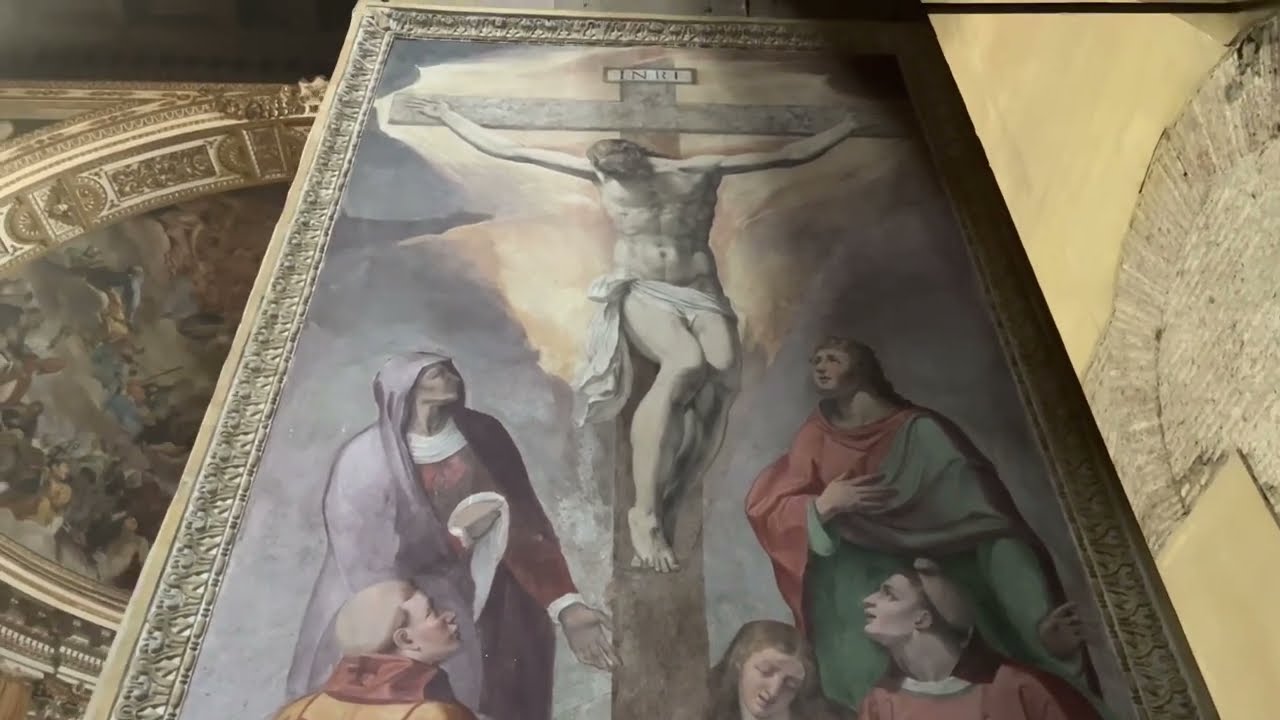
SAVE THE LITURGY – SAVE THE WORLD: We need a strong revival of the Forty Hours Devotion and we need it NOW.

For years I’ve contended that we need a strong revival of the Forty Hours Devotion.

Forty Hours Devotion developed in time of necessity.  It is not a kind of long Corpus Christi.  It is not a long Holy Thursday.

It grew up to beg God for relief and protection from plague and invasion and other calamities.   It is a mighty public supplication to the Eucharistic Lord in time of trial.

Plague… invasion and calamities.  Sound familiar?

I was sent this video of Forty Hours at the mighty Brompton Oratory.   I sure miss that place and visits to London.

Once, dioceses had Forty Hours going on somewhere every week.   The year’s schedule for the churches where Forty Hours would be was even published in secular papers.   The clergy would invite each other to participate and priests would come to pray and then to spend time together afterwards… serious and good clericalism!  The final Mass was, under the Clementine Instruction about Forty Hours, is celebrated coram Sanctissimo!

click

Posted in Hard-Identity Catholicism, Liturgy Science Theatre 3000, Save The Liturgy - Save The World | Tagged ,
3 Comments

How is what Paul VI did to the Mass entirely unlike what Pius V did?

From the great Fr. John Hunwicke at his elevating blog Mutual Enrichment [emphases and comments mine]:

Popes, Liturgy, and Authority (3): S PIUS V compared with S PAUL VI and PF

We are sometimes told that the imposition of a new rite by S Paul VI is precisely what S Pius V did in 1570.

It is not.

What S Paul VI did is precisely the opposite of what S Pius V did..

People who tell you anything different either have not read Quo primum … or cannot understand Latin … or have a regrettably fugitive grasp upon Truth.  [Or they just plain lie.]

S Pius V dealt with the question of churches with a Use of more than 200 years (i.e., going back to before the invention of printing made life so easy for liturgical tinkerers and innovators) in the following way.

He said “nequaquam auferimus” — in no way whatsoever do we take it (their old rite) off them.

It is true that he added a “permittimus” — we permit that, if they like my edition of the Missal better, they can adopt it “de episcopi vel praelati capitulique universi consensu” — provided that the bishop and the unanimous Chapter are in agreement.

If S Paul VI … or PF … had really wished to behave like S Pius V, they would have needed to decree something like this:

“We do not take away the right to use a Missal with more than 200 (or 600? Or 1200?) years of lawful use; but if a Bishop and his entire Chapter really do want to use my Novus Ordo instead, I will permit them to do so.”

As I recall, Fr. H posted this line of entirely accurate thought before, with a witty scenario involving a curmudgeonly canon.

Meanwhile, facts are stubborn.

Posted in Liturgy Science Theatre 3000, Mail from priests, Save The Liturgy - Save The World, The Drill | Tagged , ,
5 Comments

ASK FATHER: Marital relations in marriages of non-Catholics or Catholics to non-Catholics

From a reader….

QUAERITUR:

In what status does the Church consider the marriages of non-Catholics/Catholics to non-Catholics and marital relations within such marriages? I ask due to a couple I know of where neither spouse is baptized and the husband is showing interest in the Church. There has been some uncertainty among acquaintances because one couple (both cradle Catholics who fell away and only recently returned to the Church, both with previous – annulled – marriages) were apparently instructed to maintain a Josephine marriage for a period of time, though they have not clarified the specifics of the timing. They are under the impression that Catholics married to non-Catholics (or at least non-Christians) are not permitted to engage in marital relations. I’ve tried to help, but this is an area of Church law with which I am totally unfamiliar, and there’s so much confusion regarding marriage matters in the Church I’m not sure I’d trust most internet research anyway.

GUEST PRIEST RESPONSE: Fr. Tim Ferguson

Marriage is marriage is marriage. Sacramental marriage is sacramental marriage. Not all marriages are sacramental. Only valid marriages between two baptized Christians is sacramental – only the baptized can receive a sacrament. So, if a baptized person is validly married to an unbaptized person, it’s not a sacrament, but it is a marriage.

A marriage between a Catholic and a non-Catholic is not ideal, but can be permitted by the Church. For a Catholic to marry a baptized non-Catholic, the local bishop needs to give his permission, which he will generally grant freely, as long as the non-Catholic party is aware that the Catholic party has the obligation of remaining faithful to the obligations he (or she) accepted at baptism, and that includes the obligation of sharing the faith – especially of sharing the faith with any children that may be born to the marriage. For a Catholic to marry an unbaptized person, the bishop needs to give, not just permission, but a dispensation of the law.

Now, in the situation given to us, the marriage took place between two unbaptized persons. Check – presumably valid marriage. One of the parties is thinking about becoming Catholic. Hooray! When he is baptized, he brings his marriage with him. It’s still not sacramental, because you can’t have half a sacrament, but it’s a real marriage. There is no requirement that he abstain from intimacy with his legitimate spouse, no requirement that the marriage be a Josephite one (not a Josephine marriage, but a Josephite marriage). As I understand it, a Josephine marriage is when a French general civilly marries the widow of another French general and the husband later becomes First Consul and agrees to marry in the presence of the Pope as a condition for the couple being crowned as Emperor and Empress of France. It’s pretty rare.

In any case, curiosity about the goings-on of other people’s marriage is best kept to a minimum, if at all. Let them work out those details with their pastor, wish them all sorts of happiness, and then turn the conversation to sports, the weather, politics, or early 19th century French history.

Posted in "How To..." - Practical Notes, ASK FATHER Question Box, HONORED GUESTS, One Man & One Woman | Tagged ,
2 Comments

ASK FATHER: If Francis isn’t the real Pope, then do the priests of the SSPX still lack faculties to absolve sins?

From a reader…

QUAERITUR:

If the SSPX, until 2015, lacked faculties for confession, then, in the event that Benedict is still the pope and not Francis, does that mean the SSPX actually still lack faculties and sins are not being absolved? Or would the Church supply in that case?
I’ve been going to SSPX Masses for about 2 months now, confession too, and this only occurred after reading your 2013 post about SSPX confessions not being valid at that time.

Background. During the Year of Mercy, in a round about way Francis gave faculties to the priests of the SSPX to hear confessions and validly absolve, thus giving them broader faculties than regularized priests!    Irony, much?   Francis extended that at the end of the Year of Mercy.

Of course the priests of the Society of St. Pius X would be unconcerned about whether or not a Pope gave them faculties.  They will say that they have faculties anyway.

For the sake of the question, however, we can look at this as a mind exercise.

If Benedict is still THE POPE, that changes a lot of things.

So, imagine.  Benedict is still pope, but he let’s another pretend that he is pope. One could argue that, especially with something as important to the salvation of souls as Confession, if Realpope Benedict permitted Fakepope… let’s call him Edgar, Fakepope Edgar to permit Catholics to receive valid absolution from priests of the SSPX, then such permission would implicitly have the approval of Realpope Benedict.  Decrees should be in writing, but one can imagine a scenario where Realpope Benedict doesn’t want anyone to know he’s really The Pope.  To avoid a paper trail, Realpope Benedict just verbal consent to the decree of Fakepope Edgar.   This should be a movie!

Another scenario.  Realpope Benedict remains The Pope. He is being held against his will and excluded from acting as The Pope. In this scenario, Fakepope – let’s call this one Derek, Fakepope Derek is an evil mastermind, pretending to be pope while he holds the Realpope Benedict captive.  In this case, every act of Fakepope Derek would be invalid. One can then wonder…. would the faithful, deceived by Fakepope Derek, be sent to the bowels of hell with unabsolved sins on their souls because the priests of the SSPX lacked faculties?  Here, the Church gives us can. 144: common error.  Common error is the sort of error that would arise if the entire Church were to have been deceived and the man acknowledged by the Cardinals and even, apparently, The Real Pope as being the pope – attempted to provide the governance required for valid absolution.

Now, as long as we’re at it, if the NASA really didn’t land men on the moon in 1969, then the validity of the Diocese of Orlando’s claim to jurisdiction over the moon would be questionable.   BUT!  Should a priest from Orlando officiate at a wedding on the moon, common error would provide the jurisdiction for that act as well.


Posted in "How To..." - Practical Notes, ASK FATHER Question Box, SSPX | Tagged
11 Comments

ASK FATHER: Must I avoid TV, news, movies if you know that the Lord’s Name will be taken in vain?

From readers…

Lector 1 quaeritur:

Must I refrain from listening to a useful source of news and information because the presenter takes the Lord’s Name in vain or curses?

Lector 2 quaeritur:

Is it a sin to watch a movie that you know takes the Lord’s name in vain?

Not only that, I had to ask myself question a couple days ago. There is an online chess commentator, quite good though I suspect he may have some issues, who occasionally uses the Lord’s Name as an exclamation of surprise.   I’ve usually stopped watching at that point and find something else.  As an aside: he has at times stated that he is aware that this is hurtful to some people.  It goes to show how people can develop bad language habits.   The only effective way to get rid of a bad language habit is to make a list of new words and then, consciously and contentiously begin to use them instead until new habits are formed.  But I digress.

I was exchanging notes about this with a priest friend the other day whose formation and opinions are gold.

This is what we came up with.

Asking if something is sinful is certainly a valid question but a poor starting point. The real question is: “Does this give God glory?”

If that were to guide our decisions things would be much clearer.

In any event, when this sort of thing comes up, as it does in life, it is possible to respond “Praise His Holy Name”, or the like.   Also, we can make an act of reparation for the sin later on.  If we know the person well, explain that it is offensive.  Also, after my daily Masses that are streamed I will sometimes sing or recite a litany, including the Litany of the Holy Name in reparation for these offenses.

In the case of movies, etc… tough call.   It is objectively wrong to use the Name of the Lord improperly.  That said, in the depiction of life in a movie… it’s hard to say.  There are gray areas here, I think, and I don’t want to spin them out too much.

One can make arguments about depictions of real life: is it really necessary to include something like that to make it realistic?  Really?  While it is true that some people have appalling language habits, do they have to be recorded for movies, etc?

Moreover, what about so-called minced oaths?   Must I avoid reading Agatha Christie’s Poirot stories because he says, “Sacrebleu!”, which is a mince oath for “sacré dieu… holy God”?  Must I avoid Shakespeare because his double-entendres that are … ribald?  Must I avoid visiting the Metropolitan Museum of Art because someone else might consider some of the holdings there to be offensive?  If a bad movie is run on a network, and I choose not to watch it, must I therefore also never watching anything else on that network?  If you can see bad things on TV screens, must all TVs go?  (Some would say that isn’t a bad idea.)  How about computers or phones?  Where does this stop?

There are instances that cross a line from gray to “nay!”

The late Supreme Court Justice Potter Stewart, in an opinion about what constituted “hard-core pornography” or “obscene”, once stated the now famous phrase, “I know it when I see it.”   There are movies that have scripts which seem to go out of the way to offend or numb or mock through the Name of the Lord.  I saw a little of a film the other day and it seemed to me so obvious that that was the intent that I found something else.   One can always make the choice to view nothing other than what has been vetted.  You don’t lose out on all that much in the long run that way.  And certainly there are classic films that are still great and are clean.  Tutior pars?

So, circling back to the response, above.

Asking if something is sinful is certainly a valid question but a poor starting point. The real question is: “Does this give God glory?”

After this, I will redirect you to your regular confessor, who will have an insight into who you are and what you can deal with.  Ask him.

Posted in "How To..." - Practical Notes, ASK FATHER Question Box | Tagged , ,
11 Comments

ASK FATHER: Validity of absolution of accomplices in sexual sins and the censures – revisited in light of Amoris laetitia fn. 351

Today I had a somewhat protracted session of texting concerning censures for certain sins against the 6th Commandment of the Decalogue. For example, what happens to a priest who in the context of the Sacrament of Penance (and by extension internal forum counsel) would “sollicit” from the penitent sins against the 6th (sexual sins). Also, what would happen were a priest to absolve an “accomplice” of a sin against the 6th.

As it turns out, I wrote something about this some years ago.

What is really disturbing about this are the implications for those priests who, because of their liberal, modernist interpretation of infamous footnote 351 in Amoris laetitia, have in fact themselves incurred censures because they advised penitents that they could have sexual relations in an objectively adulterous relationship.   As below…

If a priest suggests to someone in the confessional that she can have sexual relations with a person who is not truly her husband, the the priest become an accomplice in a sin against the Sixth Commandment!  The priest is an accomplice by facilitating, approving of, the sin that the woman would soon commit upon his advice in the confessional.  The priest, an accomplice in this case, a kind of “middleman”, would incur the suspension.  The priest didn’t do the deed, as it were, but his advice was a key element.

So, if – in the context of the 15 minutes on the 4th Saturday of the month scheduled confession time – Fr. “Just call me Bruce” Hugalot at St. Idealia (part of the “Engendering Togetherness Community of Welcome” cluster of the Diocese of Libville) tells Cindy Lou, now shacked up with Thing 2 after leaving her legitimate husband Thing 1, that she can have sex with Thing 2, he could incur the censure foreseen in can. 1378 because it involves absolution of an “accomplice” in a sin contra sextum (can. 977).

It doesn’t pay to be a modernist.  As a matter of fact, it’s spiritually dangerous.

Here is my old post.  In the comments under that post, by the way, I got approbation from canonist Ed Peters, who also posted a link to something pertinent that he wrote.


confessional print adjustedFrom a reader…

QUAERITUR:

I have two questions about c. 977, which bars a priest from absolving an accomplice in sins against the sixth commandment of the Decalogue except in danger of death (on pain of excommunication, per c. 1378).

First, is the term “accomplice” to be understood as referring strictly to those who have taken part in impure acts with the priest, or does it extend to those who have been accomplices in other ways, such as a wingman or pimp, or a brother priest who has learned of what he’s done and responded with a high five?

Second, the canon mentions absolving the accomplice, not strictly absolving the sins[For example, absolving a censure and not a sin?] Is a priest barred, except in danger of death, from absolving someone with whom he has ever sinned against chastity?

This is a disgusting topic.  However, in light of some of the antics of certain infamous priests reported recently in the media, we need some straight talk.

Canon 977 says:

The absolution of a partner in a sin against the sixth commandment of the Decalogue [Absolutio complicis in peccato contra sextum Decalogi] is invalid, except in danger of death.

That’s pretty straight forward on one level.

In just one scenario, say a priest tells a person, “It’s okay. I’ll give you absolution afterward”, that absolution would be invalid.  In another scenario, say a priest has some sexual contact with a person and then, later, sees that person on the pavement bleeding out after having been struck down by a flying shark from one of those shark-filled tornadoes. He could give absolution validly because there is danger of death.  In another scenario, the priest’s accomplice winds up days later in the priest’s confessional and confesses the sin, the priest does not validly absolve.

Let’s also make a distinction.  There are ways in which we can participate in the sin of another person.  You suggest some in your question.  The ways in which we can also share in the guilt of another person’s sin are:

  1. By counsel (to give advice, one’s opinion or instructions.)
  2. By command (to demand, to order, such as in the military.)
  3. By consent (to give permission, to approve, to agree to.)
  4. By provocation (to dare.)
  5. By praise or flattery (to cheer, to applaud, to commend.)
  6. By concealment (to hide the action, to cover-up.)
  7. By partaking (to take part, to participate.)
  8. By silence (by playing dumb, by remaining quiet.)
  9. By defense of the ill done (to justify, to argue in favour.)

So, say a priest – this is so disgusting – gets set up by another person, a “middleman” with someone for sins against the Sixth Commandment.  Can the priest absolve the “middleman” validly?  I would say that the absolution would be invalid.  Even though the priest would have sinned with a different person, the middleman was also an accomplice.  The middleman was certainly a participant in the sin of the priest and other person by providing #1 in the list above.

One of the reasons why I conclude in this way is because of a situation that arose in the wake of dissent from Humanae vitae back in the 60s and which is surely revving up against in light of the confusion caused by Amoris laetitia.

Let’s consider can. 1378:

Can. 1378 §1. A priest who acts against the prescript of can. 977 [above] incurs a latae sententiae excommunication reserved to the Apostolic See.

§2. The following incur a latae sententiae penalty of interdict or, if a cleric, a latae sententiae penalty of suspension:

[…]

2/ apart from the case mentioned in §1, a person who, though unable to give sacramental absolution validly, attempts to impart it or who hears sacramental confession.

[…]

So, unless there is danger of death (when a priest can validly absolve), if a priest tries to absolve an accomplice, the absolution is not only invalid, he automatically incurs an excommunication (the lifting of which is reserved to someone with faculties from the Holy See), and he is automatically suspended from the exercise of Holy Orders.

Let’s move to the next step.

In the wake of Amoris laetitia, which is objectively ambiguous, some priests hold – probably as they did before Amoris – that the civilly divorced and civilly remarried, or indeed those who are living together in some arrangement or other outside of true marriage, can have sexual relations and also receive Communion.

If a priest suggests to someone in the confessional that she can have sexual relations with a person who is not truly her husband, the the priest become an accomplice in a sin against the Sixth Commandment!  The priest is an accomplice by facilitating, approving of, the sin that the woman would soon commit upon his advice in the confessional.  The priest, an accomplice in this case, a kind of “middleman”, would incur the suspension.  The priest didn’t do the deed, as it were, but his advice was a key element.

Working our way back, I think that were a priest to try to absolve a “middleman” who arranged for the same priest someone with whom he might sin against the Sixth, the priest could not validly absolve that “middleman”, who is a key accomplice in the sin.

How about someone, a “cheerleader” if you will, who were to give such a priest the “high five” afterward?  I am a little less certain about that.

Being a “middleman” is concrete and before the fact, without whom the sin would not have happened.  A “high five” from the “cheerleader” would certainly be sinful, because he participates in the sin of another through praising the sin and sinner (#5, above).  That “high five” is after the fact.  The sin took place with or without the “high five”.  However, were that cheerleader to prompt and lead the priest to do it again, that’s another matter.

This is an unpleasant topic.  However, it is also an opportunity to make some distinctions about how we can participate in the sin of another.  It is also a good warning to priests out there who think that, because of Amoris laetitia they can tell people that they can have sexual relations with those to whom they are not truly married.

Fathers… you are in BIG TROUBLE.

Lastly, if I understand your final question, can a such a priest validly absolve an accomplice from a censure without himself incurring a censure?  I don’t know.

I think the canon intends absolution of sins not absolution of censures.

In general, lifting or absolution of censures can be together with the absolution of sins.  However, there are specific formulas of absolution of censures before giving absolution for sins.  For example, this morning, after celebration of the TLM, I heard confessions and gave absolution in the older, traditional form.  First, the priest absolves any censures to the extent that the absolution is needed and his (my) faculties allow.  Only after the lifting of censures does the priest (me) then absolve the sins.  It’s a two-step process.

Furthermore, the post-Conciliar book published by the Holy See for the Order of the Sacrament of Penance includes specific forms for absolution of censures.  So, in the normal and orderly way of doing things, a priest should absolve the censure before absolving sins.  In my own work as a confessor, I have on several occasions had recourse to the Holy See to obtain the faculty to absolve some censure or other.  In those cases, I was given the faculty and I absolved the censure, independent from absolution of sins.  

That said, I think that the canons we have dealt with concern absolution of sins.

The moderation queue is ON.  Canonists and priests, especially, are welcome.  Otherwise, I may be restrictive.
Posted in Canon Law, Classic Posts, Hard-Identity Catholicism, One Man & One Woman, Priests and Priesthood | Tagged ,
2 Comments

Daily Rome Shot 455, etc.

Daily Mass Sermons

Today

“O tu che m’hai rubbato la capoccia,
vedi d’ariportalla immantinente
sinnò, voi véde?, come fusse gnente
me mànneno ar governo. E ciò me scoccia!”

Use your phone’s camera!

Reminder: Your use of my Amazon affiliate link is a major part of my income. Please remember me when shopping online. Thanks in advance.

US HERE – UK HERE

YouTube thumbnailYouTube icon

Posted in Sermons | Tagged ,
1 Comment

ASK FATHER: Subtle different between “Laetare” and “Gaudete”?

From a reader…

QUAERITUR:

Can you explain the difference between gaudete and laetare? Gaudete seems to be 2nd person plural, imperative, while laetare appears to be an infinitive, both seem to mean rejoice in those respective forms. But the roots are different, so is there a subtle difference in meaning? Thanks and happy Laetare Sunday!

Firstly, Laetare and Gaudete Sundays are slight liturgical breathers before plunging back into the last period of preparation before the great feasts of, respectively, Easter and the Nativity of the Lord.

Both Gaudete and Laetare are imperatives.  However, laetare only looks like an infinitive because the verb it comes from is laetor, which is deponent (passive in form but active in meaning).   There is laeto in Latin, but that is not what’s used here: it is deponent laetor and the form is imperative, just as gaudete is imperative.

The nickames for the Sundays are derived from the first word of the Introit antiphon. Gaudete (plural imperative of gaudeo) is from Philippians 4:4-6 and is Latin for Greek xairéte. Laetare (singular imperative of laetor which is deponent) is from Isaiah 66:10-11 and Latin for Hebrew samah.

There is no substantial difference in meaning between the forms of gaudeo and laetor here.  You can go to the context of Philippians and of Isaiah and see if the prophet and the Apostle are talking about different objects of joy.  Also, one could go into the weeds and make distinctions about the sense of inward joy and also its outward expression.

Isaiah 66 has the prophet explain how God rewards right worship.   He rewards with abundance and blessings.  Bad worship… not so much.  Philippians 4 says be joyful and peaceful for the Lord is near, so give yourself over to good things.

I will add that in Latin when we sing Lætáre, Ierúsalem, it sounds in Latin as if we are exhorting Jerusalem to rejoice. However, in Hebrew Isaiah says, “(Ya’ll) Rejoice WITH Jerusalem”.

10 “Rejoice with Jerusalem, and be glad for her,
all you who love her;
rejoice with her in joy,
all you who mourn over her;
11 that you may suck and be satisfied
with her consoling breasts;
that you may drink deeply with delight
from the abundance of her glory.”

12 For thus says the Lord:
“Behold, I will extend prosperity to her like a river,
and the wealth of the nations like an overflowing stream;
and you shall suck, you shall be carried upon her hip,
and dandled upon her knees.
13 As one whom his mother comforts,
so I will comfort you;
you shall be comforted in Jerusalem. (RSV)

This imagery is the foundation for why this Sunday has also been called “Mothering Sunday”, the original version of Mother’s Day before commercialization.

There are differences in tone between the Lenten and Adventen Sundays, as you might expect.  But don’t read much into the forms Laetare and Gaudete.  Go to the Biblical context and frame the whole context in the moment of Mass (Introit) and season.

Posted in "How To..." - Practical Notes, ASK FATHER Question Box, Liturgy Science Theatre 3000 | Tagged ,
3 Comments

Your Sunday Sermon Notes: 4th (Laetare) Sunday of Lent – and a POLL

Too many people today are without good, strong preaching, to the detriment of all. Share the good stuff.

Was there a GOOD point made in the sermon you heard at the Masses for the 1st Sunday of Lent?

Tell about attendance especially for the Traditional Latin Mass.  I hear that it is growing.  Of COURSE.

Any local changes or (hopefully good) news?

Those of you who regularly viewed my live-streamed daily Masses – with their fervorini – for over a year, you might drop me a line.

I have some written remarks about the TLM Mass for this Sunday – HERE

About the COLOR OF VESTMENTS you saw, let’s have a POLL.

Pick your best answer.  Anyone can vote, but only registered and approved members can comment.

On Laetare Sunday 2022 the color of the vestments (on the celebrant) for Mass was...

View Results

Posted in Liturgy Science Theatre 3000, Our Catholic Identity, POLLS |
12 Comments

Daily Rome Shot 454, etc.

Daily Mass Sermons

When shopping online please use my Amazon affiliate links. Thank you.

US HERE – UK HERE

Easter is coming. Think ahead.

Posted in SESSIUNCULA |
2 Comments