
Photo by The Great Roman™
Today’s Fervorino.


I just received beautifully conceived, designed, drawn and printed poster sized calendars from Sophia Press for the Seasons of Advent, Christmas, Epiphany with a special guide sheet as an introduction to their LiturgyOfTheHome.com initiative (go take a look – it’s very interesting).
I like the title “Liturgy of the Home”. If the family home is the “domestic church”, then the home needs… liturgy.
These are truly beautiful. They follow the TRADITIONAL calendar, and so they include the Ember Days of Advent.
This is not like an “Advent Calendar” with little windows that open. But that’s okay!

To give you perspective, a standard business envelope, paperback, and magazine.

They will deserve a prominent place.

A little detail.


The posters/sheets came in a tube. A tip for extraction: remove both caps, hold the tube straight up and down and give it a firm downward “jab”, as if you were punching something into the ground, but don’t touch the ground.
They will need a little time to flatten, but it will happen.
UPDATE 22 Nov:
From the Archdiocese of Milwaukee:
Statement On the Waukesha Parade Tragedy
A statement from Sandra Peterson, Communication Director, Archdiocese of Milwaukee about the Waukesha parade tragedy.“Our prayers are with the people who have been injured and killed during the tragic incident in Waukesha.
Among the injured are one of our Catholic priests, as well as multiple parishioners and Waukesha Catholic school children.
Please join us in prayer for all those involved, their families, and those who are traumatized from witnessing the horrible scene.”
Published:2021-11-21
Originally Published on: Nov 21, 2021
You are seeing the news about Waukesha (not far north west of Kenosha). It is a small town. I’ve been there.
I have a priest friend who lives in Waukesha.
He just told me that TWO PRIESTS have been a priest was injured in the attack with the vehicle on the parade, along with parishioners.
Pray for this priests and all the other victims of this attack.
Too many people today are without good, strong preaching, to the detriment of all. Share the good stuff.
Was there a GOOD point made in the sermon you heard at the Mass for your Sunday obligation (jabbed or not!), either live or on the internet? Let us know what it was.
What was attendance like?
Tell about attendance especially for the Traditional Latin Mass. I was getting reports that it is way up.
Any local changes or news?
For those of you who regularly viewed my live-streamed daily Masses – with their fervorini – for over a year, you might drop me a line. There are developments.
I have some written remarks about the TLM – HERE “This is Our Time, Come What May!”
And there’s this.

This is the Last Sunday of the liturgical year.
The last part of the liturgical year thematically dovetails with the first part of the new liturgical year. Advent was once longer, so the overlap of reflection on the End Times across this whole period goes way back into our long history as a pilgrim people, soldiering on toward our meeting with the Lord.
In the traditional Roman calendar, we use the texts from the 24th Sunday, which is always the Last Sunday of the liturgical year … even when it isn’t.
It is a little odd that the last Sunday of the year doesn’t have a special formulary. Again, this is probably because Advent was once longer than it is now, and this time of the year dovetails with Advent.
We also call today “Stir Up” Sunday, because of the first words of the Collect. This is the day when families in England would stir up the ingredients for the Christmas Pudding, so that it could season a while against the day of its own coming.
COLLECT (1962MR):
Excita, quaesumus, Domine, tuorum fidelium voluntates: ut, divini operis fructum propensius exsequentes; pietatis tuae remedia maiora percipiant.
This is an ancient prayer, occurring in the Liber sacramentorum Augustodunensis, a 9th century manuscript variation of the Gelasian Sacramentary. This prayer survived in the tender ministrations of Bugnini’s Consilium as the Collect for the 34th Week of Ordinary Time, in the Novus Ordo, used during the week after the Sunday celebration of the Solemnity of Christ the King. Thus, it stays in the same place in the liturgical year that it occupied before the changes.
Our rousing Lewis & Short Dictionary says excito means “to raise up, comfort; to arouse, awaken, excite, incite, stimulate, enliven”. Propensius is a comparative adverb of propendeo, which thus means “more willingly, readily, with inclination”. As we have seen many times before, pietas when attributed to God is less “piety, duty” than it is “mercy”. Exsequor is “to follow to the end, to pursue, follow; to execute, accomplish, fulfill”. Percipio is “to get, obtain, and receive”.
The two comparatives, propensius and maiora, set up a proportional relation between the grace-filled pursuit, on our part, and the extent of the effects of the remedy. The greater our earnestness, which is itself prompted by God’s work in us, the more will we receive His mercy.
LITERAL TRANSLATION:
Rouse up, we beseech You, O Lord, the wills of Your faithful, that they, pursuing more earnestly the fruit of the divine work, may obtain the more greatly the remedies of Your mercy.
A SMOOTHER TRANSLATION:
Stir up the will of your faithful, we pray, O Lord, that, seeking more eagerly the fruit of your divine work, they may find in greater measure the healing effects of your mercy.
OBSOLETE ICEL (1973):
Lord,
increase our eagerness to do your will
and help us to know the saving power of your love.
Noooo… I didn’t make that up or get the wrong day. That’s really what we heard all those years. No wonder Catholic identity is in such a mess. It’s as if they wanted to make everyone as stupid as possible.
CURRENT ICEL (2011):
Stir up the will of your faithful, we pray, O Lord, that, striving more eagerly to bring your divine work to fruitful completion, they may receive in greater measure the healing remedies your kindness bestows.
You can see from this the difference between a formal equivalence approach and a dynamic equivalence. Which do you prefer? I hear that some in high places want to go back to “dynamic equivalence”. In effect, Liturgiam authenticam is dead in most countries.
Keep in mind that this is for the last Sunday of the liturgical year.
This is a threshold for crossing into a new Advent.
Advent is more than a preparation for the coming of the Christ Child at Bethlehem.
Advent really points to the Second Coming of the Lord at the end of the world, when all will be laid bare and the cosmos will be unmade in fire.
In the Epistle for this Mass Paul tells the Colossians to persevere in every fruitful good work (in omni opera bono fructificantes).
In the Gospel from Matthew 24, Jesus describes the “abomination of desolation” from Daniel and the antichrists and the end times, the hour of which we do not know. This is the pericope in which Christ says He will appear like lightening in the East.
 The Lord talks about the “signs of the times” in Matthew 24. He includes this in v. 15: “When therefore you shall see the abomination of desolation, which was spoken of by Daniel the prophet, standing in the holy place: he that readeth let him understand.” In Daniel 9:27, 11:31, 12:11 we read of ha-shikkuts meshomem, one who makes desolate and a desolator and an abomination that makes desolate. Some thought that this referred to the desecration of the Temple by Antiochus, or the coming of the Romans, or the building of the Mosque. It seems they were wrong. Each generation has a feeling that they were in the “end times”. Indeed, the End Times began when the Lord Ascended. However, signs of our times suggest an acceleration toward things abominable, abominations that do cause desolation. Motus in finem velocior.
Do I have to mention pagan rites in the Vatican gardens and the placing of a demon idol worship bowl on the very altar of St. Peter’s? The highest point of worship over the grave of the Apostle Peter? What that damn thing was, it wasn’t and isn’t good.
Let’s not dismiss the fact that the one who ordered that demonic idol bowl to be placed on the altar was the one who issued Traditionis custodes. He sat in the Vatican Gardens and watched people worship a pagan idol. He stood at watched an Imam recite a passage from the Koran which claims the Vatican for Allah.
Other than that… not a big deal.
The Secret asks God to free us from earthly desires (cupiditates) and the Postcommunion asks for healing of whatever is directed to vices (medicatio). This is a fitting theme for the end of the year and the threshold of the new.
Making connections within the texts for Mass helps me drill into a possible source for this prayer’s imagery.
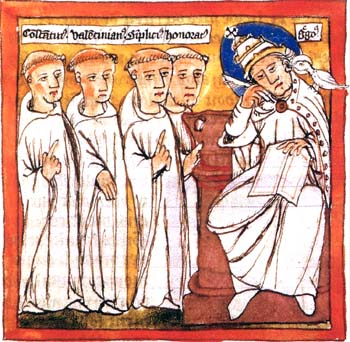 There is a sermon of Pope St. Gregory I “the Great” (+604) on Matthew 20:1-16 about the man who hires day-laborers at different hours of the day. Gregory uses an allegorical key to interpret the different hours the man came to hire workers as being the ages of a man’s life. The parable of the Lord is also eschatological. It describes the reward the Lord gives for doing His work, regardless of the moment of the calling in history. The work to be done is more than likely harvest work, bringing in the fruits of the growing season.
This parable applies to the late-coming Gentiles as well as the early-coming Jews, just as it is meant for individuals who experience conversion even late in life.
In the parable Jesus has a man identify those sitting idle without work: they will obviously receive no good wage at the end of the day. Without work, they will be poor, in straights. In the sermon there is a phrase which is echoed in the Collect:
“For whoever lives for himself and is sated by his own pleasures of the flesh, is rightly called ‘idle’ (otiosus), because he is not pursuing the fruit of the divine work (quia fructum diuini operis non sectatur).” (Hom. XL in Evangelia, I, 19, 2)
The verb sector is “to follow continually or eagerly”. In the Collect the priest prays that we will with God’s help be the opposite of “idle”, namely, that we will be not merely earnest or intent, but even more eager (propensius). The references to “fruits” and “work” in the Mass texts and the parallel of concepts in the sermon with those of the Collect, suggest to me a connection. We know that many of our ancient Latin prayers were authored at the time of Pope Gregory and before.
We are in need of healing and actual graces.
Baptism gives us an initial healing and justification, but wounds of Original Sin remain in our body, mind and will.
God gives us grace to move and strengthens us to do His will, which has healing and saving consequences.
To the extent that God gives us grace and to the extent we cooperate with His guidance and helps, the greater will be our present healing and consolation and our reward when the Lord comes like lightening from the East.
Beg His help. Beg His mercy. Praise Him for His gifts.
Recently I asked the readership to donate to the traditional parish in Rome, Santissima Trinità dei Pellegrini, so that they could cover the expenses of burying a homeless man who had – like I have – made the place his adoptive home.
My appeal HERE
The Solemn Requiem and superb sermon HERE
Today I received this note from the pastor:
Dear Father Zuhlsdorf,
Once again, you and your many friends and readers of your blog were there for the important and beautiful events of our Parish. The response to the call you made on your blog for our dear Gaetano has been beyond all hope. Thanks to you, our young 33 year old friend who had been living on the street for years, and present every day in front of our church for the last three years, and who died like an angel, was rewarded with an almost princely funeral. We have been able to cover all the funeral expenses and the transportation of his body close to his family in Emilia Romagna. These are very poor folks, and they were literally blown away by the help and other expressions of love and devotion that they witnessed at the funeral.
Thank you very, very much, dear Father, for the help you spontaneously offered. For all of us here in Rome, your generosity is an admirable sign of the goodness and boundless mercy of God. I hope that I will be able to meet you soon, and in the meantime I wish to restate my gratitude, as Pastor, together with the gratitude of my brother priests, of all the parishioners of Santissima Trinità dei Pellegrini, and of course of Gaetano’s family. “Whatever you did for one of these least brothers of mine, you did for me”.
In Corde Jesu,
Fr. Brice Meissonnier, fssp
Pastor of SS. Trinità dei Pellegrini, Rome
I had asked you to give alms to help bury the dead. HERE
Gaetano Tinnirello. He lived rough, in the streets, and often with his dog was at the doors of my adoptive parish Ss. Trinità dei Pellegrini, the Vetus Ordo parish in Rome, to beg alms of those who came and went.

One of the priests at Ss. Trinità wrote:
Your readership has been simply incredible in its response. I know the 3000 eur mark has been met, but I’m not sure about the current status since I don’t have immediate access to the account.


However, I do have a few photos of of the Requiem and I have the text of the sermon, preached by don Vilmar Pavesi.
Please tale a moment to read this.
FUNERAL OF GAETANO
I’m thirsty. On the Cross, in his agony, Jesus was thirsty. It was an immense thirst, caused by his wounds. But it was above all a spiritual thirst. Jesus was thirsty, and He still thirsts for souls, because He seeks souls to save them, without despising any of them.
Gaetano also felt thirsty. When I met him in the hospital, his mouth was dry. Father, I’m thirsty, give me a drink, that was the first thing he asked me. After inquiring if I could do this, I started giving him a drink using a syringe and a straw. He couldn’t move. After he drank half a bottle of water, I told him: Gaetano, think of Jesus Christ on the Cross. He too was thirsty, but no one gave Him anything to drink. Now you can understand it better. He nodded his head. Then I asked him if he wanted to confess. He said yes. He was perfectly lucid. He didn’t get tired. He confessed with the best dispositions of the soul, with humility and sincerity. And then we prayed together for his penance. After him, seeing signs of suffering in his face, for his pains, I advised him to offer everything for the love of God: Jesus, I offer for your love. And he repeated with me, like a child: Jesus, I offer for your love.
Then I told him that I also wanted to give him Extreme Unction, and he agreed. After the Extreme Unction he asked me for more water, because he was still thirsty. That poor Gaetano who was still thirsty, with his Confession and with the Extreme Unction had instead eased God’s thirst. Before leaving him, we talked about various things and his life after the hospital.
So he asked me to find him accommodation, and I promised him I would.
Then he asked me where he was at that moment? “Al San Camillo”, I replied.
“How far is it from the parish?” “10 minutes by tram,” I told him.
“When will I take the tram again?” “When God wills, you don’t have to worry about the future. Lord, your will be done.” And he once again, like a child, repeated: “Lord, your will be done.”
To Gaetano I brought the greetings of all the priests of the parish, especially the parish priest, and of the people who cherished affection and pity for him. At some point I had to leave. “Ah, you have to go. Then you give me some more water and then you can leave.” After the last blessing and greeting, he said to me: “Father, thank you. You made me very happy.”
The first time I went to see him in the hospital was on Saturday, after the first surgery. He was in a coma and in grave danger of death. Usually, I always carry the oil of the sick with me, but that day, by chance, I didn’t have any. And since it was too late, they didn’t let me see him. I returned like this on Monday, this time with the holy oil. Gaetano was perfectly lucid. The next day he would go back into a coma again, he would undergo a new operation and he would remain in a coma until the day of his death. He would seem to have returned to a state of lucidity only for a few hours, like that child who was resurrected at the time of San Filippo Neri only to be able to confess and receive the Extreme Unction, and then die again.
About St. Philip Neri. Without knowing it, Gaetano lived one of his councils. In fact, every day he entered the church, greeted all the saints, and then when he approached the main altar he prostrated himself on the ground, kissed the floor and prayed. This was exactly how he taught St. Philip Neri: “When you have little time or you can’t pray well, go into a church and greet all the saints. You will have said an excellent prayer.” I always thought that the Lord would save him for this act of piety, done with such sincerity. And also for the Rosary and the Miraculous Medal that he wore around his neck.
Once I found him in the church fixing the floor. Do you remember when the marbles at the in the back moved? Without saying anything to anyone, he began to arrange the marble plaques. Indeed, more than one person had tripped. “Gaetano, what are you doing?” “I’ll fix the marbles! So it is dangerous. I don’t do it for money. I do it because it is God’s house and God’s house is mine too.”
He wanted to work. He wanted to be helpful. He cleaned the street because he said he lived there and therefore he wanted it clean. He also cleaned the church staircase. I have seen him more than once spontaneously helping the scavengers to collect the garbage. He did it without interest, just to help out.
When he got here, he was wearing earrings. I can’t stand men with earrings. So one day I proposed to sell me his earrings. When Gaetano understood the reason why I wanted to buy them, he took off his earrings, went to throw them in the manhole and promised me that he would no longer wear them and did not want the money. And so it was.
The death of Gaetano at the age of 33 is a great pain for all of us. His presence gave a picturesque face to the parish. His was a good presence. He knew how to make everyone love him. Even his dog looked so good together. The death of Gaetano is a great pain for everyone, because in the depths of our soul, we all feel a little responsible. He was one of those littlest brothers of Christ, because he had an immense need to be helped in his body and in his soul. More than money, he needed sincere affection and opportunity.
How many times have we returned indifference, coldness or haste to his spontaneous “Good evening“? How many times have we passed him, without even looking at him, when he was not well? “Whenever you have done these things to one of these least of my brothers, you will have done it to me” (Mt 25).
Lord, in front of this body we ask your forgiveness for all the good we could have done to Gaetano and we have not done. Lord, in front of this body, we promise you to receive with generosity and love the poor that your Providence will deign to send us.
However, I would be unfair if I only had reproaches in front of this body. Gaetano’s death has already begun to bear fruit. Many felt touched in their hearts and opened themselves more to charity. Very edifying is the number of people who continually ask for Masses for his soul. This is a great charity. Others offered to give him a proper burial. This too is a work of mercy pleasing to the Lord. Some young people followed Gaetano with true love during his last weeks. They are the ones who took me and accompanied me to the hospital.
The Lord bless you.
Gaetano still has a great mission among us. Indeed, his mission has just begun. He, poor, but blessed by the Lord, you must teach us to be charitable. He must teach us to have great hope in God. The Lord brought him closer to this parish. He made him find the Christian affection of his faithful and priests because he wanted to give him the eternal happiness of Heaven. Gaetano also has the mission of donating to the Archconfraternity of the SS. Trinity a new impetus in his works of spiritual and corporal charity.
St. Philip Neri, pray for him. Saint Benedict Giuseppe Labre, pray for him. Holy Mary, Mother of God, pray for him.


The parish has taken on all the expenses to transport his body back to his home province and bury him with his family.
You can help. It is a good November, Four Last Things, corporal work of mercy to bury the dead.
Make a donation.


Coat of Arms by D Burkart









A Daily Prayer for Priests


They find you a pro-life agent in your area who commits to giving a portion of the fee to a pro-life group!

PLEASE subscribe via PayPal if it is useful. Zelle and Wise are better, but PayPal is convenient.
A monthly subscription donation means I have steady income I can plan on. I put you my list of benefactors for whom I pray and for whom I often say Holy Mass.
In view of the rapidly changing challenges I now face, I would like to add more $10/month subscribers. Will you please help?
For a one time donation...



Help Monks in Wyoming (coffee – UPDATED LINK) and Norcia (beer) and the wonderful "Soap Sisters" of Summit, NJ!


Please follow me on Twitter!










Visits tracked by Statcounter
since Sat., 25 Nov. 2006:


