Your Sunday Sermon Notes – 3rd Sunday after Epiphany (NO – 3rd Ordinary) 2021

Was there a GOOD point made in the sermon you heard at the Mass for your Sunday (obligation or none), either live or on the internet? Let us know what it was.

Too many people today are without good, strong preaching, to the detriment of all. Share the good stuff.

Also, are your churches opening up? What was attendance like?

Posted in SESSIUNCULA |
5 Comments

“Here is a link to a Newsreel from 1949 that seems as if it is from another planet.”

A friend sent this, with the comment,

“Here is a link to a Newsreel from 1949 that seems as if it is from another planet.”

YouTube thumbnailYouTube icon
 

A world that’s gone?

I wonder… what sort of, what magnitude of cataclysm would be needed to wake people up to reality and commonsense again?

Posted in Cri de Coeur, Global Killer Asteroid Questions, Pò sì jiù, Save The Liturgy - Save The World, The Coming Storm, The future and our choices |
10 Comments

Daily Rome Shot 58

Posted in SESSIUNCULA | Tagged
2 Comments

The pub that survived the Great Plague is shut down by Covid-1984

Okay… this is getting seriously ridiculous now. It’s time to put a stop to the Wuhan Devil.

From the Daily Telegraph I learned that the Lamb and Flag in Oxford is to close.

That’s just plain WRONG!

Posted in SESSIUNCULA | Tagged , , , ,
7 Comments

Of Benedictines, Books and Beer

Today I read the newsletter from the wonderful Benedictine monks at Norcia, in Italy.  These are traditional Benedictines, a high American component, who make wonderful beer, Birra Nursia, in the place where St. Benedict was born.   You will recall that earthquakes brought their church and house down a few years back.  They’ve been rebuilding in the hills.

The monks have a beer club to which you can subscribe.   This is how they keep putting up their monastery brick by brick.

In this newsletter we see about the Solemn Vows of three monks, news about a new online store for their beer for Europe, and see photos of their church, Our Lady of Mercy, which is now open.

What I found particularly interesting with the list of the books read during meals in the refectory during 2020.   One could do a lot worse for a reading program for part of 2021.

These are wonderful monks.  They have wonderful beer.   Helping them helps yourself.  Rising tides, and all that.

Sign up and tell them that Fr. Z sent you!

The monks reached out to me and said that for every FIVE new Club members who sign up and reference “Father Z” in the “Notes about your Order” line, I will get a free case of beer to share with my priest friends.

CLICK!

Their beers are available in both in .75 liter bottles in cases of 6 and of 12.  You can get 1 case per month or 1 case every other month.

I noted that the “Slow Food” movement in Italy has taken notice of the beer.  That’s a major endorsement.

Here are a couple ideas.

Pastors of parishes and priests: I’m sure you have to entertain once in a while, perhaps fellow priests, perhaps some parish event like a fundraising supper.  Think about providing BIRRA NURSIA from these great monks.

Parish organizations, Knights of Columbus, etc.: Ditto!  This beer is as Catholic as it gets and you would be providing support to the monks in Norcia.

YouTube thumbnailYouTube icon

YouTube thumbnailYouTube icon

Posted in "How To..." - Practical Notes, ACTION ITEM!, The Campus Telephone Pole | Tagged , , ,
5 Comments

ASK FATHER: Coming late to Mass and reception of Holy Communion

From a reader….

QUAERITUR:

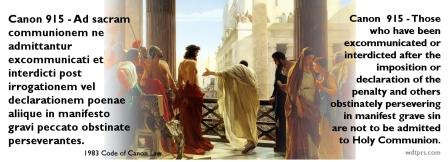
If one is late for Mass because of an unexpected occurrence (line for confession was longer than expected, traffic, etc.), is he permitted to receive Communion? Is there a point in the Mass at which a potential communicant cannot receive? Is there varied opinion about this between OF and EF parishes?

I expect that there will be varied opinions along the general lines of Novus Ordo dominance and Traditional dominance.  I suspect that people (priest and lay onlookers) at the former sort of parish, Novus Ordo, will be more censorious if they think about it at all. They may be the same people heading to the parking lot having just barely received Our Eucharistic Lord.

Of course, I’m talking about 30% who still believe what the Church teaches about the Eucharist.  The rest think that when you sing the song and get the white thing in your hand … well… that’s really nice and people should feel good so everyone should go!   And you MUST go!  ROW BY ROW!   Anything not forbidden is obligatory, after all.

At a more traditional place, where teaching has been sound and where people really believe, I suspect there will be less of a hang up about who is receiving and when, for reasons that will unfold, below.

Let’s make distinctions.

First, attendance at Mass is not absolutely necessary for the reception of Communion.

Consider that Communion is brought to the sick, outside of Mass. Also, it is possible to receive outside of Mass even directly after Mass has been celebrated, as is the case when the choir receives afterward (that’s fairly common at a TLM), or in this time of Wuhan Devil lunacy, some who desire not to be forced to receive Our Lord on their unconsecrated hands, are given the choice to receive after Mass… segregated, as it were.

Lastly, there is the example of Good Friday: the liturgy is not a Mass.

Next, while we can receive outside of Mass, it is better to receive during Mass. And during a Mass where you have been an active participant for the whole of the Mass, not just part.

Manualists (bless them) designated a certain segment of Mass when one had to be present so as to fulfill the Sunday obligation. That was generally either from the Gospel to the conclusion of Communion or else (more commonly) “from chalice veil to chalice veil”, that is, from the beginning of the Offertory (RING goes the bell when the chalice veil is removed) to when the priest veils the chalice again after the ablutions. That’s a bare and minimalistic view of participation for the sake of obligation. ‘Tis enough. T’will serve, as Mercutio would put it.

But we should not fall into the trap of thinking that, just because the minimum suffices, we are doing well. We should participate at the whole of the Mass from entrance procession to recessional. In making one’s confession, attrition (sorrow for sin because of fear of Hell) is sufficient to receive absolution, but contrition (sorrow because of offending our loving God) is better.

It could be that, arriving late though no fault of your own, could be a test to find another Mass at another church or wait for the next Mass on the schedule if there is one, perhaps praying in church in the meantime in reparation for the sins of bishops and elected officials.

Your question touches on a lot of different points for reflection about the state of the Church and our sacred worship – and therefore our Catholic identity – today.  We ARE our rites!   What we do shapes us.  Who we are shapes the rites.

Which should have logical priority?

If those who have pretty much caved into the world shape the rites, the sense of transcendence and transformative mystery will soon be obscured by the human elements (e.g., the demand some have to see the priest grin at them over the altar).

The Eucharist (both the Eucharistic species and the celebration of the Eucharist, Mass) is the “source and summit” of who we are as Catholics.

How we celebrated Mass and how we receive the species is of fundamental importance.

Save The Liturgy – Save The World

Posted in "How To..." - Practical Notes, ASK FATHER Question Box, Hard-Identity Catholicism, Liturgy Science Theatre 3000, Save The Liturgy - Save The World |
6 Comments

The Popes’ guts, martyrdom and YOU

Today is the Feast of Sts. Vincent and Anastasius.

Their church Rome is of interest.  It faces the famous Trevi fountain.  It is the place where the entrails of lots of Popes were kept.  You read that right.   Back in the day Pope’s were not embalmed.  They would extract everything that was going to go off really fast.  The urns with the innards were interred here.  Also, I don’t think this church hasn’t yet changed the Pope’s stemma over the door.   Gotta double-check.

St. Vincent is greatly venerated.  From Spain (born in Huesca where Sts. Nunilo and Alodia are), and associated closely with Valencia, he was a deacon and was martyred in the persecution of Christians in the 3rd c. at the time of Diocletian.    We know about his life from the poet Prudentius and also from several of St. Augustine’s sermons.

Then, as now, there was pressure from the state (Emperor, governors, etc.) on Christians to give up their core values, their souls as it were, by offering some sort of sacrifice to the gods or the demi-godlike “genius” tutelary spirit of the Emperor, or hand over sacred books, etc.   Many did.  Think, in contemporary terms, of clerics totally caving into the demands of the state regarding COVID-1984, except that back then you could be swiftly killed rather than just fined or bombarded with virtue signaling.  St. Vincent essentially told the local governor to stow his demands in an impossible place because they were ready to suffer for the Faith.  There are differing accounts of his martyrdom, but St. Augustine includes that Vincent and other Christians were tortured horribly.

St. Anastasius was a 7th c. Persian soldier who converted at the sight of relics of the Cross.  His newly chosen Christian name, Anastasius, comes from the Greek for “resurrection”.  He, too, was martyred, his body eventually brought to Rome and interred in the church dedicated to Vincent.  Thus, the link.

There are various martyrdoms taking place today.

When we think of martyrdom, we usually think of bloody or “red” martyrdom.  However, great Doctors of the Church write of other kinds of martyrdom.  Also, today, the Church has a path to beatification and canonization for those who endure some short of bloody, red martyrdom, oblatio vitae.

For example, St. Maximilian Kolbe, beatified by Paul VI as a confessor was canonized by John Paul II as a martyr.  He is one of those cases that falls between being a “Confessor” who lived a heroic life of virtue, and being a martyr.  He wasn’t really killed because he was a priest.  He was killed because he took another man’s place.  Therefore, as a result of his choice, he died down the line.   Another case could be St. Gianna Beretta Molla, who died because of her decision not to abort her child.   Some people who don’t necessarily live a life of heroic virtue, but who are virtuous and devout habitually, might by their offering of life have a path to beatification.   Fr. Vincent Capodanno, the heroic Navy Chaplain killed in Vietnam while trying to give last rites to a wounded Marine.  Yut! He wasn’t killed for hatred of the Faith, so he wasn’t a martyr.  It would not be necessary to demonstrate all the virtues lived in a heroic way.  “Heroic” here has nothing to do with his heroism in the fire fight during which he was killed.  He made a choice, and was killed because of it.

So, we have the ancient teaching about “red” or bloody martyrdom for the sake of charity whereby the martyr dies giving witness in the face of hatred for the Faith.

There is also a long tradition of identifying “white” martyrdom, coined by St. Jerome, whereby a person gives witness through an ascetic life, withdrawal from the world, pilgrimages involving great sacrifice, or who suffers greatly for the Faith but who does not die in bearing witness. There is also a “blue” (or “green”) martyrdom, involving great penance and mortifications without necessarily the sort of withdrawal from life that a hermit or a cenobite might live.  Gregory the Great in his Dialogues, writes of different kinds of martyrdom, bloody, public martyrdom in time of persecution and secret martyrdom, not in time of persecution.  He wrote that secret martyrs are no less worthy of honor, because they also endured sufferings and the attacks of hidden enemies, but they persevered in charity.

The Church recognizes the lives of figure who are worthy of being proposed as examples to others.  Different times in the life of the Church bring different and new examples of how to live the Christian life.  People don’t change but the world around us does.  How a Christian reacts to the world has some stable principles but life has to be lived here and now, not as it was in the past or how we would prefer it to be.  Work for a better world, yes, but we cannot compromise on the Faith.

Hence, the world will find new ways to make us into witnesses… martyrs.  And the most painful martyrdom will from from fellow Catholics.

When you examine your conscience in the evening – I hope you do – do you ever play out in your head what it would be like were society to go sideways fast?  What if all Catholics – not willing to offer a pinch of incense to the one-party rule of the Woke Democrat Party were determined to be “domestic terrorists” and were to be rounded up and put into camps.   Have you thought about what you would do?  What if they confiscate everything you have and let you twist in the wind because you won’t abide by the “Face Diapers For Democracy” executive order?    Have you thought about this?

When things go sideways, they tend to go sideways really fast.   And if you think it can’t happen where you are… ha!

The world will always need witnesses.  But you can’t give witness to what you do not know.  You can’t give what you don’t have, or in fun Latin, nemo dat quod non ‘got’.

Take the admonishment of Peter to heart and “always be ready to give reasons”.

Be situationally aware about your neighborhood, workplace, city, country.

Posted in Modern Martyrs, Saints: Stories & Symbols | Tagged ,
4 Comments

Daily Rome Shot 58

Posted in SESSIUNCULA | Tagged
3 Comments

Daily Rome Shot 57

Posted in SESSIUNCULA | Tagged
2 Comments

From a reader – “Idea: Spiritual battle/Catholic Church fullness of faith.” Wherein Fr. Z rants.

From a reader….

Idea: Spiritual battle/Catholic Church fullness of faith.

Sure the Rosary but at the same time Holy Bishops and priestly exorcists casting out the Devil from our land, the Church. My priest asked an expert and he said that we need the bishops to be around the country to do it.

This is exactly what is needed.   Exorcisms and acts of reparation.

How would this be for a program?

  • Bishops reestablishing Forty Hours Devotion in parishes on a regular scheduled as in days of yore.  Forty Hours was instituted for urgent public needs, such as plague or threat of invasion.
  • Bishops establishing a monthly day of fasting for the diocese and holding public devotions (e.g., continuous Rosary before the Blessed Sacrament) in their cathedral churches including 24 hour confessions on that day.
  • Bishops reciting Ch. 3 Title XI over their dioceses on a weekly basis, ideally in public.

On a smaller scale, pastors of parishes could do these things.

None of this would interfere with any of their other projects and campaigns.

The worldly and those oppressed by the Enemy of the soul will howl with rage and fight like hell.  But isn’t that precisely what the Church is here to battle?  For the sake of saving souls?

That’s the spiritual side.  On the material side, the fact is, dear reader, that a “demographic sink-hole” is opening up under the Church in these USA and elsewhere.   The Wuhan Devil – and I believe that once it got out of its Chinese lab somewhere along the way it was weaponized by propagation and then some bad actors cursed it – has accelerated the opening of the sink-hole.   Seasoned Catholics will pass away in God’s good time and, when they do, their unchurched or barely aware children and hardly catechized grandchildren are not going to provide material support for the Church.  Many will have lost interest in going to church on Sundays and feasts, since they were only sort of Catholic anyway – many of them – and they were attending “beige” parishes.

Tell me I’m wrong.

Convince me that, as soon as all the churches are opened and lockdowns and face-diapering are over, everyone and more will flood back into our churches with generous giving.

Go ahead.

One thing I do know.  I’m getting notes from priests who, in this interim, have started TLMs in their parishes.  They are now better attended – with young people – and they are producing more revenue than the Novus Ordo Masses.

If we want any hope of evangelizing, we have to embrace Tradition, but with a heart for spiritual and temporal works of mercy, and fire for preaching the Faith in a missionary way, not watered down, not secularizing.

Sound, clear, clarion trumpets must sound and our priests and bishops have to put on their gear and lead.

This is not rocket science.

Today, however, it is sometimes hard to distinguish what we are doing as a Church from just about any other NGO.

NGOs can’t perform exorcisms, for example.

We have to turn towards the Lord, in our hearts but also in our sacred liturgical worship.  We have to get down on our knees in reparation for sins and in adoration of the Trinity, and for Holy Communion.  Get the junk out of the confessionals, clean then up, and turn the lights on.


Posted in ¡Hagan lío!, "How To..." - Practical Notes, Our Catholic Identity, Save The Liturgy - Save The World, The Coming Storm, The future and our choices, Wherein Fr. Z Rants |
4 Comments