BALTIMORE: New life for a parish with the TLM, FSSP: Sat 16 Dec – RORATE MASS

There is a good piece in the Baltimore Sun about the newly established FSSP parish at the St. Alphonus, a fine old church.  It is the National Shrine of St. Alphonsus Liguori.  Parish site HERE.   NB: They have a RORATE MASS tomorrow, Saturday 16 Dec.  If you are in the neighborhood – GO AND SUPPORT IT.

At St. Alphonsus Ligouri in Baltimore, believers find new inspiration in old Latin Mass

An icy wind rips along a boarded-up downtown street, swirling paper wrappers into the air. A city bus roars past, trailing fumes. A man in rags begs for a handout. Two passersby ignore him on their way to lunch.

It’s a typical winter tableau for a modern East Coast city. But walk up the steps at West Saratoga Street and Park Avenue, pass through a warm foyer, and enter the sanctuary of the National Shrine of St. Alphonsus Ligouri, and you’ll think you’ve stepped back a thousand years in time.

Worshippers kneel in worn pews, a vaulted ceiling soaring far above them. Towering stained-glass windows admit just enough light to dispel any gloom.

Women young and old wear the lace head coverings of eons past, and a priest in white and blue vestments stands up front, facing not the congregation but the altar against a wall, murmuring in Latin.

“Introibo ad altare Dei,” says the Rev. Joel Kiefer, the church’s 48-year-old pastor: “I go unto the altar of the Lord.”

St. Alphonsus is the only church in Baltimore that offers the traditional Latin Mass, [WHAT?!? That’s a crime!] the celebration of the Eucharist that all Catholics observed prior to the sweeping reforms instituted by the Second Vatican Council in the 1960s.

It’s also part of what appears to be a modest worldwide comeback for the ancient service, also known as the Tridentine Mass or the extraordinary form of the Roman Rite.

Pushed to the margins of Catholic practice by the reformist church leaders of Vatican II, [That’s an understatement!] the traditional Latin Mass had nearly vanished in the United States by the early 1980s.

Now it’s celebrated in more than 400 Catholic churches across the country, according to Una Voce, an organization that promotes the rite.

Nathaniel Marx, an assistant professor of systematic theology at Saint Meinrad Seminary and School of Theology in Indiana, says it’s hard to track the numbers, but anecdotal evidence suggests that the movement is continuing to grow.

Marx explored the ethnography of modern Latin Mass Catholics in his 2013 doctoral thesis, “Ritual in the Age of Authenticity.”

I do believe it’s gaining energy, both from older Catholics who recall the rite from their childhood days and from younger ones now discovering it for the first time,” he says.  [Especially younger Catholics… with big families.  And as the numbers go south for the Novus Ordo, the numbers will climb for the TLM.  Just watch.]

That growth is certainly evident at St. Alphonsus, which offers a Tridentine Mass seven days a week in addition to Lithuanian and English-speaking services earlier on Sunday mornings.

[…]

At St. Alphonsus, weekly attendance at Latin rite masses has nearly doubled, from 125 to 247, in the four months since Kiefer took over.

Before entering the priesthood, Kiefer was an Army officer. The Philadelphia native graduated from West Point, was commissioned a second lieutenant and served in combat in Mogadishu, Somalia.

But he had always wanted to be a priest. After completing his military obligation, he entered the seminary. He learned Latin during summers.

Now he’s set to make local history.

[NB: TOMORROW 16 December] At 6:30 Saturday morning, he’ll offer the Rorate Mass, a Latin-language devotion associated with Advent that has not been celebrated in Baltimore in more than 50 years.

Per Catholic tradition, he’ll conduct it by candlelight in an otherwise dark church, the space illuminated only by however many candles the faithful contribute.

Kiefer avoids touting his work, lest the larger mission become identified with one person. But with the Rorate in the offing, and the parish in financial need, he’s happy to make an exception.

Anyone can call or visit our website and donate a candle with intentions,” [Did you get that?  About the website?] the Catholic practice of requesting prayers for particular people or causes, he says. “All donations go directly to the maintenance of our building, and the church will be as lit as people’s support.”

If that’s the benchmark, the place should be aglow Saturday.

[…]

Read the rest there.   The writer didn’t butcher the issues and facts, as so many newsies do.

The parish website is sort of fancy, which nearly always means that it is hard to find what you are looking for.  The fancier they are, the harder they are to navigate.  If you want to donate a candle, keep looking around.  It’s there.  I found it.

Again, support that parish if you are anywhere near Baltimore!  Go to that Rorate Mass.

This is the New Evangelization.

¡Hagan lío!


Posted in ¡Hagan lío!, "How To..." - Practical Notes, ACTION ITEM!, New Evangelization | Tagged
8 Comments

INTERNET PRAYER UPDATE: LUXEMBOURGISH! and BAVARIAN! and HILIGAYNON!

UPDATE:

Okay… this is quite the day. Since my original posting I have received BAVARIAN (in the comments, below) and by email HILIGAYNON, a Philippine language spoken in much of the island of Panay and the western half of the island of Negros. I await recordings.
_

A week or so ago, I received a new translation – Icelandic – of the now wide-spread Internet Prayer. All the versions are HERE.

Today I found yet another new language. And there is a RECORDING!

LUXEMBOURGISH
LISTEN

E Gebied virum Aloggen an den Internet:

Allmächtechen an éiweche Gott, deen ons als Säi Bild geschaf huet, Dier hutt ons gefrot no all Guddem, Richtegen a Schéinen ze sichen, virun allem an der göttlecher Persoun vun Ärem Jong, onsem Här Jesus Christus, erlabt ons, mir bieden Iech, duerch d’Fürbitte vum Hellegen Isidore,  Bëschof an Dokter, ob onse Reesen duerch den Internet, datt ons Hänn an Aen nemmen ob déi Sachen geriecht ginn déi och Iech gefalen, an datte mir all dei Séilen déi mir untreffen mat Nächsteléiwt a Gedold begéinen. Duerch Christus onsen Här. Amen.

Fr. Z kudos to the translator.

I welcome new translations. Please also send THE TITLE in the other language.

Also, if you are a native speaker, please record it too!

I’m still waiting for the update to the Klingon version.

Posted in Fr. Z KUDOS, Just Too Cool | Tagged , ,
3 Comments

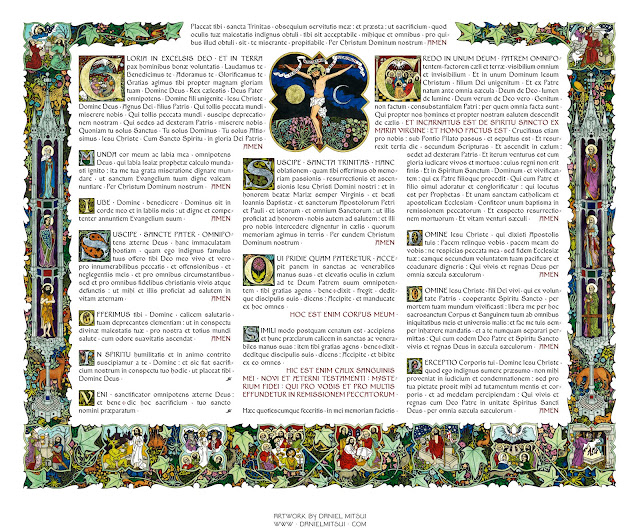
UPDATED – FRAMED: Daniel Mitsui’s new altar cards for the TLM – HOLY COW!

UPDATE:

I took my spiffy Mitsui altar cards to be framed.  Now I have them, completed.

Ready for a first look.

The central card.

Here is the frame I chose.

The guy at the store and I had a discussion about whether a narrow frame like this would be sturdy enough to support something this large.  As it turns out, its good and solid.

Back at the ranch.

I think I chose well.

Different light.

In contrast to my wonderful cards from Silverstream Priory, which I’ve had on my private altar for some time.  They, too are great.

Now I am in a bind.

I have these great cards and I want to use all of them at the same time!

I guess I’ll have to rotate them on a seasonal basis and also take some to church.

In any event, friends, if you are looking for something for a priest… or just your wall for devotional purposes… these cards are magnificent.


___ Published on: Dec 9, 2017

The talented Catholic artist Daniel Mitsui, whom I’ve often mentioned in these electronic pages, has completed a set if illuminated altar cards for use in the Traditional Latin Mass (aka Usus Antiquior and Extraordinary Form).

You might recall that I recently posted a story about a woman afflicted with Parkinson’s.  Her friend brought Mitsui’s coloring books for her therapy, and they played a role in her conversion and reception into the Catholic Church.  HERE

HE SENT ME A SET!

Unboxing.

Here they are, pinned down by low ball glasses.

The central card

Some details

I like how Peter has his hand in the loop.

The footprints on the rock show where the nails holes in the Lord’s feet remain!

And there’s a leopard? with some fancy mushrooms.

On the epistle side card, Noah is making his getaway.   There’a lot going on in the margins.

The not so fortunate in the water remind us of our dependence on God’s mercy.  Lavabo indeed.

And because it’s Advent…

Long tailed critter sniffing flowers, and a curious goose.

I don’t remember the goose being at the manger.

And is that a … scorpion?

Images online HERE.   

Daniel describes all the images and symbols and they are packed.  

For example…

On the central card, in each of the four corners is the scene of an Old Testament prefigurement of the Eucharistic sacrifice: the Sacrifice of Abel, Abraham’s sacrifice of Isaac, the Sacrifice of the Paschal Lamb and the Sacrifice of Melchizedek. Three of these are mentioned in the Canon of the Mass; two of them, together with the Creation depicted on the Gospel cards and the nine prophecies depicted on the Epistle card, complete the twelve prophecies of the Easter Vigil.

That just scratches the surface!

He developed his own lettering in order to calligraph the cards by hand.  Amazing.

IDEA: 

Christmas gift to priests who say the TLM.   Have them framed and give them to Father for Christmas.

BTW… I also very much like the cards from Silverstream, which I am using right now for my private altar.  Also, remember SPORCH for travel altar cards and great Requiem cards, along with some “antique” sets that are spectacular (and good for a man who already knows his prayers well).

LASTLY:

I wouldn’t in the least mind were some donations to come in to help me frame these bad boys.  I’d like to use them!   They’ll be a little spendy to frame with the dignity they deserve, but what a sight they’ll be!

Posted in ACTION ITEM!, The Campus Telephone Pole | Tagged ,
9 Comments

ASK FATHER: Confession of serious sins in both kind and number.

From a reader…

QUAERITUR:

According to canon law, we are obliged to confess our mortal sins in “both kind and number.” Would my sins be absolved if I failed to mention the venial sins in number?

YES!  Number, too… for serious sins.

You are not obliged to confess venial sins, though doing so is good and helpful, especially as one proceeds in the spiritual life and overcomes major faults.

If you choose to confess venial sins, sure, go ahead and confess them in kind and number if you wish, although you are not obliged to.

In regard to serious, mortal sins, you are obliged.  Why?

If you confess that you “lied”, that might mean that you lied once or that you lied 50 times.  The former could be a one-off.  The latter means that you have a serious problem as an inveterate liar.  There’s a difference.

So, it is smart to confess sins in number, because we learn who we are for the sake of our journey towards our heavenly fatherland.

It is smart, but it is also the law.  It is the law, precisely because it is smart and good for us.

In the 1983 Code of Canon Law we read:

Canon 988 – §1. A member of the Christian faithful is obliged to confess in kind and number all serious sins committed after baptism and not yet directly remitted through the keys of the Church nor acknowledged in individual confession, for which one is conscious after diligent examination of conscience.
§2. It is to be recommended to the Christian faithful that venial sins also be confessed.


Remember that each sacrament has both matter and form. The matter of the sacrament of penance is the telling of sins.

While we are not obliged to include all sorts of circumstantial information surrounding the sins, we do need to indicate number and/or frequency, by number can change the severity of the sin and indicate to the confessor (and to yourself) where your principle problems are.

Sometimes it will happen that your memory is not clear about the number of times you committed a sin. In that case, just do your best.  If you truly cannot recall clearly, that’s okay.  Ultra posse nemo tenetur.

Even when your memory is faulty, if you do your best the sins you don’t remember or confess (through no fault of your own) are also indirectly remitted.

However, if you are aware that you should confess sins in both kind and number (or at least give an idea of frequency) and you deliberately avoid indicating number… that’s not good.

A regular, daily examination of conscience will help you in developing the good habits involved in making a good confession.

So, everything, really pry into yourself and then…

GO TO CONFESSION!

And, Fathers!  TEACH people about how to make a good confession.  And go to confession yourselves!  Souls, in including your own, depend on it.

Posted in "How To..." - Practical Notes, ASK FATHER Question Box, GO TO CONFESSION | Tagged , , ,
12 Comments

ASK FATHER: “Transgender” nun?

From a reader…

QUAERITUR:

What is going to happen when someone who identifies as a male , but is in a sane biological based world female, wants to become a priest of some male who competed on the girls soccer team in high school because he feels like a female wants to join the Carmelite nuns?

GUEST PRIEST RESPONSE: Fr. Tim Ferguson

What a odd world we now live in. When someone “identifies as a male.”

I know that’s the modern parlance, but think about it – how we “identify” is supposed to alter reality.

I blame Decartes. He set us on the track where our perception is more important than objective reality. Perhaps the blame lies further back in history, with William of Ockham.

Whatever the root, we are now living in a world where Humpty Dumpty, who said in Alice in Wonderland, “When I use a word, it means just what I choose it to mean – neither more nor less.” could be touted as the the wisest man, errr, egg, around.

In any case, the Church refuses to play these contemporary word games.

If someone who is female but “identifies” as male somehow manages to get through the application process, years of formation, and all the necessary vetting and, horrifically goes through an ordination ceremony, she enters the church building not as a priest, but as an excommunicated woman in virtue of canon 1378.2.1.

If a man attempted to enter a religious community of women, and somehow managed to bluff his way through the formation process, there would not be an automatic excommunication, but he would not in any way shape or form become a nun. He would be a man masquerading as a nun – which might be funny in a movie or play, but in the light of eternity and divine judgment, which we all will face, is a serious and blasphemous action.

Anyone who assisted, or colluded, or covered for the folks who lie to the Church in order to pretend to get ordained or pretend to take vows will also be subject to penalties in this life, and judgment in the life to come.

Fr. Z adds:

Check out a post about this back in 2012 concerning a future meeting of the LCWR in 2020. HERE

Posted in "How To..." - Practical Notes, ASK FATHER Question Box, B as in B. S as in S., Pò sì jiù, Sin That Cries To Heaven, Women Religious, You must be joking! | Tagged
8 Comments

ASK FATHER: 1st Communion at another parish because grandparents can’t travel

From a reader…

I am hoping for your wisdom and guidance here. My daughter is preparing for 1st communion (May 2018) at our home parish. However, my parents, living in another state, are not in good enough health to attend the event. Last year they missed the baptism of our son for this reason. Provided she has met all the sacramental preparation requirements is there a means by which she could receieve the sacrament at my parent’s parish? I am tried asking the religious education director but they did not have an answer.

Also, must a 1st communion take place in a specially set mass? Could the sacrament not be received during any mass after which all “mandated” preparation is complete?

GUEST PRIEST RESPONSE: Fr. Tim Ferguson

There should be no problem with this – especially if both pastors are reasonable people.

There is no need for First Communion to take place at a special Mass.

The pastor of your parish could write to the pastor of your parents’ parish, explain the circumstances, and ask if arrangements could be made.

Posted in "How To..." - Practical Notes, ASK FATHER Question Box | Tagged
6 Comments

ASK FATHER: Baptized but never lived as a Catholic, soon to marry

From a reader…

QUAERITUR:

A cousin of mine was baptised in the Catholic Church as an infant to fulfill the wishes of persistent grandparents. But was in no way raised in the Church and never recieved any other sacraments – is she Catholic? And bound by the laws and precepts of the Church? She is marrying a man (whose religious background I know nothing of) outside of Church (obviously, shes never practiced or known the faith), is this, in the eyes of God, a valid marriage? Or would it be valid only if she married in the Church? I have been asked to be in the wedding party and wish to know the waters I am navigating.

Thank you for your priesthood and guidance.

Baptism has effects and consequences.  When one is baptized into the Catholic Church, one is – forever and always – a member of the Catholic Church.

One might never darken the door of a Catholic Church after the baptism, but one is still always a Catholic. As a Catholic, one is bound by the laws of the Church.

This is one reason why the Church insists that, for a child to be baptized, the parents consent to it, and the priest (or deacon, or bishop, or authorized lay person) have a reasonable hope that the child will be raised in the faith.

This is one reason why just baptizing any child that is brought around may not be the best idea: there are consequences 2o years down the line, such as an invalid marriage.

Insistent grandparents notwithstanding, baptizing a child when there is no reasonable hope that the child will ever be taught the faith, go to Holy Mass, receive the sacraments, or otherwise practice the faith, is not a good thing. If the grandparents are going to insist on the baptism of their grandchildren, then they are obliged to follow through with the catechesis and formation of their now-Catholic grandchildren.

Every baptized Catholic is bound by law to observe the Catholic form of marriage, for validity.

Since this is the Church’s law, the Church is able to dispense from it.

The marriage of a baptized Catholic outside of the Church, and without obtaining a dispensation, is invalid.

However, it’s hard to imagine that someone who has never practiced the faith would even be aware of the need for a dispensation, let alone have the understanding of how or why to obtain it.

Posted in "How To..." - Practical Notes, 1983 CIC can. 915, ASK FATHER Question Box, One Man & One Woman | Tagged , , ,
13 Comments

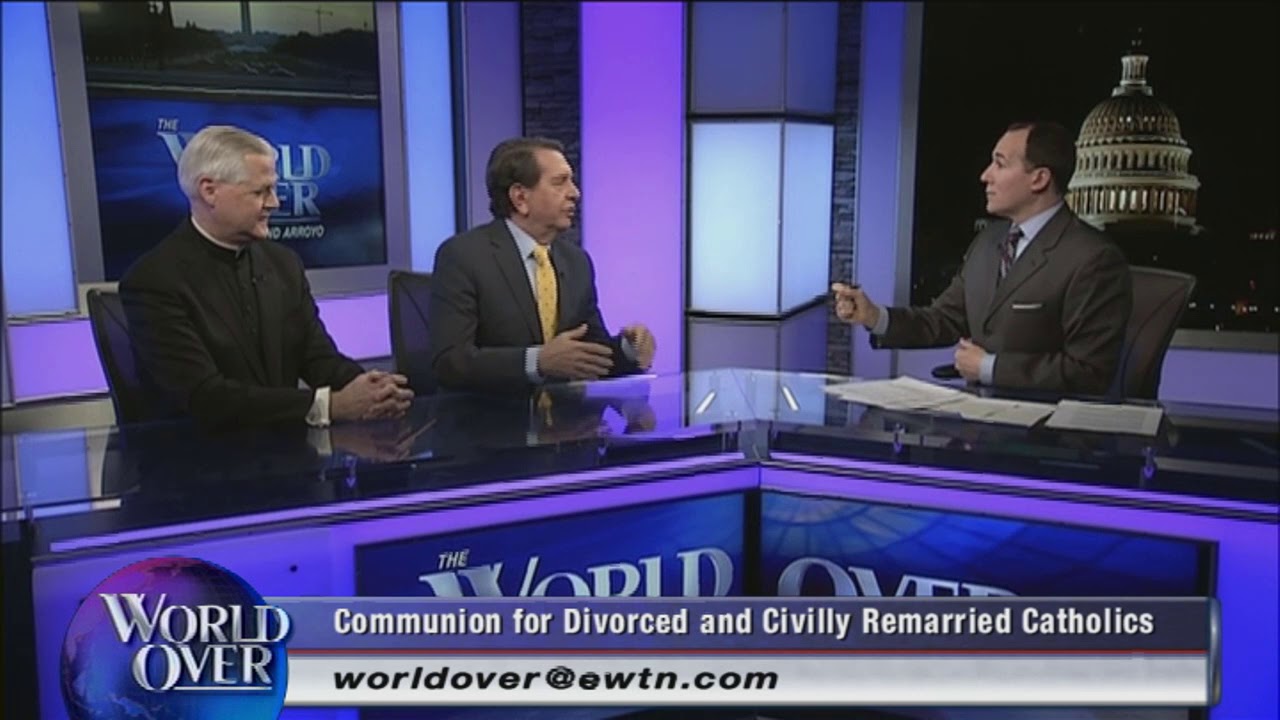
Must view video.   Fr. Gerald Murray and Prof. Robert Royal comment

Must view video.   Fr. Gerald Murray and Prof. Robert Royal comment on what’s going on.

In the wake of the Letter to Argentinian Bishop being placed in the AAS and of Il Papa Dittatore… just watch.

YouTube thumbnailYouTube icon

Posted in Francis, The Drill | Tagged ,
5 Comments

ASK FATHER: Can divorcees with “annulments” be prevented from marrying if there are young children?

From a reader…

QUAERITUR:

Something that I have been wondering about is whether or not the Church could deny marrying a couple where one intended spouse was previously married, had children then the Church granted an annulment [declaration of nullity] saying the marriage was invalid. Could it be argued that, for the sake of the children from the first marriage, a new marriage would not be possible until those children were adult age and the damage minimized from a parent’s new marriage and family? I’m not sure I explained my question well but I see so many damaged children struggling with assorted wounds and disorders from marriage and remarriage and new children and new step parents and all that instability. If Amoris Laetitia guides Pastors to consider what’s better for children in new unions, shouldn’t the Church also be mindful of protecting children from [of?] previous unions, even if those first unions were granted annulments?

GUEST CANONIST RESPONSE:

A monitum (warning) or vetitum (prohibition) is usually only applied to one party or both if one or both of the parties simulated their matrimonial consent (i.e., said “yes,” but meant “no”), and therefore either should not or must not attempt marriage in the future until it is certain that nothing stands in the way of a valid and licit celebration of marriage, in accordance with canon 1066 of the Code of Canon Law; or if there is still present in one party or the other (or both) a serious anomaly or grave affliction of the psyche which rendered the marriage null due to incapacity to contract marriage (e.g., this can be anything from alcoholism or drug addiction to schizophrenia) as under such circumstances it is also necessary to verify ahead of time that any possible future attempt at marriage will not result in an invalid marriage (emphasizing once again the immense importance of canon 1066, the admonitions of which are gravely incumbent upon those who prepare people for marriage).  [Fr. Z adds: Can. 1066: Before a marriage is celebrated, it MUST be EVIDENT that NOTHING stands in the way of its valid and licit celebration. – EMPHASES added!]

I have never heard of anyone who had a marriage declared null — having been declared free to marry and not having monitum or vetitum attached — having their right to marry (ius connubii) impacted or restricted due to the age of any offspring involved.

A Tribunal’s competence is to make a determination about the marriage presented at the request of one or both parties and, if necessary, to make provisions regarding any possibility of a future invalid attempt at marriage.

Ultimately, there is only so much any Tribunal can do. Painful family situations can often be addressed at the parish level or through counseling. Most family dysfunction is beyond the scope of any Tribunal’s competence to address or resolve.

That long-term, delicate, and time-intensive work must be left to others, in other sectors of the Church outside of the judicial branch.

Canon law can only do so much.

Fr. Z JUMPS IN

In addition to the monitum and vetitum, when a party is bound by a natural bond to a children from a previous union, can. 1071 §1, 3° requires the permission of the local ordinary before it may proceed.

It would be good for that to be spelled out in decrees.

Posted in 1983 CIC can. 915, One Man & One Woman | Tagged , , , ,
5 Comments

ASK FATHER: Confessor gave a penance I could not do. Was the absolution invalid?

From a reader…

QUAERITUR:

A few weeks ago I went to confession, and after some words of consolation and admonition, Father gave me my penance. He said I had to pray to the Holy Spirit during Lauds and Vespers for a week (I’m a layperson, but I pray parts of the Breviary as my daily routine).

Problem is: I wasn’t able to fulfill this obligation because one day I simply didn’t have the time to pray Lauds/Vespers.

Does this make my confession invalid?

I’ve answered this question many times in these electronic pages.  But, since it keeps coming up, let’s go at it again!  Repetita iuvant.

FIRST: The absolution was valid.

Your doing the penance afterward or not doing the penance does not in any way alter the validity of the absolution.

Remember, every penance is arbitrary and cannot possibly be commensurate with offending God!  Big and hard penances, small and easy penances… none of them are proportionate to offending our infinite God.  We just do our best.

However, priests must give penances to penitents and penitents are obliged to fulfill penances themselves (can. 981).  However, the penance should be clear, reasonable and doable in a reasonable period of time.

It should be clear: “Think a nice though about someone,” isn’t clear.  How do you know when you have done it?

It should be reasonable: “Rebuild with your own hands old St. Ugthred’s Church, which has been abandoned since 1923.”  Most people can’t do that.

Update your coffee ordering link!

It should be doable in a reasonable time frame: “Say the rosary for 100 days… Travel to the Shrine of Our Lady at La Vang, Vietnam… Next Easter Sunday (months away) do… Obtain and watch this movie ….”

This last point – reasonable time frame – was your situation.  You are not obliged to say the Office.  You sometimes don’t have time to do it in your state in life.  So, don’t worry about it.

That said, doing penance for sins is an obligation we have out of justice.  Penance is a necessary part of the sacrament of penance.

The next time you make your confession, tell the confessor that you are not sure you adequately performed the penance you were given last time, but add that the penance was complicated and drawn out over many days.

Ask for a clear penance you can perform right away.  If you don’t think you can do something that the priest suggests, ask for something else.


Posted in "How To..." - Practical Notes, ASK FATHER Question Box, GO TO CONFESSION | Tagged , , ,
6 Comments