It’s MSNBC:
Terror Analyst Insists, NYC Attack ‘Not Islam,’ Could’ve Been ‘Radicalized Catholics’
The STUPID! It BURNS!

It’s MSNBC:
Terror Analyst Insists, NYC Attack ‘Not Islam,’ Could’ve Been ‘Radicalized Catholics’
The STUPID! It BURNS!
 Let’s have a review of the indulgences available for All Souls and the days that follow, so that you can plan your own action. Don’t let these days slip by.
From the Handbook of Indulgences:
Visiting a Church or an Oratory on All Souls Day
A plenary (“full”) indulgence, which is applicable only to the souls in Purgatory is granted to the Christian faithful who devoutly visit a church or an oratory on (November 2nd,) All Souls Day.
Requirements for Obtaining a Plenary Indulgence on All Souls Day (2 Nov)
You can acquire one plenary indulgence a day.
A partial indulgence can be obtained by visiting a cemetery and praying for the departed. You can gain a plenary indulgence visiting a cemetery each day between 1 November and 8 November. These indulgences are applicable only to the Souls in Purgatory.
A plenary indulgence, applicable only the Souls in Purgatory, is also granted when you visit a church or a public oratory on 2 November. While visiting the church or oratory say one Our Father and the Apostles Creed.
A partial indulgence, applicable only to the Souls in Purgatory, can be obtained when saying the “Eternal rest … Requiem aeternam…” prayer.
Do you know this prayer?
Requiem aeternam dona ei [pl.eis], Domine, et lux perpetua luceat ei [eis]. Requiescat [-ant] in pace Amen.
Eternal rest grant to them, O Lord, and let perpetual light shine upon them. May the souls of the faithful departed, through the mercy of God, rest in peace. Amen.
It is customary to add the second half of the “Eternal Rest” prayer after the prayer recited at the conclusion of a meal.
Gratias agimus tibi, omnipotens Deus, pro universis beneficiis tuis, qui vivis et regnas in saecula saeculorum.
Fidelium animae, per misericordiam Dei, requiescant in pace. Amen.
We give Thee thanks, almighty God, for all Thy benefits, Who livest and reignest, world without end.
May the souls of the faithful departed, through the mercy of God, rest in peace. Amen.
My friend Fr. Finigan has a good explanation of being detached from sin and the disposition you need to gain indulgences. HERE
Keep in mind that having high standards is a good thing.
Shouldn’t we be free from attachment to sin? To what degree is being attached to sin okay?
In the final analysis, perhaps we have to admit that gaining plenary indulgences is rarer than we would like.
That said, it is not impossible to gain them.
I don’t think we have to be a hermit living on top of a tree beating his head with a rock to be free of attachment to sin so as to gain this plenary or “full” indulgence.
Also, we do not know the degree to which a “partial” indulgence is “partial”. It could be a lot. That in itself is something which should spur us on!
Generally, if someone is motivated to obtain an indulgence, he does so from true piety, desire to please God and to help oneself and others.
When it comes to complete detachment from sin, even venial, few of us live in that state all the time.
Nevertheless, there are times when we have been moved to sorrow for sin after examination of conscience, perhaps after an encounter with God as mystery in liturgical worship or in the presence of human suffering, that we come to a present horror and shame of sin that moves us to reject sin entirely. That doesn’t mean that we, in some Pelagian sense, have chosen to remain perfect from that point on or that by force of will we can chosen never to sin again. God is helping us with graces at that point, of course. But we do remain frail and weak.
But God reads our hearts.
Holy Church offers us many opportunities for indulgences. The presupposition is that Holy Church knows we can actually attain them.
They can be partial (and we don’t know to what extent that is) and full or plenary. But they can be obtained by the faithful.
Holy Church is a good mother. She wouldn’t dangle before our eyes something that is  impossible for us to attain.
That doesn’t mean that a full indulgence is an easy thing. It does mean that we can do it. In fact, beatifications and canonizations have been more common in the last few decades and in previous centuries. The Church is showing us that it is possible for ordinary people to live a life of heroic virtue.
Therefore, keep your eyes fixed on the prize of indulgences. Never think that it is useless to try to get any indulgence, partial or full, just because
Perhaps you are not sure you can attain complete detachment from all sin, even venial. Before you perform the indulgenced work, ask God explicitly to take away any affection for sin you might be treasuring. Do this often and, over your lifetime, and you may find it easier and easier. Support your good project with good confessions and good communions. You need those graces.
A person does not become expert in worldly pursuits overnight or without effort. Why would not the same apply to spiritual pursuits? It takes time and practice to develop skills and virtues. It takes time to develop habits of the spirit as well.
We can do this. And when we fall short, we still have the joy of obtaining the partial indulgence and that’s not nothing.
So… take that, Luther!
On 2 November, All Soul’s Day Bishop Robert Morlino of the Diocese of Madison will celebrate a special Pontifical Requiem Mass at the Throne (Extraordinary Form).
This annual Requiem Mass is celebrated for the deceased clergy of the diocese.
The Requiem Mass will take place on Thursday, 2 November, at 7 pm in the chapel of Holy Name Heights (formerly Bishop O’Connor Catholic Center).
Clergy and seminarians are encouraged to attend and participate “in choro” with choir dress (cassock, surplice, biretta).
All are warmly welcome to attend the Holy Mass.
The music for the Mass, under the direction of Mr. Aristotle Esguerra, will be Gregorian Chant and Tomás Luis de Victoria’s (+1611) Requiem for 4 Voices.
The Mass is sponsored by the Tridentine Mass Society of Madison.

Hopefully by next year we will have a new black set of vestments.
Please contribute!
 Right now controversy swirls around a diocese and its bishop because someone had the audacity to point out to priests that we – all Catholics, but in particular priests – have to be vigilant about that which produce “scandal”.
“Scandal” isn’t well understood, it seems.
Let’s have a brief scholion.
Consideration of “scandal” falls under the 5th Commandment. Hence, it’s pretty important.
True respect and charity towards others must necessarily involve the truth. True respect looks to the authentic good of the other person, what is really good, not just what is expedient or self-interested.
Hence, true respect and charity towards others also requires not provoking them to, guiding them to, or involving them in sins.
Sins are always harmful to the person who commits or – and this is important for our theme of “scandal” – occasions them. Sins can never be for another person’s true good. It is the opposite of charity to occasion another person to sin.
“Scandal” is a word which, in recent times, has drifted in its impact. On the one hand, it tends immediately to be associated with lurid or criminal activities. That is surely one dimension of scandal. However, the other way in which we understand scandal is an act that occasions another person to commit a sin.
There is active scandal and passive scandal.
Active scandal leads, by an word or deed, another person to sin. Passive scandal, therefore, is the sin that the other commits. Active scandal is a sin against charity. It is a mortal sin if the other person is, by your word or deed, brought into a proximate occasion of mortal sin. If you should foresee or intend that the other person commit an evil deed, then you are also guilty of the sin that the other commits.
An good action which could appear evil to onlookers should be avoided unless grave inconvenience would result from its omission.
Something which is “scandalous” is an action or proposition which is condemned because it is calculated to occasion wrong thinking or wrong acting in others.
The Catechism of the Catholic Church says that:
2286 Scandal can be provoked by laws or institutions, by fashion or opinion.
Therefore, they are guilty of scandal who establish laws or social structures leading to the decline of morals and the corruption of religious practice, or to “social conditions that, intentionally or not, make Christian conduct and obedience to the Commandments difficult and practically impossible.” This is also true of business leaders who make rules encouraging fraud, teachers who provoke their children to anger, or manipulators of public opinion who turn it away from moral values.
“Temptations to sin are sure to come; but woe to him by whom they come!” Luke 17:1
2287 Anyone who uses the power at his disposal in such a way that it leads others to do wrong becomes guilty of scandal and responsible for the evil that he has directly or indirectly encouraged.
The flip side of this is, of course, that when an authority fails to act to prevent or diminish scandal, that authority is negligent, perhaps sinfully so.
Think about parents are responsible if they let their children run wild or if they guide them to do something that is wrong. Similarly, bishops and priests are guilty of neglect if they do not guide their flocks, which includes correcting, teaching, rebuking, encouraging, etc.
Next, we influence each other by what we say and do and by what we fail to say and do.
For example, we tend to speak in way similar to those with whom we spend time. If they use foul language, it is easier for us to use it too. If you use it, therefore, you are making it easier for others to do so. That’s scandal. By your actions or words, you have caused another person to commit a sin.
Also, if, depending on our state in life, we fail to decry intrinsic evils, we give the appearance that they are acceptable, which can lead others to commit those evils or to stand silent when they are committed.
It can be difficult, in this life, to make determinations about the right thing to do or what to avoid in concrete instances.
This is one reason why we are blessed to have the guidance of the Church’s teachings and laws. For example, canon 1184 of the 1983 Code of Canon Law specifies that ecclesiastic funerals must be denied to those who were manifest sinners unless they gave some signs of repentance before death.
This canon, 1184, has an underlying principle: avoidance of scandal.
By allowing an ecclesiastical funeral for a person who manifestly is an unrepentant sinner (for example, an unrepentant abortionist, racist, criminal, etc.) the appearance is given – by the Church! – that the deceased’s crimes are not serious, which could, in turn, lead to acquiescence to those sins or even in some cases complicity or commission. “What X did must not have been so bad, if the Church has a funeral Mass for him!” That would mean that the Church authorities were negligent in their vocations and had violated charity toward their neighbors by occasioning sin or doubts about faith and morals.
In another, more common situation, permitting or condoning or participating in a wedding between two people who are not free to marry would be scandalous. By participating or condoning, you give the appearance that the evil taking place is not so bad.
That’s a violation of what is truly good for the couple and for all other onlookers.
It is not charity towards neighbor to erode virtue or Christian values.
It is sometimes very hard indeed to see clearly through the tangle of circumstances of a person’s life. Hence, we need to tread prudently in all these matters.
We tend to want to be kind and lenient, and that is a good instinct. However, Christian charity and our vocational responsibilities (as parents, teachers, elected officials, law enforcement, military, clergy, etc.) cannot be set aside for the sake of fleeting appeasement in an emotional moment.
To paraphrase Edmund Burke, great evils result in the world when, by doing nothing, we allow them to continue and grow.
If we stand by and allow evil to seem “not so evil after all”, or even to seem “good”, then we allow evil to triumph, which is a violation of charity, and itself a sin.
There are some intrinsically evil behaviors that have been allowed to take root for so long and so deeply, that when bishops and priests attempt to fulfill the obligations they swore before God and man to uphold, they become the hiss of the world… indeed of “The World”.
Our interests are not the praise of The World. Our eyes are fixed on the horizon which is Heaven and its goods and promises. That’s why we stand against committing scandal even when the worldly are screaming at us to stop.
 From a reader…
QUAERITUR:
Is it the case that any Masses that a parish priest says, other than on a Sunday, are “private Masses” and, therefore, it is entirely up to him whether or not he says them?
This is the line taken by the two priests who have taken over the parish my father lives in. It seems that there is the odd day or two in the week (differing from week to week) when a weekday Mass is offered, and it is their view that as such Masses are “private”, and that as under canon law they have no obligation to say Mass each day, then everyone should be happy with whatever pattern of weekday Masses might be offered and think themselves lucky that any “bonus Masses” above the Sunday requirement are offered.
I appreciate that canon law does not require priests to say Mass each day but, in setting out the duties of a parish priest canon law states that, in effect, the Eucharist should be at the heart of parish life, and there is a reference to offering Mass with greater solemnity on Sundays and Feast Days. This clearly suggests that Masses are by no means to be restricted to Sundays, but should be central to parish life. How can this be given effect if weekday Masses are increasingly a rarity?
Do parishioners just have to accept that they now have to give up the habit of daily Mass as the parish priest can do as he wishes? It is not even as if saying Mass takes them very long, as the present incumbents have it all over in well under 15 minutes.
[… and rambling begins….]
GUEST PRIEST RESPONSE: Fr. Tim Ferguson:
To think of any sort of “obligation” to offer Mass daily strikes me – and surely will strike the hearts of many other priests as odd. It would be similar to a tourist in Rome thinking he had some sort of an obligation to have a cup of espresso every day, or a scoop of gelato, or a beautiful plate of perfectly-cooked pasta. As a priest, those few days since ordination when, either because of illness or necessary travel I have been unable to offer the Holy Sacrifice are sad days in my calendar.
Yet, the law is the law, and just as the faithful are only required to receive Holy Communion once per year, the requirements of the priest with regards to offering Mass are pretty minimal.
Canon 904 recommends, but does not require, that a priest offer the Holy Mass daily. Canon 534 requires that pastors offer Mass on every Sunday and Holy Day of Obligation for the faithful of his parish (whether or not they’re registered, whether or not they’re Catholic (the Missa pro populo should be offered for ALL the baptized living in the territory of the parish, or if the parish is a personal parish, for all the faithful who fit the parameters set by the bishop for that parish).
Now, particular law may have different requirements, and the priests of a parish should be seeking to meet the needs of the faithful. If they are not doing so, the faithful have every right to appeal to the bishop. It would be difficult to think of how a priest could more provide for the needs of his parish than by offering Mass for them on a daily basis.
A priest may be permitted a day off during the course of the week, and during that day off, it could be reasonable for the priest not to offer a publicly scheduled Mass – perhaps he goes away on his day off, or sleeps in a bit, but it would seem to me that a priest failing to offer regular daily Masses at his parish is, if not in violation of the specifics of the law, certainly negligent in his obligations toward the spiritual welfare of those entrusted to his care. And our interlocutor speaks of two priests at this parish (what a luxury in this day and age!) Two priests should certainly be able to divide their obligations suitably so that at the very minimum, daily Mass is offered at the parish.
If the priests are not approachable, and the bishop is unwilling to address the matter, what recourse do the faithful have? I’m a big fan of the power of shame. If the priests keep the church locked up all day and twenty people show up every day at noon and pray the rosary on the front steps of the church, it won’t take long for that to grab attention. Is there another parish nearby, or a convent or chapel with regular Mass? If a dozen or so parishioners of St. Eleutherius start showing up for daily Mass at St. Exuperantius or the Convent of the Seven Dolours of the Blessed Virgin, it won’t take long for priests to begin chattering. If those parishioners then write to the priests at St. Eleutherius and tell them that, since they are receiving regular pastoral attention from the priests at St. Exuperantius and the Seven Dolour nuns, they will, in justice, have to lessen their contributions to St. Eleutherius accordingly to support other needs, attention will be obtained.
If the priests are negligent in their other duties, such as visiting the sick, or prisoners, or the homebound, and a group of parishioners take it upon themselves to make the rounds and visit the sick themselves, attention will be grabbed.
From a reader…
QUAERITUR:
This morning at Mass (All Saints), as I held a sleeping toddler and fought fatigue myself, I recalled the Holy Father’s recent words (echoing St. Therese of Lisieux) about not being too upset about falling asleep during prayer because we are like children falling asleep in the arms of our Father.
However, as an aspiring Unreconstructed Ossified Manualist, set aside such sentimental thoughts and asked myself:
If one is physically present, but asleep, at Mass, does one still
fulfill one’s Sunday obligation?
Thank you for your reference to Unreconstructed Ossified Manualism! We need it more than ever.
To your question.
A manualist will respond that to fulfill your obligation your body has to be there continually and morally, that is to say, for the whole Mass unless there is some grave reason why you have to absent yourself from part of it. Say, there are too many people and you have to stand outside the doors: you are morally present. Say you have to take your screaming toddler out for a bit, you were still morally present. If you show up half way through… sorry.
Do you have to hear and see everything that happens? No.
As for being mentally present, we can talk about internal and external presence. The first is when you with full will apply yourself to everything that is being said and done and are reaching for the content and mysteries they convey. External would be attention you give to those things that impede the former. You can still fulfill your obligation even with the later.
So, what if you are physically present, but asleep for part of it?
First, that could be the fault of the priest… the Lord knows how many preachers have tossed me into River Lethe. There are some preachers from whom God mercifully protects us by means of the grace of a brief snooze.
If you were asleep for the whole Mass, I’d say, sorry, you didn’t fulfill your obligation.
To a father who drifts off for a little while holding his sleeping child, I’d say….
… you get a pass on this one friend. Don’t worry.
I have little doubt that you fulfilled your obligation. And even if you didn’t, no one is held to the impossible.
Parents of children have a lot on their plates and you often have fatigue. Combine that with a rare moment in which you don’t have to hold down the toddler, with short hours of rest and perhaps a warm church with boring priests… yep… you get a pass.
So, next time… for the sake of your immortal soul and the removal of doubts about your obligations…

 From a seminarian…
QUAERITUR:
First and foremost I have to thank you immensely for this blog, which has greatly helped me and some of my brothers from our Seminary down here in Brazil (where stuff like those on Fishwrap are rather commonplace as well).
Now to the question… Father, I heard that somewhere not so far from here it’s been happening a situation I’m not so comfortable with but about which I have no arguments or explanations: after the faithful have received Communion, Father gives the Chalice to the EMHC or Master of Ceremonies (this one being a 16 years old boy) as he cannot consume of It himself because of illness or medication indult and only has the Communion from both kinds guaranteed by intinction. In any case, Father is the first to Communicate and the rest of the Mass is reverently and normally performed and this person has already communicated on due time.
Quæritur: who can Communicate from the Precious Blood after communion is over or proceed with purification of the Chalice?
Thank you again and may the Lord bless us all and especially this blog, you and my fellow readers.
GUEST PRIEST RESPONSE: Fr. Tim Ferguson
First rule in the seminary – as long as it doesn’t violate the moral law, do what your superiors tell you to do.
There are four Cardinal virtues – justice, prudence, temperance and fortitude. All are important, but in seminary formation, the virtue of prudence is truly the queen of all virtues, since it governs and guides the others. Prudence does not require violating one’s conscience, but prudence does require one to carefully select the battles one fights. Prudence, for a seminarian, often means swallowing some liturgical tomfoolery, because to fight against it in that situation is not the virtue of fortitude, but rather the vice of foolhardiness.
That said, Our Eucharistic Lord deserves all the respect we mere mortals can give.
Holy Communion should be received as devoutly as possible. The Church now permits the regular reception of Holy Communion under both species. There are many complications which come from the distribution of Holy Communion under both species. Some of these complications arise from the fact that the Precious Blood, unlike the Sacred Hosts, is not to be reserved after Mass – it should be wholly consumed.
If a priest consecrates too many Hosts, what happens? Ordinarily, the excess hosts are reserved in the tabernacle. If a priest consecrates too much Precious Blood, what happens? Here’s our dilemma.
All good seminarians, steeped in the theology of St. Thomas Aquinas, know that consuming a larger portion of the Holy Eucharist does not avail themselves of more Christ, and neither does receiving the Holy Eucharist under both species. Christ is truly present in the Eucharist under both, or either forms, and as long as the elements retain sufficiently the appearance of bread and wine, Christ is sacramentally present. If one were to receive a whole host, and the next person in line were to receive only half a host, both receive the same Christ.
With these theological matters in mind, we can approach the question. Unfortunately, there is not currently in the Missal a “de defectibus Missae” section that outlines what is to be done in these situations, and since reception of the Precious Blood was not ordinarily done by anyone other than the priest in the older Missal, the “de defectibus” there does not enlighten us. So, what are the options?
1. The priest could consume the excess consecrated Blood.
2. The priest could ask another to consume the excess consecrated Blood.
3. The priest could dissolve the consecrated Blood with enough water so that it no longer retains the appearance and form of wine and respectfully dispose of the material down the sacrarium.
It seems as though this priest has, for various reasons, opted for option 2. That person has already received Holy Communion, and by assisting the priest, is not receiving “more” Communion, anymore so than if he had accidentally been given two Hosts at the altar rail.
The prudence of having a 16 year old be that person seems questionable, but there is no real liturgical norm being violated here. It should be an occasion for the priest to consider consecrating a smaller amount of wine at subsequent Masses.
Fr. Z adds:
To ALL SEMINARIANS… review HERE for the Rules of Seminary Survival. I believe that we are going to return in many places to something like the experience we vets had in the 80’s.
Also, speaking of not receiving “more Jesus” with a greater quantity of the Eucharist and speaking of the horrid hell hole that was the seminary I did hard time in…
We had “substantial bread”. I’ll spare you the details of how it was made, but it was often so inedible, so impenetrable with human teeth that we could barely get it down. In spite of its resistant qualities, it still left lots of crumbs. How happy Satan must have been. In any event, it was so tough that even the lib seminarians hated it and we all complained. The response we received back – I am not making this up – from a priest on the faculty was – again, I am not making this up – the more we chewed, the more of a sacrament it was.
What times were those.
However, doesn’t that sound a little like something that you might now, these days, hear again?
 The Collect for today’s Mass for All Saints is the same in both forms of the Roman Rite. It it found already in the 8th century Liber sacramentorum Engolismensis. It was also, with variations in the Gelasian Sacramentary, among the prayers for Sts. Peter and Paul.
Omnípotens sempitérne Deus, qui nos ómnium Sanctórum tuórum mérita sub una tribuísti celebritáte venerári: qu?sumus; ut desiderátam nobis tuæ propitiatiónis abundántiam, multiplicátis intercessóribus, largiáris.
I like the separations of nos from venerari and, in the next section, desideratam from abundantiam. Note the assonance on “o” in the second line and “i” in the second. The third has strong alliteration and that whole second section hums with “m” and “n”. That last line has some thumping fine rhythms, and the final largiaris gives us a splendid clausula, or rhythmic closing: íntercessóribus lárgi-ÁH-REES. Wonderful to sing.
Our L&S says that celebritas, which looks an awful lot like an English word, is in the first place “a great number, a multitude, a large assembly, a numerous concourse or gathering, a crowd”. However, Cicero and Livy use it for “festal celebration, a solemnity” as in c. supremi diei, “a solemn procession for the dead”, appropriate for this time of year, for All Saints and All Souls. In the third place celebritas is “fame, renown”. But you might be able to hear how celebritas, while most naturally is in our prayer in the second sense of “solemnity”, can also bear that echo of “multitude” or even “throng” in our Latin ears and minds. Veneror is a deponent verb, and therefore has passive forms but active meanings. It means, “to reverence with religious awe, to worship, adore, revere, venerate” and “to ask reverently for any thing, to beseech, implore, beg, entreat, supplicate”.
Propitiatio, in our liturgical prayer, reflects propitiation in the sense of atonement, to be sure, but it is often rendered as “pardon, mercy, merciful indulgence”.
LITERAL REWORKING:
Almighty, eternal God, who granted us to venerate the merits of all Your saints under a single solemn festal celebration: we beseech You; that, our intercessors having been multiplied, You bestow upon us the longed for abundance of Your atoning mercy.
OBSOLETE ICEL (1973 translation of the 1970MR):
Father, all-powerful and ever-living God,
today we rejoice in the holy men and women
of every time and place.
May their prayers bring us your
forgiveness and love.
This is the sort of thing that libs want to return to.
I like that image of the multiplication of intercessors. Remember the great scene in the movie Fantasia when Mickey Mouse is trying to stop the brooms from multiplying? They redouble and redouble and redouble, their numbers compounding. That’s how God’s glory is increased in heaven and how we received intercessory help before the throne of God. Each soul entering heaven massively increases joy by orders of magnitude. Each saint before the throne of God – in love for us and desire for us to join them – intercedes and and glorifies.
We, however, cannot for a moment think that we can be mere passive recipients of their loving intercession, any more than we can commit the errors of Lutherans and think that we are strictly passive in the reception of graces. We have to do our part. Concerning our brethren in the Church Triumphany, we of the Church Militant must beg for intercession from on high and pray and intercede for the Poor Souls in Purgatory.
We are all in this together.
We are together because of our common humanity and our baptism into Christ, from whom come and to whom go all things.
This perspective can help us get through all the vicissitudes of this life, the duties and challenges of our respective vocations… no matter what.
Are you frustrated in your life or what you see going on around you? Anxious? Angry or sad?
Let’s hear this prayer through the lens of the Imitation of Christ (3, 47):
THE VOICE OF CHRIST:
My child, do not let the labors which you have taken up for My sake break you, and do not let troubles, from whatever source, cast you down; but in everything let My promise strengthen and console you. I am able to reward you beyond all means and measure.
You will not labor here long, nor will you always be oppressed by sorrows. Wait a little while and you will see a speedy end of evils. The hour will come when all labor and trouble shall be no more. All that passes away with time is trivial.
What you do, do well. Work faithfully in My vineyard. I will be your reward. Write, read, sing, mourn, keep silence, pray, and bear hardships like a man. Eternal life is worth all these and greater battles. Peace will come on a day which is known to the Lord, and then there shall be no day or night as at present but perpetual light, infinite brightness, lasting peace, and safe repose. Then you will not say: “Who shall deliver me from the body of this death?” nor will you cry: “Woe is me, because my sojourn is prolonged.” For then death will be banished, and there will be health unfailing. There will be no anxiety then, but blessed joy and sweet, noble companionship.
If you could see the everlasting crowns of the saints in heaven, and the great glory wherein they now rejoice – they who were once considered contemptible in this world and, as it were, unworthy of life itself – you would certainly humble yourself at once to the very earth, and seek to be subject to all rather than to command even one. Nor would you desire the pleasant days of this life, but rather be glad to suffer for God, considering it your greatest gain to be counted as nothing among men.
Oh, if these things appealed to you and penetrated deeply into your heart, how could you dare to complain even once? Ought not all trials be borne for the sake of everlasting life? In truth, the loss or gain of God’s kingdom is no small matter.
Lift up your countenance to heaven, then. Behold Me, and with Me all My saints. They had great trials in this life, but now they rejoice. They are consoled. Now they are safe and at rest. And they shall abide with Me for all eternity in the kingdom of My Father.
UPDATE:

Fr. Thomas Weinandy has been fired by the @USCCB https://t.co/ip0CdkWtJW pic.twitter.com/fqeuNh8oB2
— Matthew Schmitz (@matthewschmitz) November 1, 2017
More updates to come… look below.
Originally Published on: Nov 1, 2017 @ 11:38
Read at Crux, the piece about Fr. Thomas Weinandy comments on what is happening under Pope Francis. Weinandy is the former head for the staff of the U.S. Bishops Committee on Doctrine and is a current member of the Vatican’s International Theological Commission. Inter alia:
While expressing loyalty to Francis as the “Vicar of Christ on earth, the shepherd of his flock,” Capuchin Father Thomas Weinandy nevertheless charges that the pope is:
Fostering “chronic confusion.”
“Demeaning” the importance of doctrine.
Appointing bishops who “scandalize” believers with dubious “teaching and pastoral practice.”
Giving prelates who object the impression they’ll be “marginalized or worse” if they speak out.
Causing faithful Catholics to “lose confidence in their supreme shepherd.”
“In recognizing this darkness, the Church will humbly need to renew itself, and so continue to grow in holiness,” Weinandy wrote in the letter, which is dated July 31, the feast of St. Ignatius Loyola, founder of the pope’s Jesuit order.
There is quite a bit more. Read it there.
UPDATE:
Sandro Magistero has Fr. Weinandy’s explanation:
“There was no longer any doubt that Jesus wanted me to write…”
by Thomas G. Weinandy
Last May I was in Rome for an International Theological Commission meeting. I was staying at Domus Sanctae Marthae, and since I arrived early, I spent most of the Sunday afternoon prior to the meeting on Monday in Saint Peter’s praying in the Eucharistic Chapel.
I was praying about the present state of the Church and the anxieties I had about the present Pontificate. I was beseeching Jesus and Mary, St. Peter and all of the saintly popes who are buried there to do something to rectify the confusion and turmoil within the Church today, a chaos and an uncertainty that I felt Pope Francis had himself caused. I was also pondering whether or not I should write and publish something expressing my concerns and anxiety.
On the following Wednesday afternoon, at the conclusion of my meeting, I went again to St. Peter’s and prayed in the same manner. That night I could not get to sleep, which is very unusual for me. It was due to all that was on my mind pertaining to the Church and Pope Francis.
At 1:15 AM I got up and went outside for short time. When I went back to my room, I said to the Lord: “If you want me to write something, you have to give me a clear sign. This is what the sign must be. Tomorrow morning I am going to Saint Mary Major’s to pray and then I am going to Saint John Lateran. After that I am coming back to Saint Peter’s to have lunch with a seminary friend of mine. During that interval, I must meet someone that I know but have not seen in a very long time and would never expect to see in Rome at this time. That person cannot be from the United States, Canada or Great Britain. Moreover, that person has to say to me in the course of our conversation, ‘Keep up the good writing’.”
The next morning I did all of the above and by the time I met my seminarian friend for lunch what I had asked the Lord the following night was no longer in the forefront of my mind.
However, towards the end of the meal an archbishop appeared between two parked cars right in front of our table (we were sitting outside). I had not seen him for over twenty years, long before he became an archbishop. We recognized one another immediately. What made his appearance even more unusual was that, because of his recent personal circumstances, I would never have expected to see him in Rome or anywhere else, other than in his own archdiocese. (He was from none of the above mentioned countries.) We spoke about his coming to Rome and caught up on what we were doing. I then introduced him to my seminarian friend. He said to my friend that we had met a long time ago and that he had, at that time, just finished reading my book on the immutability of God and the Incarnation. He told my friend that it was an excellent book, that it helped him sort out the issue, and that my friend should read the book. Then he turned to me and said: “Keep up the good writing.”
I could hardly believe that this just happened in a matter of a few minutes. But there was no longer any doubt in my mind that Jesus wanted me to write something. I also think it significant that it was an Archbishop that Jesus used. I considered it an apostolic mandate.
So giving it considerable thought and after writing many drafts, I decided to write Pope Francis directly about my concerns. However, I always intended to make it public since I felt many of my concerns were the same concerns that others had, especially among the laity, and so I publicly wanted to give voice to their concerns as well.
UPDATE 1 Nov:
The USCCB issued a statement
My emphases and comments:
U.S. Conference Of Catholic Bishops President On Dialogue Within The Church
November 1, 2017
WASHINGTON—Cardinal Daniel N. DiNardo of Galveston-Houston, President of the U.S. Conference of Catholic Bishops, has issued the following statement on the nature of dialogue within the Church today.Full statement follows:
“The departure today of Fr. Thomas Weinandy, O.F.M., Cap., as a consultant to the Committee on Doctrine and the publication of his letter to Pope Francis gives us an opportunity to reflect on the nature of dialogue within the Church. Throughout the history of the Church, ministers, theologians and the laity all have debated and have held personal opinions on a variety of theological and pastoral issues. [However, personal opinions can be shown to be in keeping or out of keeping with the Church’s teachings. Pastoral issues are another matter, since they often deal with contingent situations that allow more than one solution.] In more recent times, these debates have made their way into the popular press. That is to be expected and is often good. However, these reports are often expressed in terms of opposition, as political – conservative vs. liberal, left vs. right, pre-Vatican II vs Vatican II. These distinctions are not always very helpful. [Look. This statement clearly concerns what Fr. Weinandy wrote. However, I read the letter Fr. Weinandy wrote. HERE. There is nothing “political” in Weinandy’s letter. Why bring in “pre-Vatican II vs Vatican II?” That is irresponsible. Are we to conclude that the statement is also a kind “declaration”… of something?]
Christian charity needs to be exercised by all involved. [Yes… all involved… which means the writers of statements.] In saying this, we all must acknowledge that legitimate differences exist, and that it is the work of the Church, the entire body of Christ, to work towards an ever-growing understanding of God’s truth.
As Bishops, we recognize the need for honest and humble discussions around theological and pastoral issues. We must always keep in mind St. Ignatius of Loyola’s “presupposition” to his Spiritual Exercises: “…that it should be presumed that every good Christian ought to be more eager to put a good interpretation on a neighbor’s statement than to condemn it.” This presupposition should be afforded all the more to the teaching of Our Holy Father. [And… what about to Fr. Weinandy?]
The United States Conference of Catholic Bishops is a collegial body of bishops working towards that goal. As Pastors and Teachers of the Faith, therefore, let me assert that we always stand in strong unity with and loyalty to the Holy Father, Pope Francis, who “is the perpetual and visible source and foundation of the unity both of the bishops and of the whole company of the faithful” (LG, no. 23).”
####
Puzzling.
 The people of New York City has experienced another terror attack. The perp ran people down with a rented truck. When he got out of the truck, he shouted “Allahu akbar”. He was eventually shot and taken alive. In his car he left hand written notes pledging allegiance to ISIS and an image of the flag of the same.
However, gosh… perhaps it’s too early to determine why he killed those people. (You can hear the libs now.)
This is going to happen more often. It is inexpensive and hard to predict and to stop. It can happen anywhere.
This attack took place near a high school as the students were getting out for the day.
This can happen where YOU are.
I heard four things in the news coverage about this that were excellent points.
On that last point, I remind the readership of the superb book by Sebastian Gorka, who addresses precisely the need to destroy the brand of radical Islamism aimed at killing us.
Everyone, please read…
Defeating Jihad: The Winnable War by Sebastian Gorka.

And get a Kindle! US HERE – UK HERE
I also recommend The Grand Jihad by Andrew McCarthy. This explains how and why the liberal left coddles and cooperates in the destruction of Western culture.
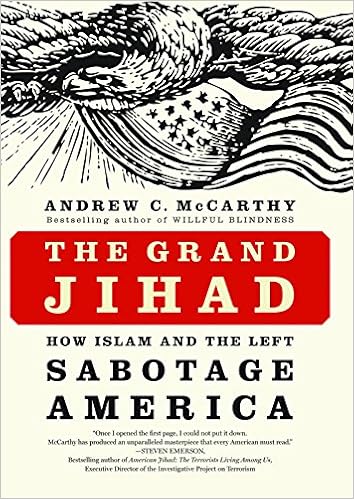
On Sunday, the Feast of Christ the King in the older, traditional calendar, I prayed the Act of Consecration. Among the things I prayed was….
Be Thou King of those who are deceived by erroneous opinions, or whom discord keeps aloof, and call them back to the harbor of truth and unity of faith, so that there may be but one flock and one Shepherd.
Be Thou King of all those who are still involved in the darkness of idolatry or of Islamism, and refuse not to draw them into the light and kingdom of God.
Sts. Nunilo and Alodia, pray for us!
St. Michael the Archangel, pray for us!
Our Lady of Victory, pray for us!
Our Lady of the ROSARY, pray for us!

Coat of Arms by D Burkart









A Daily Prayer for Priests


They find you a pro-life agent in your area who commits to giving a portion of the fee to a pro-life group!

PLEASE subscribe via PayPal if it is useful. Zelle and Wise are better, but PayPal is convenient.
A monthly subscription donation means I have steady income I can plan on. I put you my list of benefactors for whom I pray and for whom I often say Holy Mass.
In view of the rapidly changing challenges I now face, I would like to add more $10/month subscribers. Will you please help?
For a one time donation...



Help Monks in Wyoming (coffee – UPDATED LINK) and Norcia (beer) and the wonderful "Soap Sisters" of Summit, NJ!


Please follow me on Twitter!










Visits tracked by Statcounter
since Sat., 25 Nov. 2006:

