ASK FATHER: My priest doesn’t carry the “emergency phone”

From a reader…

QUAERITUR:

What’s the deal with priests carrying their emergency cellphone on them? [Hmmm… I don’t know what the deal is!] I was disturbed to learn that our priest doesn’t keep it with him. When I asked him about it and raised my concerns, and he said that it’s not that busy and that according to St. Alphonsus Liguori, priests are only responsible for the souls directly with them.

This doesn’t sit right with me. Basically I can’t call if there’s an emergency (and they have happened in the past for our former priest who would get called out for emergency sacramental needs) because he doesn’t keep his emergency cellphone with him. I have to rely on some other priest for emergencies. [So, there is one.  Okay.] I’m sure the number gets abused, but still. We all have our crosses, this one seems a bit minor.

Other people’s crosses usually are a bit minor.

So, the priests have, over time and according to their experience, their schedules, their inclinations (yes, priests are allowed to be different), handle the “emergency phone” ways that vary from your wishes.  When you want to contact the priest, then by golly, he’d better pick up.

Sure there are emergencies: hospitals have chaplains and/or priests in rotation who can cover.  They are the first line of contact in emergencies, depending on the region, local custom etc.  Of course if there is an agreement among the priests in the area, that’s another matter.  Everyone should pull his weight.

And we all have to keep in mind that the sacrament of anointing is more of a sacrament because Fr. Sven O’Reilly gives it rather than Fr. “Just call me Bob” Hühnerbein.

This email reminded me of something I posted many years ago, sure-fire way method for how to improve your priest:

The Perfect Priest

The results of a computerized survey indicate the perfect priest preaches exactly fifteen minutes. He condemns sins but never upsets anyone. He works from 8:00 AM until midnight and is also a janitor. He makes $50 a week, wears good clothes, buys good books, drives a good car, and gives about $50 weekly to the poor. He is 28 years old and has preached 30 years. He has a burning desire to work with teenagers and spends all of his time with senior citizens.

The perfect priest smiles all the time with a straight face because he has a sense of humor that keeps him seriously dedicated to his work. He makes 15 calls daily on parish families, shut-ins and the hospitalized, and is always in his office when needed.

If your priest does not measure up, simply send this letter to six other churches that are tired of their priest, too. Then bundle up your priest and send him to the church on the top of the list. In one week, you will receive 1,643 priests and one of them will be perfect. Have faith in this procedure.

One parish broke the chain and got its old priest back in less than three weeks.

And if that doesn’t work, there’s always this.  HERE

Posted in "How To..." - Practical Notes, ASK FATHER Question Box, Lighter fare, Liturgy Science Theatre 3000, Priests and Priesthood | Tagged
29 Comments

ASK FATHER: Absolution from a heretical priest and then going to Communion

From a reader…

QUAERITUR:

Today I went to confession during Sunday Mass at my parish (Novus Ordo, run by a religious order) [Why do I smell trouble?], and even though the priest (not the parish priest) said “I absolve you”, I also know (for many months now) that there’s a high possibility that he denies the existence of hell.

So I have two questions Father:

  1. Is the absolution given by priests who are heretics or possible heretics valid?
  2. Since I received Holy Communion during Mass, not knowing for sure the answer to the first question, did I commit Eucharistic desecration and/or sacrilege?

Thank you Father, and always have the courage to fight for God and thank you too for your blog.

Ad primum.   The absolution given by heretical priests is more than likely valid, just as is the consecration during Mass by heretics.  Provided that they say, do and intend what the Church intends by those acts, without a real act of will within themselves to deny what the Church intends – that is, saying to themselves “I intend to pretend to doing this”, then the absolution is valid.  The old phrase is that “the minister must have the intention at least of doing what the Church does”.  It could be that the minister has some faulty notions about the Church, but if he intends to make his own the Church’s own intention, the sacrament is validly administered.  Hence, in the case of emergency baptism, even an atheist can validly baptize, so long as she, when she pours the water and says the proper words, has the intention of doing for that person what the Church intends, whether she believes in what the Church teaches or not.

Remember that validity of sacraments depends not on the holiness of the priest, or his knowledge, or the accuracy of his notions.  Christ is the true administrator of the Sacrament of Penance and absolution through His agent the priest, alter Christus by reason of Holy Orders.

So, if Father Heretic gets into a confessional and hears confessions and gives absolution, he more than likely has at least an internal intention to administer a sacrament.  The absolution is, therefore, valid (provided he uses at least the minimal form).

Ad secundum:  You more than likely did not commit a sacrilege by going to Communion.  Even if you had a measure of doubt about the validity of the absolution at the time, you were not at the time of Communion sure that you were in the state of mortal sin.   You might have had a doubt or two, but you were not convinced that you were in the state of mortal sin.

If a person is sure that she is in the state of mortal sin, she cannot, must not, may not go to Holy Communion.  She is obliged not to receive, because she knows that she is in the state of sin and that Communion would be a sacrilege, compounding sin with sin.

If a person is in sincere doubt about her state, truly doesn’t know if she is in the state of grace, she can go to Communion.  Of course she should make a good act of contrition and resolve to go to confession, or to seek clarity about her state.  However, if she says, “I could be in the state of grace” or “I could be in the state of sin”, it is still permissible to go.  Mind you, that is not the optimal way to communicate, but remember the Lord’s mercy and the intention of one who cries, “I believe! Help my unbelief!” and as well, “God have mercy on me, a sinner.”

Of course nobody is obliged to receive Communion at this or that Mass!  If a person has doubts about her state, really doesn’t know, it is also perfectly acceptable not to receive.  As a matter of fact, if receiving would increase anxiety rather than bring comfort and peace, then by all means stay in the pew and pray.

The point is this.  If you know that you are not in the state of grace, don’t receive Communion.  That would be quite wicked and a real mistake.  If you are not sure, you think you are in the state of grace, but you are not quite sure, you can still go to Communion, even though it is perfectly okay not to go.

Everyone…

GO TO CONFESSION!

You won’t have to worry about these things.

And pray for your priest confessors.  Pray for them.  If they are heretics, do what you can to help them out.  Some of these poor guys were cheated in seminary and even in basic catechism.  That means that, before you approach them or make judgments about them, you really have to know your stuff.  The problem is, these days, a lot of lay people don’t know that they don’t know things and they don’t know what they don’t know.

Posted in "How To..." - Practical Notes, ASK FATHER Question Box, GO TO CONFESSION, Liturgy Science Theatre 3000 |
5 Comments

Your Sunday Sermon Notes

Was there a good point made in the sermon you heard during your Mass to fulfill your Sunday Obligation?

Let us know.

You were paying attention, weren’t you?

Posted in SESSIUNCULA |
14 Comments

To Prelates: “Don’t Pee on My Leg and Tell Me It’s Raining.”

I’ve just spent a few minutes in a hard-hitting piece about The Present Crisis at Crisis.  Here are a couple of outstanding paragraphs.

The apostle Paul certainly saw the redemptive side of scandal and division: “For there must be factions among you in order that those who are genuine among you may be recognized” (I Cor. 11:19). At least the laity, operating as Mary’s Heel, can say to a prelate like Cardinal Blase Cupich or a priest like James Martin, “We know who you are, and we know that you know that we know.

About those who persist in telling us that the problem is “clericalism”:

Prevaricating Priests and Prelates
The fervent devotion to the Idols of Honor and Power is reflected in recent bald-faced lies and gaslighting. The more desperate you are to defend your power and prestige, the more patently false statements you will make.

The priests and prelates sometimes remind me of a title from a Judge Judy book: Don’t Pee on My Leg and Tell Me It’s Raining. [US HERE] We’re told by Cupich (over and over), Francis, and Martin that the real problem is “clericalism” when a recent landmark study (and the John Jay Report) by Father Paul Sullins, a retired Catholic University of America sociology professor, refutes that thesis: “The data show that more homosexual men in the priesthood were correlated with more overall abuse and more boys abused compared to girls.”

And there is this:

We must remember that Athanasius was a minority of a minority. First he was in a minority of bishops who did not get seduced by the Arian heresy, and then he was in the minority within that contingent who raised a hue and cry.

Good men are not hard to find but good men with courage are rare. Fortitude is not the defining mark of the human species.

Ancient Hebrew wisdom tells us that the fear of man is a snare (Prov. 29:25), and no doubt many bishops don’t relish the idea of becoming a pariah, especially with the pontiff’s history of ousting, demoting, and marginalizing those who don’t conform to his agenda. Consequences can be severe: remember that both Archbishop Viganò and Fr. Kalchik are in hiding.

Serious times.  Sobering times.

Posted in ¡Hagan lío!, Be The Maquis, Hard-Identity Catholicism, The Coming Storm, The future and our choices | Tagged
11 Comments

Pre-Post Thanksgiving, Pre-Post Christmas Shopping

I’ve already started on my Christmas shopping list.  I want to get everything settled so that I don’t have to think about it as Christmas draws near.

May I ask for you, dear readers, to consider using my Amazon search box or links to do your shopping?  It would be of great benefit for me.

I have a search box always on the right side bar.

If you go into Amazon through my link, I get a small percent of the sales.  This adds up.  I rely on this for expenses like health insurance, etc.

BTW… I have an Audible.com membership, which gives me a “credit” each month to be applied as I wish.  This can save quite a lot of money in getting audiobooks and audio courses.  Right now I am working through a very good course, in the Great Courses series, Reason & Faith: Philosophy in the Middle Ages (US HERE – UK HERE).   Purchased by itself, it costs quite a lot, but you can apply a “credit” to buy it and save a lot of money, about half.

You might consider an Audible membership.  And you can give them as gifts.  You might give Audible a try.  US HERE – UK HERE.  I think the UK users can get a 30-day free trial.

And don’t forget your good ADVENT MUSIC!  The wonderful Benedictines of Gower, have music discs for Advent and for Christmas.  Good stocking stuffers.  US HERE – UK HERE   And Caroling at Ephesus US HERE – UK HERE

Posted in SESSIUNCULA |
Comments Off on Pre-Post Thanksgiving, Pre-Post Christmas Shopping

ASK FATHER: Could the Church make “communal services” the norm for the Sacrament of Penance?

From a reader…

QUAERITUR:

Father,

In John 20:22-24, it says “And when he had said this, he breathed on them, and said to them, ‘Receive the Holy Spirit. If you forgive the sins of any, they are forgiven; if you retain the sins of any, they are retained.'”

I’m interested in knowing the limits of this authority.

For example, it seems clear to me that they were not authorized to forgive the sins of the unrepentent, [A key point.] and I ask you to consider that a “given” in the rest of this discussion. God will not be made a fool.

We know that venial sins can be forgiven without confession, through various other pious works.

We know that baptism forgives all sins, including mortal sins, committed up to that point. And that the Sacrament of the Sick forgives venial sins (and, as I recall, mortal sins if the patient is not able to confess, and would have confessed if he were able).

We also know that the ordinary way mortal sins are forgiven is through the reception of absolution in a confession in which the penitent orally confesses all his mortal sins, in number and kind, to a priest who has faculties to hear the confession.

We also know that under certain extreme circumstances (e.g., a sinking ship or an airplane about to crash) a priest can validly absolve even mortal sins with a general absolution (abuses of this practice notwithstanding).

We also know that a priest must have faculties to absolve to be able to do so validly. These faculties can be extended or denied to persons, geographical territories, or even to particular sins (e.g., abortion).

We also know that any priest, even a laicized or apostate priest, can validly absolve a penitent in danger of death.

The Church also has at least some authority to define certain things as sins in one time or place and not another (e.g., Holy Days of Obligation, fasting and abstinence).

It is also my understanding that in the early church the practice of confession did not take the form it has today, although I don’t know what the differences were.

So we see that this authority can be exercised, changed, or denied through human law or decree (e.g., faculties, the specific form confession takes, etc.)

My question is this:[Whew!] What are the limits of the Church’s authority to bind and loose mortal sins? Could, for example, the Church make penance services, with general absolution and no individual oral confession of sins to a priest, the ordinary way mortal sins are forgiven? If so, how far could the Church go in this direction?

I’m not asking about what would or would not be a good idea from a pastoral point of view. I’m only asking about validity.

Thank you for all the great work you do!

Firstly, that was a pretty good summary you gave.  I am pleased to post it, because it could be instructive for others.

In the antepenultimate, you move too quickly from the “limits of the Church’s authority to bind and loose” to the manner in which that is enacted.

The Church’s authority to forgive sins is pretty much unbounded, but with one provision that you brought up.  The penitent must be penitent.  That is, the person whose sins are to be forgiven must truly be sorry for those sins with either attrition or contrition.  No repentance and sorrow, no absolution.

There is no sin that is so great that it cannot be forgiven.  So, the Church’s authority has no bounds in that respect.  Also, the Church determines how sacraments are celebrated.  So, the Church is free in that respect.  However, sacraments have their proper nature and that nature must be respected.  The Church is necessarily bound in by the nature of the sacrament itself.

The manner of celebration of sacraments is determined by the Church.  Hence, all the sacraments have undergone changes in their rites over the centuries.  However, the essence of the sacraments have not changed.  Holy Church teaches that sacraments have both matter and form.  With most sacraments there is a material matter (the bread and wine, the water, the oil) and form (the words prescribed by the Church).   The matter can vary (the West uses unleavened bread and the East leavened) and the form can vary (the form for Confirmation changed after the Council, and both the pre-Conciliar and post-Conciliar are valid).  What can’t change is that there must by BOTH matter AND form.

The Church teaches at Trent, along the lines of St. Thomas, that the matter of the sacrament of penance is comprised of the acts of the penitent, including sorrow, confession of sins, atonement or desire for atonement.  In the case of this sacrament, that matter is sometimes called quasi-matter rather than just matter because the acts of the penitent (sorrow, confession, desire for atonement) aren’t material substances (water, oil, wine, bread).    There are those who hold that this quasi-matter is necessary for the completeness of the sacrament, as a kind of pre-condition, but not necessarily its essence.  That is to say that, because the acts of the penitent are not themselves the causes of grace in the soul, the priest by his absolution is the sole administrator of the sacrament.  Hence, the unconscious can be validly absolved, even though they are not themselves acting to provide the quasi-matter.

In fact, there are times when it is impossible for a person to act, to express outwardly sorrow, confession and purpose of amendment.  Physical impossibility allows for absolution without the quasi-material completeness of confession of sins, etc.  Hence, when in the moment that absolution must be given, the material, outward confession is not complete (the penitent can’t confess, the penitent has sincerely forgotten some sins, the penitent confesses sins that are already forgiven and therefore gone, etc.) those sin are nevertheless absolved, though indirectly so, rather than directly.   And something is left incomplete, even though absolution was validly given.

There remains a duty to confess all sins, to bring completeness to the sacrament.  That is why in the case of “general absolution” the penitents (conscious or unconscious) have an obligation, as soon as possible, to make a regular, good confession of all mortal sins in kind and number.

Could the Church determine that the ordinary way of receiving the sacrament of penance would be through communal services lacking any outward confession of sins, expression of sorrow, etc.?  One might argue that, by the fact that they are there, the people seeking the sacrament are showing some sorrow, etc., which could be sufficient.  Also, in the ancient Church, even when there was public confession of sins, a distinction was made about those sins which, because of their nature, had to remain secret and those which had to be revealed.  Therefore, it seems possible that there can be communal penance services in which there is no open confession, profession, etc., with valid absolution.  And the Church has those, according to the law, etc.   However, again and again the Church affirms that penitents are, thereafter, strictly obliged to make an auricular confession of sins as soon as opportunity affords.

Keep in mind also that, over the centuries, we understand a great deal more about sacraments and the sacrament of penance than our forebears did in the ancient Church.  Certain practices dropped away as our knowledge and wisdom developed.  That’s why certain practices that were once valid are not done now: we found better ways, better rites, to express the inward, sacramental reality.  We are our rites.

Could the Church lay down that communal services are the ordinary way to receive the sacrament?  No, I don’t think so, because of the nature of sacraments as having matter and form.  We don’t allow that the minimum required for validity is the ordinary way sacraments are administered because the complete celebration of the sacrament is important ad integritatem.  We don’t just walk into church and have Father say, “This is my body”, etc. over bread and wine, then receive it and walk out.  We don’t just pour water with the words and baptize without everything else, except in cases of emergency.  And, in the case of emergency baptism, the person was then to go through at a later time the rest of the rites that were omitted!   Communal penance without confession and expression of sorrow and amendment, is like the 30 second consecration of bread and wine and communion (valid consecration but horrifying because it is outside of Mass).

Emergency conditions which reveal the minimal for validity don’t provide a good foundation for ordinary practice.

The matter (quasi-matter) of the sacrament of penance must be respected.

In any event, I hope that clear up that question.

And since it is Saturday…

GO TO CONFESSION!
Posted in "How To..." - Practical Notes, ASK FATHER Question Box, GO TO CONFESSION, Liturgy Science Theatre 3000, Our Catholic Identity | Tagged , , ,
3 Comments

UPDATED BRICK BY BRICK in Florida! New Sunday TLM established.

UPDATE 17 Nov 2018:

From a reader… more movement in Florida.  I think this was cut and pasted to me, but… oh well.

Father Z – thought you’d like to see Florida is headed in the right direction. From Fr. Jeremiah Payne in the Orlando Diocese: For the first time in Palm Bay in 53 years, come join us at St. Joseph Catholic Church on Babcock Street for the Extraordinary Form of the Roman Rite, often known as the Traditional Latin Mass, celebrated under the provision of Pope Benedict XVI’s Summorum Pontificum on Gaudete Sunday, December 16th, at 1:30 PM. Fr. Jeremiah will be the celebrant, celebrating his first traditional Latin Mass in public. We hope to make this, at minimum, a monthly event. Please be generous in your support. Save the liturgy; save the world.

___

Originally  Published on: Nov 2, 2018

I received wonderful news this morning.  A kind soul informed me that a regular Sunday Traditional Latin Mass will be implemented.  Here’s what I received:

Friends,
Great news! Another traditional Mass is starting up in the Diocese of Palm Beach—in Vero Beach. 12 pm Sundays! beginning the First Sunday of Advent 2 December at Saint John of the Cross 7590 26st Street, Vero Beach, Florida 32966.
We are very grateful to the decision-makers who have made this possible.
Please share this invitation with friends in Vero Beach!

This comes from the Friends of the Traditional Mass Jupiter

Brick by brick, friends.  This is how we reclaim our Catholic identity.

We need side by side, frequent, offerings of the TLM everywhere.

You’ve seen how things are going in the Church.

‘C’MON FATHERS!   Let’s get going!

Posted in ¡Hagan lío!, SUMMORUM PONTIFICUM, The Campus Telephone Pole | Tagged
5 Comments

Latin-less Priests and Homeschoolers – UPDATED

UPDATE 17 Nov:

I’ve received some interesting emails since this discussion about Latin began in these electronic pages.

First,

Thank you for writing such an awesome blog. I am a big fan. In your recent blog about the future of NO/TLM masses you mentioned Latin resources. I can recommend Getting Started with Latin by William E Linney. It is not expensive and he gives you a website to download audio for the lessons. The audio is in classical and/or ecclesiastical. Both are free. Granted it is for home school but, when you start learning Latin at 55, be humble and childlike. The audio really helps. Finally, this is very affordable and I found it on Amazon.

US HERE – UK HERE

Also,

Am a Latin teacher and want to help!

Message:

I just read a post regarding the dearth of Latin instruction for priests. I would consider it an honor to teach any priest – gratis.

Please let me know how I can help!!!

I find these messages consoling.

___

Originally Published on: Nov 16, 2018

This is amusing, in a relevant and hopeful way.

From a reader:

Just an idea, Father. There are many of us homeschooling families that are instructing our children in Latin. We have many great curricula choices at our disposal. Some even offer classes online. Perhaps we can be of service to any priest that would like to learn Latin!

I’m picturing this.

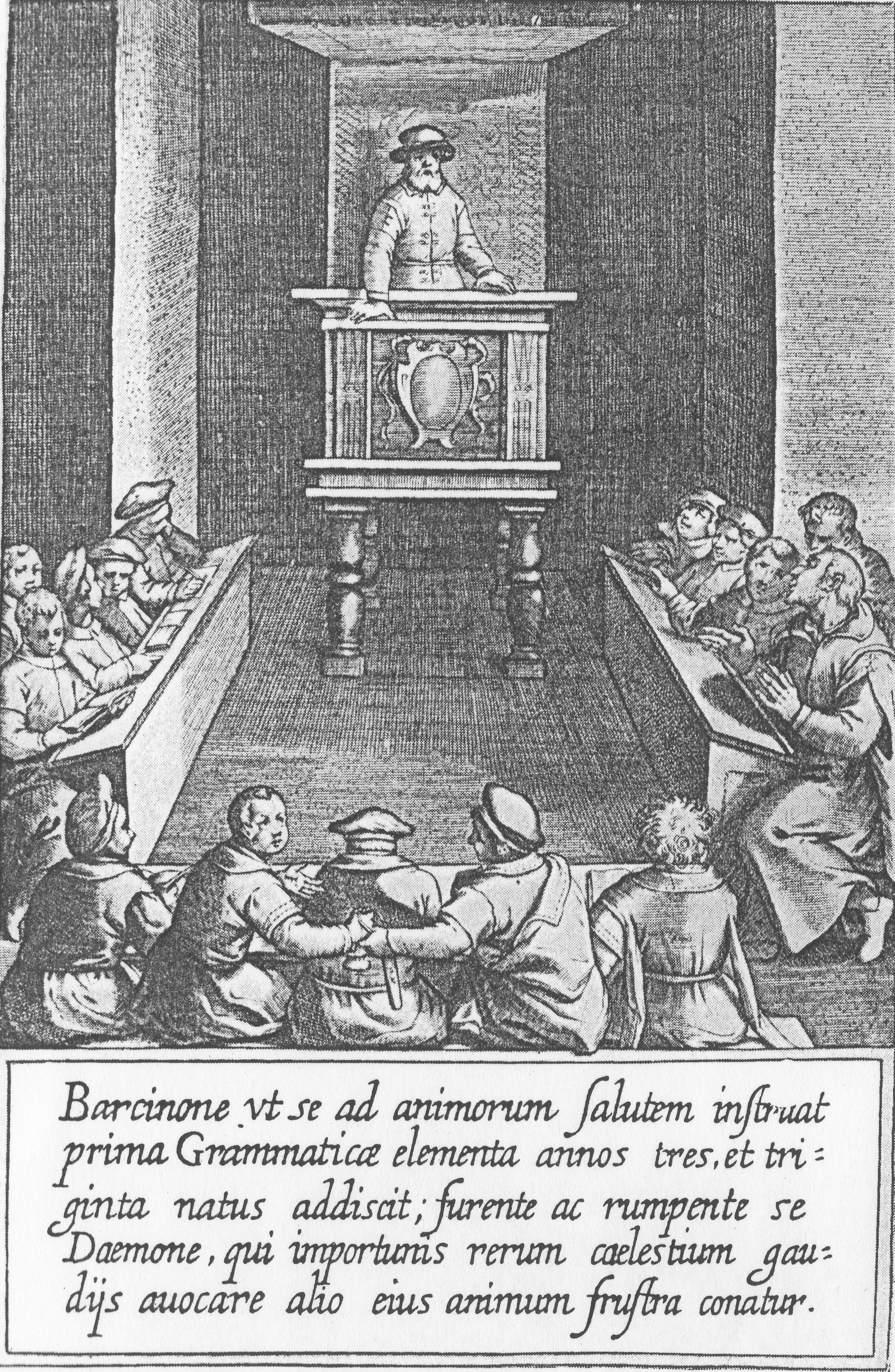
At the same time I am picturing St. Ignatius of Loyola, after his conversion.

He didn’t know Latin. Hence, he couldn’t go on to higher studies, which were, of course, in Latin. So, in Salamanca at the age of 33, he had to sit in Latin class with children.

Ignatius is depicted on the right (where else).  He is in a sort of trace, probably induced by he sheer beauty of the time shifts of verbs in past contrary to fact conditions related in indirect discourse.


Posted in Latin, Lighter fare | Tagged , ,
19 Comments

More Jesuit antics in that ‘caput malorum omnium’ the Church in Germany

Putting the pessima in corruptio optimi pessima.

From a reader:

Dear Father,

Apparently, the Vatican has accepted P. Wucherpfennig SJ as rector of the Jesuit High School Sankt Georgen in Frankfurt, Germany. He was recently denied the nihil obstat by the Vatican because of his stance for a woman diaconate, and for a blessing of homosexual couples which he suggested might be proper forms of romantic relationships, and which he called “virtuous” – as you may already know.

After theologians from Germany have signed a document supporting Wucherpfennig, and criticizing the cruel and anti-science stance of the Vatican, this Thursday, the Vatican finally gave the nihil obstat to this Jesuit, which means he is confirmed again as rector of the Jesuit High School, where he can continue with his “research”.

I give you my personal translation of the article on kath.net (http://kath.net/news/65895):

“The Jesuit priest Ansgar Wucherpfennig can finally take up his office of rector of the Catholic High School [Hochschule] Sankt Georgen in Frankfurt [Germany]. The Vatican has issued the required confirmation, as the German province of the Jesuits announced this past Thursday in München. The General Superior of the Society of Jesus, Arturo Sosa, has received this required statement of credibility (“nihil obstat”) from the Vatican, and Pater Wucherpfennig has been “appointed the rector of the High School [Hochschule] Sankt Georgen effectively immediately.”

The Congregation for Catholic Education of the Vatican had issued the statement of credibility “after Pater Wucherpfennig accepted a declaration, in which he assured that he as priest and religious was obligated to follow the authentic Magisterium of the Church”, as the press release of the German province states. Where Pater Wucherpfennig’s offices would require it, he would explain the Church’s teaching on the possibility of ordination for women, and on blessing services for same-sex couples “completely and comprehensibly” [vollständig und verständnisvoll].

Pater Wucherpfennig already in February has been re-elected for a third term as rector of the Philosophical-Theological High School [Hochschule] Sankt Georgen. The dioceses of Hamburg, Hildesheim, Limburg, and Osnabrück use this institution for the training of their seminarians. The Vatican rejecting to issue the required “nihil obstat” to Pater Wucherpfennig, caused major upheaval in broad parts of Church, Science, and Society. In Interviews, the Jesuit priest has repeatedly criticized the Church’s dealing with homosexuals and women, and supported a blessing service for homosexual relationships.\

In his declaration addressed to the Vatican, Pater Wucherpfennig – according to the press release – additionally explained that the questions he as a pastor and scientist posed to the Church’s teaching, would also prospectively be labeled as his own by him. As Christian and scientist, he personally hoped for a further opening and advancement of the Church’s teaching regarding those points. His public statements about a women’s deaconate and a blessing service for couples which a sacramental marriage is denied, targeted this very advancement, as Pater Wucherpfennig explained.

The agreement between Vatican and Pater Wucherpfennig also includes Pater Wucherpfennig being obligated to now publish articles wherein he further elucidates and presents the results of his scientific research – “in loyal and creative continuity with the fundamental opinion of the Church regarding both issues”.

Georg Bätzing, bishop of Limburg [where the institution is located], remarks according to a press release of the diocese: “With many others, I have anticipated this decision with great hope”. The Provincial superior of the German Province of the Society of Jesus, Pater Johannes Siebner SJ, showed himself relieved that Pater Wucherpfennig could finally be appointed, and thanked the General Superior, Pater Sosa, expressively for his dedication to the cause.”

Posted in SESSIUNCULA | Tagged ,
13 Comments

ASK FATHER: Could Latin be suppressed? Wherein Fr. Z rants.

In a post yesterday, I wrote about the possibility that, before too long, the TLM might wind up being the “last Mass standing”. Why? Demographics are burning quickly and the present day hierarchy has only thrown more accelerant on the fire. It’s as if they want to empty churches so that they can be closed and cut up for piecemeal sale, like the beautiful church in Fall River.

A priest wrote:

I know this is being rather pessimistic, but, given the current state of affairs within the Holy Roman Catholic Church, how long do you think the TLM will actually last beyond the death of Pope Benedict XVI?

My heart aches at the possibility of the TLM being officially abrogated maybe within one year (more likely months) of the passing of Pope Benedict XVI. That is pure speculation but, very sadly, I think it is a reasonable expectation given the current state of affairs in Rome.

Satan hates Latin…..might the Latin NO also be abrogated in favor of a vernacular only Mass? Nightmarish things to think about……

I read this on the same day that I read on an Italian site that an Italian bishop who hates Tradition suggested to the bishops conference there that they do something to block Summorum Pontificum and to suppress all those places where the older Mass has taken off since 14 Sept 2007.  Of course the situation in Italy is far far worse that it is in these USA.   Italy is a disaster.   At the end of that blog piece the writer offered a painfully poignant state of the question paragraph for Italy (my translation):

There is something psychopathically sinister in all of that [effort to suppress Summorum] and it is the jealousy of the loser: in the collapse of their own utopias, in the winter’s freeze into which the radiant ‘springtime of the Council’ has changed, it is too painful to look reality in the face and to admit honestly one’s own mistakes. It’s better then to seek to destroy the little that still works, like the zeal and the decorum of the celebrations in the ancient rite and the flourishing of vocations in traditional religious institutes. The case of the Franciscans of the Immaculate and the hatred of the immemorial liturgy are clear examples of this insane frenzy of the unhinged shipwrecked, who try to overturn the few rafts that still float, rather than thinking of climbing onto them or building new ones.

The “invidia del fallito… the jealously of the loser… the failure”… spiteful envy.   There are several kinds of people working against tradition.  There are the hard-core ideologues, with ice in their veins, who want to overturn the very constitution of the Church and remake her into their worldly tool.  There are those who are the dupes of the previous who are also ideologues, but they are chumps and useful idiots.  Within this second group of vicious pawns, are a couple of subdivisions.  You have those who realize that everything that they have done has failed but rather than admit it, they plunge forward, hacking and slashing and burning as they go.  They’d rather see a smoking hole where a beautiful church one stood rather than permit its restoration and potential revival.  Others also see that their works are vain and that their hopes were empty.  Rather than lay waste about them, they curl up in the dark and suck their thumbs, unwilling to make any sort of change for good or ill.  They just dissolve into puddles of irresolute stasis.  But their stasis blocks the efforts of those who would act.   My old pastor, Msgr. Schuler, used to say about those in the Archdiocese in charge of vocations that they were like the Irish who sat around talking about how to starve together rather than planting some other crop than the same old potatoes.   What did Einstein offer?  Doing the same thing over and over in the hope of different results is insane.   That’s a big part of the worldview of the abovementioned ideologues.

Look.   I don’t think that this effort by that dopey bishop in Italy will go anywhere.   There is no upside for Francis in abrogating Summorum.

I think that the TLM is here to stay.  It is self-perpetuating now, once again.  There are enough priests who know what to do that it can’t be snuffed out.  There are plenty of resources again, along with the books and materials that are needed.  Nope.  It is not going to happen.  It can’t be obliterated.

Also, let’s say for the sake of argument, that Francis did do that, did try to crush out the older Mass or even Latin in the Novus Ordo.  I think that at this point such a move would be like Darth cutting down Obi-Wan.  The older form would probably spread even faster as a result.  I suspect that, if some priests obeyed and stopped saying the older Mass, many many more would probably keep going.

If these jokers think that they can, for example, create a clearing house for Catholic media as was suggested at the last Synod (“walking together”), they are clearly deluded.  If these jesters of the court of Francis think that the older form of Mass can be suppressed by force, they not in touch with reality.

Could the Novus Ordo be restricted to the vernacular only?   I am unaware of a rising movement to say Mass in Latin with the newer, post-Conciliar rite.  The numbers are not that great.  Too bad.  I doubt they will give that any attention.  I was, however, irritated with the newer edition of the English Roman Missal was issued and there was no Latin appendix, as there was in the old, appalling, Sacramentary.  One priest friend had a supplement printed which could be affixed into the English Roman Missal.  

Again, solving a problem by taking matters into his own hands.

YouTube thumbnailYouTube icon

Posted in "How To..." - Practical Notes, ASK FATHER Question Box, Hard-Identity Catholicism, Liturgy Science Theatre 3000, Mail from priests, Si vis pacem para bellum!, SUMMORUM PONTIFICUM, The Coming Storm, The future and our choices | Tagged ,
24 Comments