The Pope wants to hear from you. No. Really. He wants the “sensus fidelium”.

I haven’t followed the Pope’s South American trip, other than his statements about the “dumb” people and about a certain unpopular bishop.

However, Ed Pentin – who is reliable – says that the Holy Father apparently wants to hear from the faithful.

Pentin includes a link about how to write to the Pope.

I haven’t seen the text of the speech in which the Pope said this, but Pentin is reliable.

Soooo…. writing to the Pope (or bishops or priests for that matter).

He wants to hear the sensus fidelium?  The sensus fidei fidelium?  The “sense of the faithful”? Here’s what I say.

First, in order to have the sensus fidelium something is absolutely necessary as a precondition: The Faith.  You have be faithful in order to participate and express the sensus fidelium.

Second, there may be a lot of people who write to the Pope who really don’t have the sensus fidelium because they are not, in fact, faithful.

Address the envelope to

His Holiness
Pope Francis
00120 VATICAN CITY

Tips:

  • Do NOT put Italy on the envelope.  If you do, Italian post will handle it and.. well… enough said.
  • While handwritten letters seem more personal, typed or printed are easier to read.
  • Keep it BRIEF.  ONE side of ONE page.
  • Do NOT be disrespectful.
  • Do NOT tell the Pope what his job is.
  • Go ahead and tell him what you feel.  Don’t be crazy.
  • Go ahead and ask him for what you want.  Don’t be stupid or unrealistic.
  • End the letter with a promise of prayers.
  • Make sure your own address is on the letter, not just the envelope.
  • Sign your real name.
  • Include your email and your phone number.

If you write, adhere to these tips.  Seriously.  You’ll multiply your chances of being read and taken seriously.

Finally, were I Pope, or when I will be Pope, I would consider this to be an Extremely Bad Idea™.

First, it gives the impression that, after receiving letters and messages, etc., something might be changed.

Second, it gives the impression that dogmas are changeable based on the prevalent view or desire of some well-organized lobby.

One of the problems with the Kasperites is, as Thomas Stark explained (HERE) is that Kasper, and people around Francis, have substituted philosophy with politics.  They don’t have objective underpinnings, premises and procedures.  They have polls.

UPDATE:

Why might one write?

1 – To write such a letter requires you to understand well what you think, or feel, or desire to ask.   It is, in itself, a good exercise.  In a way, it is a type of examination of conscience.

2 – The recipient is unpredictable.  He has been known to call people by phone out of the blue.

3 – You never know what impact many letters consistently saying the similar things will have.

4 – He won’t be able to plead ignorance of what many Catholics think and feel when he goes before the Lord for his judgment.  And if his minions shield him from the truth, then they will be held accountable before God.

5 – Maybe it will make a difference.  You don’t know.  If you don’t write, it won’t be your letter that is the final straw.  It’s like the lottery.  Your odds are not good.  But you will not win if you don’t by a ticket.

Lest weakness or defeatism get the better of some of you… Paul wrote to the Romans (we read this today at the Sunday TLM):

Brethren: Be not wise in your own conceits. To no man render evil for evil, but provide good things not only in the sight of God, but also in the sight of all men. If it be possible, as far as in you lies, be at peace with all men. Do not avenge yourselves, beloved, but give place to the wrath, for it is written, Vengeance is Mine: I will repay, says the Lord. But, If your enemy is hungry, give him food; if he is thirsty, give him drink; for by so doing you will heap coals of fire upon his head. Be not overcome by evil, but overcome evil with good.
 

Posted in ¡Hagan lío! | Tagged
26 Comments

Your Sunday Sermon Notes

Was there a good point or two in the sermon you heard during your Mass to fulfill your Sunday obligation?

For my part, I spoke about the centurion and the Lord.  First, as a friend reminded me this week, Teresa of Avila notes that – now – it is only in the Eucharist that the Lord is vulnerable to abuse.  The Lord continues to “risk” in coming to us.  The centurion, in great humility and faith, took social risks to come to the Lord.  In this highly charged moment of encounter and risk we should not be complacent, thoughtless, indifferent.  Communion, and all the other things we do as Catholics, from making the sign of the Cross, etc., should not be allowed to become routine.  We must develop habits but without repetition that is mindless.    Saying, for example, the “Domine non sum dignus” three times should help us to be ever more mindful of what we are about to do and what a great gift it is.

All our devotions are gifts.  We must not abuse them directly or through carelessness.

I also brought up attacks on the sacrament of matrimony, which are also attacks on the Eucharist.    For our part we can battle the attacks by our own personal devotion and care.

Posted in SESSIUNCULA |
16 Comments

From a priest: an interesting experience saying Mass

From a priest…

I am a priest of ___, ordained now about a year and a half. I have been a regular reader of your blog since college, and I wanted to write you about an interesting experience I had the other day saying Mass.

I learned the Extraordinary Form in seminary, actually the semester before the practicum in the new rite. I joke that I’m one of the rare priests under the age of 70 who learned the old before I learned the new. I usually offer a low Mass about 2-3 times a week, on the days when I don’t have a public Mass. The other day, I went into the chapel to say Mass, and it had been a very long and tiring week, and I couldn’t really think straight. It had also been a few weeks since I’d been able to offer the EF Mass, as I’d been traveling a lot and my “mobile sacristy” does not as yet contain Extraordinary Form capability. I usually offer the OF in Latin when I travel, including on the great altar my brother built to put in my room at my parents’ house.

In any event, I found that even though it had been a few weeks, and even though I was very very tired, the rite just came back to me, just as natural as can be. I stumbled a bit on the pronunciation of the readings, being a bit out of practice, but other than that, I was able to just start the Mass and hang on, and it all came right back out again. It’s just a beautiful comfort for me of how much we can keep within us, how those words that give us access to God so intimately are always right there for us.

I think about something I told the first communion kids the other week, when their teacher asked me to tell them why learning their prayers was so important. I told them about the elderly folks I sometimes visit who don’t remember anything or anybody, but the moment I start saying the Our Father, they join right in. It stays with you, the gift of prayer the Lord gives us. I suspect that when I’m ancient and barely know my right from my left, I’ll still know my rites, and all it’ll take is that first Introibo to bring it all back.

God bless you and your work, Father!

Thanks for that!

First, I am encouraged at your story.  You have it now in your marrow.  That means that it is thoroughly yours now.  It is shaping you as a priest from within.

So many times I have encountered people who perhaps have not practiced their faith for many years but, when queued, they still know their prayers and catechism that they were required to memorize as children.   It is still within them, waiting to burst out.

Memorization is extremely important.

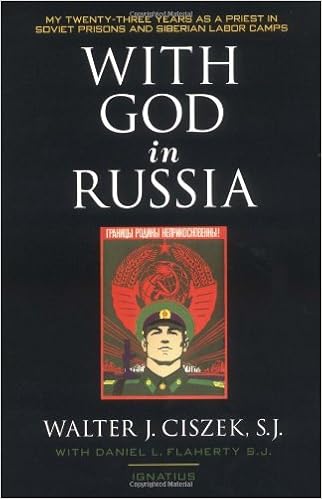
I am reminded of the way that priests who were to go into Russia during the long Communist nightmare memorized Mass formularies just in case.

With God in Russia The Inspiring Classic Account of a Catholic Priest’s Twenty-three Years in Soviet Prisons and Labor Camps by Walter J. Ciszek

US HERE – UK HERE

Of his imprisonment, Fr. Ciszek wrote:

It was impossible to say Mass in the barrack, of course. From time to time, however, Nestrov and I would take a walk into the forest, when we were free from work, and say Mass there. We used a big stump as our altar, and while one of us offered the Holy Sacrifice the other stood guard on the road. It was an experience I’ll never forget. In the heavy silence of the thick forest, you could hear the chipmunks running and the birds gathering overhead. Suddenly, you seemed very close to nature and to God. Everything seemed beautiful and somehow mysterious, all dangers for a time remote.

At other times, if we had an hour alone but couldn’t leave camp to say Mass, we would take turns reciting and memorizing the prayers of the Mass until we knew them all by heart. We were always aware that the Mass kit might be discovered, and we would lose our book and vestments, but we were determined that as long as we could get bread and wine we would try to say Mass.

And later…

After breakfast, I would say Mass by heart–that is, I would say all the prayers, for of course I couldn’t actually celebrate the Holy Sacrifice. I said the Angelus morning, noon, and night as the Kremlin clock chimed the hours. Before dinner, I would make my noon examen (examination of conscience); before going to bed at night I’d make the evening examen and points for the morning meditation, following St. Ignatius’ Spiritual Exercises. Every afternoon, I said three rosaries–one in Polish, one in Latin, and one in Russian–as a substitute for my breviary. After supper, I spent the evening reciting prayers and hymns from memory or even chanting them out loud: the Anima Christi, the Veni Creator, the Salve Regina, the Veni, Sancte Spiritus, especially the Dies Irae and the Miserere–all the things we had memorized in the novitiate as novices, the hymns we had sung during my years in the Society, the prayers I had learned as a boy back home. Sometimes I’d spend hours trying to remember a line that had slipped my memory, sounding it over and over again until I had it right. During these times of prayer, I would also make up my own prayers, talking to God directly, asking for His help, but above all accepting His will for me, trusting completely to His Providence to see me through whatever might lie ahead.

Fathers, seminarians, do you memorize?   It could be good to memorize a Mass formula, such as the classic Votive Mass of the Blessed Virgin Mary along with the Ordinary of Mass.

Frankly, we all should have the necessary prayers of Holy Mass memorized, right?

Parents, perhaps you could motivate your children (and yourselves) to memorize prayers and hymns and catechism answers through some prizes and so forth.

Memorization fell out of favor.  But once you have something memorized, it’s yours in way that it otherwise is … not.

Posted in SESSIUNCULA | Tagged ,
19 Comments

OLDIE PODCAzT 127: The Eve of St. Agnes and a Bleak Midwinter

It is a little late in the day, but today is the Eve of the Feast of St. Agnes.  This reminds us all, of course, of the famous poem by Keats.

This is the Eve of St. Agnes and, therefore, time once again for a PODCAzT I made a while back.  HERE

I, fan of poetry that I am, read out Keat’s poem, 42 Spencerian stanzas.  It is torrid and lush, with marvelous moments and imagery, imbued with the revival of romantic, courtly love which was coming back into vogue in the early 19th century.  The poem takes inspiration from a superstition, which I explain in an introduction.

The Eve of St Agnes would inspire the Pre-Raphaelites, as a matter of fact.

Speaking of Pre-Raphaelites, one of their circle, was Christina Rossetti, a poet in her own right.

Christina Rossetti wrote a poem which later was made into a Christmas carol: In the Bleak Midwinter.  We are still within the Christmas cycle until Candlemas.

When I first posted this, a few prudish knuckleheads had a spittle-flecked nutty in my combox, but we pretty much ignored or deleted them.


Posted in Classic Posts, Linking Back, PODCAzT, Poetry | Tagged , , ,
1 Comment

My View For A While: Counter March

Time to head home.

Another wonderful Delta experience greeted me at the airport.

First, in my app, all my flights, today’s and future, vanished. That was strange.

Hence, I had to go through the check in process. At least there were not problems with security.

I shared a ride with friends and, hence, got to DCA way in advance of my flight, thinking I could get work done in the lounge.

Lounge temporarily closed.

So, I have a view of counters, as I do my counter, or “reverse” march from the March.

UPDATE:

At long last, having been bored, we’ve boarded.

I have a good book on Kindle, a medieval Japanese mystery. Of course you need the right music.

Quite a few folks have asked if I was at the March. The interesting part is that only a couple of them went to the March. Most watched coverage on TV. This suggests to me strong good will.

UPDATE:

In my app, I see that my flights are back from their silent retreat and that my bag was loaded onto the airplane I am presently sitting in.

UPDATE:

Ready for the next flight.

While on the ground I’ve been reading about those who have distanced themselves from Pope Francis’ less than opportune words in S America. The NYT (aka Hell’s Bible) went for him. Other rather surprising sources did too.

Interesting.

UPDATE:

Still at the gate.

We’ve been delayed for over a half hour while they dispute about a “clerical error”.

I NEVER! Cross my heart. It’s not my fault!

Posted in On the road, SESSIUNCULA, What Fr. Z is up to | Tagged
4 Comments

#March4Life numbers and Pres. Trump’s words

LifeSite has posted the text of Pres. Trump’s address to the March for Life.

Highlights…

[…]

The March for Life is a movement born out of love: you love your families; you love your neighbors; you love our nation; and you love every child born and unborn, because you believe that every life is sacred, that every child is a precious gift from God.

We know that life is the greatest miracle of all. We see it in the eyes of every new mother who cradles that wonderful, innocent, and glorious-newborn child in her loving arms. I want to thank every person here today and all across our country who works with such big hearts and tireless devotion to make sure that parents have the caring support they need to choose life.

Because of you, tens of thousands of Americans have been born and reached their full God-given potential, because of you. You’re living witnesses of this year’s March for life theme, and that theme is, ‘Love Saves Lives.’

As you all know Roe versus Wade has resulted in some of the most permissive abortion laws anywhere in the world. For example, in the United States, it’s one of only seven countries to allow elective late-term abortions along with China North Korea and others. Right now, in a number of States, the laws allow a baby to be born [sic, aborted] from his or her mother’s womb in the ninth month.

It is wrong. It has to change.

Americans are more and more pro-life. You see that all the time. In fact, only 12% of Americans support abortion on demand at any time.

Under my administration, we will always defend the very first right in the Declaration of Independent, and that is the ‘right to life.’

[…]

Contrast that with the last guy.

Today is the 1st anniversary of his inauguration.

YouTube thumbnailYouTube icon

This morning a friend said that she heard a major network say that there were maybe 40000 people at the “so-called” March for Life.

Go HERE to LifeSite to watch an AMAZING time-lapse video and ask yourself if that was 40K.

I’d like to know the true estimate. 500K?

Meanwhile, in Chile, Pope Francis celebrated a Mass.  I think they expected more people.

Posted in Emanations from Penumbras | Tagged , ,
14 Comments

DC March for Life 2018 – DAY 2: Forward MARCH!

Today before the rally on the mall we grabbed some sandwiches at a nearby cafe and headed out.

Perfect weather.

We parked ourselves near the speakers stand, but also near to a flag from my native place.

It was great to hear Pres. Trump address the crowd.  It was a good, long speech, too.  Not just a quick greeting.


During the President’s talk, I noticed two American Bald Eagles circling, a fact that made my friends from Rome rather pleased.  After all, the appearance of eagles at a public event of this magnitude.

Alas, it was hard to get them through the branches.

A sign along the march.

The crowds for the march are always vast.  Today, however, I had the feeling that they were beyond what I had seen before.

My friend Fr. Pasley!

This was different.

So that was the march.  It was a wonderful, recharging experience.

Later I walked to Old St. Mary’s for the Mass, but I made sure to walk through the Law Enforcement Memorial.

Old St. Mary’s.  JAMMED.

I saw so many wonderful people after the Mass.  Many old friends said hello and quite a few readers.

Then… off to supper.  Friday, so no flesh.

Afterwards… which is mine?  Hint, all three contain Pappy Van Winkle.

A wonderful day.

Tomorrow, home again.

QUAERITUR: Will the government shut down affect travel?

Posted in Emanations from Penumbras, On the road, What Fr. Z is up to | Tagged
7 Comments

DC March for Life 2018 – DAY 1: Paintings and plots

It is a whirlwind jump to DC, but one of my main reasons for coming this year was also to see the exhibition of Vermeer and other Dutch genre painters at the National Gallery.   It did not disappoint.

His paintings are on the small side, but they have great details.

We didn’t have a lot of time in the gallery after the extensive exhibit, but there was a space for some of the great Medieval pieces.

Here is one with a Christological Goldfinch but… differently.   The Christ Child has not yet grabbed hold of the critter, which is being offered by an angel.

The goldfinch in these paintings is a symbol of the Passion, a foreshadowing.   The European Goldfinch has a spray of red feathers on its head.  Legend says that the finch tried to give comfort to the Lord on the Cross by pulling thorns from His head.  In doing so, the finch’s head was colored with the Lord’s Blood, which remained ever after.

NB: The little Lord holds in his little hand a pomegranate, a symbol of the resurrection!

I like to think that this angel is the angel of the Passion that came to comfort Christ in the garden before His betrayal.

The Capitol Building is all spiffed up and clean.

In the evening, supper with friends.

Which drink is mine?

Posted in On the road, What Fr. Z is up to | Tagged , ,
4 Comments

Canonist Ed Peters on the Papal mid-air airplane nuptials

From canonist Ed Peters comes a post.  I wrote about it, HERE.   There are some striking parallels.  I wonder why?

Any way…

Thoughts on a mid-air marriage

Show of hands! Who wants to rain all over the sentimental parade lining up behind (what is being presented as) the pope’s facilitation of married love? Anyone? Anyone?

I thought not. Oh well.

Readers of this blog know that I am no fan of canonical form for marriage (cc. 1108, 1117)—a cure that has far outlived the malady (clandestine marriage) it was designed to treat—but canonical form is still law for Catholics and that law goes to the validity of Catholic marriage. Based on the reports offered here and here, I cannot tell whether the ‘wedding’ that the pope put together for an unsuspecting couple satisfies Church requirements on marriage, and several other laws impacting the liceity of marriage seem simply to have been disregarded in the event. As happened several times under earlier administrations, a representative from the Vatican Press Office assures us that “everything was valid”. Such assertions by canonically unqualified and unauthorized PR staff carry, of course, no weight. Real questions worthy of real answers are still raised by this event.

Before getting into details, however, let me say that I am sorry for Paula Podest and Carlos Ciuffardi, two perfectly pleasant flight attendants who paid a courtesy call on their celebrity guest and, next thing they know, their names, faces, and rather odd marriage history are being broadcast to the world. They did not ask for a wedding and were astonished when Pope Francis suggested it. This was not their idea.

Now, about the matter itself.

Popes have jurisdiction for the external forum anywhere on earth (cc. 134, 331, 1108), so Francis can officiate at a wedding anywhere, anytime.

But officiating at a wedding means something specific: it means asking for and receiving the consent of the contracting parties to marrying each each other (c. 1108) here and now. Per the Rite of Matrimony consent is sought from each party individually and must be oriented to marrying the other party at this time; the request is not posed as a joint question to the couple about being married, akin to, ‘do you two want to be married?’, but rather is framed ‘do you marry him/her?’ at this point in time. If consent (the heart of marriage per c. 1057) is not adequately asked for and received, it is not exchanged, and such a couple would not be married [NB] (and, No, ‘Ecclesia suppletcannot make up for a failure in what is actually sacramental—as opposed to canonical—form). The above reports mention, as far as I can see, [Alas, we don’t know what really happened.] only the pope’s broaching the topic of marriage by asking the couple whether they wanted to be married, placing their hands together, saying a few inspirational words about marriage, and pronouncing them husband and wife. But such a sequence describes, not at all, a present exchange of consent by the parties. Let us hope, then, that in the actual event considerably more was said than has been reported.

Second, canonical form demands two independent actual witnesses to the exchange of consent, meaning that five persons must be immediately present for the wedding—not folks who heard about it a few minutes later, or who saw something happening and wondered, hey, what’s going on back there?—but five persons acting together and at the same time: a bride, a groom, an officiant, and two other actual witnesses. While reports are unclear as to how many people actually witnessed this event, and while this photo shows four people in the event (plus a camera man?) and four signatures on a document, another photo shows five names on the marriage document, so one may presume (c. 1541) accordingly.

Third, several canons impacting the liceity of weddings (norms on ‘liceity’ often being regarded as wink-wink rules in Church life, especially when higher-ups model the wink-winking) were apparently ignored here, including: the requirement for [NB] serious pastoral preparation prior to a wedding [Not ever omitted by a loving and merciful pastor…] (c. 1063), administration of Confirmation before Matrimony (c. 1065), urging of Penance and holy Communion before a wedding (c. 1065), verification that no obstacles to validity or liceity are in place (c. 1066), securing evidence of the contractants’ freedom to marry (c. 1068) upon pain of acting illicitly without it (c. 1114), an expectation that Catholic weddings be celebrated in a parish church (cc. 1115, 1118), and making use of the Church’s treasury of liturgical books for celebration of the sacramental rite (c. 1119).

As this story reverberates ‘round the world, now, deacons, priests, and bishops who try to uphold Church norms fostering values such as deliberate marriage preparation, an ecclesial context for a Catholic wedding, and the use of established and reliable texts for expressing consent will, undoubtedly, have the Podest-Ciuffardi wedding tossed in their face as evidence that, if Pope Francis does not insist on such legalistic silliness and only cares about whether two people love [Luuhv.] one another, why shouldn’t they do likewise? The ministry of conscientious clergy in this regard just got harder.

As mentioned above, I would be happy to see the requirement of canonical form for marriage eliminated, this, for several reasons, one of which is that—long story omitted—we could actually make higher demands of Catholics who want to marry before our clergy than we can currently demand. But the pope’s example of a spontaneous, zero-preparation, wedding is not at all what I and like-minded others have in mind. This couple undoubtedly gave more thought and attention to what they did by civilly marrying before a magistrate back in 2010 than they could have possibly given to what the pope suggested to them, on a few seconds’ notice, while at work, high above the Andes mountains.

If I have to say it, I will: I hope Podest and Ciuffardi are married and that they live happily ever after, but I worry whenever momentous life decisions are taken on a minute’s notice and under circumstances bound to contribute to one’s being carried away by events.

The pope has opined, apparently more than once, that “half of all sacramental marriages are null”. Here’s hoping that Podest and Ciuffardi beat those odds.

Posted in SESSIUNCULA | Tagged ,
13 Comments

The Pope marries a couple on the papal airplane. Hmmm.

I fairly dread papal trips these days. You never know what is going to happen on the papal airplane. Will there be another presser in which the Holy Father will say something like, “Who am I to judge?” That was a gift – now perpetually taken out of context and abused – that keeps on giving.



I read at Crux that the Holy Father married (witnessed the marriage) of a steward and stewardess on the papal airplane – during the flight.

Paula Podest, 39, and Carlos Ciufardi, 41, have been together for over ten years. They met in the air, where she was his boss as a flight attendant for LATAM, Chile’s flagship airline.
They have been civilly married since 2010. Days before they were scheduled to have their church wedding, an earthquake destroyed the church where they were supposed to marry.  [According to the Daily Mail, that was 8 years ago.  8 years… and they haven’t married in church?  I suppose they had marriage prep.  Also, in the case of an earthquake, the church building isn’t a sine qua non for getting married.  It is sad that they couldn’t get marriage in that church, but… marriage is the really important part of the equation, not the building or photos.]
On Thursday, as they were posing with Francis and the rest of the crew for the official picture, Francis asked them if they were married in the Church. They told him no, and the pontiff immediately took charge, asking them if they wanted him to marry them, and they agreed.

The newlyweds shared the conversation they had with the pontiff with the journalists, with Podest acknowledging that she was “still in shock,” so he did most of the talking, even though, from what they told journalists, “she’s still the boss in the house,” as she was at the airline when they met.
“It was historic,” the pope told them. “Never has a pope married a couple on a plane.”
“He asked us if we were married, I said no because of the earthquake, and he said, ‘well, I’ll marry you’,” according to Ciufardi.
The spouses asked the pontiff if he was certain about marrying them on the plane, asking him “are you sure?”

When the pope asked for a witness, they tapped the CEO of the airline, and to make sure there was no doubt over the validity of the sacrament, the pope “asked the cardinals who were with him” to draft the license, which they did. The document is handmade, signed by one of the cardinals, also a witness.
“He held our hands, blessed the rings, and he married us in the name of God,” Ciufardi said.
“What he said to us is very important: ‘This is the sacrament the world needs, the sacrament of marriage. Hopefully, this will motivate couples around the world to get married’,” Ciufardi said.
Speaking about the rings, Francis said that they shouldn’t be either too tight, because “they would be a torture,” or too loose, or else they might risk misplacing them.

These days there are controversies over the meaning of marriage.  These days, fewer and fewer couples are marrying.

For example, if a couple who are in an adulterous relationship because at least on party divorced his true spouse and then civilly marries another woman – without the church giving a declaration of nullity concerning his first, true marriage, can that remarried, adulterous couple be admitted to Holy Communion, even though they haven’t made any commitment to live chaste lives? Some say, “Yes!”, and, by doing so, they call into question the very meaning of matrimony and also the Eucharist.

At the very least, they make a mockery of matrimony, trivialize it.

I trust that this well-intentioned gesture by Pope Francis isn’t taken merely to be some sort of stunt, which the badly-motivated will utilize to trivialize the sacrament of matrimony even more than is is being trivialized today.

Another thing: may this couple stay together!  It would be… not so great were they to split up after this rather dramatic aerial display.  Headline: Papal midair marriage crashes!

I can’t say that I like the whole airplane thing.   The Pope makes his calls.  Who am I to judge?

Can we put sentimentality aside for a moment?   Gestures like this have consequences.  This wasn’t some odd priest on an airplane, it was the Vicar of Christ.

Again, this is all very huggy and warm and fuzzy.  But let’s think about this.

I wasn’t there, of course, but I think it could have been a good idea to make sure they knew what matrimony is really all about.   That’s what marriage preparation is for.  They’ve been civilly but not sacramentally married for 8 years.   All this time they didn’t seek the sacrament?  What’s that about?   Maybe the Pope got their story.

When a priest marries a couple, he should be reasonably sure that they know what they are getting into.  He can be fairly sure if they had some kind of marriage prep, done by himself or by another priest, etc.  You have to know before you witness the marriage of couple – if they are going to enter into this sacramental bond – whether or not they have the right intentions.   Does the couple – I’m speaking generically now – any couple – intend to remain together for life?   Do they intend for their bond to be exclusive?   Do they intend to accept the gift of children?

Also, the sacrament of matrimony is one of the “sacraments of the living”.  It should be received in the state of grace, after a good examination of conscience and confession.   Not by “surprise”, as it were.

Moreover, you have to ascertain if they are both free to marry, having no previous bond that the Church had to examine.  I imagine that, before tying their knot the Holy Father asked them about these things.  Right?   He was a diocesan bishop.  He knows about these things.

The Pope can dispense immediately anything that can be dispensed.  But if there is a previous bond… nope.  And an airplane isn’t the place to deal with Pauline or Petrine Privilege.   Get that wrong when you are Pope and problems result.

Sure, this on-the-spot – well…it was “on-the-spot” only relatively speaking – marriage took care of one instance of a couple living together. There are a lot more out there.

I wonder if the on-the-spot thing won’t spur odd situations:

“The Pope married someone on an airplane!   Why won’t you, Father, marry us right now here at the zoo?”

What do you want to bet that sort of thing will pop up for priests after this?

I hope that this no doubt well-intentioned gesture by the Holy Father won’t also wind up being one of those gifts that keep on giving, but not in a good way.

Anyway, I wish that couple a holy and happy life.

Posted in Canon Law, Look! Up in the sky!, One Man & One Woman | Tagged ,
41 Comments