More and more Pope Benedict’s intentions are being clarified in regard to the Church traditional liturgical expressions.
The Holy Father’s throne is raised high above the floor of the Basilica. I had heard when I was in Rome from one of the canons of St. Peter that there would be a dias of five steps.
This is a very "Roman" occasion. The mayor of Rome is present, and the Holy Father in his sermon adddressed the spiritual situation in the diocese, young people, the life of parishes, etc.
Vespers is on EWTN as I write. It is also available through CTV.
Can you believe that on the EWTN audio feed the speaker, all the way through, read from the English language breviary? When they were sining the hymn he read a text which had absolutely NOTHING to do with the hymn sung in Latin in the Basilica! I don’t know if that was EWTN’s audio or if it was coming from Vatican Radio. If the later, then that was truly embarrassing. How hard would it have been to get a service booklet, which are available in advance and then do the necessary homework? In any event, they sang the hymn for vespers of Christmastide, Christe redemptor omnium. I am not quite sure why they sang that rather than the hymn for 1st Vespers of the Solemnity of Mary Mother of God, Corde natus ex Parentis. Christe redemptor omnium is to be sung during the Octave unless there is a proper hymn, as there is for Mary Mother of God.
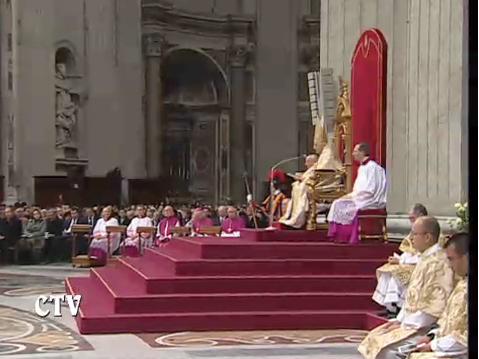
I truly detest the explanatory commentary in Italian sister, but … toleratur.
There is something important to notice. Gregorian chant is being used and not the drippy gooey personal melodies of the present director of the Cappella Sistina. I am sure he was informed that Gregorian chant shall have pride of place. I am sure he would like to keep his job.
For those of you inclined stinginess who might think this is too little too late, remember that it takes longer to build than to tear down. The Holy Father is moving pretty quickly now.
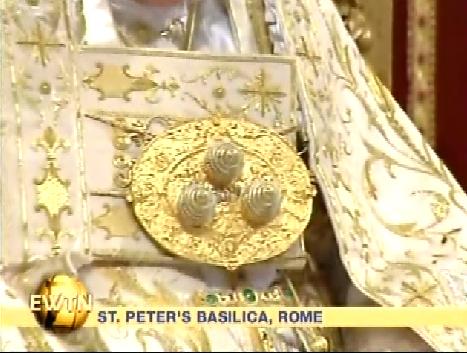
The morse of the cope:
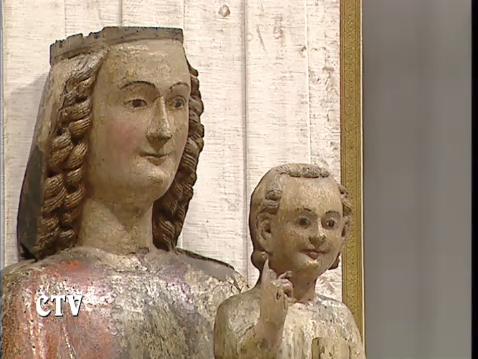
Also, note the medieval image of Mary chosen for the ceremony.
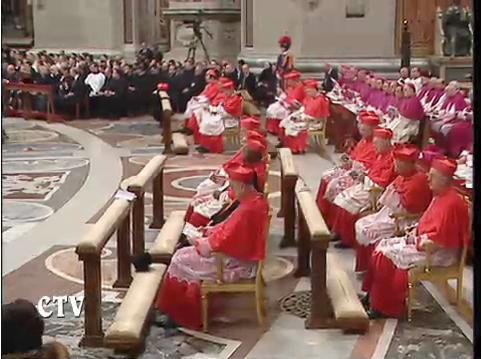
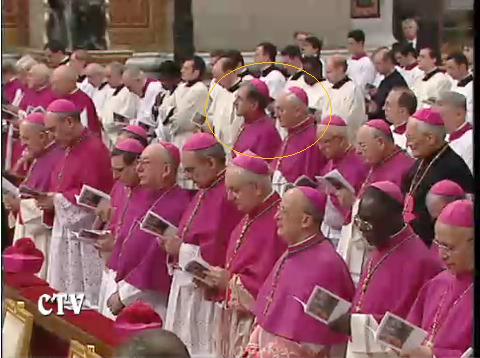
There are quite a few of the curial and other cardinals present.
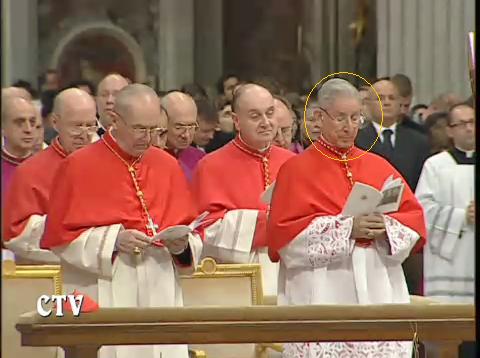
Cardinal Castrillon Hoyos, to whom those who love the older form of Mass owe a debt of gratitude.
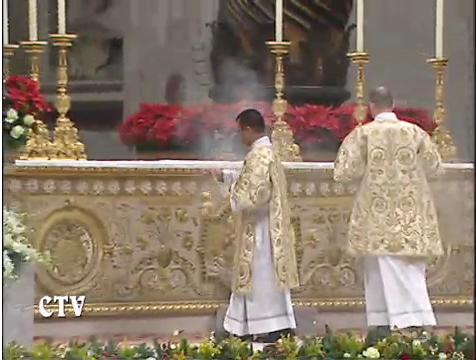
I rather wish that Cardinal deacons would have been the deacons for Vespers, but these two fellows did a serviceable job.
The Holy Father spoke in his sermon about the upcoming ordinations to the priesthood of nearly 30 men for the Diocese of Rome.
Their Excellencies Piero Marini and Renato Boccardo were preesent, together with their brethren in service of the Holy See.
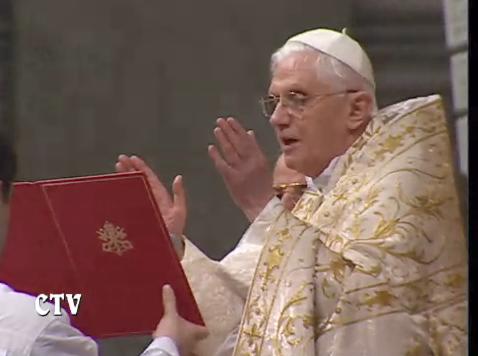
Pope Benedict sings the oration.
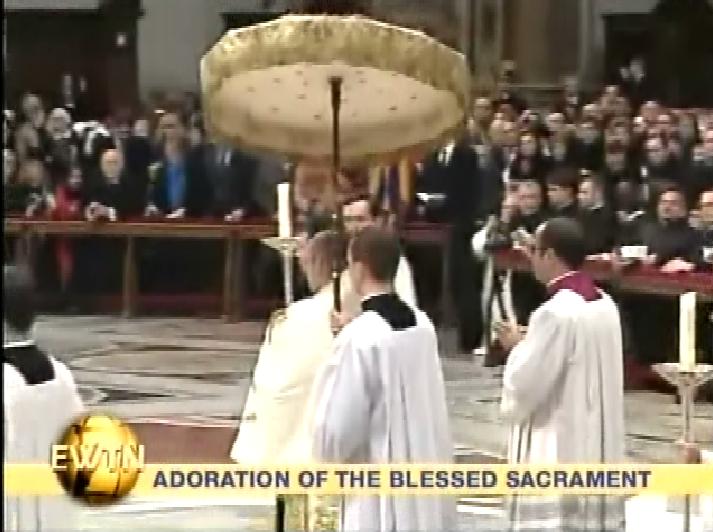
OMBRELLINO!!!!
There are some priests who think that having their cope or vestments held as they process is somehow not to be done, perhaps from false humility?
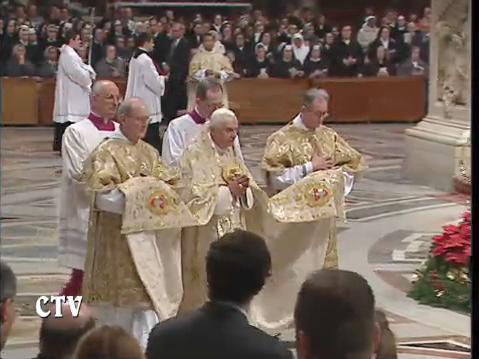
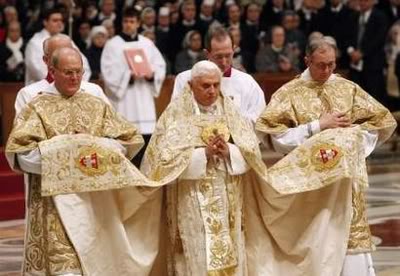
Adoration. Perhaps too much organ. Silence would have been better here.
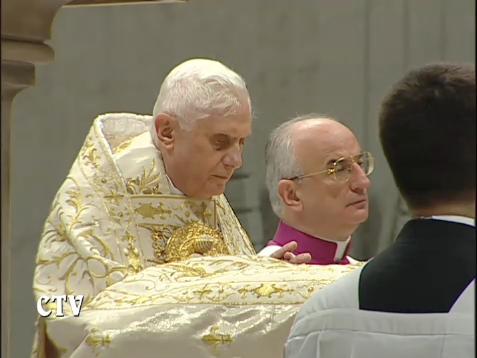
I would have much preferred a traditional Te Deum which is solemnly sung in God’s honor at the end of a year. I don’t know who wrote the Te Deum used today. I suspect it of fairly recent composition, since there was a little refrain to encourage congregational singing and you could hear traces of the traditional Te Deum.
As the great Fr. Finigan reminds us:
A plenary indulgence is granted to the faithful under the usual conditions who devoutly assist at the singing or recition of:
The Te Deum on the lst day of the year to give thanks to God for benefits received during the past year.
The Veni Creator on 1 January to implore divine help during the coming year.As ever, do see my post Plenary Indulgences not impossible if you are worried about the conditions
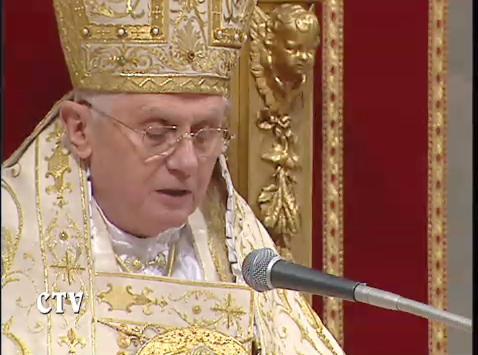
Another good look at the back of the cope.
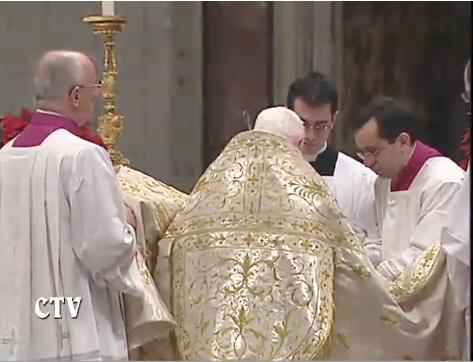
Benediction.
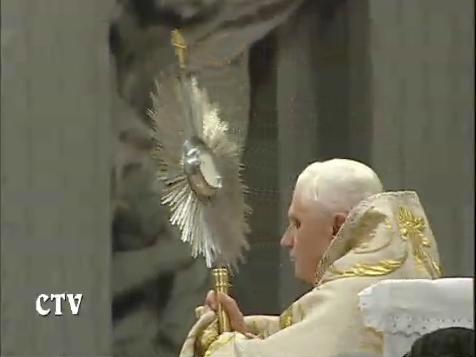
And the recessional:
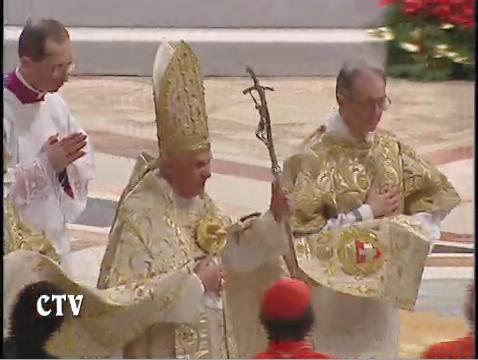
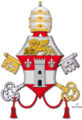
Judging from the coat of arms on the cope, this may have been from B;. Pope John XXIII, who was a great promoter of vespers for the Roman people.
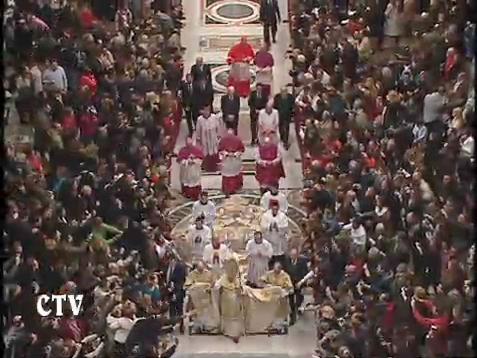
And back out into the Roman evening to find some supper!
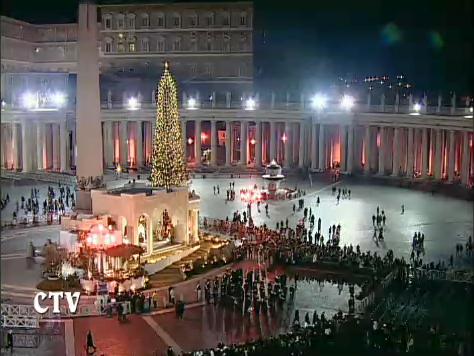
But wait! There’s more!
A band and kneeler are set up before the Christmas scene in the Piazza.
Here comes the Holy Father!
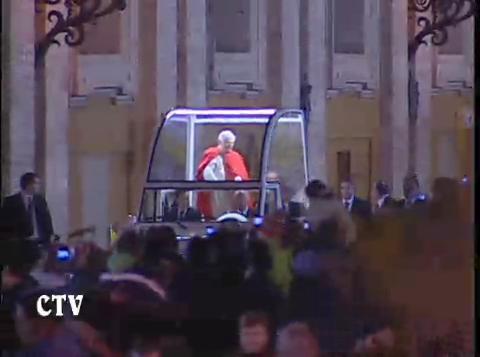
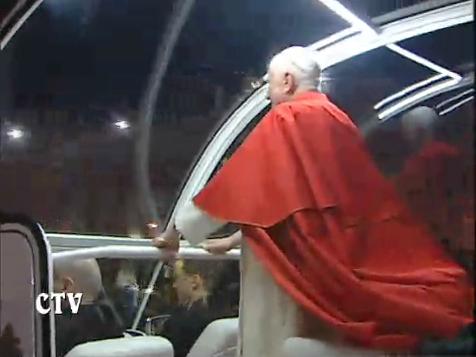
The band is comprised of the Swiss Guard and the Vatican police and perhaps also the Roman police.
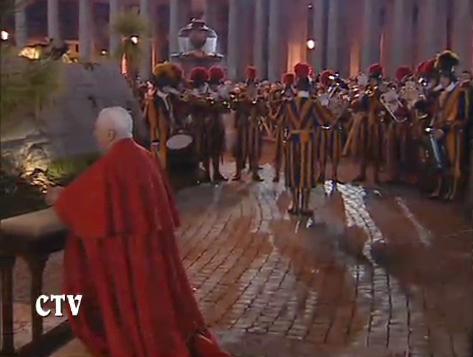
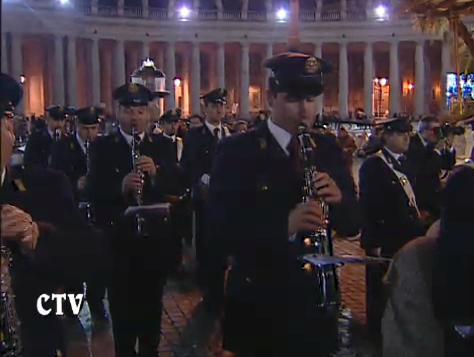
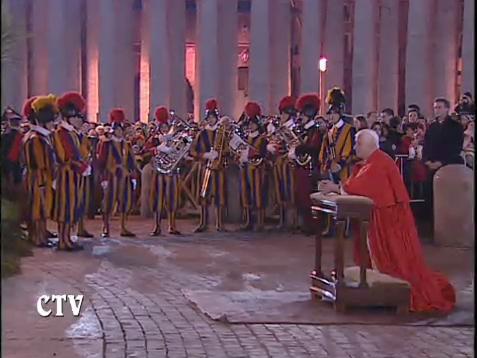
This is a marvelous occasion really. You see the Holy Father’s dedication to formal liturgical ceremony and also popular devotion, which is also of great importance in the life of the Catholic people. They strengthen each other, and the Holy Father understands that.
He is giving a good example as Bishop and chief pastor of Rome to his City and to the world. The broadcast of vespers and the visit to the Christmas scene in the piazza is his way of showing the bishops and priests of the world how this is to be done.































At the Sunday Vespers I have attended at St. Peter’s in the past, even in the days of Msgr. Colino, Gregorian chant was always used for the psalms by the Cappella Giulia . From whence does the statue of the Mother and Child hail? They are certainly taking seriously the aim to “demonstrate continuity with the past.” Hooray!
The Holy Father is moving pretty quickly now.
This is music to my ears!
Father Z,
Obviously the priest sitting to the Pope’s left is Marini II, but who is on his right hand side?
Zach
Not sure if it’s triumphalism so much as a practical re-use of traditional furnishings to make this pope more visible to the crowd. Papa Ratzinger is less distinguished by physique than his predecessor, who was quite easy to pick out of the crowd of prelates (at first by his lineman-like physicality, then by his frailty).
“I had heard when I was in Rome from one of the canons of St. Peter that there would be a dias of five steps.” And the five steps symbolize…?
Zach: That is Mons. Franco Camaldo.
This is truly amazing! I can’t decide which thing I’m liking the most, the umbrella or the lifting of the Pope’s vestment! :P
Where on earth did they dig up that infernal choral version of the Te Deum they’re botching? If they’d stuck with Gregorian chant they’d have been done in a quarter of the time, and the Holy Father wouldn’t have had to stand there wearing what’s obviously a rather heavy cope through the whole thing. Methinks HH will be having a few choice words with the kappelmeister afterwards…if he manages to survive this liturgy.
I can’t tell from the photos where this dias is; is it in front of, or behind the altar? Thanks to anyone who can answer.
They did seem to murder the Te Deum towards the end of it, not that it was terribly nice even at the beginning.
The Te Deum is by the Director, Mgr Liberto, and is available in print copies in Rome.
Happy new year!
My goodness, their rendition of the Adeste Fideles has managed to out-murder their Te Deum! Its truly awful.
Yes, the Te Deum was a bit much. The traditional chant would have been much better. Nonetheless, overall it was a magnificent ceremony where prayer was the focus and not the theatrics of the Archbishop Marini shows.
I am constantly amazed by what our Holy Father is doing. (Of course, I am not surprised either, because he is the man we know him to be.) What astounds me is the seeming decorum of the way he is changing things, restoring things, and correcting things. He is not changing things for change’s sake, or in the interest of liturgical archaeologism, but because the change is right.
I agree with all of you: The Te Deum melody was aweful. The organist obviously doen’t know what holy silence is all about. But the Holy Father always maintains the digninity of his office, and maintains the spirit of prayer in spite of the organist.
I’m afraid Rome still has a way to go in curing its musical woes. They could actually take a lesson or two from the Anglicans….pre-1970 of course. It has always amazed me beyond words how bloody awful the music is at St. Peter’s. It’s not like they can’t afford good music. Nor is it that they don’t have a treasure trove of wonderful music to pull from. Frankly even the quality of the singing is not what I would call “world class”. They don’t compare favorably to any of the great English Cathedrals. Even the organist sounds like he should be playing for a schmaltzy protestant service. Why is that?
Glorious! Cope, mitre, ombrellino, dalmatics, raised throne with backdrop behind the altar (why don’t they keep this arrangement for Mass? Everything is better than where the throne is now during Mass).
At first I was dismayed by the candle arrangement on the altar, but then very relieved when the Holy Father said during the homily that adoration was to follow, which explains it.
Two querstions: 1) Why was the regular Christmas Tide hymn “Christe redemptor omnium” sung, instead of today’s proper one, “Corde natus ex Parentis”?
2) Is it normal that the Holy Father as celebrant does not incense the altar himself, but has his deacons do it?
Father, I agree that we could do very well without Sister explaining the psalms to us. This should, if at all, happen during the homily, not all the time. This is one of the major problems of the liturgical reform – as my old parish priest put it: the highjacking of the liturgy by catechesis. But as you say, we have to be thankful for what the Holy Father has done in such short time, and await patiently the further steps.
I agree with all of you: The Te Deum melody was aweful. The organist obviously doen\’t know what holy silence is all about. But the Holy Father always maintains the digninity of his office, and maintains the spirit of prayer in spite of the organist.
Rassourcement at its finest, the way it should be.
Father: \”Judging from the coat of arms on the cope, this may have been from Bl. Pope John XXIII, who was a great promoter of vespers for the Roman people.\”
Sure it was. Wasn\’t it the same the Holy Father wore for the Urbi et Orbi Blessing?
BXVI is a new man from the one who arrived at Vatican II wearing a coat and tie.
BXVI wrote in Milestones that he returned to Germany after, I think, the second session
of VII and noticed a change sweeping over the Church, but instead of the hope forid
renewal, he noticed something negative and stale.
Tradition can never be stale, because like nature itself, things that are from God
are ever old but ever new and refreshing. There is nothing more stale than a Vatican II
worshipping pries in 70’s vestments trying to be relative and “cool”.
Truly amazing. That baroque hunched up back of the cope alone is enough to reduce me to tears.
Speaking of reducing people to tears, if you think the Capella Sistina is bad now listen to their recording of ‘Domine, salvum fac’ with Maestro Alessandro Moreschi as soloist.
Fr. Z, I agree that the Holy Father in doing this – particularly the mix of solemn liturgy and popular devotion – is showing his brother bishops how things are to be done. At the same time, I think he’s acting out of genuine and altruistic piety.
A priest friend of mine made the comment, upon seeing the Holy Father at prayer, “It’s like he actually believes this stuff.” Sadly, my friend (for whom I pray and ask for prayers) did not intend it as the compliment it truly is.
Okay…question for the rubrical experts:
Why the penitential morse?
Fr. Z. writes:
This is a marvelous occasion really. You see the Holy Father’s dedication to formal liturgical ceremony and also popular devotion, which is also of great importance in the life of the Catholic people. They strengthen each other, and the Holy Father understands that.
He is giving a good example as Bishop and chief pastor of Rome to his City and to the world. The broadcast of vespers and the visit to the Christmas scene in the piazza is his way of showing the bishops and priests of the world how this is to be done.
Once again, Fr. Z, your analysis “hits the nail on the head”. As I never tire of remarking (though my bishop does tire of me reminding him), a good bishop — indeed, a good father — teaches not only by his words but also by his example. And what an example the Holy Spirit has given the Church in this man!
Thanks, too, for giving us the “heads up” on this live broadcast. In about six hours I myself will be presiding at Solemn First Vespers in the context Eucharistic exposition, adoration, and benediction, and have been wondering for some time what might be the appropriate protocol for such a juxtaposition of liturgies. The rubrics are not particularly clear on that point.
Can anyone supply the order of service for this broadcast? I tuned in late, and noticed that they were singing the Te Deum, normally used at Vigils/Matins/Office of Readings, not at Vespers. Did the Te Deum supplant the Magnificat and its proper antiphon?
I do not believe that this morse or formale is “penitential”. I know that over at New Liturgical Movement blog there was an extensive post when the Pope wore this for Advent Vespers calling it the “penitential” formale but I believe that is a mistake. I have seen numerous photos (including one of B16 wearing this on Corpus Christi…hardly a penitential day) of popes wearing this morse on festive occasions. I do not think the three pine-cone decoration makes this morse penitential.
The cope is the same one worn by the Pope on Christmas and does date from the time of John XXIII. The mitre today (different than the one on Christmas) dates from Benedict XV and was last worn by John XXIII.
I do not believe the Holy Father must always be served by Cardinal Deacons. For an occasion like this one I think the use of actual deacons was a nice touch. I think the use of the Cardinal Deacons as attendants is kept, these days, only for the most solemn occasions.
What I’d like to see is a close up of the top of that red backdrop to the throne to get a better look at the small coat of arms that was there. I also thought it was nice to see them use the old faldstool for the Pope to kneel at, instead of a prie dieu and that they even placed the ends of the cope up over the top of the faldstool as in the “old days”.
Things REALLY are improving!
Father, I’m wondering how you captured all those CTV stills. Do you have CTV available in your cable TV or is it from your computer? I ask because for a good while I’ve been wanting to watch the papal masses and other Vatican events through CTV instead of EWTN but I can’t get a strong and stable video feed to CTV on my computer even though it’s on broadband. It’s terribly choppy and breaks up too much. I’m not sure if it’s because my computer is a laptop (Macbook) as opposed to a desktop, or it’s the software (QuickTime Player). Usually the coverage on CTV extends beyond EWTN’s often abbreviated broadcasts (which is understandable) and doesn’t have anyone explaining/commenting everything that is going on. EWTN is great with many of their programs but I think the link they provide to live Vatican events is constrained because of the necessary time demands they must adhere to, as any broadcasting station has to with their programming.
The procession down the aisle/nave looks awesome. The people seem overjoyed a not a bit put out that the spirit of Vatican II has flown off somewhere. If only our poor Holy Father did not have to walk in those heavy vestments. Let him be carried for gooness sake!
Father Arsenius: Did the Te Deum supplant the Magnificat and its proper antiphon?
No. It appeared to me that — after the usual conclusion of Vespers per se following the Magnificat (with 2 deacons with separate thurifers incensing the altar) — the consecrated host was brought out (under the ombrellino) and placed in the monstrance. Eucharistic adoration followed, ending with the Te Deum.
We’ve been having an interesting discussion over at The New Liturgical Movement on the Sistine choir. While their “style” may be a product of Italian operatic culture and while many of us may prefer English choral sounds or those of other regions, someone does really need to take over that group and instill some professional quality to it. Poor intonation, sloppy ensemble, and no attention to balance are not products of a culture, only poor direction.
Don Guido is quickly implementing many “Genoese” customs (also in the sense of once universal ones till recently preserved just in Genoa) ; among those, the ombrellino and the faldstool for benedictions.
Che bella! Roma mi manca…
OK we’ve all probably got views about this and that. But let’s for the moment stop nitpicking and just rejoice at the huge difference this great man has made over the last 2.5 years, and the example he is setting to the whole Church. 2007 in retrospect will be a truly memorable year. This is surely worthy of many Te Deums! Thank you, Holy Father. Ad multos annos!
Would it not be more appropriate for the Cardinal Deacons, or even the Deacons of the liturgy to sit directly next to the pontiff in the places where the M.C.’s have a seat and that they should handle duties such as assisting with episcopal headgear etc.? I still think the M.C. should be close at hand, but it seems that the M.C. has in too many cases come to take over directly roles that in the past were reserved to the deacon.
–Fr. B. Pedersen
Thank you, thank you, thank you for posting those great photos and the wonderful commentary! We’re doing a guerrilla Holy Hour and Benediction tonight. I live in a diocese that hates anything traditional, but only the traditionalist priest was willing to celebrate the vigil Mass tonight (I guess the others have to party hearty), and he decided to drag out anything he could that stated Rome and Church and tradition. So after Mass, we have our guerrilla service. And we will be singing a Te Deum – in Latin, with the little tiny schola leading the congregation who will sing from the program we’ve printed up.
“As long as the church wanders on earth, she has no right to glorify herself. The new triumphalism could become even more insidious than the tiaras and sedias gestatorias, which in any case and now more cause of smiles than of pride.” (The Ratzinger Report, Chapter One, Right-Left. Optimism-Pessimism.).
So (unfortunately) I suppose that there is no chance to see Benedict XVI on sedia gestatoria.
Fr. Z:
Isn’t “triumphalism” a bad word? Isn’t it a big “no-no” for many?
It is curious that the senior cardinal deacons have not yet been restored uniformly to their positions beside the Pope. It would be easy to do, and if the reformers were honest they would have to admit the custom is of immemorial antiquity in the Church and hardly a baroque intrusion.
By the way, I don’t think I have ever seen a photo of the great
Dante sitting down. In situations like the one pictured he is always a little in front of and to the side of the cardinal deacon on the left side, with the classic hands folded horizontally position, from which you can signal inobtrusively with your fingers. (Mons. Dante actually did a lot of pushing and shoving too). I hope correcting the MC’s position is on Mons. Marini’s list of things to do. The restorations are indeed coming fast and furious.
I could not agree more with Michael O’Connor. The professionalism of the Sistine Choir is obviously hampered by poor direction. Those not immersed in the centuries of auspicious English choral music may not know what they are missing. Those of us who HAVE had the pleasure often have our ears bent at odd angles by what occurs at St. Peter’s.
It really isn’t nit-picking to point this out. In this particular forum it goes without saying that we rejoice in the Holy Father’s firm and sure liturgical hand. It is a hand that we inherently accept as one that reaches beyond Himself and ourselves to mold the future of the Church. So it shouldn’t seem out of hand for us to debate here the things that prove useful to those of us being directed in the understanding of how far we truly have yet to go. Music is just a part of that journey. Altogether we have a great deal of ground to cover in order to arrive at our final destination. Knowing the burden can only strengthen us if we truly desire God’s will.
Let us all pray diligently for the Holy Father’s health, strength and (above all) continued service as our Supreme Pontiff.
I would like to point out that Arch. Marini suggested creating such a permament presider’s throne in St. Peter’s about where today’s throne was set up. So not all bad from his excellency. I must say while some of this restoration is indeed and beautiful, I would not be excited to see a return to the monarchical images of years past. The “throne” is close to that.
Would someone please explain to me the purpose of holding/raising the priest’s garment during the elevation of the host?
I cant stop smiling after reading this post!I caught the tail end of the vespers alas but it looked fantastic.It looks like Pope Benedict is channeling Pius XII lol!That vespers service could have been an old newsreel from the 1950’s!God Bless Pope Benedict for finally restoring some of the lost splendor of the papacy!If I was a multimillionaire I would send him a big check to revive small regiments of the Noble and Palatine Guard,foolishly abolished by Paul VI!I can’t wait to see the Pope’s mass tommorow.I want to give a shoutout to fellow Catholics in NYC/NYS.It seems like the “reform of the reform” fever that is sweeping the church is flying right over NYS!I live in Staten Island NY..a borough where the majority of residents are Catholic.We still dont have a weekly Tridentine Mass.When is poor NYC going to get a FSSP or Institute of Christ the King parish.I have family in Buffalo NY and Rochester who say the state of the church is so awful up there they could cry!Is there any hope for us?Has anyone heard of any good candidates to replace Cardinal Egan.I have heard some bad ones..like Cardinal Levada!I want to wish everyone a very Happy New Year!Lets hope we see the Holy Father offer the ancient liturgy on the high altar of ST Peter’s this year and that the SSPX schism comes to an end!God Bless!Ryan
I sleep pretty well at night thinking of the vicar of Christ sitting on the magnificent throne of pope Leo XIII. The one who binds on earth and it is bound in heaven by order of Almighty God the Son should sit on something more dignified that a forty dollar folding chair from Sears. I’m with Fr. Z. False humility is the pitts. I feel safer and more confident of the future with a man who acts like a pope standing on that balcony.
This was really lovely to look at and read. I am curious about something I wonder if you might know the order of the cardinal (?) sitting next to Cardinal T. Bertone (?) dressed in black. I’m sorry I’m totally ignorant but saw him during the Vespers telecast on EWTN and was very curious. Thank-you.
Monica,
Take a look at Pope Benedict’s copy.
Now imagine a chasuble like that going to his arms and down to his knees.
You need someone to help hold it up for the elevation (if you we’re doing it high enough and long enough).
This is also the reason the priests’ bench has a slot in the back of the seat. The chasuble goes down it so you don’t sit on all the embrodery [sic].
Monica,
That should have been
“Take a look at Pope Benedict’s cope“.
Sorry
What a wonderful evening! I told everybody at the Cathedral about the papal vespers, and a number of them had already seen the broadcast. Those who hadn’t, I sent here. We had our Vespers/Holy Hour and sang the Te Deum (1940 hymnal) and the Magnificat. Our Te Deum, btw, was in English – I notice that I had somehow deleted the word “not” before “in Latin” when I was posting above. The Magnificat, done only by the tiny, tiny guerrilla schola, was in Latin. We had a large crowd, a couple of hundred people, gathered entirely by word of mouth, and they loved it. Alas, the bishop wasn’t there. Maybe someday. But just doing it was good, for starters.
Refreshing and exciting seeing these wonderful images. It would also be excitingly wonderful if the coming ordination would be an entirely Tridentine ordination. What a totally fantastic grace that would be for the seminarians, and a definite a milestone in the Church. :)
Hm… and the liberals had me convinced until now that “Triumphalism” is a swear word. Not the first nor the last complete reversal in my journey towards Church Tradition…
Ryan writes: “Happy New Year!Lets hope we see the Holy Father offer the ancient liturgy on the high altar of ST Peter’s this year and that the SSPX schism comes to an end!God Bless!Ryan”
That is all happy and fine and well, but please don’t call SSPX schismatic. some, nay, many, of the greatest Christians on earth are members of SSPX; please don’t call them “schismatics” because they are not. They are loyal sons of the Church, even if irregular in the Church.
Great photos! Thank you, Father.
Thank you for photos e music. VIVA IL PAPA!!!!
The Pope IS a monarch, and an absolute one at that. We hear so much about democracy (hear rather than see!) as the ideal form of government. Christ’s Church is constitutionally monarchical. So lets not be bashful about seeing these symbols.
Let’s see what Ratzinger actually said, first of all realizing that what was quoted further above doesn’t come from the time of the Ratzinger Report, but was dug up by Vittorio Messori from a conference Ratzinger gave back in, get this, 1966:
In other words, Post-Vatican II false optimism (self-glorification) is groundless. The Sedia gestatoria and the tiara, instead, are “dangerous” only in their false perception. It is that false perception which was part and parcel of the “old triumphalism”, which, then, never actually existed, except in false perception. The Sedia gestatoria and the tiara do not at all point to our works, but rather to an office, in the person of Peter, established by Christ (all His work).
Ratzinger isn’t stupid. I’ve pointed out elsewhere in this blog why it may be that Benedict wears the miter, which still doesn’t exclude, in principle[!], an extraordinary form in the tiara.
———
The Church Militant: under the cross
The Church Suffering: receiving from the cross
The Chruch Triumphant: rejoicing in the Risen Christ (who still bears the wounds of the cross).
The Church, however, is one, not three. Even on earth we can and absolutely must always rejoice in the Risen Christ, and in His Almighty governance, which does not abandon Peter. If we are not triumphalistic in the good sense, then we are not Christian at all.
Happy, Holy New Year to all.
Dear Father Zuhlsdorf, and Ladies and Gentlemen:
Regarding the issue of the voice-overs that occurred during the broadcast — is anyone aware of to whom complaints can be made about such issues?
This is one of my greatest sufferings during liturgical broadcasts. The only way that I can deal with such things is to offer my sufferings. Otherwise, great anger sets in. Furthermore, there is something more important to think about with all of this, which goes to the heart of the Mass, Vespers, etc. — That the worship of Almighty God should be the most beautiful thing that it can be – according to the degree appropriate for the occasion. Therefore, does this not mean that all should be approached with an aesthetic mindset, whether in its celebration, or in its broadcast?
Should the Mass not be the highest, and most beautiful form of art? Should it not be seamless? If there are to be explanatory notes for broadcasts, should they not be crafted and polished so that a minimal intrusion is made? It goes without saying that the Latin Ordinary parts of the Mass or very familiar prayers require no translations, whatever. I wish that broadcasters would give significant thought to this.
Furthermore, I wish that priests who offer the Traditional Mass, in their celebrations, would give much more thought as to how they can make the public prayer of the Universal Church to be more dignified. Indeed, it is possible for even very excellent, not only pious, but even holy priests who offer the Traditional Mass to do too little to purge the influence that their own personalities might have – noticeable self-consciousness, the abnormally fast or slow pace of speech, too little control over demeanor, etc.
Admittedly, this is likely one my greatest sufferings because I have studied aesthetics – I am a musician with years professional training, two degrees, and some work completed on a doctorate – in church music, nonetheless.
Please forgive my mild loquacity in all of this. These are things that I have wanted to say for some time, and think that there is some worth in posting in a public forum, such as this. Of course we must pray for holy priests, but are there other suggestions that people would like to offer?
Best Regards,
Joseph Mary Pius
Regarding the issue of the voice-overs that occurred during the broadcast—- is anyone aware of to whom complaints can be made about such issues?
Some time ago I sent an e-mail letter to EWTN complaining (somewhat bitterly, actually) that I would vastly prefer to hear — for example, the Collect or Gospel — chanted in Latin than to endure an English voice-over reading a typically abysmal translation. EWTN replied that they had no control over this, they simply pick up the Vatican Radio audio feed for these papal events, and are not able to supply their own commentary, with the exception of rare events like conclaves and papal funerals.
My letter to EWTN got forwarded to Vatican Radio, with which I had subsequently had a cordial but ineffectual exchange of e-correspondence, early in which it was explained to me that while the live Latin might be edifying to me as an isolated individual, it would mean nothing to the vast majority of their listeners world-wide (and especially in third-world countries, as I recall).
I have a question concerning the indulgence.
“A plenary indulgence is granted to the faithful under the usual conditions who devoutly assist at the singing or recition of:
The Te Deum on the lst day of the year to give thanks to God for benefits received during the past year.”
Does this have to be at a public Vesper service or someting of the like, or can it just be said privately? the word “assist” makes me think that it must be at a larger service, and not just privately. Thanks
Maybe I missed it, but what happened to the seventh candle?
Jack: It isn’t used for Vespers.
The photos from First Vespers in St. Peter’s Basilica were magnificent. Pope Benedict XVI and Guido Marini have really outdone themselves by bringing back true visual Catholicism. I was stunned to see the Papal Eucharistic “umbrella”. I understand that to be extremely traditionalist, and something not seen for over 45+ years. Which makes it even more wonderful. Tremendous too, is the arrangement of the Papal throne, and the return of the stairs covered in purple satin, and the red canopy behind the Papal throne. I also was pleasantly surprised to see a return to the Papal “kneeler” ….for lack of a better word. The large pillow/cushion and kneeler the Pope used when adoring the Blessed Sacrament. I know John Paul II discarded it years ago. I read once (no joke) that John Paul II considered himself too “macho” for alot of the Papal pomp. That’s a ridiculous reason to discard papal tradition if true !
Glad to see all the things John Paul II discarded being brought back.
One negative note though. I saw the “Siamese Twins”, Archbishop Marini and Bishop Boccardo together again at a Papal Mass. Everyone knows of Archbishop Marini’s radical liberal leanings towards the liturgy, but few know that Bishop Boccardo,(about 10 years younger than Marini) and who once was also on the liturgy crew with Marini for years, is every bit as radical and liberal about the Mass as Marini. I noticed that even as Archbishop Marini and much of the Curia knelt (or at least bowed their heads) before the Blessed Sacrament, Boccardo remained sitting straight in his chair, with not one bow of reverence toward the Blessed Sacrament. I think the Pope should watch out for both of these men. One is nearly at retirement, but the other represents the last of the Bugninites.
Matthew Mattingly: I noticed that even as Archbishop Marini and much of the Curia knelt (or at least bowed their heads) before the Blessed Sacrament, Boccardo remained sitting straight in his chair, with not one bow of reverence toward the Blessed Sacrament. I think the Pope should watch out for both of these men. One is nearly at retirement, but the other represents the last of the Bugninites.
Isn’t it nice that Matthew’s attention was focused precisely where it ought to be!?
Dear Fr Z,
perhaps, since you had an immediate answer for Jack’s questions, you (or someone else) might have one for mine from above, that is:
1) Why was the regular Christmas Tide hymn “Christe redemptor omnium” sung, instead of today’s proper one, “Corde natus ex Parentis”?
2) Is it normal that the Holy Father as celebrant does not incense the altar himself, but has his deacons do it?
Optime Z,
Maybe the Pope wants to go back to the whole repertoire of traditional Hymns, like Christe Redemptor omnium, which was formerly used at 1st Vespers of the Circumcision, rather than use the awful things which Anselmo Lentini inserted into the Liturgy of the Hours for what is in case a completely fabricated feast.
Gregorius Minor
Gregorius: In that case, I wish he would also insist on a traditional singing of the Te Deum, so we would not ever again have to suffer through that ludicrous arrangement used yesterday.
How do you think: is there a chance to see Benedict XVI in sedia gestatoria? I don’t think it will happen, but it’s more possible than tiara.
Fr Renzo: what do mean by an extraordinary form in the tiara? I missed your previous comments on the mitre.
Buc: His Holiness is halfway there already. He used part of a sedia gestatoria as a throne at Christmass Midnight Mass.
Habemus Papam….
Just joking about the tiara being the extraordinary form of the miter.
That whole bit was a comment against Szczebrzeszczynski’s misquotation of Ratzinger.
Anyway… there may be some truth behind the joking. The bishop of Rome, BECAUSE he is BISHOP of ROME, is able to bear the tiara in its significance regarding the triple munus of prophet, priest and… of course… king.
Thank you Fr Renzo. For a few minutes there I had glorious visions of Pope Benedict swaying aloft in a sedia, crowned and gloved as he wended his way to the first Papal Mass in the Extraordinary Form. Ah well, maybe someday soon.
Habemus Papam…
Somewhere I said something about the series of blue volumes containing the sources of Canon Law. In one of the first volumes, if not the first, there is a discussion, if I remember correctly (and this is second hand from years ago) about Ratzinger asserting, heretically, decades ago, that a layman being elected Pope could refuse ordination as a bishop, but still have complete jurisdiction over the Church in all aspects. He repented of this, as is documented there.
The point, for him, then, especially, in regard to the miter over the tiara, at least for the time being, MAY be an emphasis on the tiara first of all being based on the fact of being a bishop, and, specifically, bishop of Rome. He’s just insisting, for a while, on the fact of the Pope being the bishop of Rome. Perhaps as part of his repentance. If someone has these volumes and can offer some precision or a correction, I’m all ears!
Interesting theory Fr. Renzo. There has been so much confusion around the tiara since Paul VI gave his personal one away and then John Paul I refusing to be crowned, that it would somehow be reassuring to again see a Pope in a tiara. It would be an important statement somehow.
As I listen to the ‘Te Deum’ I think people are being much too harsh. The bad parts are when the congregation sings along to what is admittedly a very banal tune of the first words that keeps intruding — an archetypal modernist musical obsession,as with the awful Responsorial Psalms. But the choir itself is singing quite well in its style — lots of vibrato in the men and a very forward placement in the boys as opposed to English hootiness. This style of singing is what produces a Pavarotti when the voice changes. The English get some version of Peter Pears.
Concerning the “voice overs” folks that is commentary. Let’s remeber a couple of things here. First whent they broadcast from the Vatican with the exception of the Papal Blessing “Urbi et Orbi” we are not participating in the ceremonies. We are watching them. Their broadcast is sent out to hundreds of millions of people around the world. Many if not most of those who see these events are not Catholic and of those who are the ceremonies are far grander than they normally experience. They are also normally in Latin or Italian which are foreign languages to ost of the world. These ceremonies are showcasing the Catholic Church in a way no commercial media would attempt to do. They are therefore a means of catechesis far more than they would be to those who are in the church building proper. Yes, listening to someone explain what I already know can be discormforting and annoying; but I am not the only one watching nor are you. Remember also that the commentators from Vatican Radio are in a studio and not in the Basilica. They work from prepared scripts, with the possible exception of Cardinal Foley. Today I watched the Mass from St. Peter’s and it was beautiful. The singing was not. There were five choirs participating, four were from America. Enough said. I also noticed a change in voice tone from the Sister who provided commentary, a change from her normally cherrful tone. Is it possible that she has read the disparging remarks in this blog? She is doing a job folks that reaches a thousand times more people than this blog. If you are trying to win friends and influence people, as you people are hoping to do for the TLM, might I suggest that you consider your criticism and choice of words with that in mind? CHRIST calls us to Charity not bitternes. I know this is a private forum of sorts but it has got a lot of play and a wide reach and people in power can and I suspect do view it. So if you are trying to compain or make a point this is probasbly a good place to make it. Your target may well read it here or have it handed to them by another reader.
Happy and Blessed New Year
Larry is correct. Living in a diocese of only 60,000 Catholics, the commentary is very helpful and instructive to non-Catholics who enjoy watching papal liturgies on television. I know from personal experience that these TV events have actually resulted in not a few conversions to the Faith.
If we can participate in the papal blessing, we can certainly participate in some of the graces of the Mass via the blessing of “technological bi-location.”
Presently, secular commentary hinders us from receiving these graces, unless we are saintly enough to bear this mockery, as Our Lady of Sorrows bore the commentary of the crowds beneath the Cross. I don’t mean the commentary of the revilers, but that of those who simply didn’t understand the mystery before them. It was all mockery in the face of deicide!
The Mass is more intimate an action than anything we do behind closed doors. How have we come to the point of treating the Holy Sacrifice of the Mass as “must see TV”! How is this not the worst kind of voyeurism?
The Lord accepts this public stripping; and, yes, converts some “centurions” through His humiliation. Can we not at least admit how horrible it is that we are so faithless that He must stoop to these levels to save us?
If we don’t admit the horror of it all, how can we pray for the day when the Bride of Christ is given back Her veil? And the Sanctuary is again Her bridal chamber? And Christ Her Bridegroom?
I think now there is a 50% chance that Benedict XVI might surprise the Church and start using the Sedia Gestatoria for indoor Masses in Saint Peter’s Basilica and the General Audience in the Paul VI Audience hall….simply so he can be seen. It’s ridiculous for so many people come to Rome to see the Pope at a Papal Mass inside Saint Peter’s, or an audience inside and not be able to see him as he processes down the aisle.
Not everyone knows that many Popes in the past didn’t like the Sedia, but used it and didn;t discard it.
Pius XII loved it, because He could see and be seen by everyone, and He could go down the aisle reaching out to every hand.
John XXIII hated it because the swaying made him nauseous.
Paul VI didn’t like it because he was terrified of being pulled from it by over zealous faithful, or it toppling over with him in it.
John Paul I didn’t like it because he was embarassed to be the center of attention, but he restored it because people complained they couldn’t see him.
It was John Paul II who discarded it out of hand. But perhaps Benedict XVI might restore it. I would not be in the least surprised if he did.
Andrew said: “Isn’t “triumphalism” a bad word? Isn’t it a big “no-no” for many?”
Yes. So is Merry Christmas.
You know, with people like Fr Renzo di Lorenzo supervising his penitence, Matthew Mattingly guiding his furniture choices, and all those “manning” the blogs arranging his wardrobe, poor Pope Benedict just might manage to scramble into heaven.
And with Little Bertie handling all the snide self-righteousness, they can better concentrate on getting him there.
Larry, you seem to know much about the prepared scripts of Vatican Radio. Did you work there, too? Then, maybe you can answer these questions:
• What’s the percentage of people working for the English Programme section of Vatican Radio who come from a third world country? Tough question, that.
• Besides Veronica and her programme with Fr Reginald Foster, how many white, first world people who work there know any Latin at all?
Then, the best question of all:
• If the Holy Mass were all in English at St Peter’s (shudder), is there anyone anywhere who, BECAUSE OF THAT, would have a better idea that the Holy Mass is the Last Supper and Calvary (even while it is the Risen Christ who offers Himself and us to the Father)?
I challege anyone to tell me that the world in general knows more about the Holy Sacrifice of the Mass because of the vernacular translations seen in these last decades. The exceptions prove the rule (and some contributors here are exceptions). I’m talking about general parish experience, with everyone filled with reverence before the Sacred Mysteries because of the vernacular. No? Didn’t happen? Didn’t think so.
That’s not bitterness, Larry. Those are the facts. Tell us, do you work for The Tablet now?
——–
Albertusminor: You don’t see the point, do you? If someone changes his mind in a very public way on a very important topic, this is very much to his credit. I’m not criticizing Pope Benedict; I’m praising him. But, why is it that you don’t see that? My prayer for His Holiness is continual. But, obviously, in your view, he needs no prayers at all from you, as you don’t want to see the real grandeur of God working with Peter, or any of us, do you? If Ratzinger way back when, needed a correction and wanted a correction, and you had been three to give it to him, but you refused (for what reason?), do you really think he would appreciate that? He’s a great man.
Now, about your penitence: Pray for the Pope:
Dominus conservet eum, et vivificet eum, et beatum faciat eum in terra, et non tradat eum in animam inimicorum eius. Fiat manus tua… etc.
In the last photo, where the Pope is kneeling before the creche in the piazza, it appears that he is not kneeling on the prie deux but on the ground. Can someone explain that?
Father di Lorenzo (who is not my alter ego!) is right; the faithful were supposed to understand the Mass better since it was in their own language. This has not happened. If anything there is a greater lack of understanding, a greater lack of comprehension, than ever. Just try asking — if you are brave enough to hear the answers — “what is the Mass?” of people just going into or leaving a Catholic church on any Sunday in any part of the world. As I said, it’s only for the brave.
And the “greater selection” (“richer fare”) of Scripture has not led the faithful to know the Scriptures any better (those who do have usually had recourse to a Bible class or the like, but a greater knowledge as a result of the new Mass readings has not provided this — who can remember a three year cycle anyway?).
What may help people to understand the Mass better is what the Holy Father is attempting to do now. They may not understand the full theological significance, but the beauty, solemnity, majesty, and sheer “Catholicity” of such rites may signal to the faithful and non-believers alike that something not of this world is going on.
We are getting there — and not so slowly either, but surely.
Re: Boccardo
Have you considered the possibility that he might be disabled in some way, and can’t move much? Or that he might have fallen asleep? Heck, for all we know, he was in ecstasy.
Re: Vatican Radio
I think the major problem is that they are doing a _radio_ broadcast, which necessitates a lot of voiceovers. The TV broadcast is simulcast. Now, I’d think it’d be just as easy to pre-program some subtitles and run them, and not run the Vatican Radio voiceover along with the audio. But I don’t work in that industry, so I don’t know.
Maureen:
The good news: what excellent and perceptive points you make.
The bad news: such perception, which necessarily looks below the surface and, especially, which gives any benefit of any doubt to “the enemy” (Boccardo, P. Marini, the “heretic Benedict,” as di Lorenzo described him) is bound to be lost on men whose principal preoccupation, nay obsession, is with the minutiae of lace and faldstools and steps leading up to thrones – in short, with anything but the essentials, and for whom judging others is not merely a pastime cultivated probably since junior high but, indeed, now a vocation – “for the good of the Church, of course.”
Point this out, however, and you’ll have those who consider themselves everyone’s divinely appointed confessor, like di Lorenzo assigning you a penance or a princess like Jennings arriving, not to offer any cogent response to what you’ve said, but just to chime in with his own special brand of “catty” (apologies to the world’s felines).
But you made wonderful points!
No, albertusminor.
No one said “heretic Benedict”. Just the oppposite. The Holy Father is not my enemy, nor the enemy of Fr Z or others. Is portraying what ot hers say in a manner that does not reflect what they have said what is essential for you?
Also, those who love the Church don’t mind talking shop, sometimes with some humor. These are the thing that are part of the Church. Many are not seen every day. Does that cause you to throw a tantrum? Why?
To speak of the office of the bishop of Rome is not an unimportant topic. The triple munus behind the miter and tiara (prophet, priest and king) may cause you to throw a tantrum, but that doesn’t mean you shouldn’t pray for His Holiness. You should: it’s “for the good of the Church, of course”. BTW, no sacraments over the internet. But I thought you might know that. You can still pray for him, though. Really.
As far as my vocation to be a Confessor. Yes, I do make judgments as part of that vocation. That vocation depends on the power of keys held by His Holiness (back to the essential discussion of the Pope being the bishop of Rome). As a Confessor, I spend my life in judgment of others, that’s true. And that is not a bad thing. As far as the legitimacy of making comments outside of the Confessional, here, for instance, well, this can sometimes by an act of mercy, as in instructing the ignorant. That’s not a bad thing either.
It’s interesting that you should mention “junior high”. It sounds like you were one of the commentators on another post concerning abortion. Were you there under a different name? Is that what is really bothering you?
———-
Maureen: (Sorry this goes together with albertusminor): Regarding subtitles: Wouldn’t that be good? In that case, the viewer should be able to choose from a variety of languages(technologically very possible, at least in a couple of years time, practically speaking). Regarding the radio: Less commentary, more of the Latin, and script which is not written by Vatican Radio. Sometimes it has to be said that Latin in NOT an embarrassment to the Church.
Happy, Holy New Year every one!
albertusminor…
What you mock is what our Holy Father finds important enough to present to the whole Church. So, in effect, you are mocking the Pope.
When I said that you should pray for the Pope, it was a fitting suggestion. If you don’t know the prayer I mentioned, the Lord’s Prayer, for instance, will do instead. And I think all our WDTPRSers can do that.
The Keys of the kingdom and the keys of the vatican storage lockers. what a combination!!
I don’t understand – why is so gosh-darned important for him to use the Sedia? Just because Pius XII did it? My god – the incense some of you people smoke must be pretty good cause I think you are all a bit off.
And the bit about the pope being a constitutional monarch on earth? Excuse me? Did I miss something? Or misread something? Guess the speaker: “My kingdom is not of this earth…” Or even better yet check out the Acts of the Apostles. There wasn’t even a Roman Curia MENTIONED in that book – purely heretical!
THe problem with so many of these Traditionalists is that their Tradition starts & ends at Trent. The Council sought “ressourcement,” i.e. the privileged period of the early church, where there were no tiaras, sedias, copes, or morses!!! Give me the good ole’ days!
SouthernCatholic,
Yes, the Church should always look back to her beginning – the time closest to Christ and the privileged Apostolic Age. Yet, we can’t simply ignore 20 centuries of existence. Any re-creation of those days without an acknowledgment of the legitimate development of the Church over time runs the risk of denying the Holy Spirit’s guidance and direction over the Church. It becomes simple antiquarianism.
While some traditionalists tend to ignore anything that happened before Trent, there are others in the Church who see everything that happened between Trent and 1962 (or the Edict of Milan and 1962) as “accretion” and wish to wipe it all away.
The reason some Catholics hope for the restoration of the sedia, the flabella, the tiara, et al. is because they are legitimate portions of our Christian heritage. They symbolize important truths of the faith. I doubt you’ll find anyone who considers them vital to the Church’s mission, or integral to their faith-lives, but neither are they merely peripheral. If my parish was to rip out our stained glass windows, it would still be my parish church, and the Eucharist would still be validly confected and my sins forgiven, but I’d bemoan the loss of something that deeply affects me, and would call for their restoration. Same thing with the trappings of the papacy that you seem to dislike, but many of your brothers and sisters find to be helpful in ekeing out their salvation here on earth.
Your call to check out the Acts of the Apostles almost seems to belie a sola scriptura view of the faith. Themere fact that there wasn’t a Roman Curia in the Acts, and St. Peter did not wear a tiara or have himself carried on a Sedia Gestatoria does not mean that such things are inimical to the faith.
The Vespers and the Mass of Mary Mother of God were beautifully and tastefully done. The Pope is gradually restoring the beautiful visual elements from the past. What the Pope is showing us very clearly with these changes and his demeanor is that it is not about him. He’s not the rock star pope. It’s about the Mass and it’s about God and this is what he is teaching us by his example. The music is actually getting better, with more Gregorian Chant rather than less. I think he is gradually phasing out the more modern stuff. I am confident that the organ accompaniment to the chant will disappear soon, but they do need a new director first. He made some strange alterations of the meter even in the Credo. The Pope is an accomplished musician with a great love of the chant but these changes can’t be made immediately. The choir has to be trained and this is a very busy couple of weeks for them.
So let’s all watch the telecast of Mass on the Feast of the Epiphany and I’ll bet we’ll see further progress. By the way, the commentary is much less extensive than it has been in the past. I certainly wish that they would do subtitles, and they could make the booklet that everyone was using available on the Vatican web site and I’m sure it would then be picked up by EWTN and posted on their website.
Mr. Ferguson:
Not quibble with your comments at all. But perhaps that “development” to which you positively refer has taken us beyond the days of viewing the Pope as an earthly monarch to whome homage is due, and rather, as John Paul II conveyed so movingly, a fellow companion on the journey. Returning to the “glory” days past with ostrich feathers and crowns is dangerously close to a view of the Pope which I think we have positively developed beyond.
Dear SouthernCatholic, after your perceived smoke clears up, read this:
The Roman Curia is in Rome because this is where our beloved first Supreme Pontiff lived and was martyred. The Curia is simply a help to the Bishop of Rome (or should be!). Pray for them.
As far as any Curia in the Acts of the Apostles, when Peter was still in Jerusalem, try Acts 15. You’ll see that James is a kind of Secretary of State for Peter.
What the Holy Spirit inspires deserves to be read prayerfully, in union with the Magisterium, which aids interpretation as the custodian of Divine Revelation, that is, Sacred Scripture and Sacred Tradition together. Sentire in et cum ecclesia.
Perhaps some people need to re-read what Ratzinger said back in 1966:
In other words, Post-Vatican II false optimism (self-glorification) is groundless. The Sedia gestatoria and the tiara, instead, are “dangerous” only in their false perception. It is that false perception which was part and parcel of the “old triumphalism”, which, then, never actually existed, except in false perception. The Sedia gestatoria and the tiara do not at all point to our works, but rather to an office, in the person of Peter, established by Christ (all His work).
————-
The Church Militant: under the cross
The Church Suffering: receiving from the cross
The Chruch Triumphant: rejoicing in the Risen Christ (who still bears the wounds of the cross).
The Church, however, is one, not three. Even on earth we can and absolutely must always rejoice in the Risen Christ, and in His Almighty governance, which does not abandon Peter. If we are not triumphalistic in the good sense, then we are not Christian at all.
And oh, by the way, incense in very Scriptural. It represents the prayers of the saints rising up before the throne of God. It’s wonderful to have this reminder of the commingling of the liturgy on this earth with that of heaven. There’s no reason to be bitter. Really.
Fr. Z.
The latest from Cardinal Rigali… St. John Neumann’s back in his Roman vestments!
http://roamincatholicphiladelphia.blogspot.com/
has the story from the Catholic Standard and Times.
I seem to upset Fr. di Lorenzo,
No Father I don’t know the answer to your ethnic/racial questions and frankly I don’t really care. As to the verancular translations yes they stink; but, if we only heard the Latin and the Italian and we weren’t Catholic what good would that do? And with the ceremonies as grand as they are at the Vatican I suspect that many Catholics would have trouble really followng the ceremony especially Vespers. I also know that my Faith was taught to me in English not Latin so my understanding of Latin small as it is really only avails me when I am making a comparison between a Latin and English text. I suppose if I knew Latin better and Greek and Hebrew I might be better informed but so far as I can discover God does not intend to hold a language exam on Judgement Day. You chose to send me a message in Latin which I have not translated. Therefore I don’t now what you said. When Fr. Francis Xavier taught I believe he spoke to people in their native tongue (vernacular) and as far as I can determine whenever our Blessed Mother appears she is kind enough to speak in the language and dialect peculiar to the people she is adressing. If you want to teach you have to share what you know in the language of the people you are speaking to. As to numbers I am sorry Father but as bad as the translations are the broadcast by the Vatican using EWTN and similar media outlets actually does reach more millions of people than ever before. So in spite of everything people who do watch and listen do learn about the Mass. Sadly when they go to their Parish they may be scandalized at what they see and hear. But at least they will have heard and seen things done in a more beautiful way and through theior prayers they will receive the graces.
Mr. Ferguson:
I agree wholeheartedly with artistic elements in the church (stained glass windows, religious statues, icons etc) that enhance/assist our spirituality. For myself adornment of clerics – whatever their station -thru use of a tiara or other items such as sedia gastoria, flabella etc, smacks to me of royalty worship. As it is, there is no overabundance of humility among clerics and this would surely make it worse.
Little Gal said: “adornment of clerics – whatever their station -thru use of a tiara or other items such as sedia gastoria, flabella etc, smacks to me of royalty worship. As it is, there is no overabundance of humility among clerics and this would surely make it worse.”
Now, Little Gal, really, since we’re talking about the tiara and sedia gestatoria, etc., your jab at (effectively all) clerics (and isn’t that revelatory?), is actually directed at the successors of Peter (and isn’t that revelatory?). Or, Little Gal, do you really mean to say that you actually think that “clerics – whatever their station”, can legitimately use the tiara, sedia gestatoria, etc.? Now, isn’t THAT revelatory?
=========
Larry… here’s my comment to Maureen:
Happy, Holy Epiphany.
For myself adornment of clerics – whatever their station -thru use of a tiara or other items such as sedia gastoria, flabella etc, smacks to me of royalty worship.
Comment by Little Gal
That\’s not very ecumenical–the miter worn by Orthodox bishops is a crown.
http://www.sthermans.ca/galleryView.asp?whichGallery=36
Fr. Lorenzo:
I am trying to comprehend your post and use of the word ‘relavatory’, but it doesn’t make sense to me. Perhaps you can explain what you mean by revelatory.
Perhaps you could also explain how priests deal with the issue of humility given their station…
———————————————————-
Mr. Brown:
I think you may have found a new definition for eccumenical–common headware.
Dear Little Gal,
It means you wear your anti-clerical heart on your sleeve. And the key words in your 5 Jan. 4:30 pm post are “For myself”. That says it all, really.
“It means you wear your anti-clerical heart on your sleeve.”
Christ was a carpenter whose hands were probably scarred and callused. He probably owned one set of clothes. And when he rode into Jerusalem it was on a donkey not a fine horse. After the miracle of the loaves and fishes when He saw they would try and make him a king, he retreated to the mountains (John 6:14). When asked by Pilate if He was a king, He stated that His kingdom was not of this world.
Christ did not allow himself to be considered an earthly king. Why would priests who are to model themselves on Christ and act in the person of Christ thru the sacraments allow themself to be treated as an earthly king thru the use of mitres, jewelled & brocaded robes and sedia gastoria etc?
I disagree with those who hold this view. They can slap the negative label of anti-clerical on me, but I would suggest that their talents could be better used writing TV ads for Mitt Romney.
To Little Gal:
The Lord is the Lord of history, and is with His Church, and it is this that triumphalism celebrates, always, necessarily. All these things that have been mentioned regard the office of the Supreme Pontiff in the person of the Holy Father. For anyone to insist that all clerics could wear the triple tiara, be carried on the Sedia gestatoria, be accompanied by the flabella, etc., is mistaken. I should think that you should be able to understand that, but what, you don’t want to? Why? Is that a Little Gal version of self-triumphalism?
Anyway, some clerics are superabundantly humble because of accepting the work of sanctification wrought by the Holy Spirit. The aggressive attitude of anticlerical wordliness risks condemning this work of the Holy Spirit among those who are beloved by God. We can and must rejoice, triumphalistically, in the triumph of grace.
Your question about how priests deal with the issue of humility isn’t important for non-priests to know. I mean, you don’t think of yourself as becoming a priest anytime soon, do you, Little Gal? Anticlericalism and an illegitimate desire to be a priest go hand in hand. Yes, self-contradiction can and does happen. It’s a matter of the will against reason. Anyway, you have the answer right in front of you:
Being triumphalistic is being humble.
==================
The Heart of Triumphalism
If you think triumphalism is disgusting on this earth, wait until you see the Heart of Christ the King pierced open in His risen Body at the last judgment. I hope you won’t find that disgusting. That Heart, still pierced open on His risen Body… THAT is triumphalism par excellence.
Triumphalism refers to Christ’s triple munus of Priest, Prophet and King, which He did exercise on this earth and which He does exercise now in heaven, whether as the One who, as Priest, offers Himself to the Father with us, or as the One who, as Prophet, is Himself the Living Truth, or as King, is the One who is the Prince of Peace, the Everlasting Father, the King of kings and Lord of Lords, the Lord of all history, who draws all to Himself, and all of this, even in the midst of the hell of anticlericalism which goes on in this world, or in the midst of the accusations of Satan in the next. The office of the Papacy is Christ’s work, and this is a reason to be triumphalistic, that is, about Christ’s work.
As an apologia (in the classic sense), I must say that I write all this because of there being more than one Little Gal in the world today. Perhaps one of the them will be reached.
I think you may have found a new definition for eccumenical—common headware.
Comment by Little Gal
No, it\’s old definition of Ecumenical.
You are one who made the objection about the tiara. I merely pointed out that your criticism also applies to the Eastern tradition of bishops wearing a crown as a miter.
Your attitude is typically anti-ecumenical simply because you fail to understand the importance of it to the Orthodox. You’re trying to fit them into your own little narrow box, which is an admirable fit for ecumenism with the Protestants.
Also: BXVI has pointed out more than once that the present state of the liturgy in the West undermines Ecumenism with the East.
Christ was a carpenter whose hands were probably scarred and callused. He probably owned one set of clothes. And when he rode into Jerusalem it was on a donkey not a fine horse. After the miracle of the loaves and fishes when He saw they would try and make him a king, he retreated to the mountains (John 6:14). When asked by Pilate if He was a king, He stated that His kingdom was not of this world.
Christ did not allow himself to be considered an earthly king. Why would priests who are to model themselves on Christ and act in the person of Christ thru the sacraments allow themself to be treated as an earthly king thru the use of mitres, jewelled & brocaded robes and sedia gastoria etc?
I disagree with those who hold this view. They can slap the negative label of anti-clerical on me, but I would suggest that their talents could be better used writing TV ads for Mitt Romney.
Comment by Little Gal
Christ said he would come in majesty and glory. Thus any royal gear worn by bishops reflects the Risen Christ–it is eschatological.
NB: The sedia gestoria has a very practical use–it allows people to see the pope (and vice versa) when he enters.
A comment on Cardinal Deacons . . . I’m pretty sure none of Cardinal Deacons are deacons, but are priests or bishops, mostly bishops (I know there are a couple of Cardinals who were dispensed from the canonical requirement to be ordained Bishops upon elevation – theologians of stature – thus remained priests, but I’ve never heard of a Cardinal actually being a deacon in the modern world). I know at one time Cardinal deacons were deacons, Cardinal priests were priests and Cardinal bishops were bishops, but such is no longer the case; the grades of Cardinal no longer correlate to grades of ordination. I know pre-VII it wasn’t uncommon for a cleric to function as a cleric of a lower grade (often as a deacon) during a liturgy, but since then, the Deaconate has been restored to it’s rightful place. I have heard it said that it is now considered improper for a cleric to function as a cleric of a lower grade in a liturgy, if clerics of that grade are available (in the Roman rite). I know in the East, a cleric can never function as anything other than their grade. Could this be the reason the Cardinal deacons are in choir, not functioning as deacons? Because actual deacons were available and present?
J, go here: http://en.wikipedia.org/wiki/Cardinal_%28Catholicism%29
This is a rather exhaustive explanation, and includes a picture of Cardinal Protodeacon Medina Estévez announcing the election of Pope Benedict XVI.
Cheers
When Jesus heard of the death of John the Baptist, He responded with the multiplacation of loaves, demonstrating symbolically that He is the One for whom John was the precursor, Jesus being the Shepherd for the sheep without a Shepherd. The crowd thought of Jesus as a Prophet, and were going to make Him King (they didn’t know He already was a King), but they did not understand His Priesthood. They would have to wait until Calvary, or until the veil is lifted.
“Christ said he would come in majesty and glory. Thus any royal gear worn by bishops reflects the Risen Christ—it is eschatological.”
I return to my earlier point that living beings should not use these symbols; their use in art is something else. And why would a bishop wear such a symbol anyway?
“NB: The sedia gestoria has a very practical use—it allows people to see the pope (and vice versa) when he enters.”
It’s much more than transport, it is considered a throne and its origins are traced to ancient Rome. People carry whomever is riding on this pallet and what kind of a message does this send? BTW, when is the last time that a monarch was transported in this way? I don’t recall Queen Elizabeth using it. John Paul II refused to use it. Why not use a donkey? It’s symbolic of humility among other things.
“I think you may have found a new definition for eccumenical—common headware.”
Comment by Little Gal
“No, it’s old definition of Ecumenical.”RBrown
You failed to understand my response as humor. Do trads have any?
“You are one who made the objection about the tiara. I merely pointed out that your criticism also applies to the Eastern tradition of bishops wearing a crown as a miter.”RBrown
So,we’re using rhetorical tricks,(i.e. Extension of an opponent’s proposition by contradiction or by misrepresentation of it).
“Your attitude is typically anti-ecumenical simply because you fail to understand the importance of it to the Orthodox. You’re trying to fit them into your own little narrow box, which is an admirable fit for ecumenism with the Protestants.”RBrown
More of the same. Plus,negative, personal characterizations: i.e., anti-ecumenical, narrow little box AND use of the word protestant (I think that only converts like to throw the word protestant around in a deprecating way. FYI,my Catholic roots go way back. Is this a worthy way of discussing these issues Mr. Brown?
Being triumphalistic is being humble.
Comment by Fr Renzo di Lorenzo
Yes, Father, and black is white. I always dislike arguments like these which are often used today by politicians. You say exactly the opposite of what is true and obvious and expect people to accept it because it doesn’t make any sense. Maybe I’m too dumb to understand, but I don’t think so. Triumphalism is a show of excess pride and is hardly humble by any definition, no matter how many illogical statements are made about it.
Dan O…
Paradoxes like \”Being triumphalistic is being humble\” are difficult, I know, but they are worth the effort.
It\’s good to make a distinction. There is evil triumphalism, of the arrogant, kick you in the face type. Then there is rejoicing in the redemption of Christ, which IS triumphalism in a good and wholesome sense, and it takes a mighty humble heart to rejoice in the triumph of Christ. Really it does.
Those who apologize for their faith, keep quiet, live practically like atheists so as not to \”offend\” anyone with the love of Christ are, well, arrogant, not humble. There\’s heaps of arrogance today.
The honor given to the office of the Supreme Pontiff is honor given to Christ who, with the Holy Spirit, works marvels of infallibility for the Pope on behalf of the Church. This is really not an evil thing. The triple tiara points directly to the triple mandate of Christ. We are (to be) members of the Body of Christ.
It couldn\’t be clearer if one does not want to be mistaken. Quick and ignorant and mistaken judgments about centuries of such practices is a sign of personal triumphalism: I\’m right because I\’m me and I live today, not like all those other people! Wasn\’t it G.K. Chesterton who said something like: \”tradition is the democracy of the past\” ?
Again, back to the wisdom of Ratzinger back in 1966:
AGAIN: In other words, Post-Vatican II false optimism (self-glorification) is groundless. The Sedia gestatoria and the tiara, instead, are “dangerous” only in their false perception. It is that false perception which was part and parcel of the “old triumphalism”, which, then, never actually existed, except in false perception. The Sedia gestatoria and the tiara do not at all point to our works, but rather to an office, in the person of Peter, established by Christ (all His work).
————-
The Church Militant: under the cross
The Church Suffering: receiving from the cross
The Chruch Triumphant: rejoicing in the Risen Christ (who still bears the wounds of the cross).
The Church, however, is one, not three. Even on earth we can and absolutely must always rejoice in the Risen Christ, and in His Almighty governance, which does not abandon Peter. If we are not triumphalistic in the good sense, then we are not Christian at all.
================
To repeat it again: Being triumphalistic is being humble.
Take, for instance, the wonderful triumphalism found in the letter to Diognetus:
http://www.vatican.va/spirit/documents/spirit_20010522_diogneto_en.html
God bless!