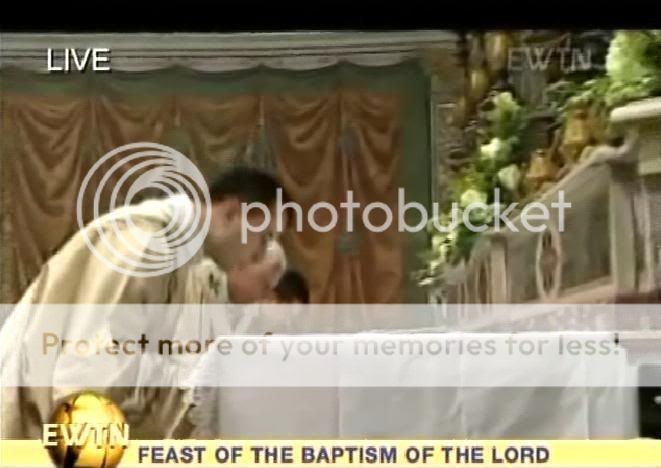
At long last we see the Holy Father celebrating Mass ad orientem versus.
Here he is kissing the altar at the beginning of the Mass for the Baptism of the Lord in the Sistine Chapel.

At long last we see the Holy Father celebrating Mass ad orientem versus.
Here he is kissing the altar at the beginning of the Mass for the Baptism of the Lord in the Sistine Chapel.



Coat of Arms by D Burkart
 on 11 October: Maternity of Mary. A tale of an antiphon, image, and a little street chapel.: “Father, there is a lovely setting of this antiphon in Catholic polyphony by the great Spanish Renaissance composer Cristóbal de…”
 on This is what I get when I procrastinate…: “SSPX, necessity. More documented proof. While for years those who wished to reform the Church have played a long game,…”
 on ROME 26/10– Day 10: butcher, baker… no candlestick maker (sorry): “Black to move and mate in 2. 1 … Qc3 2. b2xQc3 forced Ba3#”
 on 9 October – Feast of St. John Henry Newman – WDTPRS: Collect and “Lead, Kindly Light”: “Having experienced my homecoming, my spiritual renewal, and completion of Christian initiation at a Newman Center namesake, I was wholly…”
 on Archbishop: Church had greater unity under Summorum Pontificum: “HM, mickeyfitz notes that perhaps the bishop wants the TLM’ers off and segregated, perhaps so he can show how much…” on ROME 26/10– Day 09: very cool and a rare restaurant review: “Everyone knows that lace on the battlefield possesses a decisive, nay, crushing advantage.”
 on ROME 26/10– Day 09: very cool and a rare restaurant review: “Value of Nobel Prizes: Solid: Chemistry, Physics Good, if flawed: Medicine Complete jokes: Literature, Peace I missed out on the…”
A Daily Prayer for Priests








They find you a pro-life agent in your area who commits to giving a portion of the fee to a pro-life group!

PLEASE subscribe via PayPal if it is useful. Zelle and Wise are better, but PayPal is convenient.
A monthly subscription donation means I have steady income I can plan on. I put you my list of benefactors for whom I pray and for whom I often say Holy Mass.
In view of the rapidly changing challenges I now face, I would like to add more $10/month subscribers. Will you please help?
For a one time donation...



Help Monks in Wyoming (coffee – UPDATED LINK) and Norcia (beer) and the wonderful "Soap Sisters" of Summit, NJ!


Please follow me on Twitter!










Visits tracked by Statcounter
since Sat., 25 Nov. 2006:


ínicio da “reforma da “reforma”.
Pax et Bonum.
This is just the beginning.
Gloria in Excelsis Deo!
Happy Feast of the Holy Family, Father
While musing over the “back to the people” or “back to Jesus” ways to celebrate Mass, I was struck by the fact that there is a parish in St Paul, St Leo’s now called Lumen Christi, constructed in the round in 1965, (and I really hate it although everybody is much closer to the main altar) where when the celebrant faces the people, he is also “facing Jesus.”
There was a side altar constructed in the “back” of the church where the tabernacle has been placed.
It is good to see the holy father leading from the front(no pun intended)in returning to Versus Deum worship which was handed down to us from the time of the Apostles.
Viva il Papa!!!!
Deo Gratias!
Thank you, Holy Father.
The Pope’s next meaningful action would be the incorporation of his past few “steps” into Mass at World Youth Day.
Bring the steps directly to hundreds of thousands of young Catholics at WYD and said Catholics will return to their respective parishes as heralds of the Holy Father’s liturgical reform.
We know directly from Pope Benedict XVI that young Catholics desire to return to Holy Tradition.
The Holy Father declared the following: “Immediately after the Second Vatican Council it was presumed that requests for the use of the 1962 Missal would be limited to the older generation which had grown up with it, but in the meantime it has clearly been demonstrated that young persons too have discovered this liturgical form, felt its attraction and found in it a form of encounter with the Mystery of the Most Holy Eucharist, particularly suited to them.”
World Youth Day 2008…hundreds of thousands of “young persons” will gather with Pope Benedict XVI…he is aware that young persons yearn for Holy Tradition…
Therefore, the perfect opportunity exists for the Pope to bring his “steps” directly to hundreds of thousands of young Catholics.
Don’t get me wrong. I see any and every move that the Holy Father does to restore the liturgy to its former status as positive. What gets me, though, is how the same many people who get so excited when the Holy Father does these things are the same many people who have very little problem going to your local Novus Ordo parish and assist at the Novus Ordo rite. They seem to have the right premises, but jump to the wrong conclusion. The answer is this: the Traditional Mass has everything we need to give God due glory and honour. It always has and always will. Therefore, if one really wants to get back reverence and right doctrine in the liturgy, then he must STOP assisting at a rite of Mass that is more Protestant than Catholic. Doing otherwise only keeps him confused on which direction to turn.
God bless.
Br. Anthony: the same many people … have very little problem going to your local Novus Ordo parish and assist at the Novus Ordo rite.
How do you know that \”these people\” have no trouble with their local Novus Ordo parishes, with whatever some of them must endure to worship at the foot of the Cross of Calvary made present at Holy Mass, however imperfectly it may sometimes be celebrated?
I suspect you know no such thing. Why don\’t we all stick to what we do, in fact, know?
Br. Anthony:
Charitably, my response is…grrr!
Those of us who are trying to celebrate the ordinary form of the Roman Rite with dignity and fidelity to Tradition, to bring it back where, in my judgment, the Council intended it to be, need a LOT of help from the laity!
And the last thing we need is advice like yours.
Too often, it seems to me, priests who are trying to do the right thing are left to do it, while many tradition-minded Catholics are far from the battlefield, sending good wishes but little else. I’m sorry that we face a struggle to preserve, and in many ways, to restore, tradition and the liturgy; but alas every generation of Christians has faced struggle for the Faith; why should it be any different for us?
Back to the topic: thank you holy father! Now, may many of our bishops follow his example. That would be a huge step forward to open the door for parish priests.
Br. Anthony: I’m very excited about the TLM, but I attend the Novus Ordo every Sunday, because the nearest TLM is quite a drive away. It isn’t always the irreverent mess you seem to think it is. I can be very reverent and beautiful when celebrated by a good priest. :(
If I understand Henry right, then I agree with him. The Holy Father has demonstrated that there is a continuity between what he calls the two forms of the Mass. I would gladly serve at my local Parish–if my Priest actually allowed adult servers.
And this is sometimes the rub: it is not the Mass that is the problem. Oftentimes it is the other stuff that goes with it: the people, the music, the atttitude.
I’m at the point now where I commute away from my own Parish on Sundays because it’s just become too painful to go to the Mass there. There’s nothing wrong with the Mass, but rather the lack of reverence at it. It’s been cheapened and made common–a simple, common-meal. (sorry for the pun) The noise is symptomatic of that for a start (kids SCREAMING all the time). Though it is the Holy Sacrifice of the Mass, it’s no longer it at the same time (if you get my drift).
Three cheers for Benedict!
Viva Papa Benedetto!
A WARNING: Everyone: Bash the Novus Ordo unreasonably and I will ban you from posting.
We should be grateful for every step taken in the right direction. Thank you, Holy Father.
By the way, the last time I questioned the use of jazzy music at Mass in my parish, I was told that its okay because the Vatican masses also had jazz. Perhaps I should visit the same guy with these pictures now :)
A nitpick first: surely it would be inaccurate to call this the first ad orientum? The recent Masses at St. Peter’s were celebrated ad orientum and the cross being in the centre, it was clear that it was not meant to be a primarily versus populum posture?
I was disappointed though at the reduction in the solemnity of the Mass. Lots of said parts (even the Gloria! I do think sung parts of the Mass should get preference over motets). No incense. A little more Latin would have been welcome (though I suppose it was a more pastoral liturgy given the baptisms) -the Holy Father actually began the Pater but then switched to Italian. And Eucharistic Prayer II (though I suppose that’s good in a way because that’s what a lot of celebrants use. Shows it’s not incompatible).
Aside from this grouching, the versus apisidem posture was excellent. I also liked the custom of the two acolytes flanking the Pope with lit candles during the Communion.
I’m afraid that Br. Anthony has missed the whole point of Benedict’s work with the MP, and I think it’s been so very carefully and lucidly discussed by our own Fr. Z; that is the hope that with greater use of the EF will come a better understanding of how the OF can be celebrated with dignity and reverence by example.
I understand, and please correct me if I’m wrong, that St. Agnes in St. Paul MN celebrates the Novus Ordo (in Latin) every week and at this point has no intentions of replacing it with the EF. According to their trainer of altar boys, the amount of retraining it would require would be rather overwhelming, considering they already execute the ritual with exacting detail. (St. Agnes sends per capita the highest number of young men to seminary over any other parish in the Archdiocese of St. Paul. I hardly think that’s a demonstration of participation in the OF causing confusion).
And, getting back to the topic of this thread: we owe Benedict so much for his tireless efforts in restoring the Church. I sincerely hope that he will continue the example at WYD, and put at least one more nail in the post-concilliar psycho-babble coffin wherein the bones of “shared Christian praxis” and it’s sickly offspring can be put to final rest!
I am very familiar with the attitude Br. Anthony exhibits. There are many in the
SSPX who will refuse to attend a valid Sunday Mass in the novus ordo because
they refuse to recognize it as valid. Some will sit at home as they only
have a traveling SSPX priest every other week, etc. Some will even go so far
as to say that it is mortal sin to attend a novus ordo Mass and if some
Catholic desiring to attend the TLM does come to an SSPX chapel, they might
need their armour on! There is much bitterness and anger and even hatred. This
is what I have encountered. They are right and the whole world, even the Holy
Father is wrong.
The Holy Father is seeking to restore what was lost yet many will still throw
stones–both from the ‘right’ and from the ‘left’. Let us rather support him all
all we can–with prayer and sacrifice and attending the EF of the Mass when
and if we have it available to us. In this way, holy tradition can be
restored.
As for the SSPX–some will take the olive branch that will be offered and others
will refuse it and remain outside the Roman Catholic Church and will continue
to claim they are the one true church–many faiths claim that, after all.
Having just watched the Mass (recorded thanks to the miracle of DVR), I couldn’t help but have an ironic laugh at the woman doing the voiceover during the Offertory, who said that the Pope was celebrating ad orientem “in a stark break from tradition…with his back to the congregation”. A “stark break FROM tradition”??
With regards to Br. Anthony’s comments, it may help to know that he is a member of the SSPX according to his blogger profile.
Perhpas this will put his comments in context.
Anyone watching the Holy Father’s Mass on EWTN right now has no grounds to label the Novus Ordo more Protestant than Catholic. It’s not the Novus Ordo that’s the problem; the problem lies in the WAY it is celebrated by some priests and bishops. To bash the Novus Ordo is to bash the Church, and, to use the modern vernacular, “that’s not cool.” Let’s not boast being more Catholic than the Pope. Where there is Peter, there is the Church, and not the other way around.
I like the way the throne is to the side of the altar. Msgr. Marini “gets it.” Let’s hope bishops throughout the world begin to “get it” too!
Dear TNCath,
The “Protestant” character of the NO is *not* merely a function of the *manner* in which it is celebrated, although that may be the most obvious criterion by which to make such a judgment. The texts and the structure of the NO in and of themselves are susceptible of a “Protestant” interpretation. The so-called “Ottaviani Intervention” establishes this quite persuasively. It is a relatively short document, and can be found here:
http://www.fisheaters.com/ottavianiintervention.html
“STOP assisting at a rite of Mass that is more Protestant than Catholic.”
To which I say:
STOP giving credence to an organization (the SSPX) which is itself more Protestant than Catholic.
WAC
Did anyone else notice that the Vatican Radio Anouncer claimed, “the use of the original altar is a break of tradtition from the past.” That seems like a ridiculous comment.
Thomas L.: Did anyone else notice that the Vatican Radio Anouncer claimed, “the use of the original altar is a break of tradtition from the past.” That seems like a ridiculous comment.
Didn’t I just ask that about 3-4 comments above?
She mentioned it twice before the consecration once as a “stark break” with tradition that was a FOFLMHO moment a “stark break” with nearly Five whole decades of tradition compared with the many centuries before that. to her credit she is good otherwise I hate it when they speak over the original language its nice to hear the pope as he is speaking
The Novus Ordo is certainly more Protestant than the Tridentine Mass, with the Preparation of Gifts in place of an Offertory being a major concern. However, the Holy Father is doing all he can to emphasise the Catholic elements of the Novus Ordo and it our duty to support him, particularly with our prayers.
The (a bit) sour report of German Vatican Radio…
Papst: Taufe in der Sixtina
Fest der Taufe des Herrn: Einer alten Tradition folgend, hat Papst Benedikt an diesem Sonntag Kindern in der Sixtinischen Kapelle das Tauf-Sakrament gespendet. Diesmal waren es dreizehn Neugeborene – alles Kinder von Vatikan-Angestellten. *Benedikt feierte die Messe am historischen Altar der Sixtina direkt unter dem riesigen „Jüngsten Gericht des Michelangelo“ – also mit dem Rücken zu den Gläubigen und nicht, wie man das in den letzten Jahren machte, an einem Holz-Altar zu den Gläubigen hin. Ein Vatikan-Statement meint dazu, Benedikt wolle „die Schönheit und Harmonie“ der Sixtina „nicht stören und darum die Messfeier-Struktur nutzen, die es dort schon gibt“; die „Liturgie-Normen“ erlaubten ihm das. Wenn der Papst mit dem Rücken zu den Gläubigen feiere, aber „mit dem Blick aufs Kreuz“, dann „orientiert er damit die Haltung und Einstellung der ganzen Versammlung“, so das Vatikan-Statement weiter.*
In seiner Predigt meinte Benedikt XVI., Taufe bedeute das Eintreten in eine „Kultur des Lebens“; und er setzte dem die „Kultur des Todes“ entgegen.
„Leider ist der Mensch in der Lage, dieses neue Leben mit seiner Sünde auszulöschen, indem er sich zu einer Situation erniedrigt, die die Heilige Schrift den „zweiten Tod“ nennt. Während bei den anderen Geschöpfen, die nicht zur Ewigkeit berufen sind, der Tod nur das Ende ihrer Existenz auf Erden bedeutet, bringt die Sünde in uns einen Abgrund hervor, der uns für immer zu verschlingen droht, wenn der Herr des Himmels uns nicht seine Hand reicht. Das ist, liebe Brüder, das Geheimnis der Taufe: Gott wollte uns retten, indem er selber bis in den letzten Abgrund des Todes herabstieg, damit jeder Mensch – auch der, der so tief gefallen ist, dass er den Himmel nicht mehr sieht – die Hand Gottes finden kann, an der er sich festhalten kann, um aus den Schatten hinaufzusteigen und wieder das Licht zu sehen, zu dem er erschaffen wurde.” (rv)
“And Eucharistic Prayer II (though I suppose that’s good in a way because that’s what a lot of celebrants use. Shows it’s not incompatible).”
The Roman Tradition is that on one Eucharistic Prayer — the Roman Canon.
During the 1960s, Monsignor Bugnini and friends attempted to eliminate the Roman Canon from the Novus Ordo Mass. Pope Paul VI insisted that the new Mass would retain a “reformed” version of the Roman Canon.
Monsignor Bugnini and friends turned to “Plan B”…they invented new Eucharistic Prayers designed to allow priests to bypass the Roman Canon.
Incredibly, Pope Paul VI signed off on the new Eucharistic Prayers.
1. The addition of the new prayers constitute a break with Holy Tradition.
2. The additional prayers in question do not remotely match the Roman Canon and even Eucharistic Prayer 1 in conveying the Catholic Faith to the people.
3. As at one FSSP priest has argued, the additional Eucharistic Prayers have “deformed” the Roman Mass.
4. The sooner that Rome returns to the Roman Canon (even Eucharistic Prayer 1) as the lone EP for the Novus Ordo Mass, the better.
Br. Anthony,
I agree that the TLM is the best way to give to God what is his, but these steps by Benedict XVI are leading the way to a full restoration. BXVI is trying not to move too fast because the Priest has been facing the west for forty years, and instead of a sudden shift, which would shock the system, so to speak, BXVI is gradually introducing back into tradition. Michael Davies, who was on very friendly terms with BXVI, said that BXVI is \”on our side,\” that is, the side of traditionalists. I have no doubt that BXVI wants to have a TLM in St. Peter\’s, but I think he feels he needs to pave the way, first.
I wonder what Bishop (now, Cardinal) Foley thinks of all of this. After all, wasn’t he the one that said no more ad orientem masses to be televised in the United States on EWTN? Is he now on the same page (liturgically speaking) as Pope Benedict XVI? or is he still opposed ad orientem public celebrations?
Tom – If I remember correctly what is called EPII dates to the 3rd century Rome. Some might see that as being part of Roman Tradition.
AS far as Br. Anthony & the SSPX goes, as far as I understand things, the big hangup isn’t over liturgy. Rather, the Lefvrebrites real problem is with the Council’s teaching on religious liberty. This is where the real “revolution” of the Council happened: and its hard to argue it wasn’t a revolution. Democarcy was condemned in the Syllabus of Errors. You don’t hear anyone now talking about how voting is a sinful act.
As far as Mass ad orientam. I actually think the Episcopalians are ahead of the curve on this. When I was at Yale, the big “high church” Episcopal Church had an 8:30 service which was “ad orientam,” replete with all the “smells & bells.” The 10:30 was the more ordinary liturgy where a tabel was set up in front of the altar. Instead of all this ‘either or’ talk, I think we should take a page from the Episcopalians on this. It seems to me that instead of “Marini I versus Marini II”, if we’re good Catholics, then its BOTH Marini I & Marini II. AFter all, as Graham Greene famously said, “Catholic means here comes everybody.”
Monica, I believe you’re confusing your Foleys.
Bishop David Foley was the bishop of Birmingham who, exercising his legitimate authority as diocesan bishop (even though I disagree with his decision, it was his decision to make), forbid EWTN to broadcast Mass ad orientem.
Archbishop, now Cardinal John Foley is another person who, as far as I know, has not publicly expressed an opinion pro or contra with regards to ad orientem celebration.
Folks (well, some of you, not all):
Why is it necessary to turn every occasion into mudslinging? Can’t some of you just relax? Find a hobby or something? Somebody will log into this blog for the first time and all he’ll remember is the mud. You’re doing a disservice to this blog by piling up arguments. Try to find some beauty in something. A little delight here and there is a good thing.
“Here comes everybody”, yes, but, all must repent, which leads to respectful liturgy.
1. When you come to know the truth, you are obliged to follow up on it.
2. Error has no rights.
That’s a quick summary of Dignitatis humanae.
Anyway, I’m waiting for a Catholic, executive monarchy.
“If I remember correctly what is called EPII dates to the 3rd century Rome.”
Fr “C”, If you compare EPII with what some call the Anaphora of Hypolytus I think you will see that it was very loosely based on this third century prayer. One of the problems is we are not quite sure of the origins of this prayer. It seems unlikely to actually be part the of writings of the anti-pope of that name. Whether it was a model for an actual Eucharistic is also a matter of contention.
The Barque of Peter is no sail boat, but more of a Super-Tanker, which does not handle well when sudden turns are demanded of her. She is best turned around a half degree at a time.
Or as Father Z prefers, brick by brick.
I think utilizing the legitimate option of ad orientem in the OFRR automatically cultivates a more contemplative, more mystical, and more prayerful ethos than anything other liturgical option….even above the use of Latin. And I say that as a member of a gregorian schola cantorum.
Fr. Z, is there any way to petition or encourage the pope to offer Mass ad orientem at the high altar under the baldachino when he comes to St. Patrick’s Cathedral in NY for the Mass with clergy and religious?
Thank you Papa! You are in my prayers.
Does anyone know if the Mass is archived anywhere?
“Rather, the Lefvrebrites real problem is with the Council’s teaching on religious liberty. This is where the real “revolution” of the Council happened: and its hard to argue it wasn’t a revolution. Democarcy was condemned in the Syllabus of Errors. You don’t hear anyone now talking about how voting is a sinful act.”
Has it occured to some folks that the Syllabus had not condemned true liberty or even Democracy, as such? Rather, we should understand that false liberty (license) and positivism were the target of condemnation by Pius IX — and continue to be condemned today.
@TNCath:
Anyone watching the Holy Father’s Mass on EWTN right now has no grounds to label the Novus Ordo more Protestant than Catholic. It’s not the Novus Ordo that’s the problem; the problem lies in the WAY it is celebrated by some priests and bishops.
This is not a good argument at all. Protestantism is not about the way worship is celebrate. In Germany it is today far more likely to encounter a Lutheran “ad orientem” celebration than a Catholic, and those are more reverent, too. The Lutheran state churches of Scandinavia don’t have people’s altars.
I’m not saying anything about the NO here, only that the argument that ad orientem and reverence automatically is Catholic is very flawed.
So rather than trying to help to save the Novus Ordo mass to become more reverent and more grounded in the ancient liturgical traditions of the West, are we supposed to leave it rot where it’s already rotting and let it poison Catholicism even more? No, thank you!
TLM will not replace NO by a day to day decision. I can be pretty sure that this will never happen. Such move would be more harmful than helpful. Remember what happened after the mass was changed about 40 years ago? How many anti-popes do we have as of today?
No, the way towards TLM is directly through NO. Once NO starts being celebrated how it should have been and once people understand the importance of reverence and tradition, only then TLM will gain on strengths. Because honestly, if you go as far as places like Birmingham oratory went with their Latin Solemn Hight Ordinary Mass, what is holding you in making the “small” jump towards the ancient liturgy?
Things need to change bit by bit and while a lot of it must come from the Vatican and the seminaries, in the end it is the attitude of the average Joe that will make the greatest difference.
Pleased as Punch:
This is a prime example of what true loyalty to the Petrine Office is all about. Bottom line: we either believe that the Holy Father is Vicar of Christ and Head of the Church on Earth or we don’t. That means we humbly accept and support what the Holy Father chooses to do (and what he chooses not to do), whether we personally agree with it or not. We can sympathize with Cardinal Ottaviani’s “intervention,” but, right or wrong, he was never elected Pope.
Question, please. What’s with the Br. Anthony bashing? I’ve never seen any of you carry on with anyone else’s post the way you all have here regarding his comment. Is it because he’s SSPX? Diane K’s pointing out, “With regards to Br. Anthony’s comments, it may help to know that he is a member of the SSPX according to his blogger profile,” is questionable whether she is making a reference point or being condescending. Is one’s hostility to Br Anthony based on his association with the SSPX? Perhaps. In my travels, I find much contempt for the SSPX but they have all this gush for the Schismatics of 1054. The SSPX cares more for the Roman Faith than they do. Are they bashed for their hard-core stances? Much more progress is being made with the Pius X people in the past few years than the thousand years with the Orthodox. Who’s to be more appreciated?
Many may not like what SSPX stands for, but I appreciate the fact they care enough to be what they are. In fact, I believe in many ways, if it wasn’t for the SSPX and their confrontation with the Church, I believe Summorum Pontificum would have been more difficult to come by.
It is a great thing for the Pope to celebrate Mass ad orientem but at the same time it was a Novus Ordo Mass which could be celebrated either way. In our travels in Europe, there were many a shrine and holy places which had the original altar only, and our Father-chaplain said the Novus Ordo ad orientem and in English. The Novus Ordo says one can celebrate it as you find yourself as appropriate as possible.
Easter is coming soon. Let’s hope the long prayed-for Papally celebrated Tridentine Mass is on the horizon.
Fr D asked:
“Fr. Z, is there any way to petition or encourage the pope to offer Mass ad orientem at the high altar under the baldachino when he comes to St. Patrick’s Cathedral in NY for the Mass with clergy and religious?”
()
Father, being that the Holy Father had been celebrating Mass as he has been lead to by his MCs, I don’t see it as a problem to get the organizers of the New York portion of the trip to have the Mass as such. It would be wonderful. I am sure there is a greater chance for it in St Louis if he ever gets there. Better yet, maybe he can drop by Bishop Burbidge’s place and say the Extraordinary there. ;-)
Matt Q,
Diane here…Just wanting to clarify that my pointing out that Br. Anthony’s affiliation to the SSPX may explain his clearly anti-Novus Ordo position – for those who did not understand his comment.
Br. Anthony said, “…What gets me, though, is how the same many people who get so excited when the Holy Father does these things are the same many people who have very little problem going to your local Novus Ordo parish and assist at the Novus Ordo rite…”
This yielded some rather strong responses. I understood what Br. Anthony was saying because I am familiar with him through dialogue in my own blog. The sentiment he had expressed against the N.O. was so strong that, in good conscience, I could no longer support posting his comments.
Br. Anthony does have a right to freely express his views on a blog of his own, which he has.
I am very much in favor of the Traditional Latin Mass, and indeed prefer it myself. However, I accept the Novus Ordo as a legitimate Mass. It is not being celebrated in many parishes as it should have been from the beginning (examples: the absence of the ad orientem posture, jack-hammering out beautiful wall altars and altar rails, forcing table altars even where they weren’t desired, and forcing Holy Communion in the hand, standing to the point of making it a norm, etc.).
I have a deep affection for all of my Christian brothers and sisters, including those who love the usus antiquior, yet cannot accept all that they must to regularize their status with Rome. They are in my prayers. Hence, there was no intent to come across as condescending to Br. Anthony.
I hope Fr. Z will allow me to reply to this:
SouthernCatholic – Democarcy was condemned in the Syllabus of Errors. You don’t hear anyone now talking about how voting is a sinful act.
You have this all wound wrong. The popes have condemned “democracy” in the liberal sense, that all power comes from the people and all rules must reflect what the people want – regardless of whether it offends God or not. The Popes have never condemned democracy for voting by partial or universal suffrage. The problem with Dignitatis Humanae is that it says that heretics can profess their beliefs publically in Catholic countries – something that the Popes have never allowed.
Maybe a stupid question, but are you sure the Mass at the Sixtine was really ad orientem ?
I think it wasn\’t if my recordings are good (that is : the entrance, with the Dispute around the body of Moses, is at the East).
Of course there\’s more to my question, because what I got from Fr. Lang\’s book was that the historical practice (carefully studied in his book) was very diverse, but the criterium more often used wasn\’t to be or not in the same orientation of the people, but to pray, at least at the eucharistic prayer, ad orientem – that meaning, if the entrance is at the East, that the priest is turned versus populum !
It\’s not very clear from his book (and, I think, from what we can know) what happened in this case for the people, I think (I must read the book again) that Fr. Lang gives some indication that more probably the people in this case also turned themselves to the entrance (being East), so showing their backs to the priest. But the result history gave us in the Roman basilicas, for example, goes in the opposite way, because the tradition there has been for the priest to celebrate Holy mass facing the people (and the East), and for the people to face him.
Does Fr. Zuhlsdorf or somebody else has some thoughts on this ?
Prayers for all, this public move from the Holy Father will, despite of the negatively expressed commentaries of the media, have a good effect. There\’s indeed a very heavy intellectual terrorism on even the possibility of not facing people… (That said I\’m not convinced that possibility is in every case the thing to do, and I have anything against celebration versus populum in se (I think we shouldn\’t have, because, as what I wrote before imply, it is also a part of Catholic tradition).)
“The problem with Dignitatis Humanae is that it says that heretics can profess their beliefs publically in Catholic countries – something that the Popes have never allowed.”
Ottaviani, that is not exactly correct. DH does not proclaim such an absolute and unqualified “right” to do whatever one pleases. The right in question is always bound up with “due limits” that respect the rights of others and the common good of civil society.
Dear Diane K:
Thank you for replying to my post and clarifying your position. I’m glad to know you were not being unkind to Br Anthony as many of the others seemed to be. Yes, he does have the right of expression although I’ve never heard of him beyond here.
There is much we see eye to eye on. For myself, I dislike the the Novus Ordo for what it is but accept it as part of the Church. It’s juridically in force, and anything the Church implements juridically is valid on its own. Theologically the Novus Ordo is poor ( the Pope himself has said so ) and it’s also artificial. Nonetheless, here it is and here we are having to deal with it. I don’t see it becoming infrequent in the average parish. Another ten or twenty years perhaps depending on how well Summorum Pontificum is embraced and implemented, and how well the reform of the Novus Ordo goes. There is much which can be done to elevate the Forma Ordinaria but it takes time and the help of the Obstructors to get out of the way.
Thanks again for your reply.
Oliver: Of course I have thoughts on this. And I have posted them extensively and even made audio projects to explain them.
Dear TNCath:
You articulate a grossly exaggerated view of papal authority and the respect and obedience due to it. Unfortunately, many otherwise good Catholics suffer from this or something like it. The Holy Father is preserved from error when he teaches on faith and morals ex cathedra. He is *not* so preserved in the exercise of his prudential judgment. Popes make mistakes in the practical sphere. Such mistakes do *not* deserve the support and acclaim of the faithful. They are to be opposed–with charity, of course–and their correction is to be yearned and prayed for. Read the Catholic Encyclopedia entry on the papacy of St. Celestine V. A summary quote: “It is wonderful how many serious mistakes the simple old man crowded into five short months.” And this man was, nay is a saint.
Or consider the famous rebuke that St. Catherine of Siena issued to Pope Gregory IX, one of the Avignon popes, telling him to return to Rome: “Be a man! Father, arise! I am telling you!” Would you have supported the move to Avignon, TNCath, merely because the pope decided to do it?
You claim that “we either believe that the Holy Father is Vicar of Christ and Head of the Church on Earth or we don’t. That means we humbly accept and support what the Holy Father chooses to do (and what he chooses not to do), whether we personally agree with it or not.” This is simply false. Accepting the pope as the Vicar of Christ and Head of the Church on Earth does not mean humbly accepting and supporting whatever the Holy Father chooses to do regardless of our personal agreement with it. No dogma of the faith requires that we check our reason and our conscience at the door when it comes to papal action. We owe assent to the pope’s teachings on matters of faith and morals, and we owe obedience to the decisions of his prudential judgment. But obedience does *not* equal uncritical acceptance. Consider again the cases of St. Celestine V and St. Catherine of Siena.
A similar mistake in judgment was made in the composition and imposition of the Novus Ordo Missae. Its flaws have been rehearsed in a thousand comments posted to this blog. It was never asked for. It clearly disregarded Sacrosanctum Concilium. Protestant divines did have a hand in its creation. It was essentially (though not entirely) rejected by the Synod of Bishops in, as I recall, 1967. It was in part the product of an unprincipled archaeologism that sought a return to some allegedly “pure” Roman liturgy of the third century or so, an archaeologism itself premised on a “corruption theory” of the state of the Roman Mass thereafter. Its sacrificial language was systematically repressed or diluted. I could go on, but there’s little point. Very fine scholars of great integrity have already cataloged all this.
The point in all this is very simple. A good Catholic does not regard the claims of a Cardinal Ottaviani on the one hand and the (implicitly opposed) claims of a H.H. Pope Paul VI, of happy memory, on the other and simply say, “Well, the Pope decided X. Therefore X is just fine with me.” A good Catholic uses his God-given reason, informed by his faith, to make his own judgment. That’s clearly what St. Catherine did. And it’s actually every Christian’s duty to do so. “Test all things and hold fast to what is good!” 1 Thessalonians 5:21. What is good about the NO is what it shares with the TLM. The NO is best when celebrated as closely as it can be to the TLM. What does this suggest? What makes the NO the NO is not good. The NO is an ill-conceived experiment that has gone horribly awry, and we should not “hold fast” to it. In believing and articulating this, a Catholic does not “bash” the Church. He does not display “disobedience” to the Holy Father. He simply bears witness to what he believes to be the truth. If he’s wrong, prove it. And remember all the saints who opposed misguided popes. God grant that we never have to do what they did, and if we do have to, the grace to do it well.
the right step to make the sacrifice more sacredly to the Lord.
If you give the greatest chef in the world the wrong ingredients for cooking his dish, the result will not be so good. In the same way, if you give the most reverent priest the Novus Ordo rite (ingredients) to celebrate Mass, the result will not be so good either. A Hindu worship service can be said very reverently by the presiding Hindu priest. Can we say that it is pleasing to God simply because of the reverence by which it is celebrated? The Novus Ordo rite is not fit to embody the august sacrifice which the Mass is. It is not pleasing to God. One day, when Rome fully returns to Tradition, the Novus Ordo will be condemned.
Read the Ottaviani Intervention, which clearly and rightly criticizes the Novus Ordo in its purest form.
Dear Pleased as Punch,
Thank you for your post. While I still stand by my original statement, I do agree with you that Popes can make mistakes and understand where you are coming from. I am well aware of the difference between infallible and fallible teachings; this is something that people like Father Andrew Greeley, Father Richard McBrien, Sister Joan Chittister, and other disagreeing Catholics love to bring up when clarifying their views that do not harmonize with those of the Holy Father. And yet, as I mentioned in an earlier post, “Where there is Peter, there is the Church” and not the other way around–mistakes and all. I think all of us, at some time or another, fail to give the Holy Spirit enough credit for guiding the Holy Father and the Church and would rather focus on the mistakes rather than the good that is done. I also feel that many people do not give Pope John Paul II and Pope Benedict XVI enough credit for turning the tide back from the abuses and, yes, the mistakes made in the aftermath of the Second Vatican Council. We’ve come a long way since 1978. Yet, I daresay that even if the Holy Father scrapped the Novus Ordo and mandated its return, there would still be folks out there that still wouldn’t be satisfied.
I enjoy this website very much, but at times I am beginning to think perhaps we need to simply talk less and pray more.
Why is it that, in nearly every area, this blog’s commenters always seem to find a way to condemn the Novus Ordo? This is very distressing to me, and I feel it serves to divide rather than unite.
A quick clarification: Ad Orientem means to the East Liturgically, not necessarly literally east. (Although many of the Churches were biult that way with the altar to the east)
While the NO Mass is Theologically flawed it is still valid. The problem the English Translations. They are not translated literally. The NO Mass would be a lot stronger Theogically (at least in English) if this was the case.
My hope is for a mandate demanding the de-wreckovation of Churches everywhere. But all things in patience as the Pope is showing :)
William said: “Why is it that, in nearly every area, this blog’s commenters always seem to find a way to condemn the Novus Ordo? This is very distressing to me, and I feel it serves to divide rather than unite.”
I agree with you 110%. I am weary of all the negativity (and often downright hostility) in regards to the Ordinary Form of the Roman Rite, as well as bishops and priests who don’t do what “traditionalists” think they should do.
It is curiously significant that those who prefer the NO service on Sunday complain about the immense reassurance and relief in the traditionalist camp that the voice for liturgical & doctrinal orthodoxy can be heard again. The arguments advanced against the vernacular only liturgy are certainly valid and it is clear The Vatican has taken very particular note. It is time for the whole church to similarly take note. It is evident that many do not wish to.
When the post-conciliar progressives in parishes were vilifying the bastion of the Latin Mass For All Times & criticising traditional catechetics, I remember hearing plenty of negatives about The Church, its traditions, its past history, the “fossil” of the Latin Mass and the “fuddy-duddy old conservatives” who were “losing the Faith” and being allegedly “disobedient” to the pope. My parents and other orthodox Catholics they knew were sometimes insulted and were even ostracised at times by liberal catholic associates for “hanging on” to an “irrelevant” idea of the church and its faith. This hurtfully enough included priests some of whom lost their vocations, it has to added, painfully.
I cannot express how delighted I am that Pope Benedict XVI has officially given the necessary importance back to the real Roman Catholic liturgy. And how I rejoice that he has celebrated The Latin Mass once more and in public. I hope, like one other priest who expressed his feelings on the topic of saying The Latin Mass on this site, that the Holy Father felt enough loneliness in front of the the Tabernacle to be able to share in the immense solitariness Our Blessed Lord in sacrificing Himself for us at Calvary. Without upstaging this immense act of self-giving, many traditional Catholics must have experienced similar feelings of isolation and humiliation in the face of what appeared to be an overwhelmingly hostile crowd.
Deo Gratias! Alleluia! Alleluia! May Almighty God give our Holy Father all the strength he requires to continue to restore all things truly Catholic in Christ. Alleluia!
At the very least SSPX members should realize that banning the Novus Ordo mass altogether would create schism. Unless I’m mistaken, a mass is valid as long as the words of consecration are pronounced correctly.
Personally, I think some kind of mass in the vernacular would be beneficial for children and converts. I would like to see the Vatican replace the Novus Ordo with something resembling a vernacular translation of the TLM. Bring back the “Asperges me”, the last Gospel, all the missing references to the saints, the incense, all of it!
About the loneliness of ad orientem…
Loneliness is the opposite of the intimate prayer of Christ to the Father: “My God, my God, why have you abandoned me?”
The priest brings all with himself not only to present to Christ for the offering to the Father, but acts in Persona Christi to this end. This is the moment when Christ draws all to Himself, and the lowly, unworthy, ordained priest is there, witnessing and participating in a special way in this very redemption of time, of men, with all looking on Him whom they have pierced.
Anyone who thinks they are lonely at such a time simply needs spiritual discernment to understand what is happening with: “My God, my God…”, which, again, could not be further from being lonely.
Yet, the loneliness might be there for psychological reasons (wanting to face each other as a way to escape the true unity of being made, together, into the members of the mystical Body of Christ offered to the Father, to whom we look through, with and in Christ.
And, finally, loneliness might be there because whatever priest is cut off from the Mystical Body of Christ because of his own rejection of the doctrine and morality of the Church. Such priests must feel repugnance for ad orientem, however much they are fascinated by it.
The rest of the faithful must all discern between loneliness on the one hand and Christ’s offering on the other. This touches all aspects of our lives, how we deal with others, whether we are politically correct or will witness to the faith, etc.
Personally, I think some kind of mass in the vernacular would be beneficial for children and converts.
Melody, I am a convert and I have two small children. We do not need the Novus Ordo Mass. It was, in fact, the Traditional Latin Mass that converted me. My four year old, who is just beginning to read a few words, follows the Mass in a children’s missal and makes all of the usual responses along with the rest of the faithful.
Fr Renzo di Lorenzo-
As a layperson, I never quite grasped what a priest is “for” until I witnessed ad orientem. The sacrificial nature of the mass and the priest’s role in it becomes intuitively clear. Before, I likened the priest to a teacher in a classroom.
Unfortunately, post-Vatican II priests just learning the TLM can’t know the experience of laypeople intensely praying in support of the priest. You could say we are literally behind you! Perhaps this will come with time and lessen the loneliness.
I was blessed to attend a TLM today. The young priest who celebrated sang and said it beautifully. He also preached a powerful sermon. Afterwards, we had a conversation and I was shocked to discover that he stutters when saying his own words! I thought, “What a wonderful priest! But surely we would lose him if he was forced to always be before an audience.” I wonder how many vocations are lost that way.
William- I’m happy you hear you crossed the Tiber and may God bless your little ones. Sadly, not all are convinced to come over by the beauty of the mass. I believe that a reformed vernacular mass, used as a teaching tool, can provide that final shove. I also know many people who grew up with the Latin rite who say they never want it to go back to it because they never knew what was going on. I have been trying quite unsuccessfully to get these people to go to sung high mass with me. On the other hand, I learned things from the reverent Novus Ordo masses I attended as a child which led me as an adult to prefer the Latin mass. Knowing the prayers by heart from the Novus Ordo prepared me for the TLM. If I had children I would seek a reverent Novus Ordo and take them to that about once a month, or even attend both a Novus Ordo and a TLM.
Why ad orientem is not lonely, but speaks to the fatherhood of the priest…
These are a few notes ripped from a conference on chastity for a vocation retreat that I gave the other week. This might not seem to have anything to do with ad orientem, but, give it a chance. You’ll be surprised! If only more priests knew what is written here, there would have been less of a crisis in America and elsewhere.
Although what is said here refers only to men that our Lord is calling to the priesthood, men and women can learn a great deal about what their own consecrated chastity for the sake of the kingdom of heaven signifies, or, indeed, about the meaning of their own marriages.
EUNUCH is the only word used by Jesus Himself in describing those men whom He draws to Himself in perfect chastity for the sake of the Kingdom of heaven. There is a synonymous phrase He uses, which we will examine after taking a look at what our Lord says about eunuchs. The word eunuch is misunderstood in western cultures and, now, also in the east.
The word makes one think of a large harem of a powerful king, which is guarded by a eunuch, someone whom modern society thinks was castrated as a way to keep him from misbehaving with the women. Eunuchs can still sin with their eyes, but the horrific barbarism inflicted upon some of them may have kept some of them alive, for death was the penalty for touching the women of a king like Solomon, with his three hundred wives and seven hundred concubines (1 Kgs 11,3).
However, castration of the eunuch merely depended on the prudence of a king. Being castrated and being a eunuch are not the same thing. One can hold the office of a eunuch and not be castrated! Eunuchs were often the most trusted individuals of an empire. They were often second only to the king in power. Not infrequently, they were more powerful than king or emperor who was only a figurehead for the eunuch, who actually ruled the land, taking care of all the political relations of the king, treating other nations as if they were the harem of the king. Although the office of the eunuch does not require that he be castrated, he was required to be chaste.
The word eunuch comes from the Greek words meaning bed, and to have [and, in context: have charge of something]. A eunuch has charge of the bed that is, for someone else]. “The bed” refers to the marriage bed of the king, with the idea being that the eunuch prepares both the bride and the wedding bed.
Mt 19,12 – Eunuchs for the sake of Heaven’s Kingdom – – “There are eunuchs who are have been born as such from their mother, and there are eunuchs who have become such by the action of men, and there are eunuchs who have made themselves such for the sake of the kingdom of heaven. He who is able to make room, let him make room. The usage of the term eunuch by Jesus admits of three types, the first two have similarities, while the third is unique.
The first is a congenital defect; the second refers to those who not only have the office of eunuch, but who have also suffered the humiliation of being castrated; the third type of eunuch – those who have made themselves such for the sake of the kingdom of heaven – cannot refer to self-castration despite the fact that some of the greatest thinkers, such as Origen (died 254), mutilated themselves because of what they thought they saw in this scriptural passage (perhaps paying too much attention to a misunderstanding of the Latin Vulgate translation). The Vulgate at this point changes the phrase to say “castrate themselves” (se ipsos castraverunt). While this has a correct spiritual sense, one must pay attention to the original, inspired Greek.
Those who do something for the sake of the Kingdom of Heaven do what they do only with the greatest respect and reverence for the Lord’s salvation. It would be anti-evangelical to castrate oneself while saying that this was done for the sake of the Kingdom of Heaven. Thinking one can save oneself from temptation and sin simply because one castrates oneself is an insult to the saving power of the grace, the charity, which Christ granted to us from the Cross.
Being celibate, chaste, continent and virginal for the sake of the Kingdom of Heaven must be done is a way that demonstrates that the establishment of the Kingdom of Heaven is most important in our lives, and that this kingdom is brought about through a transformation in grace of the individual (Eph 1,3ff).
Faith-filled chastity is not a burden, a curse, or a cruel condemnation to suffer the most useless loneliness. Jesus knows that there will only be some who are open to seeing the radiant joy of Jesus’ union with His Bride, the Church.
The Lord gives a command to these few people, who are open to receiving the grace to be consecrated in their chastity for the sake of the Kingdom of Heaven, who are open to dedicating their lives to proclaiming the marriage of the Lord with His Bride, the Church, who are open to being eunuchs for the sake of the Kingdom of Heaven.
The Lord commands: He who is able to make room, let him make room. This is often mistranslated to read: “Let him who is able to understand, understand!” or “He who has ears to hear, let him hear!” Instead, here, we read about making room. “He who is able to make room, let him make room.” This making room is the named office of the eunuch, who is to have care specifically of the bedroom. One’s vocation depends upon one’s being able “to make room” because of having received that very ability from the Lord. We must know that the ordained priest is merely the helper, so to speak, of the one and only Priest, Christ Jesus, the King.
Using the imagery of Jesus, we can say that the priest has charge of the marriage bed shared by Jesus and His Bride, the Church. The ordained priest keeps the bride perfect in purity by his administration of the Sacraments. He prepares the Bride for Christ with Baptism and Confession. In his office as eunuch, the priest prepares the Bride for marriage (see, for instance, Ez 16,6-14), that is, the wedding banquet which is the Last Supper, and the consummation of that marriage on the Cross, the total self-giving of Christ, the Holy Sacrifice of the Mass.
The priest is ordained to be an alter-Christus, another Christ. But there is only one Christ, one Priest, one Lord, one King, one Bridegroom. But the ordained priest is deeply made into the image of Christ, differently from all other Christians. The chastity which the priest lives finds its fulfilment in the charity of this marriage bed, so to speak, of Jesus and His Bride. The eunuch priest is officially in charge of that marriage bed. The priest is in love with the Church, also his Bride, through, with, and in Christ Jesus, for the priest says the wedding vows of the Lord – as the Latin saying goes – in the very person of Christ, in persona Christi.
Saint Paul comments about a man leaving his father and mother to be joined to his wife, so that the two become one flesh, insisting that this mystery is of great importance, that is, in speaking of Christ and the Church (see Eph 5,31-32).
THE PARABLE ABOUT THE SONS OF THE BRIDAL CHAMBER – – “Can the companions of the bridegrooom fast when the spouse is with them? But the days will come when the bridegroom is taken from them, and then they will fast” (see Mt 9,15 and Mk 2,19; Lk 5,34). They are too busy to mourn. They have a joyous task to accomplish, preparing the bride and the bridal chamber for the groom. The phrase “the companions of the spouse” mistranslates the Greek, which refers to “sons of the wedding hall” or “sons of the bridal chamber” or “sons of the room containing the bed where the marriage is to be consummated”.
These “sons” are not the illegitimate children of the groom. They are called “sons” since sons should not be in any danger of taking the spouse of their own father to bed. In other words, these friends of the groom have the office of preparing the bride and bridal chamber with the bridal bed (not to mention the wedding hall) for the groom. This is the exact description of the office of the eunuch, the one who has charge of the bed.
In this case, the apostles are to prepare the Bride of Christ by their preaching, by their rejoicing in the presence of the Groom. In their confusion after the death of Christ, not knowing that the Last Supper and Calvary was the Wedding Banquet and the consummation of the marriage, the Apostles fasted and mourned. After the resurrection and after Pentecost, they kept themselves busy with preaching and the Sacraments, preparing the Bride of Christ, the members of the Church, for the Wedding Banquet and the consummation of the marriage of God with the Church that we call the Holy Sacrifice of the Mass.
There are many passages throughout Scripture, such as the wedding of Cana. I’ll only add one last passage here, the parable in Mt 22,1-14 and Lk 14,15-24, which is about an invitation, a calling, a vocation to participate in the wedding of the Son of God which was arranged by our Heavenly Father, the King. The wedding is the Last Supper and Calvary.
This great love of God makes fallen man nervous. We can think of many excuses not to go to the Wedding. One said he bought a field; one said he must try out his new oxen; one said he’s just been married, and has no time for the marriage of the King of kings.
Rejecting the marriage of the King is tantamount to a declaration of war, which is what we see in the parable. God wins, and fills His wedding hall with those whom He desires, the outcasts of the world. Everyone will look upon Him whom we have pierced (Jn 19,37; Rev 1,7), but those who reject this wedding go to hell. It does not look good for the son of perdition, Judas, who found his way into the bridal chamber without a wedding garment, which is the grace Jesus gives to us, His very Life. Judas was cast into the “outer darkness” of the Prince of Darkness, that is, after “Satan entered into him” at the Last Supper, the Wedding Banquet (Lk 22,3; Jn 13,27).
In contrast to this is the enthusiastic desire of God the Father that we accept the invitation to the wedding in the way in which He is calling us, as priests, as religious, as laity, providing us with a wedding garment of grace, wanting us to rejoice with Him and His Son forever in heaven.
==================
What this has to do with ad orientem…
The priest should be a father, married to the Church, by way of the Sacrifice he offers in Persona Christi. He should not be lonely at the time of his wedding, when all are being brought to the Father through, with and in Christ. He might offer a prayer of “My God, my God, why…?” but this manifests the glory of the love of God for us, not loneliness.
Priests are married, and they lead their children (ad orientem) to God. This is not arrogance or turning one’s back on anyone. It is through the Sacrifice that the priest faces the whole of the Church, but this must be through the Sacrifice. If this is not understood, as can be the tendency with non-ad-orientem, disasters follow in every way.
Everyone becomes lonely, and leaves the Church, or they start to force themselves on others to solve their loneliness. So many, wanting what is right, suffer horrifically.
Give me not the loneliness, but the abandonment spoken of by Christ, any day.
Br. Anthony says: If you give the most reverent priest the Novus Ordo rite (ingredients) to celebrate Mass, the result will not be so good either.
The result is the Body and Blood of Our Lord Jesus Christ, unless you hold the SSPX position that the Mass is invalid no matter how it is celebrated.
Can we say that it is pleasing to God simply because of the reverence by which it is celebrated?
It is pleasing to God because it is a valid Mass, regardless of the reverence or holiness of the priest. The holiness of the priest does not affect validity. This is a known heresy.
How pleasing the Mass is to us is not a measure of how pleasing it is to God. If that were the measure, it would be an open field. What is pleasing to God is to humbly accept what Holy Mother Church says is valid.
But it gets down to whether you believe Pope Benedict XVI is Peter on earth? Do you accept Pope Benedict as a valid pope? How about Paul VI? If you can\’t accept the line of Peter up to Pope Benedict, then the discussion is moot. It would be impossible for you to accept the Novus Ordo, even if it were celebrated with 100% reverence according to the mind of the Church (not the way it is seen in most parishes today).
I suppose I am asking you to make clear if you hold the sedevacantist position.
The Novus Ordo rite is not fit to embody the august sacrifice which the Mass is. It is not pleasing to God. One day, when Rome fully returns to Tradition, the Novus Ordo will be condemned.
So, you are not only playing arm-chair pope, but you are now speaking in the name of God as to what He should find pleasing?
Be assured Br. Anthony, you will remain in my prayers along with all of my brothers and sisters in the SSPX.
William asks: Why is it that, in nearly every area, this blog’s commenters always seem to find a way to condemn the Novus Ordo? This is very distressing to me, and I feel it serves to divide rather than unite.
Dear William: What may be unknown to you as that there are members of the SSPX – a breakaway group of Catholics, some of whom cannot accept the current line of popes. Hence, they could never accept the Novus Ordo, for example, if they do not believe Paul VI was a valid Pope. They could not accept the Novus Ordo, if they felt Paul VI was a valid Pope, but that Vatican II was an invalid council.
There are members of the SSPX engaging in discussion so it may appear that Father’s blog is carrying dialogue of Catholic’s aligned with Rome. The SSPX is in an irregular status with Rome for a host of reasons. However, we are hopeful that in time more groups of the SSPX will come home to Rome.
See related news on Zenit: Schismatic Groups Coming Home, Reports Vatican
In my discussions with Br. Anthony, I have not wanted in any way to sound condescending, but merely wanted to flush out some things that would explain his anti-Novus Ordo position.
If someone outright condemns the Novus Ordo, perhaps the best thing to do is to find out if that person is in union with Rome. And…..pray for full union.
In fact, the more distressing you find these discussions, take it to Adoration and pray for unity.
Thank you for your answer, Father. Thus I’ll search your site for your comments on this issue. God bless you.
Diane K.,
It seems that you are confused about the SSPX’s position regarding the Novus Ordo Missae. The SSPX believes that the Novus Ordo Missae, when celebrated according to the rubrics, is valid. Valid meaning that Our Lord actually becomes present on the altar, Body, Blood, Soul, and Divinity. However, the SSPX holds that a valid Mass is necessary, but NOT sufficient for a pleasing form of worship to God. The classic example is the valid confection of the Eucharist by Orthodox priests. Even though valid, it is a schismatic who is offering. The same can be said about a black, satanic Mass. Imagine an ordained priest saying the words of Consecration in a satanic rite; would this Mass ever be pleasing to God simply because Our Lord becomes present. No! In the same manner, the Novus Ordo may be valid, but because the rite has been Protestanized and made to please Protestants for the sake of a false unity (i.e., conciliar ecumenism), it is not a worthy form of worship of the Almighty God.
I hope that you have become a little more clear in this regard.
God bless you and yours.
Br. Anthony,
I’m glad that you realize that the canonical status of the priest offering the Mass has much to do with whether that sacrifice is pleasing to the Lord. As you point out, when an Orthodox priest offers Mass it is valid but illicit. This is also the case with the priests of SSPX. Since they are all suspended, when they confect the Eucharist, they commit a mortal sin of disobedience to the Church. How tragic and displeasing to the Lord that they commit a grave sin in the very confection of the Holy Eucharist! Those priests moments later then receive Holy Communion unworthily.
It is also interesting that you make a claim that the NO is not a worthy form of worship. According to what standard? Clearly, our Holy Father does not think it is a substandard form of worship.
I must say, comparing the NO Mass to a satanic Mass crosses the line.
As Fr. Z said: “WARNING: Everyone: Bash the Novus Ordo unreasonably and I will ban you from posting.”
Diane: I think you’re getting the SSPX confused with the sedevacantists. To my knowledge, the SSPX (meaning the authority of the Society) has never denied that any of the modern popes were popes. Some of the people that go to Mass at an SSPX chapel might be sedevacantists, but that’s irrelevant to the position of the Society itself, just as the fact that the pro-abortion, pro-gay Catholics that I know go to (not the traditional) Mass each Sunday but their opinions do not define the position of the Church.
For the record, I don’t go to an SSPX Mass, but I know some who do (including the odd sedevacantist). Incidentally, I didn’t see a check box requesting adherence to Pope Benedict XVI when I logged on, so I guess sedevacantists are allowed to post as well. I’m sure someone here will put in the effort to divest them of their error, or at least warn them away from the rabbit holes.
Pax,
Yes…
We all should THINK before posting. Please refrain from making private judgments on positions held by some who attend SSPX run chapels. Do read their website first, before criticizing what you perceive as an SSPX position. I myself attend an SSPX chapel as often as I can. It does not mean I subscribe to SSPX dogma as if there were any. Lay people are not SSPX-ers (if it can ever be possible) since they are a priestly society. Mere attendance does not make anyone schismatic.
Also, the SSPX does not believe it’s another Church nor sets itself as a new Vatican. At the least one should at least have respect for a group of priests who feel unjustly persecuted for holding some traditional perspectives. This does not mean that their status and positions can be justified as right all the time. In addition, not all lay people who go to the SSPX chapels are bitter, schismatic, sedevacantists. Some of them are like you and me. I for one do not totally agree with the SSPX responses to the New Mass and the allegations of the New Concilliar Church. I still attend the Novus Ordo on the other Sundays and I am not bitter.
That being said, this thread is drifting…
So just to put it back on the road…Does anyone know if the Holy Father said the canon sotto voce?
Isaac.
There are of course dozens of specific reasons (perhaps over a hundred actually) why I find the so-called novus ordo Mass to be scandalous and even horrifying. The general contempt towards the venerable and profound apostolic tradition of ad orientem celebration is of course one of those reasons. Someone mentioned the banal Berakah prayer before meals that replaced the venerable offertory as part of an agenda to undermine the theology of the Mass as a propitiatory sacrifice and explicitly conform to the mind of certain heterodox Christians (Lutherans and Anglicans for example); this is another reason that I share.
Another reason that struck me particularly hard the last time I was forced by circumstances to assist at a novus ordo Mass is the so-called prayers of the faithful. There I was among the assembly responding to the most banal and even asinine prayer intentions that some strange lady had apparently cooked up on the spot. For five minutes or so this lady was playing both priest and author of the liturgy while the actual priest was simply off to the side playing along with the whole charade as though simply a layman; simultaneously denying his own status and affirming the sacerdotal role of this random lay person who was presiding over us all from within the holy of holies. The entire experience felt extremely perverse to me and by the end of this Mass I felt as though I had participated in a parody or twisted mockery of the Roman Mass.
And why is it that the propers of the Mass are most often replaced by absurd jingles that really have nothing to do with the Divine Liturgy? I find it odd that even in searching the internet I get site after site containing the propers for the traditional Roman Mass (which is used by only a small minority of the Church) and yet the propers for the novus ordo are virtually non-existent. Have they changed the name and I am just ignorant of this fact? Perhaps it is that the propers, which were already impoverished and twisted by the reformers and further disfigured by the translators, are now simply irrelevant because we have Protestant music?
What kind of liturgy is this? What kind of worship is this? In all honesty I find it most difficult to accept the liturgical climate of the Roman Church these days as anything other than heterodox. I have seen a quote around where Pope Benedict apparently said that we need a new liturgical movement. Having read a few things from the original pioneers of that movement I am inclined to agree. As long as the traditional and most venerable worship of the Church is seen as something foreign and even offensive I don’t see how the Church can be seen as other than sickened and off-track.
Melody: “Personally, I think some kind of mass in the vernacular would be beneficial for children and converts.”
The Council of Trent condemned a vernacular-only Mass (Canon 9), for the very reason
that folks such as Cranmer and Luther became schismatics: a vernacular only mass defies
the history and tradition of our Church.
The argument that a vernacular mass gains converts and teaches children is oxymoronic:
since the Novus Ordo was unwantedly hoisted on the faithful, there has been an unprecedented
falling away of the faith: A dramatic drop in converts, children growing up with little
or no knowledge of the Faith, a general disbelief in the Real Presence, priests teaching
heresy, etc. “Liturgical abuse leads to sexual abuse,” as one Priest I know of puts it.
Do you think St. Therese of Lisieux bemoaned having a traditional Latin Mass as a child
even though she spoke French? St. Francis of Assisi spoke Italian but was an early
advocate for the traditional Latin Mass in a nearly identical form that we have it in
today. The Missionaries to the New World converted millions to the faith using the TLM.
A full restoration of the TLM will bring in converts and teach our children the True Faith.
I used to think as Br. Anthony does, and that for a long time. But in recent times, I have been persuaded by arguments pertaining to the Indefectibility of the Church, some of which have been made in comments here, to accept the 1970 Missal as a legitimate ritual, even though I still dislike it for pretty much the reasons he and others of like mind have cited.
To clarify what objection the SSPX actually has, in essence, to the NOM (and the revised Office alongside): they consider it an illegitimate and irreformable ritual on account of its being devised under a neo-Modernistic theological vision, which in their 2001 position paper The Problem of the Liturgical Reform, they identified as “the theology of the paschal mystery.” The questions of legitimacy and validity are entirely separate; a rite must have both to have status as a Catholic rite.
But like I said, I finally came to understand that a private discernment of an approved rite’s illegitimacy runs into unsolvable problems with respect to the Dogma of Indefectibility … a dogma that I certainly believe is going to need to be revisited with greater precisions sometime in the future, on account of the objections the Society has raised in a number of areas.
To Br. Anthony and Neal,
I should have been clearer. It is indeed confusing to figure out what the SSPX stands for since so many varying positions come from people claiming to assist at SSPX chapels, among them sedevacantists.
I’m not sure how anyone who believes in the validity of the current line of popes, and believes in the validity of the final results of Vatican II (as they should have been implemented), could possibly condemn the Novus Orod – the same Novus Ordo celebrated by Pope Benedict. It is a conflict to say you believe in the Pope, but to condemn something which he himself does not condemn.
Illicit N.O. Masses – that is, those with abuses not having anything to do with the words of Consecration, is still a valid Mass. An invalid Mass can only happen under a very narrow set of circumstances, no matter how badly illicit the Mass may seem. A priest must pretty much botch the Consecration itself. If the Vatican approved the lateest liturgical texts, and the sloppy English, who has a higher authority to say it is not valid? Where Peter is there is the Church and when he comes to the US, and Pope John Paul II has celebrated the Canon in English.
I will end my discussion on the SSPX aspects here and leave the rest in the hands of Fr. Z.
Regardless of my ignorance of all things SSPX, there are some irreconcilable comments here against the Novus Ordo.
Thank you Somerset. I tend to agree with Cardinal Ratzinger’s brief remarks at the 2001 Fontgombault Conference with respect to the SSPX critique of the theology of the paschal mystery alla Casel et al.
Quite frankly I have never been attracted to the SSPX in spite of my love for the Roman rite and the sorrow that I experience towards the post conciliar liturgical nightmare.
Perhaps my leanings could be summed up to some degree by saying that I believe the Roman Church is in need of conversion to Orthodoxy. This does not mean that I idealize the Orthodox Churches or any of that. Perhaps that is actually a very misleading way of trying to summarize my views.. I don’t really have a conclusive position that could be pithily expressed in a comment box. lol.. Sorry for this nonsensical post. Maybe I’ll start a blog and let loose some rants just to get it all off my chest. haha
Fr. di Lorenzo, that is a beautiful reflection. Thank you for posting it.
jack burton; for me the banal Berakah prayer before meals (the Preparation of Gifts)that replaced the venerable Offertory is by far the most serious defect in the Novus Ordo. It changes the whole character of the Holy Sacrifice. This alone leads me to believe that the NO can never be improved or reformed unless the Offertory is introduced to replace this Jewish invocation.
BTW I’m not sedevacantist or SSPX. I’ve just reached the conclusion that Mass in the vernacular exists in the 1965 Missal and the Novus Ordo leaves havoc in its trail.
Thanks techno_aesthete.
I was wondering if the entry was posted with invisible letters!
Maybe I can get through about the meaning of ad orientem if I shout:
HAS ANYONE HEARD ANYTHING LIKE THE AD ORIENTEM REFLECTION ABOVE?
SEE: Comment by Fr Renzo di Lorenzo — 14 January 2008 @ 3:01 am
Fr.Renzo, No I havn’t! You write so many interesting pieces, articles really. Deep and thought provoking.
After all the restoration work done to the Sistine Chapel is incense ever used?
Thanks, Habemus Papam!
I’m so new to the blog “thing” (only a few weeks) that I don’t know quite how to approach it. It’s so different from the classroom experience.
Fr.Renzo, you sort of pick it up as you go along. The thing is, inumerable people read what you write. I’ve probably learnt more in a couple of years “blog-reading” than 30 years of book-reading. the reason being of course that the internet is so accessible.
Fr. Renzo: HAS ANYONE HEARD ANYTHING LIKE THE AD ORIENTEM REFLECTION ABOVE?
I’ve been “here” since it was just (as I recall) Father Z and me and one other regular commenter, and I’ve never seen such a deep reflection in the comments box.
Perhaps we could help Fr. Renzo start a blog to collect those reflections, lest they get buried into obscurity within a post.
Thanks,
I just want people to realize that something has, in fact, been missing all of these decades, and that this has catastrophic results. Change the liturgy by caprice (non-ad-orientem), and change the world for the worse.
We must always come to know better that we were all made for marriage, and that we have been redeemed by a Marriage, and that we all make or break our Salvation (so to speak) in view of marriage one way or the other.
I want to see, for instance, the USCCB take into account that the seminarians are preparing to get married to the Church through the Holy Sacrifice, that is, in the Bishops’ ever revised documents on seminary formation. (I have a great time with those documents in my “fictious” trilogy of novels).
Questions such as women’s ordination, homosexual priests, etc., become ever more ridiculous when we understand what the Holy Sacrifice of the Mass is. It’s about Christ’s fatherhood, about His triple munus as Priest, Prophet, King, about… well, you get the idea! Let’s go East!
=======
Diane K… “Start a blog!” What a fright! LOL! Thanks, but… well, instead, I have a chant (not Gregorian!) for everyone to shout out: Fr Z rules! Fr Z rules!
Different,
The difference between the SSPX and schismatic Orthodox is that the SSPX diligently uses the 1983 Code of Canon Law to defend its position with the concept of supplied jurisdiction. This is in addition to the fact that of course the SSPX are anything but heretics. “Heretic” is a word to better describe many in the Novus Ordo establishment. Remember it is the Novus Ordo that has brought upon novelties upon the Catholic world and not Archbishop Lefebvre and the SSPX. The good Archbishop stood firm in Tradition while the rest of the Catholic world was adopting novelty after novelty after novelty. This is undeniable, whether that novelty came from your local parish priest or the pope himself.
Back to canon law, we must never forget that the highest law of the Church is the salvation of souls. Therefore, lower Church laws can be transgressed for the good of the Church, as long as the act committed is not instrinsically evil. This is exactly what Archbishop Lefebvre did. While the whole hierarchy went Novus Ordo, he really didn’t have a choice. Given the dire situation, it would have been a mortal sin for him NOT to consecrate the four bishops before his death. His action was truly prophetic and will be proven so when he is canonized.
One more thing to remember is this: one in a good canonical standing is by no means invincible proof of his holiness. Let me ask you something – did not Pope Paul VI remove the excommunication from the Orthodox? Does this mean that they are now within the Church and have no further need of conversion? I didn’t think so.
Viva Archbishop Lefebvre!
Fr. Renzo- I agree! Start a blog! Your reflections are beautiful and sure have a proper place. The blogger site makes it quite easy to start one too:https://www.blogger.com/start
Question for Fr. di Lorenzo:
Were you or are you with the Archdiocese of Boston?
I recall tuning in to a radio program on a local Boston radio station many years ago hosted by a Fr. di Lorenzo. He was very orthodox and he along with the late Dr. William Marra and Fr. Vincent Micelli opened my eyes as to what was happening within the Catholic Church. Much of what they were talking about back then has come to fruition today.
Hopefully, our Holy Father will turn the Barque of Peter in a more traditional direction.
Boston? Like in Baked Beans? Red Sox? It would be an honor to be from Boston. Such stalwart people live there, keeping the faith in the midst of hell.
I don’t know any Bostonite di Lorenzo. I did meet William Marra and Fr Miceli (in my younger days!), Marra in New Jersey and Miceli elsewhere. They are both an inspiration.
For those who know the history of Fr Miceli with the Jesuits… let’s make a toast: “The Jesuit”, that not being pejorative in this case!
Dr Marra knew all about ad orientem. He would rejoice to see this day in the Sistine Chapel. But maybe he sees it from where he is!
Fr. Renzo: May I have your permission to post that beautiful explanation shown here
Diane K,
What a wonderful blog you have! Of course you post it over at Te Deum. You might want to join the last couple of paragraphs starting “Priests are married” and “Everyone becomes” for greater clarity.
I know you have lots of links to WDTPRS, but you might put in an extra plug and link with the post itself!
Thanks Diane K!
P.S. When I see mega-blogs like you have, and that of Fr Z, I’m thinking, “No way” as in mental block: TOO HARD! Technology isn’t second nature to me.
*gentle poke* Dear Father Renzo, if I can have a blog, so can you. Go to that site I posted. You just enter data , choose a layout, and it sets it all up for you. Do not be the person hiding the light under a basket and whatnot. (I probably misquoted that).
Melody: Soooo…. WDTPRS is a basket, hiding the truth and the light, huh? o{];¬)
What can I say?
I have another toast for all WDTPRSers (invented by my father):
“May the most that you wish for be the least that you get!”
Um…. that was… \”open mouth, insert foot\” much? FYI, I\’m terrible socially. I got better once I stopped caring about everyone\’s opinion, and am now only socially dysfunctional when dealing with the few people whose approval I actually care about, like priests… So…yeah… ^_^;;
But seriously, how many readers here check and recheck all the comments on the posts? I\’m sure I\’ve missed other good things Fr. Renzo has said because of this. Please Father Z, do help me in the effort of convincing the good Father Renzo that starting a blog of his own.
At least I get a biretta smiley. ^_^
PS: Ever get my email with the Latin rock music?
Um…. that was… “open mouth, insert foot” much? FYI, I’m terrible socially. I got better once I stopped caring about everyone’s opinion, and am now only socially dysfunctional when dealing with the few people whose approval I actually care about, like priests… So…yeah… ^_^;;
But seriously, how many readers here check and recheck all the comments on the posts? I\’m sure I\’ve missed other good things Fr. Renzo has said because of this. Please Father Z, do help me in the effort of convincing the good Father Renzo that starting a blog of his own.
At least I get a biretta smiley. ^_^
PS: Ever get my email with the Latin rock music?