
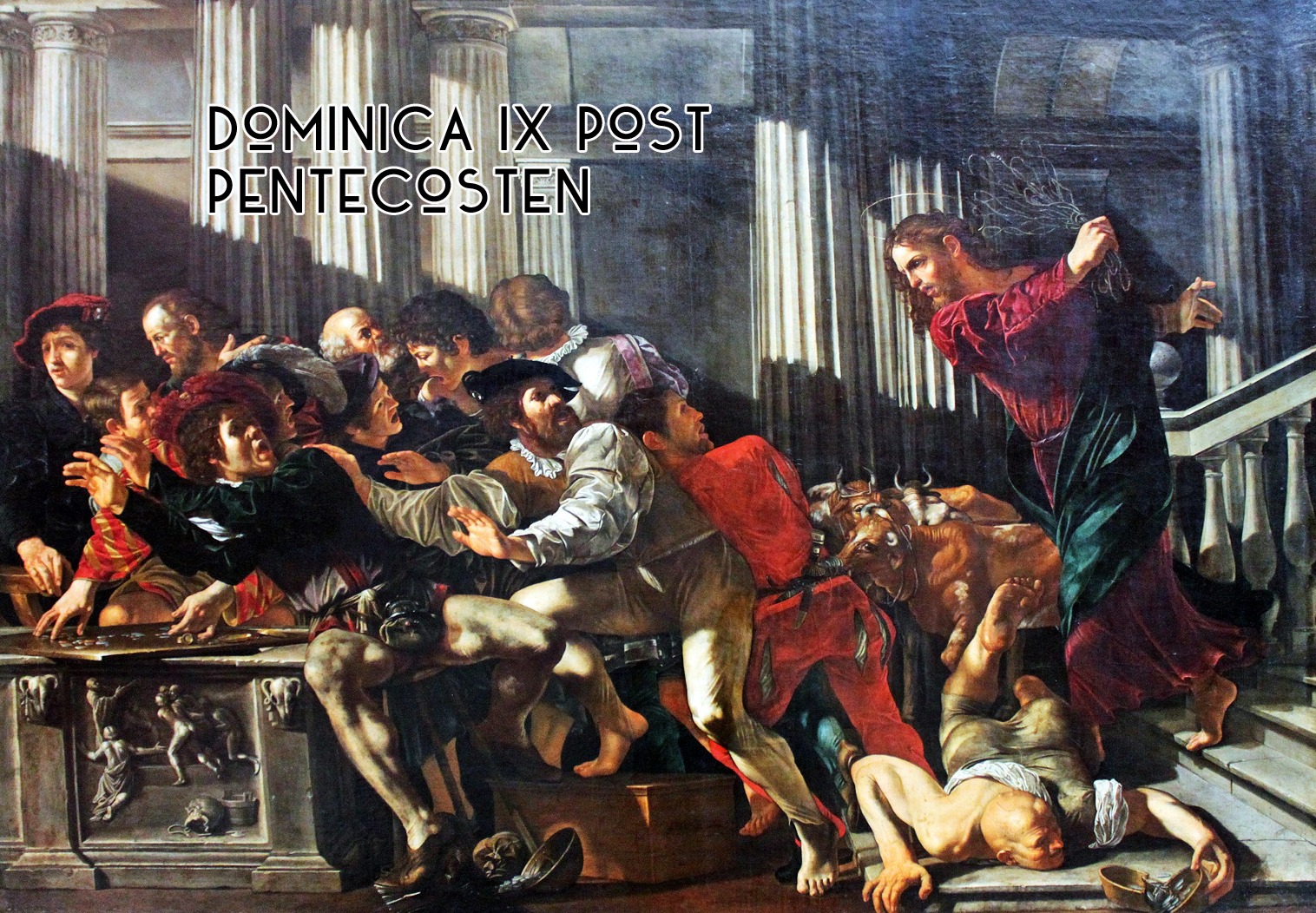
Click for larger… look at His eyes.
Too many people today are without good, strong preaching, to the detriment of all. Share the good stuff.
Was there a GOOD point made in the sermon you heard at your Mass of obligation for this 9th Sunday after Pentecost in the Vetus Ordo (17th Ordinary Sunday in the Novus Ordo)?
Tell us about attendance especially for the Traditional Latin Mass.
Any local changes or (hopefully good) news?
A taste of what I offered at 1 Peter 5 this week. I wrote about the 2nd Sunday after Pentecost but related it to the great feasts nearby.
[…]
Commenting on this dramatic “cleansing of the Temple” moment, St. Jerome (+420) remarked that this was perhaps the Lord’s greatest miracle, considering their numbers and the way enemies were arrayed against Him. Jerome opined that something of His divine authority must have shined forth in that moment which could not be withstood:
To me, among all the other [miracles], it seems more wonderful that, as one Man, and He at the time contemptible and so vile as to be subsequently crucified, with the Scribes and Pharisees raging against Him, and seeing their gains destroyed, He could by the stripes of His single scourge cast out so great a multitude, overthrow the tables, break the seats, and do other things, which a whole army could not have done. For something of fire and of the sidereal flashed from His eyes, and the majesty of His Divinity shone in His face (Commentarii in Matthaeum III, on Matt. 21:12).
[…]































The priest at the Mass which I attended (ICKSP) used the Lord’s weeping over Jerusalem and cleansing of the temple as an opportunity to reflect on the correct role of the emotions, specifically sorrow and anger, in the moral/spiritual life. He argued that the experience of emotions on the part of our Lord, having a human nature in addition to a divine nature, legitimizes emotions and rules out Stoicism, which he mentioned by name, and while he did not mention Aristotle by name, he definitely endorsed the Aristotelian view of the emotions. He also suggested that a properly ordered soul does not rest in sorrow but is prompted by sorrow to action, which in the instance of our Lord cleansing the temple included anger. The homily was a very interesting reflection on the relation between the emotions of sorrow and anger, and on their proper roles. He also suggested that the Lord weeping over Jerusalem is the Lord weeping over us sinners, who as temples of the Holy Spirit need to be cleansed, and vigorously at that.
In the Novus Ordo, Father addressed the images in the Gospel of the treasure in the field and the merchant searching for pearls. Quoting St. Jerome, he said that these are symbols of treasures hidden in our hearts. And what would these treasures be? Well, in this life we have gifts which are very precious to us, for example, air, sufficient food, water and our health. Without these, life would be difficult if not impossible. Just recall, he mentioned, the sacrifices people were willing to make in service of health, six years ago. None of these compare to the Life of Grace which is imparted to us at our Baptism and maintained by the sacraments, especially Confession and the continual nourishment of the Eucharist. When we die in a state of grace, we pass on to the Life of Glory, wherein these gifts become eternal. Nothing, nothing at all, is worth the price of losing that. We need to maintain a sense of ongoing attention to this by prayer and the sacraments.
I wish I could tell you if the Latin Mass has seen an uptick in (already high) attendance since the whole consecrations/excommunications situation. When my friends come back after the summer I’ll ask them. In the meantime, I’m going to bestir myself to get up early on weekdays so I can go to the daily ones.
“Arise, O Lord, let Thine enemies be scattered, and let all that hate Thee flee from before Thy face.” Numbers 10:35
Seek God above all else