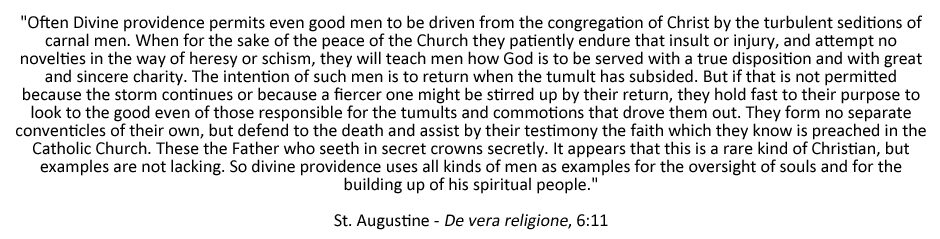
If they think this is going to go away, they are delusional.
Keep in mind the phrase: quod gratis asseritur, gratis negatur.
Also, yesterday in some commentary on the strange opinions of a bishop, I mentioned the issue of “unity”, which has become a prevailing theme (aka buzz word).
From Infovaticana. How it starts:
The prefect of the Dicastery for Divine Worship and the Discipline of the Sacraments, Cardinal Arthur Roche, has assured that Pope Leo XIV will not modify the restrictions on the celebration of the traditional Mass established by Traditionis custodes nor restore the regime provided for by Benedict XVI in Summorum Pontificum.
The statements were made in an interview granted to the British weekly The Tablet, [aka The Bitter Pill] in which the English prelate categorically affirmed: «Pope Leo is not going to change Traditionis custodes and is not going to return to Summorum Pontificum.»
This is the first public statement by Roche regarding the Pontiff’s position on one of the liturgical issues that has generated the most debate within the Church in recent years.
Unity as an argument
During the interview, the prefect defended that the question of the traditional liturgy must be understood from the perspective of ecclesial unity. He recalled that the Eucharist is «the sacrament of unity» and maintained that, if the celebration of the Mass becomes a cause of division, «something is seriously wrong». [Something is seriously wrong with his ecclesiology. Are Romans not in unity with Ukrainians and Maronites? Apparently we are not in unity with those who use the NeoCat thing or Anglican use.]
Roche also rejected the claims of persecution made by some faithful linked to the traditional liturgy. According to him, when the Pope grants authorizations in accordance with current regulations and those groups continue to claim they are being persecuted, «they cannot answer what the real problem is». [What?!?]
Likewise, he lamented the tone of some criticisms directed against Church authorities and even wondered: «Can one honestly say that one is Catholic when one writes things so full of hatred about people and about the Church?».
Defense of the liturgical reform
The prefect clarified that he does not consider the liturgy prior to the Second Vatican Council to be erroneous, but maintained that the reform promoted after the Council responded to the need to prepare the Church for a renewed missionary task. [Does we need again to trot out the statistics of what has gone on since the Council? Do we need again to point out that the great missionary age of the Church was not carried out with the Novus Ordo?]
[…]
How long, Lord?































Given that the idea of ex ecclesiam nullus sallus is persona non grata in the post-conciliar period, I feel the need to ask:
What is the renewed missionary task of the church of which +Roche speaks?
Given how quickly arguments like Roche’s fall apart upon the slightest scrutiny, it would be comedic, except that he and all to many like him sit in various drivers’ seats. Therefore, it is instead dangerous and tragic, if not completely maddening.
Likewise, he lamented the tone of some criticisms directed against Church authorities and even wondered: Can one honestly say that one is Catholic when one writes things so full of hatred about people and about the Church?
What the heck does that even mean? Roche is going to be replaced soon, and his office leaves a legacy of hatred for the authority of bishops and the dignity due to the people of God. He sneers at anyone who likes the Traditional Mass, he forces bishops to ask him for permissions to do things within their competency. He abolished the privilege of bishops to dispense particular elements of the Universal Law via Canon 87, something the Vatican has only done for processes like scandal and sex abuse. He goes around every few months taking interviews and flaunting his authority.
Indeed, Cardinal Roche, can one honestly say that one is Catholic when one writes things so full of hatred about people and about the Church?
What is asserted without proof can be denied without proof indeed. Sounds to me like ++Roche might be wishing out loud. Matthew Hazell posted this excerpt from the Bitter Pill on his X account with his take, “Well, what Card. Roche claims in The Tablet this week may very well be true. Until it isn’t.” Time will tell. Kind of like the rumor mill stating right after the conclave last year that “Cardinal Prevost even said the TLM privately.” Rumors that turned out to be false. What irks me is that people ran with the rumor waving it around like gospel truth, people who should know better than to be broadcasting this stuff without evidence.
About a year ago there was a National Bureau of Economic research
(https://www.nber.org/papers/w34060)
paper released that creatively used survey data on attendance at religious services to exam how attendance across countries had varied since the 1920’s.
The authors, two of which are recognized as outstanding economists, used common statistical methods to show that their extension of the data back to ‘20s gave an accurate reflection of behavior by examining how religious services attendance had changed since 1965 as well as after the fall of the iron curtain.
What I did not realize is that the results they got were already well known by economists (and others) who studied religious observance. They just wanted to show that this creative use of the data is useful. So what did they find? Among other things:
1. Attendance in predominately Catholic countries declined relative to attendance in predominately Protestant countries beginning in 1965.
2. Attendance in predominately Catholic countries relative to that in Protestant countries has continued to decline.
3. This relative decline did not exist in the 1950’s.
I found this astounding because the authors referred to enormous scholarly literature beginning over 40 years ago trying to explain why Catholic attendance at Mass has declined. But the guy who has the Hand Missal History website has pointed out that not only did Vatican II end in 1965, the Mass began to be changed in 1965. I think the change in the liturgy is the main cause but the NBER working paper, if I am remembering correctly, does not mention this.
Since I read that paper I have become even more astounded than I was before. I was impatient with Catholic Answers and EWTN commentators who blame the general loss in faith by Catholics on changes in the culture because it is possible that the Church largely responsible for the changes in culture that have occurred in predominately Catholic countries.
What also is not discussed is the emptying of monasteries and the loss of most of the Human Capital in the Church that staffed Catholic colleges and primary and secondary schools. (There were at least 3 English professors at my university who had gone to seminary in the early ‘60s as well as many proud ex-Catholics.)
Things are not going to get better until the hierarchy of the Church looks in the mirror and each one admits he has some responsibility for the decline Catholic piety.
I did not reread the paper before writing this, so I hope I did not make any mistakes.
How has that “renewed missionary work” progressed over the last 50 years? Just take a look. The pews filled every Sunday? Catholics attending Mass regularly? Our seminaries filled with young men? Convents filled with sisters dedicating their lives to Christ? Please, someone just tell me where to find the “fruits” of Vatican II. I’m sorry, I have no “hate” for Church authorities, but I just don’t see the fruits and I can’t pretend that everything is fine.
Quoting Roche: “…when the Pope grants authorizations in accordance with current regulations and those groups continue to claim they are being persecuted, «they cannot answer what the real problem is». ”
This is like saying, when a child is being abused by separating him from other members of the family, being confined to his room 23/7, being fed barely adequate nutrition, and is crying out for the perpetrator to stop, the cruel parent saying, “The child can’t really say what the problem is. After all, he has a place to sleep and gets fed.” You’d have to be a flaming heartless narcissistic abuser to take that position.
Is it that those being hurt by Traditiones Custodes can’t really say what the problem is, or is it that those in authority refuse to acknowledge the effects of what they’ve put into place? I guess any and all complaints serve to verify for the likes of Roche that the policy is causing the pain it is designed to cause.
This reminds me of a diocesan pilgrimage in SW Germany back in the 90’s in which the bishop, upon having visited several Byzantine Catholic churches, with great self-satisfaction proclaimed to all on board the bus how “diverse” the Catholic Church in Germany is. A woman then asked the bishop, “If you were so interested in “diversity”, why do you not allow the FSSP to work in your diocese?” He was gob-smashed and rescued to silence. “Unity”, “diversity”, these are empty terms once you depart from the Truth.
@Ben asked: “What is the renewed missionary task of the church of which +Roche speaks?”
I think there’s a clue in the post of yesterday (July 29) here on Fr. Z’s blog in the quotes by the bishop of the Diocese of Pilsen in the Czech Republic, Tomáš Holub.
(From the quotes provided by Fr. Z:)
“Synodality, which is “rooted” in Vatican II changes, must be a tool of evangelization.”
…the “old tools” of evangelization “do not meet the needs of today’s people,”
He convened a synod which he claims “…fundamentally changed the role of laypeople in the Church.”
“The people of God “became the protagonist, not just the recipient of the services; a people composed of clergy and laymen, men and women, united without distinction in common baptism,..”
““It is not about convening a synod but about becoming a synod to imitate Jesus and become His disciples.”
As I read this post the Communist Internationale came to mind. Here’s a couple of lines of some of the lyrics:
“A better world’s in birth!
No more tradition’s chains shall bind us
Arise, ye slaves, no more in thrall;
The earth shall rise on new foundations
We have been naught we shall be all.”
Refrain:
“’Tis the final conflict
Let each stand in his place
The International Union
Shall be the human race.”
“We want no condescending saviors
To rule us from their judgement hall
We workers ask not for their favors
Let us consult for all. …
We must ourselves decide our duty
We must decide and do it well.”
“Away with all your superstitions
Servile masses arise, arise
We’ll change henceforth the old tradition
And spurn the dust to win the prize.”
“Refrain:
So comrades, come rally
And the last fight let us face
The Internationale unites the human race.”
Roche is, in my opinion, lying. He is attempting to present his anti-TLM views as Pope Leo’s views, saying it from his position of authority to make people believe it to be true. Let’s instead read what Pope Leo himself has told bishops: “May the Holy Spirit suggest to you concrete solutions that will allow for the generous inclusion of those sincerely attached to the Vetus Ordo.”
“the reform promoted after the Council responded to the need to prepare the Church for a renewed missionary task.”
In what way?
Are those three words so hard to use? Why do our bishops always seem to get a pass from getting hard questions? At the very least, stupid responses to real questions would then be on the record.
The question I proposed is not even worded in the more truthful, lopsided, confrontational way, such as:
“So, how much have missionary results improved since V2?”
“How does this missionary effort relate to the churches you closed last year?”
“Do you really believe this, or are you saying it out of obedience? Is it morally licit to lie in service of obedience to a superior?”
“At this missionary success rate, when does it become appropriate to reduce the number of dioceses (and bishops) required?”
The better question is how long will traditionalists resist the will and Magisterium of the successors of St Peter?
The future of the liturgy, especially solemn masses, will be a reverent Novus ordo with some Latin propers and an increase in the use of ad orientem. I point to the Novus ordo Sunday high masses at St Mary’s Cathedral in Sydney, AU or the English oratories as exemplars. As much as I have benefitted from blogs like this one, it’s becoming increasingly clear that what Francis wrote in TC is spot on and that the vocal leaders of resist or woe are we movement (Fr Z, Dr K, Rorate and others) should instead work to align their thinking and hearts to that of the Church. Not as we would prefer or want it to be, but as God is expressing his will through the Church he promised to stay with and protect.
Reminder: There are some in Rome who DO look at the Eastern liturgies as deficient and needing to be brought into line with VII, Romanized, and eventually replaced by the N.O.
These are not just liberal progressives who desire to Romanize the East, and it was for this very reason (frustration at the Latinization of the East by conservative traditionalists and not affording the appropriate honors) that the Eastern Patriarchs ended up siding with the German/French/Dutch/LatinAmerican (CELAM) Bishops at VII and voting to scrap the original schema at Vatican II.
“How long, Lord?”
Not long to wait now, I should think.
@PaulK – Thanks. Go troll somewhere else.
@Kenneth Wolfe – Also Pope Leo’s words, “If we celebrate the Vatican II liturgy in a proper way, do you really find that much difference between this experience and that experience?” Also, Roche isn’t saying anything that the Nuncio in England said in November of last year.
In general, I imagine Roche is an astute political creature (remember back when he was pretending he might be a suitable candidate at the conclave and suddenly found that Tradtionis Custodes was too harsh and he didn’t understand what the big deal is about letting folks offer the TLM?). He would not be saying such things like this in very public interviews if he did not either believe they accurately reflected Pope Leo’s position or if he didn’t believe Pope Leo was in such a weak position he couldn’t do anything to Roche if he disagreed with his statements.
It’s a foolish time for folks to practice wishful thinking. There are no signs that Traditionis Custodes will be overturned any time soon. Far from it, especially after the SSPX consecrations and the ignored calls from several cardinals and bishops to restore Summorum Pontificum.
@PaulK,
Speaking of “quod gratis asseritur, gratis negatur,” care to support your statement that “it’s becoming increasingly clear that what Francis wrote in TC is spot on”? In my line of work, that’d be considered conclusory pleading at best.
And while it is true that God “promised to stay with and protect” the Church, there is nothing in Catholic belief that holds every decision regarding discipline or practice, or even faith or morals, can be equated with the “expression of his will.” As the same pope who expressed God’s will (right?) in broadening the TLM’s use in the Church once said, the pope is not the oracle of God.
That’d be like equating the fallible implementation of Sacrosanctum Concilium with the infallible… oh wait, many do exactly that.
Those who are attached to tradition and the traditional Mass are seen as unworthy members of the current church. It is amazing the persecution that is meted out for doing nothing more than worshiping in the same way as our grandparents. It really, truly does feel like persecution.
I would love to have an ICRSS or FSSP parish within an hour of my home. I want to just shutout the noise and be catholic in the same way my grandparents were. Diocesan TLMs feel and look like persecution. Isolated to a non-church building, no traditional sacraments outside of the Mass. A bishop who never visits you. Homilies that remind us we are not to stray to the SSPX, etc. We are being handed stones when we want bread. We are being denied water when we thirst.
How should one feel when his spiritual father abandons his spiritual children for want no more than to be as his forefathers were? How should we feel when a bishops tells us to stay away from fellow Catholics and then welcomes all of the reprobates of the world? Does one not betray his own words and actions when he sends away those most in need of his mercy?
Sorry @PaulK, the unicorn “reverent Novus Ordo” will not be the future of the liturgy – in many places even it is considered a step too far away from “Unity”. If you read Dr. K’s book “Close the Workshop” he explains the reasons much better that I can, why the Novus Ordo reverent or not, cannot be the future.
We have to remember the real issue is not the actual liturgy but what is behind it – the lex credendi that underpins the lex orandi. The sacred tradition that puts God rather than Man at the center and charges the Church with changing the world, rather than being changed by and conforming to it.
Thank you Fr Z .
The Card Roche comments contradict those of Pope Leo. Words that the Holy Father expressed to the French Bishops in a formal letter.