
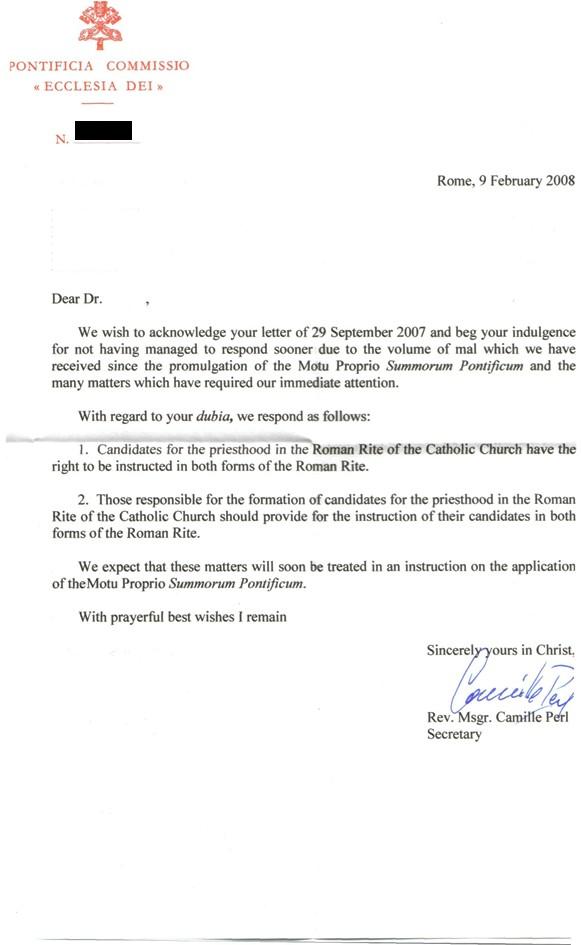
The seminarian asked the Commission some questions.
The answers are illuminating.
First, the Commission says that seminarians "have the right" to be instructed also in the older form of Mass.
Second, those responsible for formation of semiarians "should provide for the instruction in both forms of the Roman Rite."
These items will be in the forthcoming instruction about Summorum Pontificum the Holy Father will issue in forma specifica.































I’m pleased that the right to TLM training was affirmed. As for Fr Z’s comment about “those responsible for formation of (sic) semiarians,” I’m sure it was a harmless slip.
Its good the see this logical conclusion on paper, lets just hope that those who want to learn the ER are not found to have “issues” later on by seminary staff who happen to think that these seminarians are “too rigid” or too “conservative”, and therefore not properly suited for the priesthood. Here’s some advice to seminarians: Be sweetness and light to your formators, smile, but not too much, and talk about your “feelings” every once and a while.
I love it. It seems like clarifications and instructions are needed when the bishops are reluctant to do their job….is it poetic justice when a clarification goes a step further than what a bishop would have gone had he done his job in the first place?
As someone who spends a lot of time interpreting regulations, guidelines and procedures the word ‘should’ is not as strong a word as ‘shall’ or ‘will’. Using ‘should’ provides wiggle room for the recalcitrant bishops who don’t want to implement the motu or are putting roadblocks in place to slow its expansion. Althought saying the seminarians ‘have the right’ provides some force behind the use of ‘should’
We have 4-8 seminarians from St. John Vianney in St. Paul attending our Masses. They wear cassocks and surplices – and are now given the front pew. Probably a dozen of them rotating through the year. At high Masses they often process to sit on the altar.
Father Z: This morning I’m preparing some materials (laminated cards, etc.) to train a class of about 10 new altar boys — essentially all the boys of age in our small TLM community. Some of these boys are attending Catholic schools. So I wonder whether the Pope might be persuaded to include in this document a requirement that all Catholic elementary and high schools provide TLM altar server training to all Catholic boys who are enrolled. This would save quite a bit of time and effort for aging altar server trainers like me.
Benedicamus Domino.
This is very good news.
One of the problems that I foresee (for my seminary at least, which is a minor seminary) is that at the moment, none of the seminary staff are prepared to offer Mass in the EF. This would however give those of us who have been eager to learn some leverage when it seems appropriate to finally ask.
This is indeed good news. Our own beloved Bishop Joseph V. Adamec forbade any seminarian from leaning the TLM recently.
This is indeed good news. Our own beloved Bishop Joseph V. Adamec recently forbade any seminarian from learning the TLM.
Like any of the empty recommendations from Rome, are these pronouncements going to have any teeth to these “rights” and “shoulds?”
When is this “forthcoming instruction” going to come out? I only have two years left in Seminary and want to learn the older form of Mass, but at present my seminary does not have plans on preparing us in it.
This is indeed good news. Our own beloved Bishop Joseph V. Adamec forbade any seminarian from leaning the TLM recently.
Comment by AJdiocese
I am really confused.
On April 19th, 2005, after “Eminentissimum Dominum, Dominum Iosephum Sanctae Romanae Ecclesiae Cardinalem”, I would swear that I heard the name “Ratzinger” not “Adamec”.
I hope something similar can be mandated for those of us already ordained.
This will be ‘forma specifica’. That means it will have the force of Papal law apparently, so what happens to those who feel free to opt-out? Time will tell how this plays out, I guess.
RBrown: Not only did Bishop Adamec forbid learning the TLM, he threatened to pull our seminarians from St. Vincent’s in Latrobe, Pa., because of a TLM elective being taught there this Spring.
Well, Vatican II includes somewhere in its list of things that seminaries should teach Christian art and architecture – and it was more than recommended. I looked one time out of curiosity and found no seminary in America requiring it and precious few even offering a course in the catalog. That’s entirely impressionistic, but telling. I didn’t see much real church history, either. La la la la la philosophy la la la la la theology. I’ve never wondered since why so many churches are so ugly.
Hatred for the EF that is publicly shown by certain shepherds is indeed
a reason for much prayer. Their continued public disobedience in this and
in other arenas has long been a scandal to the faithful.
Hatred for the EF that is publicly shown by certain shepherds is indeed a reason for much prayer.
None of us would question the power of prayer, but would not hatred–expressed by a bishop for the Mass in any form declared valid by the Vicar of Christ–call for application of a different and more immediate kind of power?
Henry Edwards; Yes. But what form would that power take?
Concerning the situation in Altoona-Johnstown, there is some consolation. Some of the small town parishes are staffed by Benedictine Fathers from St Vincent’s in Latrobe. Adamec is essentially powerless to prevent them from offering private celebrations of the TLM on a regular basis.
I don’t think he’ll be around for long anyway.
Deo gratias!
This statement is a big key in my opinion. One of the greatest obstacles to getting liturgy back on track has to start with those most directly responsible for it: the priests. No matter how well versed the laity are, as long as priests and bishops are either biased or misinformed about the EF, there really can be no progress.
Unfortunately, the skeptic in me see this directive will be ignored as are most liturgical directives from Rome.
Still, there continues to be hope!
When the Vatican uses the word, right, they know what they are talking about. In the secular world, they use the word, right, for “right to choose”, “right to become woman priests” … all bogus.
Tom Liang
David,
Although those parishes may be staffed by Benedictines, I don’t know how many of them are trained in the EF. Even at the Monastery itself where there is a decent-sized EF community, there seem to be only a few priests trained.
From all I can tell as a quasi-local (away much of the time for college), the Archabbot seems to not have any objections, so more priests may be working on learning.
Praised be the Lord!
Many in the administration at the Pontifical College Josephinum have continued to be extremely prejudiced against the Extraordinary Form and has repeatedly treated seminarians seeking to learn the EF and liturgical latin traditions harshly.
May the Lord enlighten their hearts as they bring themselves into full obedience to the supreme pontiff!
Looking with hope to the future, as a new generation of faithful witnesses arises!
Habemus: But what form would that power take?
Hmm … Might there be a case so extreme it would call for the
Rite for Degradation of a Bishop
http://www.cwnews.com/news/viewstory.cfm?recnum=21242 ?
Comment by GCC Catholic: “From all I can tell as a quasi-local (away much of the time for college), the Archabbot seems to not have any objections, so more priests may be working on learning.”
The Archabbot seems to be ambiguous at best. The bishops of Greensburg and Altoona-Johnstown are attempting to put a stop to both the celebration of the TLM at St. Vincent’s, as well as the TLM elective currently being offered. Only eight seminarians (out of 70 or 80 total) are taking the TLM elective; some seminarians were forced by their local bishops to drop the TLM elective at St. Vincent’s.
Wow.
I think this is arguably the first time in the history of the Church that seminarians have been acknowledged to have a right to anything other than a Christian burial, and it is the right to have access to TLM.
Irony.
What I really like about this letter is that seminaries will have to provide the training also. The seminarians are not merely free to seek the training elsewhere, if they can find it, the seminary has to help them.
“Comment by GCC Catholic — 16 February 2008 @ 1:13 pm”
If you want everything to happen right away, you’re going to be disappointed no matter what Rome does. How many of us could have predicted a few years ago that anything resembling a “universal indult” would happen today?
I believe there is a great difference between this pope and the last. The last pope said many good things, but was never able to follow through. I do not think this pope is one to allow his words to not be followed up by deeds. Yes, it might take some time to see all the seminaries teaching what should be mandated courses, but I believe this pope will ensure that they start. Res non verbum!
Could someone (Fr. Z?) instruct on the proper protocol for submitting dubia to Rome? Who can submit a dubium?
Correct David, Bp. Adamec turns 75 in August of 2010 and we cannot wait! His famous words to our seminarians concerning why they are not to learn the TLM were as follows (a direct quote): “It’s only for old people who can’t change.”
lol! Was the phrase (in the letter) “volume of mal” [sic] some sort of frenchified freudian slip?
I’d like to introduce Bp. Adamec to Pope St. Gregory VII. Then the good folks of AJ woul not have to wait until anywhere near 2010.
It will be interesting to see the context in which the words “should provide for the instruction in both forms of the Roman Rite” are found. What we read here could be taken as “it is desirable that the instruction etc…be given”.
Laws are made up of words and which words are used makes all the difference in the world.
Correct David, Bp. Adamec turns 75 in August of 2010 and we cannot wait! His famous words to our seminarians concerning why they are not to learn the TLM were as follows (a direct quote): “It’s only for old people who can’t change.”
Comment by AJdiocese
It seems that Bp Adamec himself is someone who can’t change.
As I’ve said before, the Vatican can name a co-adjutor to that or any other diocese and give him the authority.
A decade of my rosary will be offered for the protection and intentions of all the seminarians whose hearts are burning for the Tridentine Latin Mass.
Does the letter also mean that EF communities will have to teach the Novus Ordo in their seminaries? It seems to read that way too.
Frank,
It doesn’t seem unreasonable.
After all, even if the priest is not going to use it, he must know
how to celebrate what is still the ordinary form of the juridically
one Roman Rite.
And he must take part in Chrism Mass (that is probably going to be
concelebrated by the Bishop and all priests in the ordinary form), and
must know how to celebrate the ordinary form if for some pastoral reason
the need arises.
Now, what is important here is… that all priests of the Roman Rite must
also receive instruction on how to celebrate the extraordinary form of the
rite.
And, if you think of numbers, having seminarians of EF communities learn
how to celebrate the OF reverently for some situation when they might need
this knowledge is a small price to pay in exchange for having all the
seminarians of the Latin Church learn how to celebrate the EF.
I wonder if you could make that document in PDF so it can be printed accurately? This would allow us to print it and use it.
I have a letter into “Ecclesia Dei”, asking for a clarification on the role of the “Permanent Deacon” in the Extraordinary Form. I have reason to believe that the Albany Diocese in NY are leading Deacons to believe that they can not participate in this liturgy. They appear to be using a flawed logic… something like, “There were no “permant” deacons back then, so there is no role for you.”
It may be innocent ignorance or an attempt to supress… we’ll see.
If you want everything to happen right away, you’re going to be disappointed no matter what Rome does. How many of us could have predicted a few years ago that anything resembling a “universal indult” would happen today?
David,
I certainly understand that it’s not going to happen right away. I apologize if I was ambiguous in any way. The TLM at St. Vincent caught me by complete surprise, and I was quite pleased to find that it was happening.
Sacristy Rat: Of course permanent deacons can be sacred ministers for the older form of Mass! They are DEACONS, after all. I am sure you will get a positive letter back from the PCED.
Frank: Does the letter also mean that EF communities will have to teach the Novus Ordo in their seminaries? It seems to read that way too.
A very good point! That would see to be the case, yes.
Henry Edwards: Rite for Degradation of a Bishop. Wow, powerful stuff! And another excellent reason for reinstating the Old Rite.
It would seem from a reading of the above referenced letter and the seminarian who submitted the dubia, that an EF community would have to provide training in the NO ONLY if requested by one of their seminarians. While always a possibilty, I strongly suspect that no such request will ever be made. Why waste time being trained in a “yo dude” liturgy?!
Yes, but learning something and using it are two different things. The question becomes will a priest be required to say the Novus Ordo, and if so, does he have to say it in the vernacular? And which vernacular will they be teaching it? Forcing a priest to say the Novus Ordo can become another can of worms. But, to be fair, so can saying the TLM. 7/7/07 opened up a new era in the Church. And lots of opportunities too. Very good for the Church.
Does this letter also apply to the FSSP? Do they now have to train seminarians in the OF?
bjr
Even that I don’t see the situation is going to change. When we asked our teachers about learning the Extraordinary Form of the Roman Rite we heard that they didn’t want to theach us anything to not provoke any evil inclinations or tendecies to an old liturgy in us. Doing anything with Summorum Pontificum is not predicted in my Seminary. No comment.
Barbara: I think we addressed that already. It seems to me that letter implies that the Novus Ordo. Would be taught in traditional formation programs. It suspect that would take the better part of a day, for men who already know the older form of Mass.
Father Z: It suspect that would take the better part of a day, for men who already know the older form of Mass.
Surely you jest. Once the seminarians have spent a semester learning the EF, why would it take more than a half hour to tell them what to leave out in order to celebrate the OF instead?
Might not your estimate of “the better part of a day” be more accurate for teaching seminarians (from scratch) to celebrate the OF? Indeed, for men who have been attending exemplary OF seminary Masses all along, what’s to learn? It seems to me that many an ordinary layman, once instantly ordained, could without instruction or practice, celebrate the OF better than sometimes seen.
Well, one thing is not just learning to ‘say’ the Ordinary or Extraordinary forms, but learning what to say what days – look at the debates about ordo (calendar) on this site alone!
I looked at a picture book of the life of a seminarian done at St Joseph’s, Yonkers, back in the 50s (I think Karsh did the photos). They spent a course their last year learning to say the mass….
What are some “traditional” seminaries? I’m thinking about applying for the seminary under the Diocese of Toledo next year. Most of the diocesan seminarians attend Pontifical College Josephinum, St. Meinred Archabbey, or Mount St. Mary’s Seminary of the West.
Thanks in advance…
” It seems to me that many an ordinary layman, once instantly ordained, could without instruction or practice, celebrate the OF better than sometimes seen.”
That is very much true..I have all the liturgical books, I’m pretty sure that if I was ordained right now, I could offer a reverent NO Mass (and because of say the Black, do the Red, Ad Orientem for the NO’s to be offered by me)