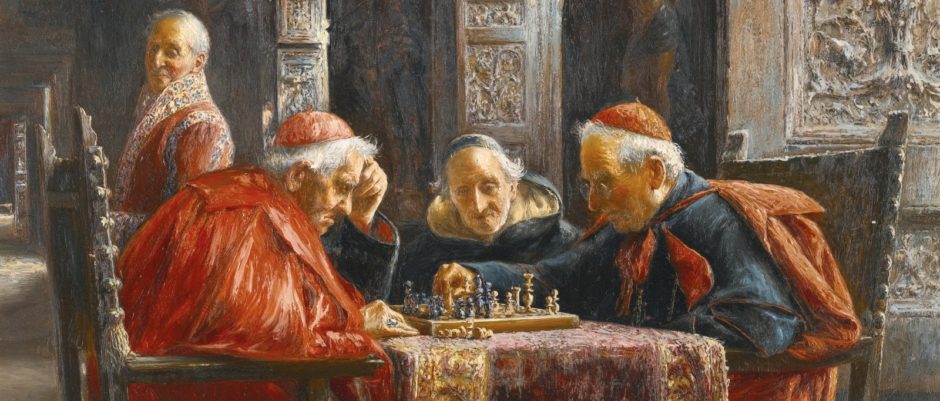
You want liturgical eye candy?
Take a look at this coverage by the incredibly connected NLM.
A sample:

Slavishly accurate liturgical translations & frank commentary on Catholic issues - by Fr. John Zuhlsdorf o{]:¬)


Take a look at this coverage by the incredibly connected NLM.
A sample:

I got this question by e-mail:
Greetings Father,
A question that the bishop and I were discussing today…If a priest celebrates Mass according to the Missal of 1962, is he REQUIRED to wear a maniple? Certainly it would be preferable, but is it required?
I am torn as to whether this is a matter of discipline, which would mean the reformed vestments would be acceptable in the Extraordinary Form, or a matter of rubrics, in which the priest would be bound by that particular missal.
Any documentation you or the readers could provide would be of great help.
I have written about maniples before. Check here and here.
My first inclination is to say, yes, it is required. If you have the maniple, it ought to be used.
In the editio typica of the 1962 Missale Romanum, we find in the first part of the Ritus Servandus the method of vesting. In that section we find: Sacerdos accipit manipulum, osculatur crucem in medio, et imponit bracchio sinistro. This seem pretty clear to me.
Moreover, the prayers to be said be the priest while putting on vestments, including the maniple are, in fact, printed in the 1962 edito typica of the Missale Romanum. The prayers a bishop is to say, including that for the maniple, are also in the 1962MR.
Of course, no one is held to the impossible. If there is no maniple available, that does not mean that the EF cannot be celebrated. That would be silly, and it would never have been the case in the old days, either.
I think some silly people tried to block celebrations of the older Mass because, they claimed, you could not say Mass if you didn’t have the proper vestments. That is far far too rigid an approach.
By "reformed" vestments I think you might be referring to variations from the old days. For example, if an alb closes at the nexk so that it entirely covers the street clothes or cassock, then no amice would be necessary. Or if the alb is fitted, no cincture is necessary.
BTW, how often do we see priests with their Roman, military, collars visible sticking out of their albs and chasubles during Mass, in violation of the rubrics. Street clothes are to be covered! The collar of your shirt, or vest, or cassock, is part of your street clothes, Fathers! But I digress.

The vestments had a purpose beyond the merely practical or functional. They had a spiritual significance for the priest as he says Mass, a meaning which informs his words and actions at the altar.
I fear that functionalism overtook a Catholic sense of things after the Council, must as the utilitarian spirit eviscerated sacred music and architecture.
Thus… against this error of functionalism, I remind you all of my anti-functionalist battle cry:
I have heard from a source who has first-hand information that Cardinal Castrillon is happy with the answer from Bishop Fellay and has sent him a brief note in response.
I have also heard that the Cardinal will pass on the letter to His Holiness.
So behind the scenes it actually looks much brighter than the impression given by liberal press or some of the … SSPX bishops.
This is a very hopeful message. I can take this as a confirmation of something I posted before.
I am hearing various things about this, and their cumulative effect reinforces the hope I did not abandon, even in the face of some of the press accounts and stories I have read.
I will be starting Mass in about 15 minutes as of this post.
PRAY! PRAY NOW!
May God the Holy Spirit soften hearts and illuminate minds.
May St. Paul, whose year we celebrate, help us all to greater unity.
May St. Peter, the Rock on whom Christ built the Church, gather us into one fold.
May St. Michael and the heavenly angels defend us from the attacks of hell.
This is posted by Reuters.
My emphases and comments.
FaithWorld
Religion, faith and ethics
SSPX “answer without response” to Vatican ultimatum
Posted by: Tom Heneghan
The schismatic [The writer is not going with the nuanced position of Card. Castrillon Hoyos, namely, that while the 1988 consecrations were a "schismatic act" they didn’t actually result in schism.] traditionalist Society of Saint Pius X (SSPX) has reacted to a Vatican ultimatum by challenging the conditions Rome set for its return to the Catholic fold. By sending this in a letter, SSPX leader Bishop Bernard Fellay partly fulfilled one condition of the ultimatum, i.e. answering by the end of this month. But he did not fulfill the more important other half of that requirement, i.e. that he respond positively. In fact, he told the Vatican that other conditions — to accept papal authority and not criticise the pope — were too vague to be accepted, according to SSPX spokesman Rev. Alain Lorans. As Lorans put it: “You can say he’s not responding, despite answering it.”
[I am not sure where the writer of Reuters is getting this, aside from (the item I posted the other day) from Radio Svizzera.]
This is a clever way of ducking deadline pressure, but it doesn’t answer the real issues. It looked like the Vatican had the SSPX in a corner when the ultimatum of June 4 became known early this week. By wording the five conditions so vaguely that contentious issues such as the new Mass and the Second Vatican Council reforms went unmentioned, Pope Benedict and Cardinal Darío Castrillón Hoyos — the Vatican official dealing with traditionalists — may have thought they might win over the schismatics. Benedict had already taken the first step towards a possible accord last year by liberalising the use of the old Latin Mass that the SSPX has championed as its visible trademark. The ultimatum made a further conciliatory gesture by keeping the explicit requirements to a minimum.
But Benedict has his red lines too. Compare the current five conditions to the much more explicit five conditions that SSPX founder Archbishop Marcel Lefebvre accepted in May 1988 (with the then Cardinal Joseph Ratzinger) but renounced the following month. The new list of conditions strips away the explicit demands of the 1988 document, but they basically remain implicit — a fact that Vatican spokesman Rev. Federico Lombardi confirmed this week. [However, the Five Conditions given by Card. Castrillon to Bp. Fellay were really "pre-conditions" for continued dialogue. I don’t think they were intended only by themselves to resolve all the problems between the SSPX and Rome.]
Fellay clearly saw that and spoke out bluntly against the ultimatum a week ago at an SSPX seminary in Winona, Minnesota. The eye-catching quote in that sermon was “They just say ’shut up’ … We are not going … to shut up.” He also offered a longer and quite vivid image of two icebergs. The tip of one iceberg is the old Latin Mass and its underwater part stands for Church tradition. The other has the new Mass at its visible tip and the underwater part is a symbol, he said, “of Vatican II and of these modern ideas, what they call the spirit of the Council, which has come in with all these reforms which have almost kicked down the Church.” Referring to the restoration of the old Mass, he said:
“What happens with this motu proprio is as if they would have taken this tip of the iceberg. When we see this, we have the impression, OK, they take the tip, so they take everything which is below. That’s not exactly what they did. They tried to take the tip and to plant it on the other iceberg, the iceberg of the new thing. And so we have two tips and they say it’s only one tip. But if you try to go and see and look under the water, what is below, you will see that they maintain that the only thing you can have below is the new thing.”
The text of that part of Fellay’s sermon and the full audio posted here show how firmly Fellay — who sharply criticised Benedict only days before meeting Castrillón Hoyos to discuss the Vatican’s conditions — is upholding the SSPX rejection of Vatican II reforms. Two other SSPX bishops (Alfonso de Galarreta and Richard Williamson) have also spoken out against the ultimatum. For his part, Benedict has changed the wording of the Vatican demands and partly conceded the old liturgy (”partly” because he supported it anyway). But he has not budged in principle on the Council that he himself attended and helped shape as a young theologian.
So it’s back to a rock and a hard place. [Hmmm… a familiar phrase in this context.] Will either side blink? Fellay says he has plenty of time and the ultimatum showed Vatican’s in a hurry. He told Swiss radio RTSI (in Italian, from 17:44) “Maybe it’s wrong to say so directly that I reject, that I totally reject (the ultimatum), that is not true. Rather, I see in this ultimatum a very vague and confused thing … we have relations with Rome that develop at a certain pace, which is really slow … there may now be a chillier period, but frankly, for me, it’s not finished.”
The Vatican conditions may be the best the SSPX can ever get and Fellay has replied positively to one-half of one condition out of a total of five. That’s just enough for him to get semantic and say that maybe it’s wrong to say he totally rejected the ultimatum. Well, he certainly didn’t accept it, or even come anywhere near accepting it. Is he just buying time waiting for the Vatican to blink?
It looks like the Vatican’s turn to reply. What’s next? [A very good question.]
I want to put this question, which I received via e-mail, out there to you readers. I edited it a little.
I have been reading your blog as a "lurker" for some months now and give thanks regularly for your service through it. I realize that you receive many, many emails and other contacts, and that you may not be able to respond but I thought to give it a try anyway.It seems to me that some of you out there may have made this journey yourselves. You could help this fellow.
To be honest, I am troubled. I am Anglican, but over the past few years have become increasingly agitated by where the Episcopal Church is pointing itself. [... Lots of personal stuff here… ]
Over the past several years as this has progressed, I have sensed a call to move toward the Roman Church, but I want to be sure that I am not just going "from" something, but "to" the Roman Church. I have a general sense of the doctrinal, theological, and governance differences between our two Churches, but want to make sure I really understand.
Is there a book or series of books you can recommend? I am currently working through a Catholic Study Bible, and the Navarre Bible Gospels. I have added occassional use of LOTH to supplement my Daily Office (I should probably say "almost-Daily Office"). Where else can I go to understand?
Any time you might have to respond to this request would be greatly appreciated.
Here is an opinion piece in the Charlotte Observer.
My emphases and comments.
IN MY OPINION
Latin Mass is fine, but I like the new ways
MARY C. CURTIS
mcurtis@charlotteobserver.com
When in Rome – and you need to go to Mass – do as the Romans do. A few years ago, I did just that, dashing into a beautiful church a coin’s throw from the famous Trevi Fountain.
As I made my way through the ritual, following along, just barely, in Italian, I had a sudden longing for the Latin Mass of my youth. The feeling was only part nostalgia for lace mantilla head coverings and the soothing sound of “Dominus vobiscum” and its answer, “Et cum spiritu tuo.”
I wanted to fully share in the celebration with those gathered in the pews around me. [But, by wanting to, and by being baptized, and by trying to, you were fully participating.] When Latin was the common language of the ancient liturgy, you could go to any Catholic Church anywhere in the world and be at home.
In the little church in Rome, the people were friendly, the handshakes sincere and the communion inspiring. [hmmm] But if we shared the words in Latin, I thought, there would be the comfort I did not feel stumbling my way through prayers and response























