
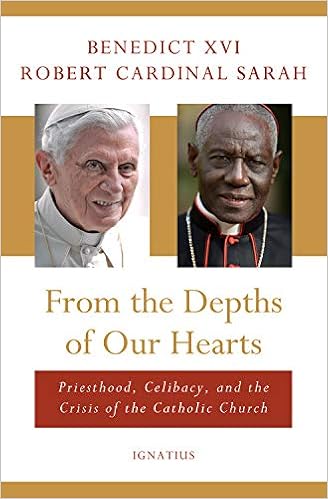
Robert Card. Sarah and Pope Benedict XVI have collaborated on a new book. They respond to certain aspects of The Present Crisis.™
From the Depths of our Hearts
The dedication of the book says it all.
En hommage aux prêtres du monde entier.
This comes into archaic English parlance better than more modern.
“With our compliments to the priests of the whole world” or rather “as an act of hommage/tribute/respect/gratitude to all the priests in the world”.
I have some initial remarks. I may ramble a little, since I am writing really quickly.
I’ve now read the editor’s note or preface by Nicholas Diat (who helped Sarah with the other books), the introduction signed by both authors, Sarah and Benedict, and the first essay by Benedict which is a theological look at the meaning of priesthood.
Yes, the book is partly a reaction to the chaos that came from the last Synod (“walking together”… and bowing before idols together). But it goes far beyond the synod. Yes, the book treats priestly celibacy, which has lib knickers all in a twist, but it goes way beyond mere celibacy, as important as that is. So far what I’ve read is an attempt to bring priests back to a better understanding of who they really are as priests, what priesthood is.
I’ve been saying for years that Benedict engaged in a kind of Marshall Plan for the Church when he issued Summorum Pontificum. That was one major move in his work to reconstitute the identity of the Church, and it involved the critical element of our liturgical worship. As these days I repeat a lot: we are our rites. As the Marshall Plan intended to create a strong Europe against Communism, so Benedict wanted to build the Church up to resist the onslaught of the dictatorship of relativism. Liturgy is key.
Another thing I’ve been saying for years is that when priests learn the older, traditional form of Holy Mass, it changes their self-perception as priests. They learn about themselves in way that the Novus Ordo does not provide. In turn, this priestly self-understanding has a knock on effect on their congregations. They see that he says Mass differently, etc. and react to it. It is not by chance that some, who have forgotten or never learned who they are as Catholics, or who have perhaps succumbed to the three great enemies we all face, the world, flesh and Devil, react violently to priests who have reconnected with tradition. The Enemy wants us atomized, cut off from the good sap of our identity, which is rooted in tradition.
In this new book, Benedict is trying to help priests know themselves better. Yes, that involves the meaning of celibacy, but celibacy is just a result of self-understanding.
Another thing which I gripe about constantly is that when 99% of bishops say or do anything collectively, they virtually ignore our sacred liturgical worship. They think that initiatives, programs, pamphlets, committees will help us in The Present Crisis. I’ve been saying that everything has to start with revitalization of our liturgical worship because we are our rites. We must attend, first, to the virtue of religion, individually and collectively. Only then will programs accomplish anything. It’s about liturgy. Benedict’s section is deeply liturgical.
Benedict compares and contrasts the Old Testament priesthood with the New. He gets into “ministry”. (I have an anecdote about that with him from my years in Rome.) After writing about the New Testament priest as mediator of the Word, he unpacks three texts, two from Scripture and a phrase from Eucharistic Prayer II which is ancient. Remember that Ratzinger understands that liturgical texts are loca theologica. He provides part of a sermon he gave on a Holy Thursday.
However, all three of these are points of reflection for Benedict from his own personal history of meditating of the priesthood, and on his own priesthood.
For example, the first text he unpacks is Ps 16: 5-6 which he states is part of the pre-Conciliar ceremony of tonsure, by which a man first became a cleric (under the old Code). He writes that he meditated on this verse the night before he was tonsured, so long ago, and provides his own thoughts.
How I envy, in a way, those young men in traditional seminary programs now who will be able to use what Benedict wrote here to ponder and reflect on before and after they are tonsured. What a tragic mistake it was to eliminate those minor orders. Perhaps if we had retained them and tried to make them better understood and more profoundly appreciated for what they are, we might not be in this crisis of priesthood now.
One of the points Benedict works with in looking at Ps 16 is how all the tribes of the Jews had a portion of property that would sustain them. All except for the Levites, who renounced land and property to live wholly from the altar. But there is in the verse also the image of the chalice. He unpacks that as well.
About the common introduction by both Sarah and Benedict.
There is something quite subtle going on in that introduction, it seems to me. They quote St. Augustine’s Letter 23, written in the 390’s, to a Donatist bishop in Numidia, Maximinus, who was reported to have re-baptized people. Benedict is no fool. He knows his Augustine. If there is a quote from a letter, it is a good idea to look at the whole letter and see if there is something more going on.
What’s up with Ep 23?
Augustine is, at this point, still a priest, not yet Bishop of Hippo. The Donatist crisis is tearing the Church apart because if, effectively, a misunderstanding of priesthood and how grace is conferred. Altar was pitted against altar. There were Donatist terrorists called Circumcellions who would waylay people on the roads, hoping even to be martyred in their cause. The military was deployed. Sarah and Benedict quote the part of the letter in which Augustine says that, because he is so troubled by what he had heard about Maximinus. Augustine suggests a public discussion via open letters to help everyone get to the truth. He adds that if Maximinus doesn’t respond in kind, he will not be silent and he will read his letters in public. Augustine makes the point that he will not read the letters in the presence of the military, lest people think he was trying to bully anyone. “Let us deal with the facts”, Augustine writes, “let us deal with reason, let us deal with the authorities of the divine scriptures”. And he concludes, “If [my bishop] were here, [he] would perhaps have rather sent a letter.”
So, Augustine won’t bring in the military. He says that his bishop isn’t there, but this is so important that it can’t wait. He says that he wants dialogue, but if he doesn’t get it, he will make his own views public all the same.
Does any of that resonate with today’s phenomenon of requests for explanations and responses, but, in the absence of dialogue, making your own concern public anyway?
There is more in Ep. 23 but that’s enough to make me think that the introduction is more than just an introduction.
Back to Benedict on priesthood. He writes:
« Face à la crise durable que traverse le sacer? doce depuis de nombreuses années, il m’a semblé nécessaire de remonter aux racines profondes du problème. »
Faced with the enduring crisis that the priesthood has been going through for many years, it seemed to me necessary to go back to the deep roots of the problem.
The problem is, many many priests and bishops, too, it seems to me, don’t know who they are anymore.
I think that a huge part of the reason for that was the decimation of our liturgical worship.
His essential view is that priesthood affects the entire being of the priest, it is not a function. THAT is what has been lost in the Church, in his view. As a matter of fact, he make an interesting remark that can be taken as laying part of The Present Crisis on the doorstep of the Second Vatican Council on the priesthood:
À l’époque de Vatican II, cette question de l’opposition entre ministères et sacerdoce est devenue absolument incontournable, y com? pris pour l’Église catholique. En effet, l’« allé? gorie » en tant que passage pneumatique de l’Ancien au Nouveau Testament était devenue incompréhensible. Le décret du concile sur le ministère et la vie des prêtres ne traite prati? quement pas de cette question. Pourtant, dans la période qui a suivi, elle nous a accaparés avec une urgence sans précédent, et elle s’est muée en une crise du sacerdoce qui perdure jusqu’à aujourd’hui dans l’Église.
During the Vatican II era, this question of the opposition between ministries and priesthood became absolutely essential, including for the Catholic Church. Indeed, the “allegory” as a pneumatic passage from the Old to the New Testament had become incomprehensible. The decree of the council on the ministry and life of priests practically does not deal with this question. However, in the period that followed, it grabbed us with unprecedented urgency, and it has turned into a crisis in the priesthood that continues in the Church until today.
About that anecdote. One day I went to visit my old mentor Card. Mayer. His previous guest was still with him so I waited. Out came Mayer with then Card. Ratzinger, whom I also knew quite well by that time. These two were great friends of many decades, both Bavarian, etc. After some chit chat, Ratzinger said that they had been talking about what the burning issues were that had to be solved and, characteristically as a great teacher, asked me what I thought. I replied that we have to make better distinctions about priesthood and “ministry”. They looked at each other and Ratzinger said that that was exactly what they had been talking about.
Benedict touches on this issue of priesthood and ministry in his present offering. Long ago he also wrote quite a bit about it.
In any event, Benedict’s section is deeply liturgical in its starting points.
Those are some preliminary remarks based on reading more than MSM reports or lib reactions.
US Pre-Order Soon HERE for 12 March 2020 release! – FRENCH HERE































“Does any of that resonate with today’s phenomenon of requests for explanations and responses, but, in the absence of dialogue, making your own concern public anyway?”
Yes indeed. +Athanasius Schneider has made these concerns known, and much else, in “Christus vincit”. Wonderful book.
RE: Levites — I love reading Benedict’s review and appreciation of Jewish liturgy and theology (e.g., with the Rabbi in the first Jesus of Nazareth book).
I once had a Jewish client who, upon discovering that I was a Catholic with an interest in Jewish history and culture, told me multiple times that she and her family were “100% Levi-Kohen.” I didn’t really understand what she meant until reading about it here:
https://www.jewishvirtuallibrary.org/the-tribes-today-kohens-levis-and-yisraels
Because of its Divine institution, the weight of being a Levite still means something ineffably important to orthodox and conservative Jews today. How much more weight should we Christians afford to the universal priesthood of Our Lord!
I like the analysis by Charles Collins at Crux Now.
Pope Francis has stated on more than one occasion that he is against optional celibacy for priests.
And under certain circumstances Pope Benedict XVI allowed married men to be ordained (eg former Anglican clergy). The media brouhaha is hysteria, if I can use that term.
Mario Bird: I agree. By tradition, St. Joachim, father of the Blessed Virgin, was a Levite/Priest. And the Apostles were “daily in the Temple” – when the Old Law sacrificial ritual was still being carried out in all its ornate splendour, with copious incense. That must/should surely mean something to Orthodox Jews? Not least that the High Priest’s vestments, the head-dress especially, are not unlike those of a Bishop vested for a Pontifical Mass?
It looks as though I have a new gift for my seminarian friends. If I was a man of means I might buy a case for my local seminary!
This is an extraordinary moment. I said a Te Deum for Benedict and Sarah after seeing the news yesterday. It is fascinating that they chose to be co-authors as I could fathom one choosing to be a ghost author to save the other from blowback; but no, it is a firm, undeniable word spoken by two men that, as far as I can tell, one can only oppose by conspiracy!
The conclusion of A Call to Arms, by Matthew Schmitz, senior editor of First Things:
In different ways, Benedict and Sarah both recognize that clerical celibacy is not an arbitrary discipline. It is a sign that the Church refuses to follow the logic of this world and instead follows the logic of a world where men do not marry. So long as Christians are tempted to idolize earthly powers—party, nation, and market—we cannot dispense with this sign of loyalty to the heavenly city.
I’ve pre-ordered my own copy — though I am not a priest nor a Bishop, and so not in the target audience …
However, it seems to me through the extracts that I have seen that the Pope is using a brilliant manner of metaphor to, through these reflections on the priesthood, bring to our attention a manner of what it more generally means to be a Catholic Christian, baptised for the Faith and not for these or those transient political matters.
Thank you Fr for the time and effort taken to unpack all of this.
The Jesuits at Amerika attacked Card. Sara, accusing him of, essentially, lying about co-authorship with Benedict. They claim Benedict didn’t write his part.
Card. Sarah is fighting back. HERE
Dear Fr. Zuhlsdorf, I’ve been reading your blog, I think, since the very beginning. Here is a line from this post that long-time readers will find familiar: “Another thing I’ve been saying for years is that when priests learn the older, traditional form of Holy Mass, it changes their self-perception as priests. They learn about themselves in way that the Novus Ordo does not provide.”
…
I am a product of Vatican II, born in 1965. My father was career-Navy, so we moved every couple of years and lived on both coasts. As a child, I experienced the Mass in a variety of unorthodox permutations. The same three rings had a different show at each parish circus.
…
Fast forward many years and here I am, in love with authentic Catholicism, fortunate to attend a parish with a reverently prayed Novus Ordo, no circus! About 15 years ago, out of a curiosity inspired by your blog, I purchased an old, used Missal on Ebay. I was blown away by the beauty of the prayers of the Mass, accurately translated. Blown away! Those prayers “change[d] [my] self-perception” as layman. I “learn[ed] about [myself] in way that the Novus Ordo does not provide.” –Just saying that the ancient prayers of the Church in the Holy Mass have the same effect on lay people.
…
Home from college for Christmas break, out of the blue, one of my daughters asked me to buy her a Missal for the TLM. With joy, I gave her the one I bought all those years ago. –Such gratitude to you, Father! Your influence on our family is quite beautiful.
[Thanks for that.]
Fr Z: I suppose it might be reasonable to suggest that a man capable of writing such a theologically complex book 7 YEARS after abdicating might have been capable of remaining in place and not abdicating at all.
Some are associating this with an attempt to cut off Francis at the pass, that is, before he issues his Post-Pachamama Synod exhortation. The publisher disagrees and says all three are in full agreement.
https://youtu.be/VOoXjKyHXpQ
https://youtu.be/VOoXjKyHXpQ
Saying that the Pope Emeritus could not have written that introduction because he is physically incapable of writing is patently ridiculous. Have they never heard of a little innovation called DICTATION?