
On this day in 1962, Pope John XXIII solemnly opened the Second Vatican Council, the 21st and most recent ecumenical council of the Catholic Church. pic.twitter.com/8IlECgpsil
— Catholic Sat (@CatholicSat) October 11, 2025
A quote from his opening speech called “Gaudet Mater Ecclesia“.
The most IMPORTANT thing in the speech is not the famous bit about “to make use of the medicine of mercy rather than the weapons of severity”. The MOST important bit is also the most IGNORED.
Let’s see some text.
I make here the observation that it is not especially easy to find an English translation of Gaudet Mater Ecclesia online. HERE The Vatican website has only Spanish, Italian, Latin and Portuguese. No English, French, German….
No English? After 63 years of being able to work up a translation? I wonder why that is?
Happily some of us can read Latin.
The most important thing John said in Gaudet was (my emphases):
6. Having laid down these things, it is sufficiently clear, Venerable Brethren, what are the parts which, as regards doctrine, are entrusted to the Ecumenical Council.
Indeed, the Twenty-First Ecumenical Council — which avails itself of the effective and highly esteemed assistance of those who excel in knowledge of the sacred disciplines, in the exercise of the apostolate, and in right and orderly conduct — wishes to hand down the Catholic doctrine entire, not diminished, not distorted, [integram, non imminutam, non detortam] which, although amid difficulties and controversies, has become as it were the common patrimony of mankind. This is not, indeed, pleasing to all; [!] nevertheless, to all who are endowed with good will it is proposed as a ready and most abundant treasure.
Yet it is not our task merely to guard this precious treasure, as though we were concerned only for antiquity; rather, let us now, with eager spirit and without fear, apply ourselves to the work which our age requires of us, pursuing the road which the Church has followed for almost twenty centuries.
Nor does our work look, as though to its primary end, to disputing certain chief points of ecclesiastical doctrine, and thus to repeating at greater length those things which the Fathers and the theologians, ancient and recent, have handed down, and which we rightly think are not unknown to you but are fixed in your minds.
For, indeed, for the holding of such discussions alone there was no need that an Ecumenical Council be convoked. However, in the present circumstances it is necessary that the whole of Christian doctrine, with no part taken away, [nulla parte inde detracta] be received by all in our times with new zeal, with minds calm and peaceful, expressed in that accurate manner of conceiving and formulating words which shines forth especially from the acts of the Councils of Trent and Vatican I. It is necessary that, just as all sincere promoters of what is Christian, Catholic, and Apostolic earnestly desire, this same doctrine be more widely and more deeply known, and that minds be more fully imbued and shaped by it. It is necessary that this doctrine, certain and unchangeable, to which faithful obedience must be given, be examined and set forth according to that manner which our times demand.
For one thing is the very deposit of faith, that is, the truths contained in our venerable doctrine; another thing is the manner in which those same truths are expressed, though with the same sense and the same meaning. To this manner, indeed, much attention must be given, and patiently, if need be, labor expended upon it — namely, that there be introduced ways of presenting things which may be more in accord with the magisterium, whose character is above all pastoral.
Just pause here for a moment and think about what the Church is like right now.
Have you paused and thought?
John went on…
7. At the beginning of the Second Ecumenical Vatican Council, it is manifest, as never before, that the truth of the Lord remains forever. For, while one age succeeds another, we see the uncertain opinions of men one after another taking the place of others, and errors arising often quickly vanish as a cloud driven away by the sun.
Against these errors the Church has at no time failed to stand opposed; she has often also condemned them, and indeed with the firmest severity. As regards the present time, it pleases the Spouse of Christ [wait for it…] to employ the medicine of mercy rather than to take up the arms of severity; she judges that, more than by condemning, she ought to meet the needs of the present day by explaining her doctrine more abundantly in its power.
Not that there are lacking false doctrines, opinions, dangers to be guarded against and dissipated; but because all these are so openly at variance with right principles of honesty, and have produced such deadly fruits, that men today seem of themselves to be beginning to condemn them [?] — and namely, those ways of living which set God and His laws aside, the excessive confidence placed in the progress of technical skill, the prosperity founded solely upon the conveniences of life.
They themselves recognize more and more that the dignity of the human person and its fitting perfection are matters of great moment and of very difficult attainment. And what is of greatest importance, they have at length learned by experience that external force imposed upon others, the power of arms, and political domination are by no means sufficient for happily resolving the very grave questions which distress them.
In these circumstances, the Catholic Church, while through this Ecumenical Council she lifts up the torch of religious truth, wishes to show herself the most loving of all mothers—kind, patient, and moved by mercy and goodness toward her children who are separated from her.
To the human race, laboring under so many difficulties, she herself, as once Peter to that poor man who had asked alms of him, says:
“Silver and gold I have none; but what I have, this I give thee: in the name of Jesus Christ of Nazareth, rise and walk.” (Acts 3:6)
That is to say: to the men of our time the Church does not offer perishable riches, nor promise merely earthly happiness; rather she imparts the goods of heavenly grace, which, while they raise men to the dignity of the sons of God, are a powerful help and support toward rendering their life more human.
She opens the fountains of her more abundant doctrine, whereby men, enlightened by the light of Christ, are able to understand deeply what they truly are, by what dignity they excel, and what end they must pursue.
Finally, through her sons she enlarges everywhere the realms of Christian charity, than which nothing is more apt for rooting out the seeds of discord, and nothing more effective for promoting concord, just peace, and the brotherly unity of all.
*sigh*
Such overarching optimism.
There are a few more paragraphs.
The documents produced by the Council would have a highly anthropocentric turn in them, corrected by shining moments of beautiful Christocentrism (e.g., GS 22). They would be written in such a way that would allow many with great influence to read their subtext, the meta-message, and do whatever they wanted thereafter. Some would go so far as to claim that Vatican II was a turning point so important that it was like another Council of Jerusalem with the Apostles themselves, even a new Pentecost.
Some today think that every aspect of the Church’s life, all of her cult, code and creed (liturgy, law, doctrine) must be reinterpreted according to the subtext, the meta-text of which they are the discerners and interpreters. In other words, rupture.
That flies in the face of what John XXIII said at the opening of the Council.
But a powerful bloc of bishops and experts took control and soon the Council was mostly out of John’s control.
You might read…
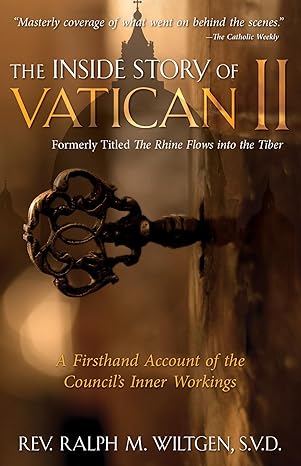
The Rhine Flows into the Tiber: A History of Vatican II by Fr. Ralph M. Wiltgen originally published in 1967.
The title is a metaphor for the influence of the bishops from the Rhine region on the proceedings and outcome of the council. It’s an inside account of the council from an eyewitness journalist, detailing the key events and figures and focusing on the impact of the German-speaking bishops.
John wanted to give us a Council to engage the world with hope and optimism after the horrors of WWI and WWII. What we got was nothing like how the Council started, and not even completely according to the black on white of the subsequent documents. What we got is the “spirit of the Council” about which only the members of the Gnostic Insiders Club™ are permitted to pronounce.
A pretty good historian of councils, a deceased Jesuit John W. O’Malley, wrote in his book What Happened at Vatican II something that explained the “spirit” of the Council, the most ongoing effect of the Council, its most essential contribution. In nutshell, O’Malley – not a theologian and clearly a lib – thought that the real content of the Council was not the black on white of the documents but rather the marked change in tone. It is in this change of tone or attitude that we find the deeper, authentic message of the Council, so strong that it trumps the texts themselves, the ink on the paper, and forces reinterpretation of everything that went before.
In short, justification for rupture.
In any event, on this day in 1962, 63 years ago, Pope John XXIII solemnly opened the Second Vatican Council.
Finally, I think that Vatican II is hardly to called the most important of all councils. Nicea, Ephesus, Chalcedon, Trent… to name just four … were far more important.
It gets attention because it was the most recent, in our time.
Perhaps we should get over ourselves.































Fr. Wiltgen’s book is great. the title too is great: it’s a riff on Juvenal’s line “the Orontes flows into the Tiber” complaining of the excess influence of the Syrians and other easterners in second century Rome – the Orontes being the river that supplies Antioch. perhaps not as great of a title as Fr. Anthony Cekada’s “Work of Human Hands” about the Novus Ordo though.
may both of these priests through the mercy of God rest in peace.
The greatest significance of Vatican II was that liberals during the council demonstrated that they have controlling power within the Church.
The period of Pentecost and the Council of Jerusalem was at the time of covenantal transition between the Old and New Covenants. In the modern Church people try to use this covenantal transition period to justify wrenching changes to the Church. The hermeneutic of rupture proposes a church with a similar covenantal scale division with the historic Church, which is at odds with Christ’s institution of His New and Everlasting Covenant. The coming of Christ and His Covenant were predicted in the Old Testament prophecies. There is no record in the New Testament where there is any prophesy of God authorized wrenching changes to come in the future or any new covenant to replace Christ’s New and Everlasting Covenant.
the whole VII thing has haunted my puny wizened brain all day. this is not a good thing. it strikes me that many of the council fathers lived through all of WWI, the Russian revolution, the bacchanal of Weimar, the great depression, the Spanish civil war, WWII, and the opening salvo of the cold war – and the rest lived through most of that list. people of our day and age would say these fellows were all subject to “post traumatic stress disorder”. well . . . i can’t make a compelling counterargument. i also can’t say that anyone should entrust their judgement to men who lived in the belly of the beast from 1916-1945,
“The Rhine Flows into the Tiber” was the book that really opened my eyes (ca. 1992)… shortly thereafter I shared it with my (late) mother, a dyed-in-the-wool Catholic who’d nonetheless been completely swept along by the “Spirit of the Council” and fully invested in the Splendor of the Renewal™… she returned my copy heavily annotated and underlined and then immediately borrowed some of my (recently acquired) Michael Davies books, which came back in the same condition! Suffice to say it opened her eyes as well!
It was Robert de Mattei’s “The Second Vatican Council: An Unwritten Story” that was most influential for me. It cites Wiltgen heavily and goes further.
De Mattei’s writing has taken a different tone since then, but I found that book edifying.