
 7:12 was when the chariot of Helios began to grace the Roman skies.
18:44 is when Pyrois, Eous, Aethon, and Phlegon will seeks their nightly stable.
19:00 is when the Ave Maria Bell should ring.
Yeah… it’s day 10, not day 8. I got off somehow. I guess I need remedial counting.
Yesterday I ran into a priest of my native place whom I haven’t seen for some years. At first I didn’t recognize him! We had a nice catch up. In the course of our stroll and conversing, he wondered what the Ave Maria Bell is all about. Since I usually explain the bell at least once during my Roman Sojourns, here we go again!
QUAERITUR:
“What is the Ave Maria Bell you keep mentioning?”
The Ave Maria Bells signals the end of the “religious” day and the beginning of “religious” night.
It is rung in the ball park of 30 minutes after sunset. Usually the Ave Maria is rung in a way not dissimilar to how the Angelus (Regina Caeli now) is rung… 3x… 4x…5x… 1x.
If the Ave Maria rings at, say, 19:00h (7PM), then 18:00h (6PM) would start the 23rd hour of the day and 19:00 would start the 1st hour of the new day’s “evening and morning”. In Roman churches, Vespers were usually sung about an hour before the Ave Maria Bell. Hence, in the example above, at about 18:00 at the 23rd hour.
What was the Ave Maria Bell doing for the Roman Curia?
In the Roman Curia, Cardinals who were Prefects (the offices of the Congregations had/have throne rooms, btw) and other “pezzi grossi” around the place would receive visits for an hour after the Ave Maria. An hour after the Ave Maria was rung to signal the change of religious days, another bell was struck to denote the 1st hour of the new day.
The Ave Maria could also follow the sun, and ring precisely one half hour after sunset. So, following the sun strictly, the solar Ave Maria this evening would ring at 19:14.
To simplify this for the Curia – ’cause who had watches, right? – they adopted 15 minute cycles. We are in the 19:00 cycle now. Actually we are in the 18:00 cycle, which lasts from 4-13 October. BUT… there’s the “ora legale” here, the European “daylight savings” in force which moved the hour hand forward. On 2 November this year “ora legale” is over and we will turn our clocks back to normal.
This also ties into the old Six Hour Clocks, you can still see around Rome. The Six Hour Clock, which divided the day in 4 parts and made a complete revolution every 6 hours, influenced the recitation of the Angelus at 06:00 – 12:00 – 18:00. These Six Hour Clocks were adjusted daily according to solar noon.
Here’s one:

Solar noon was tracked carefully, because that is when contacts and appointments went into effect. In the Church today, appointments still generally are designated as starting at noon.
For Solar Noon in Rome, there is a solar calendar made by a shaft of light through a tiny hole at the church of Santa Maria degli Angeli by the Piazza della Repubblica. The light spot on the floor traces the sun’s analemma over the course of the year across a 45 meter long meridian line. It also could track certain stars, such as Sirius, the Dog Star. Clement XI (+1721) commissioned it to check the accuracy of the Gregorian Calendar (1582). 
That sun clock was used to determine solar noon for all of Rome: a signal would be sent from that church by means of a flag, watched for by telescope across town from the Gianicolo Hill where a cannon fired to sound noon. It still does, everyday! BOOM!
John L. Heilbron has a book on churches and cathedrals as solar observatories. It is called The Sun In The Church. Very cool.
And now back to other things.
? Tradition is the Future of the Church ?
? Procession of the monks to Holy Mass at the Abbey of Sainte-Madeleine du Barroux, Le Barroux, France ??
This Benedictine community, famous for it’s bread, olive oil and wine, celebrates the Traditional Latin Mass which is broadcast… pic.twitter.com/fAy9fcyjhZ— Beauty of the Catholic Faith (@advoluntas) October 6, 2025
Charlotte… yeah…
First High Mass at the designated TLM chapel in Mooresville, NC. Combined attendance today between the early Low Mass and noon Sung Mass: 600-625. Gratitude for our priests, deacons, servers, and talented schola. Blessed be God! #CharlotteTLM #CLMC pic.twitter.com/RoVkxe8rUS
— Charlotte Latin Mass Community (@CLMCLatinMass) October 5, 2025
?Update: “I am pleased to announce that I will soon be awarding Charlie Kirk, posthumously, the Presidential Medal of Freedom!”
– President Trump pic.twitter.com/7BIXI5edfW
— US Homeland Security News (@defense_civil25) October 5, 2025
I always enjoy walking by this little church in the Via Giulia. Why?
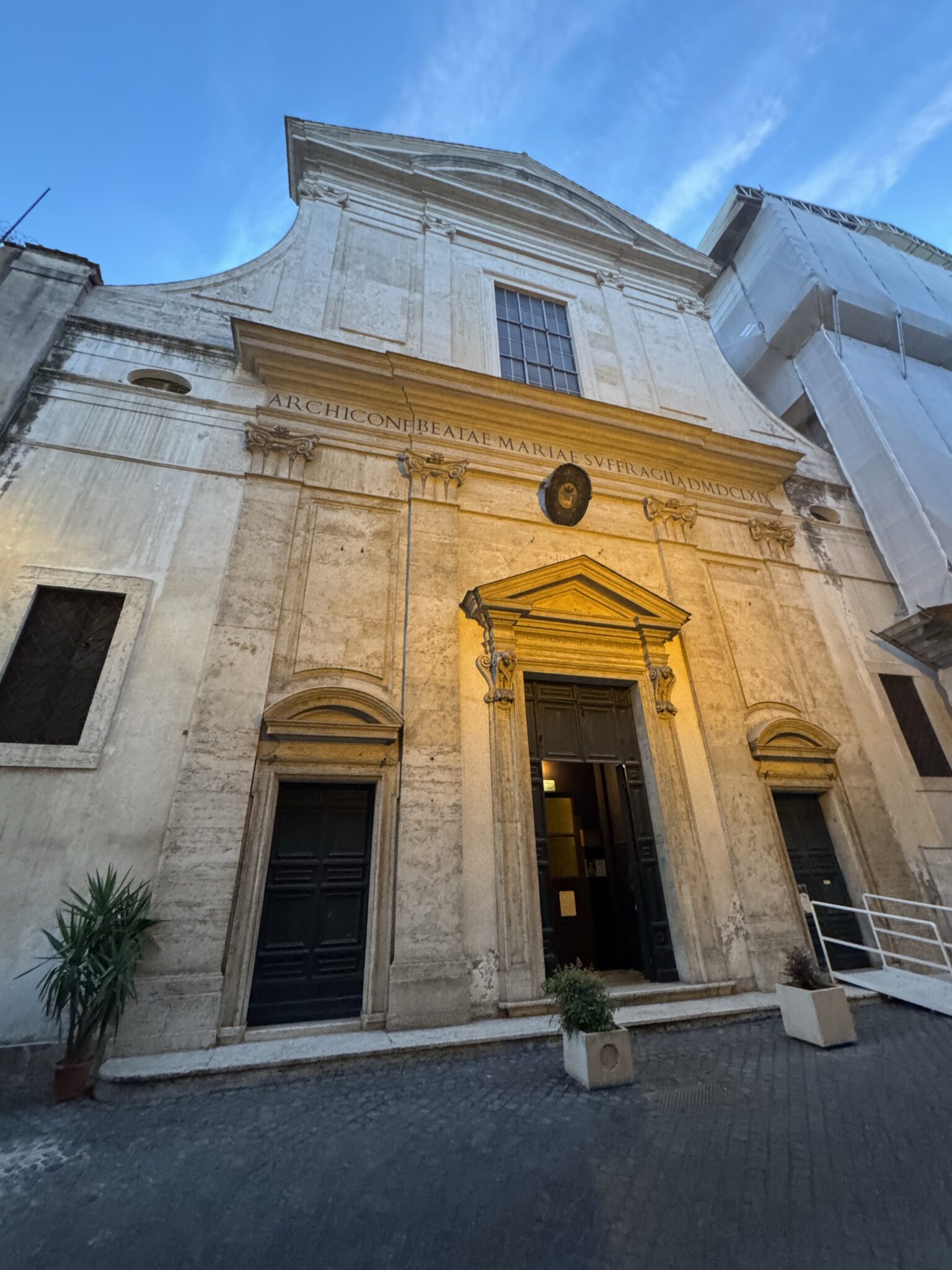
Because they haven’t updated the papal coat-of-arms since 1914 when Giacomo della Chiesa was elected as Benedict XV.

It is customary in Rome to place the papal arms over the main door, or, if the church has an assigned cardinal, place their arms to each side of the door.
This is also done by embassies to the Holy See.
Here, along the Via della Conciliazione, there seems to be some confusion. Different embassies sharing the space.
Amusing: Argentina is up to date!

And now a different thing altogether.

In chessy news… there is now info about the 2025 FIDE World Cup HERE
 NB: I’ll hold comments with solutions ’till the next day so there won’t be “spoilers” for others.
Priestly chess players, drop me a line. HERE
White to move and mate in 4. Good luck.

What is the tactic called that you have to use?































Actually, the ora legale will cease on October 26th (it’s on the same day throughout Europe, the last Sunday in October).
I sometimes quip that the Feast of Christ the King is the day when we leave the wrong time behind and enter the real one.
re: the persecution of Latin Mass in NC (and elsewhere)…will there come a time when Priests will begin saying Masses “underground”?