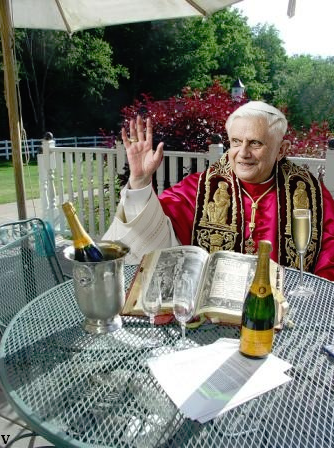
What a day that was. I was still at the “Sabine Farm”, like Horace away from Rome’s summer heat. The days were bright and full of hope. A friend stopped in to share a bottle of “The Widow”. What a day.All this madness will pass one way or another.
Today is the 19th anniversary of the release of Summorum Pontificum, the saintly Pope Benedict XVI’s “emancipation proclamation” for those who desired what they ought to have had all along: freedom to use the Church’s traditional Roman Rite.
That endured – although hampered by those who hate those who love Tradition – until it was shut down, again an act of hatred of those who love Tradition, under the cruel document Traditionis custodes and subsequent incoherent burpings of dyspeptic micromanagement from what is now called the “Dicastery”.
Traditionis custodes is to Summorum Pontificum what Plessy v Ferguson was to the Emancipation Proclamation. If that trend holds, who shall issue the parallel to Brown v. Board?
They won’t win. Too much is at stake. Too many people are now involved with traditional sacred liturgical worship. Too many people hardly involved in anything are dropping away. Too much information is available on the internet.
The other day Card. Koch suggested that it was time to rescind TC.
So, it is going to end, someday. I foresee different possibilities.
First, perhaps Pope Leo will give more than 15 minutes of personal attention to this issue which he, more than likely, knows little about. It wasn’t an issue in S. American, nor among the Augustinians to any extent. It is very complicated and it will take both desire and effort to get up to speed. Therefore, he would do well to find a few “coaches” who could guide him through the theological questions the SSPX raises and through the canonical realities. Will he? I suspect most of his energy is directly toward things that the UN would be interested in. And “unity”.
Second, people will simply, in larger and larger numbers, ignore the cruelty and will take matters into their own hands without – NB – without malice or any sense of separation or schism from legitimate authority legitimately exercised. Home chapels and perhaps even purchased places, plenty of cancelled priests to help, lots of willing and happy hands, ready to build the ark and ready to turn it all back to normal when the storm ends.
Third, the chaos born of ignorance (like the ignorance about the Explanatory Note) will continue. Leo indicated to the French bishops that they should be generous (yeah… right). Meanwhile, in these USA bishops are being anything but generous with a new spate of repressions of the people who desire the ancient forms. Coincidently, they are the sort of Catholics you would think bishops would want to support and foster. It seems that bishops or their mandarins are not able to figure out what the Explanatory Note is and ISN’T, leading to bishops frightening and confusing their flocks.
Forth, do I think that, in the wake of 1July, a new Summorum Pontificum is in the offing? No. Nor will there by another Pontifical Commission.
Fifth, the Lord will return.
Sixth, in lieu of the Lord returning, there may be an extinction level cataclysmic event, such as a massive meteor that strikes the planet.































If and when Summorum 2.0 drops, I hope that the pope will also take a serious look at the Novus Ordo. I also hope we have an indication as to what “accepting Vatican II” means. Is that too much to ask? None of these issues live in isolation.
Don’t rule #6 out too quickly, but what is triggered to happen has been arming for the past 12000 years…
https://www.youtube.com/watch?v=levsYok2ttw
https://youtube.com/playlist?list=PLHSoxioQtwZcVcFC85TxEEiirgfXwhfsw&si=ojHRtnx2V9bqQqf-
Well, the meteor thing could happen…
“Sister Lucia, in 1944, before writing the third Secret of Fatima to send to the Bishop of Leiria, had a vision that concerns the future.
“I felt my spirit flooded by a mystery of light that is God and in Him I saw and heard: – the tip of the spear like a flame that extends until it touches the earth’s axis; – and this jolts: mountains, cities, towns and villages with their inhabitants are buried. The sea, the rivers and the clouds burst their banks, overflow, flood and drag with them in a vortex an incalculable number of houses and people: it is the purification of the world from the sin in which it is immersed.
Hatred, ambition cause destructive war!
Then in the accelerated beating of my heart and in my spirit I heard a sweet voice resound that said:
“In time, one faith, one baptism, one Church, holy, catholic, apostolic. In eternity, Heaven!”
This word “Heaven” filled my soul with peace and happiness, so much so that, almost without realizing it, I continued to repeat for a long time: “Heaven! Heaven!”.
As soon as that overwhelming supernatural force passed, I began to write and I did so without difficulty, on January 3, 1944, on my knees, leaning on the bed that served as my table.”
Sister Lucia had a similar vision six years earlier (1937) and described it in a letter as follows:
“If only the world would recognize the moment of grace that is still granted to it and do penance”; then the confidence:
“I see, in the immense light that is God, the earth shake and tremble before the breath of His voice:cities and villages buried, razed, swallowed up; mountains of defenseless people. I see the cataracts amid thunder and lightning, the rivers and seas that overflow and flood and the souls who sleep the sleep of death! …”
Regarding the second point – I know the laity, by and large, are ready to make this happen. What we need are priests willing to go along with us. And it’s part of why this weaponizing and en-vague-ening (I’m making up a word) of the concept of “obedience” is so demonic. Pair it with the absurd notion that “the most basic validity of a sacrament is all that matters) and good men and priests are being spiritually hamstrung by these false ideas. They are doing what they know is wrong or refraining from doing what they know is right because the bishop said so and that’s it. COVID seems like a test run, and T.C. was the actual beginning of the plan. Priests, whose primary mission is to offer God’s grace for the salvation of souls by administering the sacraments, are being ordered to not administer the sacraments, and they seem unable to countermand their programming.
As a laymen who bought one of the St. Joseph portable altars, a full set of altar cards, altar linens, and a missal to be ready for the eventuality of having to do secret Masses, I’m realizing that it’s all for naught. The priests in my diocese are, by and large, toeing the line as hard as they can.
What is needed is an honest assessment of Vatican II and the aftermath. And a clear statement on what is pastoral and what is not. The SSPX situation will never get resolved until that happens. And the progressives never want such an assessment to occur unless they are in control to shape the narrative. I do not see all of this being resolved for another 60-80 years at the earliest.
Pater – thank you for reminding us of this great anniversary… we should continue to honor and observe it despite the unjust restrictions of the past few years. Personally I think that the need to revisit Trad. Perditores is becoming more and more evident and that the concomitant necessity to likewise reconstitute a “new PCED ” well also come to the four him not too distant future… Or perhaps I am living in deepest Xanadu ;-)
Always thought, must begin with the unification of the calander of the vetus and novus ordo. . Rome and tradition need a place to agree. . .
I hope that the next pope, or the one after that…will do a permanent fix, setting up a permanent, irrevocable framework for the TLM to be said on a normative, regular, frequent and widespread basis. The “reform of the mass” was meant to RESTORE the mass to its core meaning, not just sacrifice, but sacrifice offered by the priest with the people intelligently joining in, within their proper place, with knowledge, understanding, and love. That happens now at TLM usually, which means that reform has succeeded in its purpose. There is no reason TLM should not be a permanent fixture in the Church, irrespective of what happens to SSPX or to the Novus Ordo.
I dream that this future pope will sit down with heads of SSPX, FSSP, ICKSP, and half a dozen others, and initiate a multi-year program of GRADUAL movement together. It starts with the Vatican asking for a small, even tiny, concession, and SSPX asking for a tiny concession in like kind. (E.G. that the Vatican ACTUALLY penalize and put a stop to JUST ONE persistent abuse (and punish its purveyors, e.g. by defrocking), one that is ALREADY admitted to be an abuse: do something REAL to address the abuse concerns SSPX has been noting for 50 years. Just one. And move on from there.
I had a small hope that Leo would be that pope. But he is the one who (a) kept Card. Fernandez in a seat he has no business in, and (b) appointed Fernandez as his spearpoint in dealing with the SSPX. “Personnel is policy”, as the prefect for the Congregation for Bishops before being elected pope, Leo must have know the tenor of the man he assigned is effectively a mortal enemy of the SSPX. Why not pick someone who actually KNOWS the Society very well, like Bp. Athanasius Schneider? I would dearly love to believe that this year’s disaster is a result of Leo’s being naively ignorant of the true nature of the problem, but it seems unlikely. And I have little hope of his ever becoming better informed, so long as he surrounds himself with men like Fernandez, and Cd. Roche.
The Lord will repair His Church: may we live to see it in our lifetimes, though we cannot foresee how.
Why would you trust a Cardinal, or any priest who who says this? Card. Koch is notorious for obfuscating the clear teaching of the Church on the Jews, and exactly why the SSPX refuses to accept a document like Nostra Aetate without clarification. [Your thinking is too narrow. That fact that he said it at all is a win. And from him, it is a double win. Even he thinks things are not going well.]
“I consider this vision of the Society to be anachronistic in light of the Shoah. What happened there was one of the triggers for Nostra Aetate, prompting a rethink of the relationship through the shock of the Shoah. The Society seems unable to go along with this. In doing so, it naturally points to a fundamental problem of Nostra Aetate and the history that followed, because I think the fundamental question of how the statement regarding the permanent validity of God’s covenant with Israel, which we recognize, can be reconciled with the New Testament statement that something new entered history with Jesus Christ so that neither Jews nor Christians are offended—this question does not yet seem to me to be fully resolved theologically.” Card. Koch
Leo so far has been making himself the Pope of Disunity. Quite ironic considering his stated priorities.
He seems to desire an Anglican Communion kind of unity except with him still holding all the administrative and disciplinary power.
“…there may be an extinction level cataclysmic event, such as a massive meteor that strikes the planet.”
OR, the “three days of darkness.”
@TonyO
“I hope that the next pope, or the one after that…will do a permanent fix, setting up a permanent, irrevocable framework for the TLM…”
I suggest studying a bit more of Church History…
@TonyO
—>I hope that the next pope, or the one after that…will do a permanent fix, setting up a permanent, irrevocable framework for the TLM to be said on a normative, regular, frequent and widespread basis. <—
That would have been St. Pius V following Trent…..Oh wait…..
I just have to post this – the guy is a brilliant cantor and we all know the tune :-). I chuckle every time I see it. So, Father Z, I agree, this may occur first!
https://www.youtube.com/watch?v=hkTgYiMDRHY
Just a point on Pope Leo wanting unity in the church. The Eucharist is the Sacrament instituted for this very thing. The Mass is therefore the perfect instrument to bring about true unity and peace. Assuming good intention on the Pope’s part, could not this honest desire for unity be an “on ramp” to get true liturgical reform onto his agenda?
@nex001
At this point, “true liturgical reform” is the last initiative I want to see happen. It would, invariably, result in things getting worse, not better. The complete liberation of the Traditional Rite is the most I would hope for, but even that seems to be a bridge too far at this point.
Pope Leo has given it more than 15 minutes of consideration already, as at the very least he has met with Card. Burke, with +Areas Rifan, and with the sociologists who wrote a book about American traditionalism. That is what we know of, not counting what we might not know about. The lack of swift action does not equal complete disinterest. And it is not to be discarded that the SSPX stunt might have pushed forward in time decisions that would otherwise have been taken already. I also think that the dig with the UN reference is harsh and unwarranted for any of the purposes of this post.
A happy anniversary to Summorum Pontificum; I will still wish and pray for its return.
Tomasthetorque – the four horsemen of the apocalypse are saddling up, just very lazily and with less thunder and lightning.
@WVC I disagree that this is necessarily true. There is no reason to believe that things will *never* change for the better, just because things aren’t good right now. Where is your faith, friend?
Heh, Fr. Reader and Lurker59 both comment (within minutes of each other) on my wishing for a “permanent, irrevocable” solution, by noting that that Pius V had put in place a permanent solution.
Allowing for the humor of their juxtaposition, and noting that there is some truth to the point that Pius V’s own action was for permanence, please let me point out that
There’s different kinds and degrees of permanence.
The pope, not AS pope, but as Patriarch of the West, has a kind of authority over the Rite of the West that he doesn’t usually exercise over the Rites of the East. As pope, of course, he can shove his oar into even the Eastern Rites and change things: his primacy is universal, extending to the entire Church. But in practice Rome is more cautious (now, that is) about forcing changes on the Eastern Rites, and She is so in part because she tried that kind of stuff way back in history and, well, it didn’t go that well. While in the pope has the power to change a Rite and might (possibly) even (in theory) have the power to eliminate one, de facto the Universal Church has established in her constitution that having different Rites is conformable to the unity of the one true Church, and as a consequence it would seem impossible for a pope to eradicate one of the Rites merely on account of it not being the Roman Rite. In a sense, the separate rites are irrevocable – in a sense that isn’t as true of one particular form of one of those Rites, which might be eradicated in favor of another existing form of said Rite.
So: if for example a pope were to stick the TLM into its own eparchy, and just plain designate it the normative Rite of that eparchy, doing so would (in a sense) establish that Mass in a way it isn’t now established.
I admit that this wouldn’t make it absolutely impervious to later popes. But it should make those popes more cautious.
@nex001
My faith is not in the cardinals and bishops who would be tasked with “the liturgical reform” – that’s for sure.
The problem is that we live in an age where, thanks to Vatican II and the Novus Ordo, EVERYONE thinks the liturgy is a thing to tinker with. Arguments about reverence and communion on the hand vs/ the tongue or altar rails or the vernacular . . .etc. are all arguments stemming from a baseline understanding that OUR preferences should somehow be used to shape the liturgy. Going any further down this road will only lead to more of the same dreck and a never-ending cascade of arguments.
The best that could happen is that the TLM have every single restriction lifted, including any restrictions against the pre-1955 missal, and then nothing is done for at least the next 400 years. By that time, I would think that TLM would have become, by default, the predominant liturgy, and, through the graces it offers, our understanding of liturgy would be repaired to a point where we understand it’s not ours to play with, but ours to preserve and protect and cherish. At THAT point, and at no point sooner, do I think the topic of “liturgical reform” can be entertained, but even then only with very strict guidelines governing the endeavor.
@TonyO
I concur — fracturing “the West” into multiple eparchies is a solution to the “too big to fail/ too big to turn the ship around” West. I am amenable to that being a solution. However, 1.) that solution runs contrary to the general disdain that one finds in Western thought about the Catholic East’s model of “Church”. 2.) The Church (both east and west) when it comes to issues of governance and jurisdiction, is very “flat”. No one likes overlapping jurisdictions, everyone demands that traveling priests in their jurisdiction have “papers”, and the modern concept of flying bishops (quite literally), as the Anglicans proved, just leads to more friction, not unity (I suspect more than a little bit of the SSPX excommunications has to do with the flying bishops angle.) 3.) There is a good chunk of “Romanish” bishops of the orthodox and heterodox style that think that the sun rises and sets in Rome and that unity means everyone doing the Roman thing (which the heterodox see as the one world, one government, one people human fraternity thing).
All that said, I do think a “make a mess of it” solution might be a fix for a few hundred years.
From the CatholicVote site Zeale:
“US bishops offer pastoral responses after SSPX excommunications and schism”
…”Bishop Terry LaValley of the Diocese of Ogdensburg, New York, issued a similar statement accompanied by an FAQ sheet about the SSPX.
He explained that the divide between the SSPX and the Catholic Church “is not simply about the celebration of the Mass and the Sacrament.”
“The SSPX repudiates and denounces the teaching of the Second Vatican Council,” he wrote, “in particular, ecumenism, religious liberty, collegiality of the bishops with the pope, and the Church’s understanding of, and relationship with Judaism.””
I think Rome sees the Tridentine Rite and liturgical calendar, with all the readings, contradict these Vatican II “teachings.”
@ B: I agree that resolution is decades away. An “honest assessment of Vatican II and the aftermath” will not happen until all who were present at the council and their protégés have passed from this world; they are too personally invested in the council to give it an honest assessment, which would mean admitting that it was a failure.
@ Dantesque: Fr. Z’s criticism of Leo XIV for giving too little attention to liturgy and too much attention to the priorities of the UN is spot-on. @ Fr. Z, rem acu tetigisti.
@ Tony O: I fully agree that the TLM should simply be declared a separate rite. I think that the reason why this does not happen is that the TLM fosters a certain type of spirituality, and the opponents of that spirituality know it.
@Ionathas: reading Francis through Benedict was misguided, and I knew that because I knew the man in fame and proximity for years before he was Pope. But at least that one had the merit of being an attempt to be as charitable as possible. Being determined to read Leo and his actions under the worst possible light is the exact opposite, and benefits no one. Francis bred contempt for the office and person of the Holy Father, but I don’t see how that justifies taking hostile and dismissive attitudes towards anyone sitting on the throne of Peter who doesn’t fit my personal idea of the ideal pope. Or picking up on all the mistakes, magnifying and distorting all that can be made so, and ignoring everything else. Does he really dedicate that much time to political matters? Is his praise of Monaco for being a Catholic country a UN thing? His emphasis on the right to not emigrate? His defense of human life from conception to natural death, between other things he said to the Spanish courts? I feel a bit insane trying to defend a position that isn’t even like, milquetoast centrist; or has something like Rorate Caeli become modernist overnight?
@Lurker 59,
With respect to point 2 you mentioned, I have to think that’s a weak argument/excuse/justification. The various ordinariates (military, former Anglicans, etc.) do alright, and then there’s the Personal Apostolic Administration of St. John Vianney. Bishop Lopes is even head of the USCCB’s divine worship committee. Layering jurisdictions can work, if those in charge care enough to let them.
@WVC
Thank you for your thoughts. I agree with much of what you wrote in your last comment. I do think that it is something that will only be fixed when the time is right in God’s eyes and at his prompting. The liturgy is a painful subject for any serious Catholic to discuss, and it’s clear you are a person who takes their faith seriously.
I do not trust every bishop either. They are men, just like us. Some of them are very flawed. Some of them are even worse than that.
As for myself, I am trying to put my own faith in Jesus. Sometimes it is easier said than done. I’m praying for the both of us for this.
@Dantesque. When Leo XIV was elected, I knew nothing about him, and I was open-minded to see what kind of pope he would be. After a year, however, it is clear that he shares many priorities of Jorge Bergoglio and of the United Nations, such as coming as close to pacifism (Palm Sunday homily) and complete rejection of capital punishment (video message to a conference at DePaul University, April 24) as one possibly can without violating the law of non-contradiction with regard to Catholic tradition. And we do not have to go to Rorate Caeli for these things, which can be found reported on the website of the National Catholic Register. Meanwhile liturgy was not a prioritized topic at either of Leo’s consistories. So at this point, when Leo chooses to go to Lampedusa, which I think was Jorge Bergoglio’s first destination abroad after he started acting as pope, where he can put the spotlight on a topic about which he is at odds with the Trump administration and many Americans, including for example various writers at First Things, on the very 250th anniversary of these United States, to which I think he turned down an invitation, do I think it’s all a coincidence? No, I think that Leo was sending a message, namely that he is continuing the legacy of Jorge Bergoglio. If, however, you can point me to any texts where Leo expresses worry about the negative effects or, to put it even more neutrally, challenges which immigration might pose for Americans and Europeans, especially with regard to Americans’ and Europeans’ culture and economic well-being, I would be much obliged.
@NickD and Lurker59:
Your points both have validity. I suspect that perhaps one way to temper the problems is to have each such jurisdiction have (at least) one physically regional place where it is “home”, having regional jurisdiction there, as well as personal / relationship jurisdiction beyond.
@TonyO. I did not mention Pius V.
A solution for the Extraordinary Form (regardless the name) needs to come not just from the top, but from the roots.
If the ordained clergy is supposed to know the rites, make everybody learn the rites. I have seen that young seminarians are attracted by the EF (some because of the aesthetics, of reverence, of fashion, or because it helps them to pray, each one his own reasons), and some older priests are very afraid of this. I think that if the rule from Rome is that every seminarian should be exposed and learn the EF, then there is no need to for the Pope to “stick the TLM into its own eparchy.” Not everybody would obey that rule, but at least the seminarians would feel that if they are not taught it, they have the right to learn it. 50 years ago it was not possible, in the internet era, it is much easier.
If the EF is forced on priests, some, I am not saying many, but at least some, will just use it to celebrate less reverent Masses, as it happens with the OF. The difference is not just which book you use, behind the choices there are differences of theology. If I believe that the Mass is all about entertaining, inclusion and didactic gigs, I will transform a Mass with any Missal into that, and I will use the Introibo ad altare Dei for a musical dancing.
@Fr. Reader,
I dare say that the roots have already provided the solution, and it is the top that is ignoring the desire of the roots to know their rite.
The laity have a need to know their rites. It is the obligation of their pastors to 1.) teach them. 2.) provide the actual rites.
We laity can only ask pastors to do their jobs.
@Ionathas,
“So at this point, when Leo chooses to go to Lampedusa, which I think was Jorge Bergoglio’s first destination abroad after he started acting as pope, where he can put the spotlight on a topic about which he is at odds with the Trump administration and many Americans, including for example various writers at First Things, on the very 250th anniversary of these United States, to which I think he turned down an invitation, do I think it’s all a coincidence? No, I think that Leo was sending a message”
Agreed!
“any texts where Leo expresses worry about the negative effects or, to put it even more neutrally, challenges which immigration might pose for Americans and Europeans, especially with regard to Americans’ and Europeans’ culture and economic well-being, I would be much obliged.”
Me too! Much with the rhetoric of the past decade that makes Catholicism sound completely pacifistic, the rhetoric used around immigration almost completely ignores the Church’s “via media” teaching as to the rights of “recipient” countries.
@TonyO,
Unless I’m mistaken, the Apostolic Administration in Brazil already does something like this. They provide priests to offer the TLM to dioceses in Brazil not already covered by the administration’s territory. I’m not sure if this model could be easily replicated though; that jurisdiction has a truly unique history, if memory serves.
@Ionathas and @NickD:
It is possible to disagree personally with some decisions of a government, because of one’s personal convictions, without being perfectly aligned, or worse, subservient, to the ends of those on the other side of the aisle. Leo has said more than once that countries have the right to control their borders, and that the problem is when people trying to emigrate are treated inhumanely. When he talks about emigration, he focuses specifically on people fleeing war and similar conditions, that is, on *refugees* in the strict sense of the term. Besides and in connection to that, he speaks of the right of people to not-emigrate, and in so calling for solutions that make life livable in their countries of origin. Outside of the matter of immigration, as I said, he has spoken firmly against abortion and euthanasia, which are darling goals of the UN think. I do think the Pope is allowed to be his own man; I sometimes get the suspicion that some people would be happy with the Pope being a puppet, if they were politically aligned with the puppeteer. At least I suppose we can agree that cesaropapism of any description never produces anything good.
As for the invitation to the anniversary, just in case, I think it would have been unwise to accept it, and it would have been easier to see for Americans if the Pope had another nationality. Specially if that nationality was that of a very powerful country.