
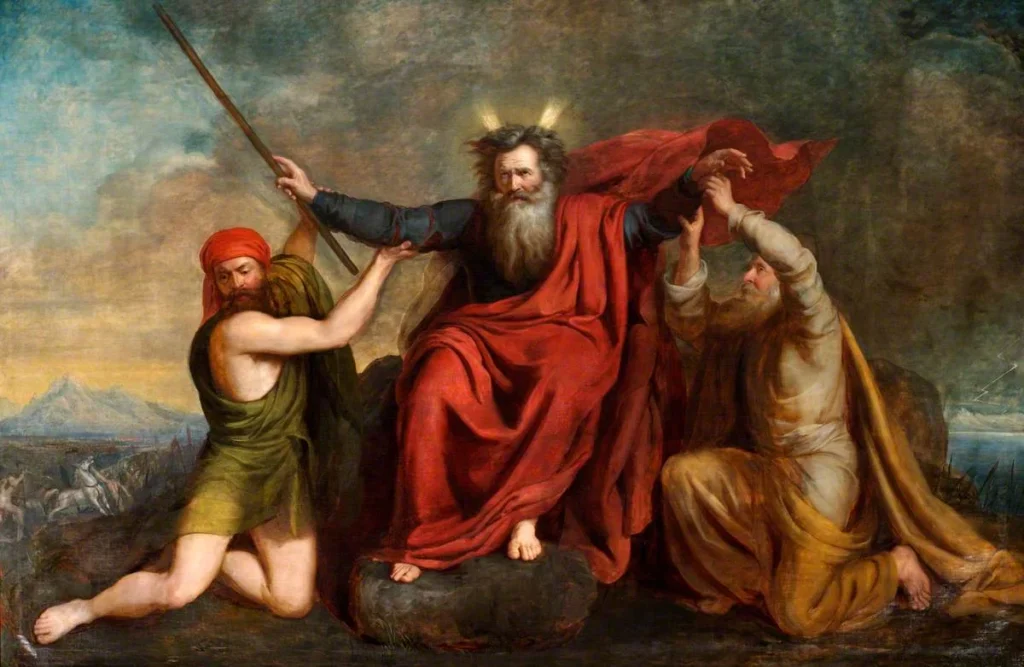
Today is the feast of St. Moses, lawgiver and prophet in the Old Testament.
Many people do not realize that may Old Testament figures are considered by Holy Mother Church to be saints. Many of them are listed in editions of the Roman Martyrology, both pre-Conciliar and post.
Here is today’s entry for Moses.
1. Commemoratio sancti Moysis, prophetae, quem Deus elegit, ut populum in Aegypto oppressum liberaret et in terram promissionis adduceret; cui etiam in monte Sina sese revelavit dicens: “Ego sum qui sum”, atque legem proposuit, quae vitam populi electi regeret. Ille servus Dei in monte Nebo terrae Moab coram terra promissionis plenus dierum obiit.
Anyone want to take a crack at What The Martyrology Really Says?
Also, a question/request to readers:
Have any of you ever seen a stained-glass window of Moses at the cleft in the rock in Exodus 33?
I would like a good photo.































hadn’t even seen a bad one before today tbqh. i asked grok to get a “stained glass depiction of Moses in Exodus 33”. after about 90 seconds, it gave me something that didn’t look too bad to me. your mileage may vary.
I haven’t done more formal study of Latin than the basic rudiments, but it seems easy enough to translate without too much cheating… Certainly more plainly legible than the Roman inscriptions you usually post, Father. Here goes:
“The commemoration of holy Moses, the prophet, whom God chose, that the people oppressed in Egypt might be freed and led to the promised land; to whom He revealed Himself on Mount Sinai saying: “I am who am,” who also gave the law which would govern the life of the chosen people. That servant of God died (passed away?) at a length of days on Mount Nebo in the land of Moab, before the promised land.”
A note about that translation:
I’d like to have preserved the way the original text ends with “plenus dierum obiit” because I admire how elegantly it closes everything, but I wasn’t sure how to make that sound natural in our barbaric tongue.
This made me realize how inattentive I am to St. Moses stained-glass windows, but my old-fashioned manner of searching did not find any Exodus 33 ones. Meanwhile, I looked in the index of the translation of Egeria I’ve started – and what a lot of St. Moses entries! But I am still a long way from her visit to the (putative?) grave of St. Moses mentioned in the introduction.