
 I celebrate as my onomastico or “name day” the Feast of the Beheading of John the Baptist, 29 August. “He must increase,” said the Baptist, “I must decrease” (John 3:30). I need that rule of life.
Although St Augustine of Hippo (+430) principally connects the “decrease” with John’s Nativity near the Summer Solstice and the shift to shortening days, John’s sudden, violent “decrease” occurred with his head’s removal from his shoulders, during the autumnal shortening of daylight. It’s just about now that we really start to notice that the day’s are getting shorter. I rose this morning and thought, “Gosh, it seems a lot darker.”
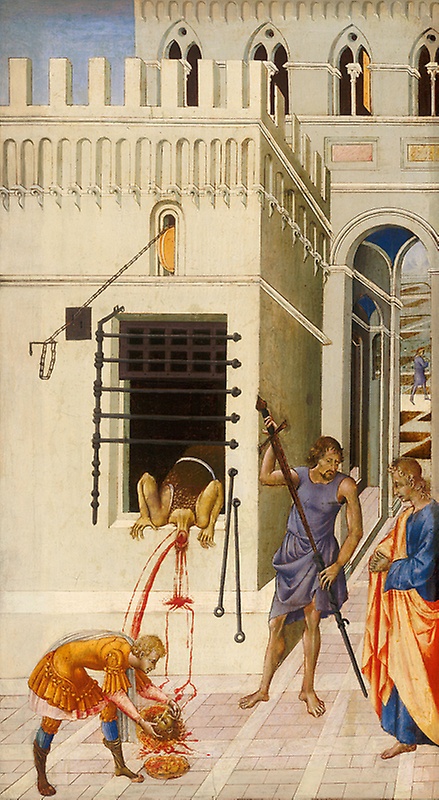
In the Art Institute of Chicago, there is a tempera on panel depiction of the Beheading of the Baptist by the Sienese painter Giovanni di Paolo (d 1482).
You view the instant after the deed. Seen from outside the prison, John leans out of his window, guillotine like, his headless shoulders and angled arms still in place as a massive gout of blood jets forth the jutting neck. A servant with a platter stoops for his head. The executioner sheathes his man-length blade.
John was not only a martyr for the Truth.
The miraculous son of the elderly priest Zechariah was a priestly martyr.
John stood against Herod and his crony cadre of corrupted priests who backed his violation of the truth of sexuality and marriage.
Herod used his power to sin. John’s blood exposed also priestly corruption in a way that no one could ignore.
By the way, Herod’s command to kill John, the incorruptible priest, came from his lust for a child. Salome was a “little girl” (Greek korásion).
Speaking of seeing that things are darker, that’s the direction, of course, of the aggressive homosexualist agenda. Their ultimate goal is the lowering of the legal age of consent. That’s their “brass ring“.
To their eternal shame, there are priests and bishops who are advancing the agenda.
Korásion occurs 8 times in the Synoptic Gospels involving two events, the raising of the daughter of Jairus (Matthew 9:24-25; Mark 5:41-42) and the beheading of John the Baptist (Matthew 14:11; Mark 6:22, and in v. 28 two times).
Mark deliberately applies korásion to two girls standing at the frontier between life and death.
To the daughter of Jairus Christ says, Talitha koum, “Little girl, arise” (Mark 5:41). She rises and is restored to her father. Herodias’ daughter receives the severed head of the Forerunner upon a platter (Mark 6:28).
In the house of Jairus, divine authority restores life. In Herod’s hall, disordered appetite, cowardly authority, and a mother’s hatred combine to murder the preacher of Truth.
Both events involve a young girl. One ends in life, the other in death.































He has deep connection to my family and Newfoundland Canada. Praying for his intercession on behalf of my uncle, John, who is gravely ill.
To those who minimize the mentioned agenda of today’s corrupt leadership in the Church, ask your pastor if there is a Courage ministry in your diocese. The lack of such ministries that work with those afflicted with same-sex attraction and related conditions to live chaste lives as taught by Tradition and the silence that surrounds such ministries is a sign of the corruption in leadership. (I will allow that asking one of his already overworked clergy to take on this ministry can be challenging for a local bishop.)
Pray for those afflicted with these conditions find the path to their salvation.
At Mass this morning the priest gave a wonderful homily of a metaphor contained in the story of the beheading of St. John the Baptist.
He said Salome is, of course, sin, which by it’s attractiveness and alluring nature entices us to be willing to give up great treasures, both material and spiritual to have it.
St. John the Baptist is our conscience, which reminds us of God’s law, and the righteous way of life.
Herodius is our desire to silence our conscience, and our desire to kill it, to stop that which stands in the way of sinning.
Herod is our concupiscence, that even though it hears the word of God, and in fact, even sometimes enjoys listening to God, the temptation to sin, combined with the weakness of our character often succumbs to human respect, being unwilling to face the disapproval of the world: our friends, our family, our neighbors, our associates.
When I get a chance I will tell Father just how great I thought his homily was, and will ask him if this was his own reflection, or was written by one of the Church Fathers.
To whom should I go to ask for advice?
This is always an important question, whether we are seeking guidance from an automobile mechanic or a priest.
The daughter of Herodias went straight to the wrong person, the worst possible source of advice.
I bet it was not long afterwards that she wished she had asked Herod for half the kingdom.