 Here’s an experiment.
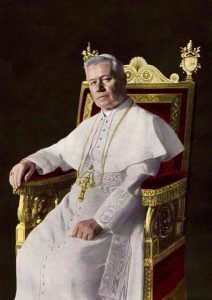
Today in the Vetus Ordo we honor St. Pius X, of happy memory. For Lauds, we have the hymn Iesu Redemptor Omnium. I spotted something in it which made me want to drill a bit. Let’s see what we can do with this.
This is for the Common of a Confessor Bishop and version we have goes back to Urban VIII’s tinkerings in the 1632 Breviarum Romanum. Some have attributed it originally to St. Martin of Tours, but… well…. The mediaeval versions differ.
In any event, what we have here are five quatrains of iambic dimeter. Each line has eight syllables. The line of thought is 1) Invocation of Christ, 2) Commemoration of the saint, 3) his renunciation of the earthly and reward in Heaven, 4) Petition for intercession, 5) Trinitarian doxology.
What Does The Hymn Really Sound Like? Here are the Benedictines of Le Barroux at Lauds 3 Sept ’26. It is slightly different.
| LATIN | ENGLISH | COMMENTARY |
| Iesu Redémptor ómnium, Perpes coróna Praesulum, In hac die cleméntius Indúlgeas precántibus. |
Jesus, Redeemer of all, Everlasting crown of bishops, on this day show greater mercy to those who pray, |
Christ has two titles here: Redeemer and Crown. Christ crowns His own merits in us and He is the “crown” of the blessed in Heaven. Note: unfading crown of glory in 1 Peter 5 for faithful pastors |
| Tui sacri qua nóminis Conféssor almus cláruit: Huius celébrat ánnua Devóta plebs solémnia. |
On which the gracious Confessor of Thy sacred name shone forth; whose yearly solemnities the devout people celebrates. |
Latin qua refers to die in the last quatrain. “Confessor” here is someone who professes the Faith. |
| Qui rite mundi gáudia Huius cadúca réspuens, Æternitátis praemio Potítur inter Ángelos. |
He, duly spurning the fleeting joys of this world, possesses the reward of eternity among the Angels. |
Potitur, “possesses,” “enjoys, has obtained”. Cf Matt 19:21 |
| Huius benígnus ánnue Nobis sequi vestígia: Huius precátu, sérvulis Dimítte noxam críminis. |
Graciously grant us to follow in his footsteps: at his prayer, forgive Thy little servants the guilt of sin. |
Dimitte invokes the Our Father |
| Sit Christe, Rex piíssime, Tibi, Patríque glória, Cum Spíritu Paráclito, Nunc, et per omne saeculum. Amen. |
To Thee, O Christ, most loving King, and to the Father, be glory, together with the Spirit, the Paraclete, now and throughout every age. Amen. |
The Church’s praise raised now echoes into eternity. |
So, there it is. The hymn’s driving image is the ascent from time into eternity. The bishop, in this case Pius X, renounces the world’s fleeting pleasures, shines forth on the anniversary of his dies natalis – heavenly birth, receives Christ as his crown, lives among the angels, and leaves a path, “vestigia…footprints” for the faithful below who praise the Holy Trinity in advance.
There! Now I have a fuller grasp of this hymn, which comes along pretty often. Gotta keep drilling.
If you are wondering, Yes, Iesu, Redemptor omnium was retained in the post-Conciliar Latin Liturgia Horarum, but in a revised and expanded form and in the “Common of Holy Men” for one saint. Some things from before Urban VIII’s tinkerings were restored. (I rather like it more.) It may be used at First Vespers, the Office of Readings, and Second Vespers. At Lauds, the corresponding hymn is Iesu, corona celsior.































Thank you for this!
A curious feature of the Propers for the Mass of his Feast (e.g., in the 1962 Liber Usualis) is the use of the Bea or Pian translation of the Psalms. What of his Feast as celebrated on 21 August? And what differences in its Office in the 1961 edition of the Roman Breviary, promulgated by Pope John XXIII and in the post-Conciliar Latin Liturgia Horarum?
Would love more of these! Especially if you could include the post-V2 versions for comparison—I have and frequently use the updated versions by Solesmes, but all the commentaries I’ve seen are for the old hymns, and I would love a bridge between the two.
More Breviary Posts!!! Well done, Pater, well done!