
I am very sad today.
BREAKING: The Holy See has declared that all six SSPX bishops are excommunicated.
The decree states that the consecrator Bishop Alfonso de Galarreta and the four newly consecrated bishops (Pascal Schreiber, Michael Goldade, Michel Poinsinet de Sivry, and Marc Hanappier) have… pic.twitter.com/vgUeKhcd4O
— LifeSiteNews (@LifeSite) July 2, 2026
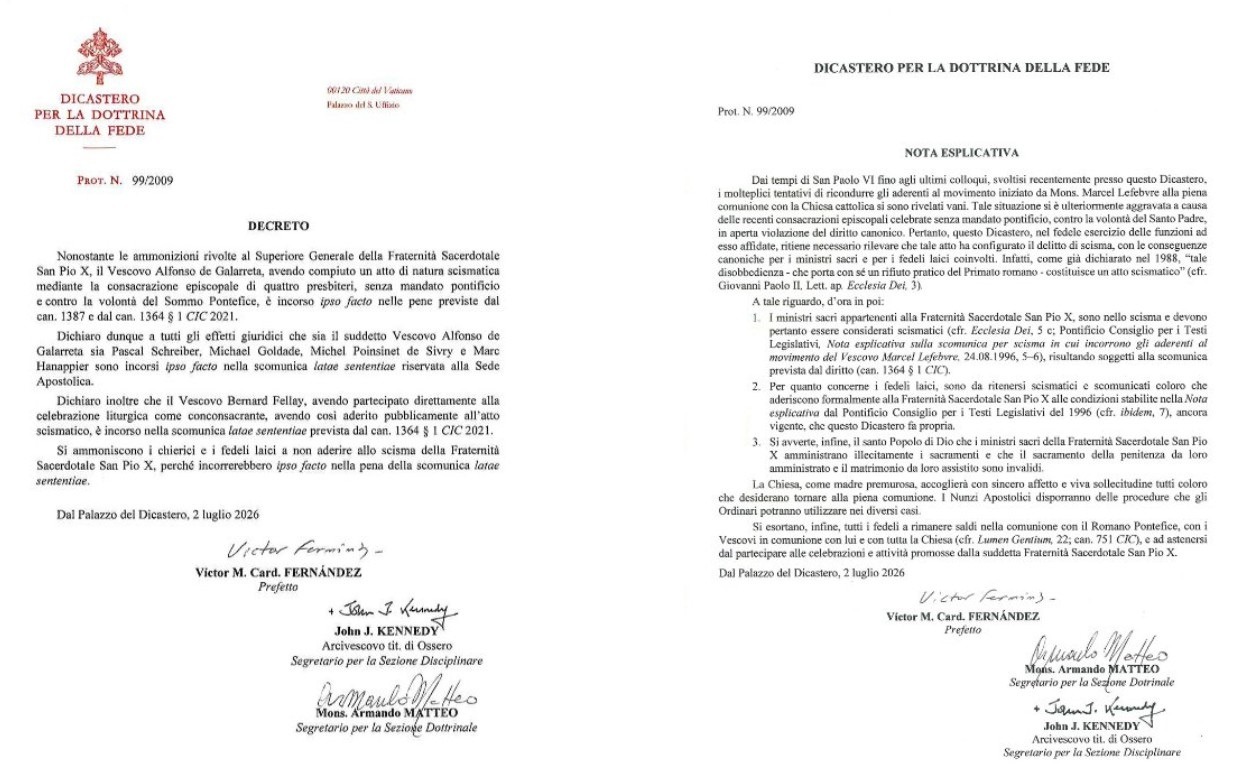
Vatican website DECREE and NOTE
DECREE (my emphases)
Despite the warnings addressed to the Superior General of the Priestly Fraternity of Saint Pius X, Bishop Alfonso de Galarreta, having committed an act of a schismatic nature by the episcopal consecration of four priests without pontifical mandate and against the will of the Supreme Pontiff, has incurred ipso facto the penalties foreseen by Canon 1387 and Canon 1364 § 1 of the 2021 Code of Canon Law.
I therefore declare, with all juridical effects, that both the aforementioned Bishop Alfonso de Galarreta and Pascal Schreiber, Michael Goldade, Michel Poinsinet de Sivry, and Marc Hanappier have incurred ipso facto the excommunication latae sententiae reserved to the Apostolic See.
I further declare that Bishop Bernard Fellay, having participated directly in the liturgical celebration as a co-consecrator, thereby publicly adhering to the schismatic act, incurred the excommunication latae sententiae provided for by Canon 1364 § 1 of the 2021 Code of Canon Law.
Clerics and lay faithful are warned not to adhere to the schism of the Priestly Fraternity of Saint Pius X, because they would thereby incur ipso facto the penalty of excommunication latae sententiae.
From the Palace of the Dicastery, 2 July 2026
Víctor M. Card. Fernández
Prefect
John J. Kennedy
Arcivescovo tit. di Ossero
Segretario per la Sezione Disciplinare
Mons. Armando Matteo
Segretario per la Sezione Dottrinale
DICASTERY FOR THE DOCTRINE OF THE FAITH
Prot. No. 99/2009
EXPLANATORY NOTE
From the time of Saint Paul VI up to the most recent discussions held at this Dicastery, numerous attempts to bring the adherents of the movement begun by Msgr. Marcel Lefebvre back into full communion with the Catholic Church have been in vain. This situation has been further aggravated by recent episcopal consecrations performed without a pontifical mandate, against the will of the Holy Father, and in open violation of canon law. Therefore, this Dicastery, in the faithful exercise of the functions entrusted to it, deems it necessary to point out that this act constitutes the crime of schism, with canonical consequences for the sacred ministers and lay faithful involved. Indeed, as was already declared in 1988, “such disobedience, which implies a practical rejection of the Roman Primacy, constitutes a schismatic act” (cf. John Paul II, Apostolic Letter Ecclesia Dei, 3).
In this regard, henceforth:
1. Sacred ministers belonging to the Priestly Fraternity of Saint Pius X are in a state of schism and must therefore be considered schismatics (cf. Ecclesia Dei, 5 c; Pontifical Council for Legislative Texts, Explanatory Note on the excommunication for schism incurred by adherents of the movement of Bishop Marcel Lefebvre, 24 August 1996, 5–6), thereby incurring the excommunication provided for by law (can. 1364 § 1 CIC).
2. Regarding the lay faithful, those who formally adhere to the Priestly Fraternity of Saint Pius X under the conditions established in the 1996 Explanatory Note by the Pontifical Council for Legislative Texts (cf. ibid., 7), which remains in force and which is adopted by this Dicastery, are to be considered schismatics and excommunicated.
3. Finally, the holy People of God are warned that the sacred ministers of the Priestly Fraternity of Saint Pius X administer the sacraments illicitly, and that the sacrament of penance administered by them and the marriages at which they officiate are invalid.
The Church, as a caring mother, will welcome with sincere affection and deep solicitude all those who desire to return to full communion. Apostolic Nuncios will establish procedures that Ordinaries may utilize in various cases.
Finally, all the faithful are urged to remain steadfast in communion with the Roman Pontiff, with the Bishops in communion with him, and with the whole Church (cf. Lumen Gentium, 22; can. 751 CIC), and to refrain from participating in celebrations and activities promoted by the aforementioned Priestly Fraternity of Saint Pius X.
From the Palace of the Dicastery, 2 July 2026
Víctor M. Card. Fernández
Prefect
Msgr. Armando Matteo
Secretary for the Doctrinal Section
John J. Kennedy
Titular Archbishop of Ossero
Secretary for the Disciplinary Section































Sad too.
I have been sympathetic to the SSPX. However this time around it feels like deliberate prideful defiance.
Folks dreaming that T.C. is going to get overturned . . . what about all of this makes anyone think there’s any mercy or sympathy in the Vatican for anyone who “formerly adheres” to the TLM?
I’d be happy to be wrong, but I don’t see anything good coming over the horizon anytime soon. And by not soon I mean not in my kids’ lifetimes.
Meanwhile, it looks I’m going to have to discern what “formerly adheres” to means when it comes time to seek Confirmation for my kids in the near future.
I will say, not that I gave it much thought before, but to me, from this point forward, any talk from Pope Leo about “mercy” and “unity” and “togetherness” and the like is worth less than hot air on a humid summer day.
Sad. Very sad. They certainly wasted no time. I know that it was already decided, but I had hoped that Pope Leo might delay the decree at least for a short time. Also, isn’t there any process involved? A hearing of some sort? Anything?
12/5/25 – Bishop François Li Jianlin was unilaterally elected by the state-controlled Chinese Catholic Patriotic Association. His appointment was later quietly ratified and accepted by Pope Leo XIV in August, leading to his formal consecration.
When the Holy Father, the Cardinals, the Bishops and priests, even the laity, consider the meaning of Schism in today’s world, what has it, before the recent news of the SSPX, meant to them?
Does it bother the Holy Father that the English Church became schismatic, and later, Protestant? He didn’t seem to tell the new female “Archbishop” of Canterbury that the Anglicans must return to the True Church.
When the Muslims wanted to perform their false worship, did the Pope remind them that the Blessed Trinity is God, and they should convert to the True Church, or did he give them a room in the Vatican in which to pray?
Did Archbishop Weisenberger in Detroit tell the Muslims in the mosque he visited that they were not worshiping the Trinity as God taught, or instead did he say it “made him feel “a profound divine presence” and that there was “no place where I feel more respect, fraternity, and kindness”.””
When the Chinese Communist political leaders told the Pope they will choose the bishops of the Catholic Church there and give them the jurisdiction to rule over territories, did the Holy Father strongly remind them it was not their place to do so? Or did he after the fact accept those bishops consecrated without a papal mandate as Roman Catholic bishops?
In all seriousness, does schism or excommunication mean anything in today’s Church? It doesn’t seem to. Pope Leo insists “We are one; we are all one!”
Cardinal Fernandez says “I fully trust every human being will be saved.” Why does he care what the SSPX does then?
So I’m just wondering why the SSPX and its consecration of bishops, excommunication and schism even make the headlines. If anything, it seems like perhaps they will get more attention from the Vatican, perhaps be invited to bless the clergy in Rome, and be given a room in the Vatican or an altar at St. Peter’s to celebrate Mass.
In all seriousness: what does schism and excommunication mean to Rome today? Is it only reserved to traditional Catholics who hold to the Faith and Mass taught and assisted at by our ancestors for centuries, until Vatican II came along?
There does not seem to be great efforts made to bring “our separated brethren” of Protestants back into the fold. Often they are praised for their works instead.
The whole things seems ironic and contradictory. How can everyone be “one” and have their religion and practices be accepted, except for this small inconsequential group of priests and faithful whose biggest fault is not accepting a few documents of Vatican 2 which either are ambiguous or directly go against what the Church had taught before, and whose next biggest fault is to respectfully ask the Pope for an audience and for his permission to consecrate a few bishops whose only role is to Confirm people and ordain the priests of their society, having absolutely no jurisdiction and no desire to set up any parallel Church? With all due respect, Pope Leo didn’t show any sign of being a caring father to the hundreds of thousands of people who rely on the SSPX for Sacraments. He abandoned them, and then it seems he has thrown them out of his house, without a backward glance, saying “we must continue to move forward.”
There is also the supreme law of the Church which says the salvation of souls is most important.
Also, there is the Canon that gives permission to break a law in times of crisis or emergency, EVEN if that crisis is only in the acting person’s head! So we know for a fact the SSPX believes there is a crisis and they acted in necessity, which means the penalty cannot apply.
While the Holy Father has by this excommunication and declaration of schism rejected his paternity and a part of his flock, there is no doubt those same clergy and lay people will continue to acknowledge him as their Father, and pray for him and remember him and their diocesan bishops in their Masses.
Let us pray for everyone involved in these decisions, that true peace may come and that God’s Church is purified of schism, charity reins, and when the world finally is “One”, everyone will be members of the one True, holy, Catholic and apostolic Church!
That escalated fast…
Vatican News has an unsigned post of “02 July 2026, 09:00” entitled “Excommunication decreed for Lefebvrian episcopal ordinations” which also has a photographic reproduction of the Italian “Decreto” and “Nota Explicativo” – saying “Further details are contained in an ‘Explanatory Note,’ published by the Dicastery at the same time as the decree of excommunication, which is reproduced in full below” in English – but no translation of the “Decreto” or indication where any translations are to be found.
Yes I agree, a very sad day. Such draconian measures that seemingly go beyond what happened in ‘88 (eg including all the clergy as well).
Have they not, Father, stated the confessions are also invalid in saying “the sacrament of penance administered by them and the marriages they assist at are invalid.”?
Father, when time permits, can you advise in terms of Mass attendance, as the letter exhorts the faithful to “refrain from participating in the celebrations and activities promoted by the aforementioned Society of Saint Pius X”, but not necessarily forbids? It’s not as if they’ve ever “encouraged” such a thing! As someone who doesn’t have a schismatic bone in his body, and frequents the SSPX for weekday Masses, is that something I can continue? Thank you Father, and may God bless you.
I think I respect Pagliarani’s assessment of the situation over that of Fernandez.
Is there a particular reason that your headline says “confessions illicit”? Its pretty clear that their confession are now invalid except for the obvious situation of one hearing a confession of a Catholic who is on the verge of death.
The best analysis I’ve read is from Fr. Raymond de Souza in his syndicated column.
St. John Paul II was willing to take “no” for an answer. The Holy Father is also willing to take “no” for an answer.
There’s nothing new in the current decree. It’s just a formal declaration that the SSPX had chosen to implement the 1996 terms of their 1988 excommunications again.
Pope Leo is implementing the canonical effects determined in the pontificate of St. John Paul II for the same crime.
Link to article: https://www.ncregister.com/commentaries/desouza-sspx-no-to-the-church
Sad, angry and disappointed- especially in Pope Leo, who it seems, is towing the line Francis left for him. I will continue to pray for him and for the SSPX.
As I mentioned the other day, the madness that compels my father to not speak with my brother is something that I need not participate in. As long as my brother continues to speak well of my father and acts to be in communion with him, there is no reason for me not to speak with my brother, or visit his house and dine with him.
With the stroke of a pen, the number of priests in the world who can and do hear confessions has been reduced by 735.
Father, it gets even worse: https://rorate-caeli.blogspot.com/2026/07/dicastery-for-doctrine-of-faith.html#more
“With respect to the lay faithful described in nos. 3–4, it is sufficient that they approach a priest who is in full communion with the Church and resolve not to attend the Priestly Fraternity of Saint Pius X in the future.“
Where the nos 3-4 are:
“ (3) Lay faithful who attended the Priestly Fraternity of Saint Pius X solely for liturgical or spiritual reasons;
(4) Lay faithful who, although aware of the tensions with the Holy See, do not reject either the Magisterium or the authority of the Roman Pontiff.”
I’ve attended their Masses due to the allowances of the Ecclesia Dei commission in the past as discussed here many times. Now we need to approach a priest and resolve never to do this again? What is going on?
Leo has roared. He has found whom he may devour.
How unhappy to feel the need to resist him, standing steadfast in the Faith.
Potentially important side note, as best I understand, salvo meliore iudicio. The latae sententiae excommunication that applies to the act of episcopal consecration against papal mandate is a reserved excommunication, which means only the pope can lift it. The latae sententiae excommunication that applies to the act of adhering to schism is not a reserved excommunication, and thus gets lifted for the internal forum at the moment of a valid sacramental confession. What might be required for a valid sacramental confession in such a circumstance would be a further discussion. Today’s decree from Rome is not a declaration of ferendae sententiae excommunication, but just a statement of observation about the applicability of existing law.
Do you think Francis’s approach would have been different? As it stands, all SSPX faithfull & priests are out of the game so to speak, give or take..I somehow do not think he would have let it come to this…
@WVC – there is no point trying to “discern” “formal adherence” in relation to your children’s confirmation.
The sacraments dispensed by the six bishops are illicit, you cannot play ecclesial politics your children’s souls. Please do not do this.
Even if you protest they are not invalid – think about it. They cannot absolve in confession – that is declared invalid. How could a bishop who cannot hear the child’s First Confession validly possibly then confirm effectively?
I’m more than sad. Distraught. Angry.
I have two adult children who attend the sspx chapels. Am I now no longer able to witness my grandchildren receiving the sacraments there? (Baptism, 1st Communion,etc) What about their eternal salvation? The SSPX brought this upon themselves but the hypocrisy and severity from Rome is sickening. Diabolical really.
Fr Jackson :
“The latae sententiae excommunication that applies to the act of adhering to schism is not a reserved excommunication, and thus gets lifted for the internal forum at the moment of a valid sacramental confession.”
Indeed.
IIRC at the time of the original excommunications, only those laity who were personally present at the consecrations were in principle excommunicated in turn, though as you say — not “reserved”.
@bobba_dwj
Cardinal Tucho, with the authority of Pope Leo, is wielding excommunication as a blunt force trauma tool to punish anyone he possibly can who has been sincerely devoted to the TLM and the traditional teaching of the Church. I have no reason to doubt that, if there were a Jesuitical way to apply the same weapon against those TLM folks stuck in gymnasiums because their bishop has cast them out in the name of Vatican II, he would. Watch for “schism” talk to start circulating about those who “adhere” too closely to the TLM in the near future – and this will include the FSSP and ICKSP. The way will start being paved to force us all to “submit or be excommunicated.” The lies of T.C. will become the cornerstone upon which they will continue to build their war against the Church and the faithful.
I’m very sad today. And angry. But mostly sad. The carelessness by which the men in charge of Holy Mother the Church are abusing Her is distressing, but the legion of voices defending this abuse with, “the only thing that matters is to obey” talk are truly disheartening.
It is a sad day.
I can agree the Church is in a moment of crisis, that confusion reigns, that much is let go unpunished that should not be.
But at the same time, we are not allowed to play all the cards the enemy can play, particularly that of disobedience to legitimate and lawful authority. Regardless of any unfairness, imprudence, or malice that may be behind the refusal to grant a mandate (if any), if the society accepts that Leo is the pope, then his mandate is lawfully required. The only emergency at hand was Father Time’s impending deprivation of the society of bishops to administer the sacraments only bishops can do.
Even the nutty bishops don’t go around ordaining the James Martins and extraterrestrial Jesuits of the world to the episcopate without a mandate, nor would we want them to. The punishment is severe and not proportionate to what the modernist set get, but just because there are many bishops acting badly does not sanction this act, and if the Church needs any group to carry the banner of obedience to legitimate authority, it is the traditionalists, painful as it is in the present day.
IIRC, JPII didn’t go after the marriages. There have also been Bishops in the US who were happy to receive marriage documentation from the SSPX because it meant Catholic marriages were happening and that Baptisms would result. Now what of those Bishops who had good relationships with the SSPX in their Sees? And what and members of the SSPX Third Order? Usually getting released from a Third Order requires Rome’s approval. And what about the Sisters of the SSPX? Or Catholics in never-Christian countries like Japan where the nearest non-SSPX church may be far away?
I’m honestly not sure for whom I have lost greater respect: Tucho for doing this or Leo for allowing him. What hope I had for this pontificate has disappeared entirely.
@Josephus Muris Saliensis
The most polite response I can muster is for you to kindly keep your sanctimony to yourself.
[Like Dad said, “Okay, kids, don’t make me come down there!”]
Obedience is quickly become the new “synodality.”
One cannot simply throw that word around as if it explains and justifies all things.
Obedience must have a qualifier. When folks warble on about how “so long as we’re obedient it will all work out in the end” the question is, obedient to WHAT?
To one’s own conscience? To the consistent and plain teaching of the Catholic Church prior to Vatican II? To the Magisterium of the previous popes? Or to whatever the current pope happens to say, no matter what? Because it often comes across like that last option, and this is papalism, not Catholicism.
If the master owns a magnificent garden, hires gardeners to tend the flowers, and places a chief gardener above them all with instructions to lead and support all the other gardeners, making it clear that his desire is to grow as many beautiful flowers as possible . . . if the chief gardener turns around and orders all the gardeners to put on combat boots and stomp on the prettiest flowers in their section of the garden, the problem is not solved by just shouting “obedience” over and over again. Obedience to whom? The chief gardener or the master? Obedience for what? To stay in the chief gardeners favor or to protect and grow the most flowers?
@Fr. Jackson is right.
And this is a point that matters to the possibility of reconciliation where it is needed.
As long as a _latae sententiae_ excommunication that is not reserved remains undeclared, it can be remitted in sacramental confession. If it gets declared publicly, then its remission has to be public as well.
Obedience that comes from servile fear isn’t the virtue of obedience. It is rather a form of vanity.
“The sacraments dispensed by the six bishops are illicit, you cannot play ecclesial politics your children’s souls. Please do not do this.”
Oh indeed, take them to your average diocesan novus ordo church where they have a very high chance of falling away like most children do. Don’t ask the bishop to ensure sound teaching and liturgy in his parishes and schools, he’s too busy doing interreligious dialogue to worry about the souls of your kids. That’ll be better!
It would seem to be time for a strong bishop like Schneider or Strickland to “swim the Tiber”
“Obedience is the only virtue which plants all the other virtues in the mind, and preserves them once they are planted.”—St. Gregory the Great, as quoted by St. Ignatius of Loyola.
Obedience to legitimate religious superiors is the virtue upon which the other virtues is built, as it extinguishes pride, which is the greatest vice. This has been the teaching of the saints since at least the Counterreformation.
The Pope is the only valid religious superior when it comes to consecrating bishops. I don’t expect those who are disdainful anytime the topic of religious obedience is brought up to change their minds on this topic, but I think it is worth pointing out to any lurkers that this is not some new thing liberals created with Pope Francis.
St. Ignatius’ letter on religious obedience is worth a read. It deals specifically in the context of the life of consecrated religious, but the ideas are applicable to this situation as well: https://library.georgetown.edu/woodstock/ignatius-letters/letter25#letter
Does this document really have the legal effect it purports to have?
@WVC , I too am looking ahead to future confirmations and marriages, and I wonder again at the very precise timing when a former commanding officer showed me an essay on “critical obedience.” After discussing various principles and historical examples in “How Much Obedience Does an Officer Need?”, the author concludes, as I think you’ll find applicable to the current crisis, that “obedience to orders is a high military virtue, without which an army is merely a mob . . . however, obedience is not absolute. Orders must be based upon law and morality. Soldiers are obligated to disobey illegal or immoral orders.” My commander gave this to me when I pushed back against what I believed were immoral orders. Given that this was during COVID, his was not a very common understanding of the virtue, within or without the Church.
https://www.armyupress.army.mil/Portals/7/combat-studies-institute/csi-books/ObedienceOfficerNeed_Zwygart.pdf
@R2D – The context of consecrated religious life is actually a pretty big context. And for those who are NOT in consecrated religious life, the vow of obedience is completely different. As in, it doesn’t exist. And this includes priests. Obedience, in this other context, is more nuanced and tempered by many other factors.
So throwing around saints quotes about consecrated religious life doesn’t actually answer any of the actual issues that have been brought up. The “obedience” is the only thing that matters mantra doesn’t address let alone win any of the arguments at hand.
The only issue is whether the papal mandate is a legitimate exercise of papal authority, and whether conditions exist to dispense with it. The mandate was codified in the 1917 CIC, and the penalty set as excommunication in 1958, so it seems the mandate itself is on solid ground. I don’t think it’s possible to argue necessity exists to dispense with the mandate with the Holy See occupied (and its occupant affirmatively saying not to proceed), with communication taking place between the society and Rome, and apostolic succession in no way about to go extinct if society didn’t act.
Leo as pope chose not to dispense with the mandate and also chose not to grant it. Chapter 3 of Pastor Aeternus from Vatican I doesn’t give leeway to supersede Leo’s judgment in the matter on the part of the society.
@Rob83
There is the apostolic mandate, which belongs to the episcopate and entails sacramental validity, and the papal mandate — which is more related to the jurisdictional function of the Church — i.e., the lawful exercise of governance and jurisdiction which impacts sacramental licitness. The Pope, as an episcopate, primate of the Roman Church, and pope of the Universal Church, exercises both, and these tends to get conflated as “The Apostolic Mandate.” The Papal Apostolic Mandate or Petrine Mandate might be more appropriate terms. Keep in mind that in the four marks of the church, “apostolic” isn’t shorthand for petrine but rather refers to the lineage of sacramental authority that each bishop immediately possesses from Christ directly through the apostles and their following lineage, i.e., the “fullness of holy orders”.
We need to be careful with conflation of the three crowns of the papacy unless we endup with “L’Église, c’est moi.”
You see the same issue with “The Apostolic Pardon”. Your local bishop could, in his name, issue “AN apostolic pardon”; we just tend to see the Papal “The Apostolic Pardon” being the one that is used because it has been codified using the Papal universal jurisdiction key. Case in point: if you look at Eastern Catholic theology, which, granted, doesn’t have a theology of indulgences, the independent sacramental authority more clearly rests in the local bishop in union with Rome, rather than flowing jurisdictionally downward from Rome as Western Theology can view it (lopsidedly overlooking the authority of the local bishop due to the West’s post enlightement monarchial model of the Church).
Remember, the Orthodox have the jurisdictional power of the keys located in their Churches NOT as something that comes from and is ordered to the Roman Church (as VII discusses the Protestants’ sacraments and ecclesial-like elements).
Keeping the above in mind, we can go to PA 3 and notice no 5 which reads:
5. This power of the Supreme Pontiff by no means detracts from that ordinary and immediate power of episcopal jurisdiction, by which bishops, who have succeeded to the place of the apostles by appointment of the Holy Spirit, tend and govern individually the particular flocks which have been assigned to them. On the contrary, this power of theirs is asserted, supported and defended by the Supreme and Universal Pastor; for St. Gregory the Great says: “My honor is the honor of the whole Church. My honor is the steadfast strength of my brethren. Then do I receive true honor, when it is denied to none of those to whom honor is due.”[51]
First, let us note that we are talking about jurisdictional authority, NOT sacramental authority. Second, let us note that this specifically says that the jurisdictional authority of the local bishop is supported by the jurisdictional authority of the Pope NOT that it flows from the Pope, even as #2 states that episcopal authority is “bound to submit to this power by the duty of hierarchical subordination and true obedience”.
Further, there is what VII (LG 27) states, along with the 19th-century document to the German Bishops, that upholds the real and true sacramental authority of the local bishop and their rights to govern.
Question: Is the Pope under the authority of Canon Law? No. He is the supreme lawgiver and is not bound by Canon Law. That is universal jurisdiction. Are bishops bound by Canon Law? If you read Canon Law, you will notice that in specific places the Law states that if push comes to shove, the local bishop is free to act as he sees fit, within the confines of orthodoxy and orthopraxy according to their episcopal mandate from Christ (those are the true binds, not the Law). What binds a local bishop to Canon Law is the principles of collegiality and communio (not legal positivism). It is a tool by which the Bishops govern their subjects; it does not create the authority of the bishop, just declares how they agree to exercise that authority. Bishops are not branch managers of the papacy. Canon 87 is declaratory of divine law, not to be read in a legal positive manner.
So, there is a certain tension — it is not a good idea to ignore the Pope when he says “no bishops.” On the flipside, it is not a good idea for the Pope not to provide bishops for his flock. Both are, in a certain sense, derelictions of duty. Which one takes precedence? Depends on if you think hierarchy is a term of taxonomy and governance or if you follow St. Dionysius the Areopagite and St. Augustine, and find that hierarchy is about ordered love, and then if you find that the salvation of souls is the second thing that the Church is about, following true worship of God.
As Catholics, we need to get rid of legal positivism and the post-enlightenment “will of the autocrat” from our “lived experience” of the Church. (And yes, the SSPX does have a bit of the “will of the autocrat” in their monarchical model of the Church that crept into things following VI (just as the “spirit of VII”^TM crept into things following VII) that needs to go as well.)
@WVC: the SSPX bishops and priests are clerics who by their office have a duty of obedience to the Roman pontiff. The fact that they’re not professed religious doesn’t get them an out from that.
@R2D
You continue to miss the point, as even amongst bishops and priests the duties of obedience are very different from those of consecrated religious, but I know better than to try to carry this any further. Just pointing out that all your saints quotes about “obedience” are in the context of consecrated religious life, and that context is significant.
Usually getting released from a Third Order requires Rome’s approval
It depends on the Constitutions of the Order. In some cases, one signs a document that is kept in the Order’s files. Rome is not directly involved. I can’t speak to the case of the SSPX Third Order, however.
The Chicken