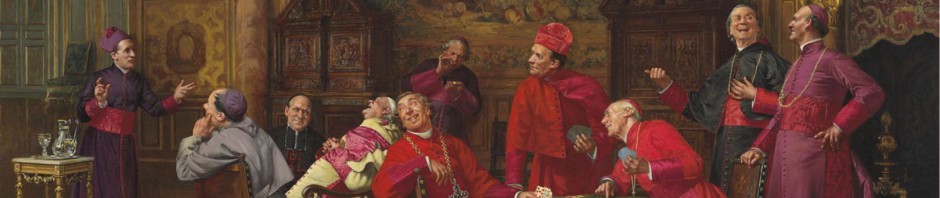
For a while now, a growing number of smart people have been asking for a definition of “synodality” (aka “walking together”), which is a complete innovation and seems to be an endless process whereby predetermined outcomes are managed and attained… on paper, at least. Wondering about synodality are
Cardinal Raymond Leo Burke
Cardinal Rainer Maria Woelki, Archbishop of Cologne
A group of unnamed bishops participating in the 2024 Synod
The International Theological Commission: “synodality is a ‘linguistic novelty which needs careful theological clarification’”.
Etc.
During his recent trip to San Marino and Rimini, Leo XIV met with members of Communion and Liberation. HERE He tiptoed up to a definition of “synodality”. Let’s call it for future reference the “Rimini Definition” (RD).
As he moved toward his “definition” he quoted an address by Francis in 2024 to Participants in the Jubilee of the Synodal Teams and Participatory Bodies. He offered this curious observation about “listening”, that is, “We need to continue to discover how valuable it is,…”.
So, one might ask, is listening something to be “discovered”? Indeed it seems that we lost “listening” and it has been reclaimed. Leo:
In recent years, we have rediscovered the synodal and missionary dimension of being the Church, which calls us, first and foremost, to learn to listen to one another.
Rediscovered? It is consummated, I guess. So, we are now a “listening Church”? I thought we were a teaching and witnessing Church (cf. Christ in Matthew 28:16-20 and The Great Commission). But then I’ve not been been invited to “walk together” in the synodal process. Oh well.
Leo went on…
This is a journey that also calls for the renewal of every association and ecclesial movement. I invite you, both within the Communion and Liberation Movement and within the particular Churches to which each of you belongs, to undertake this experience of walking together [See? He says it too!]. It involves each person listening, allowing himself or herself to be transformed by the faith of others, [What if they are poorly forned?] and together, discerning new insights, taking further steps and responding courageously in obedience to the Holy Spirit. [Here it comes…] Synodality is not the name of a process, but the very nature of a people who, through friendship and encounter with others, come to recognize that they belong to God alone. In this way, authority is transformed into service, one that honors differences and fosters their harmony.
“Honors differences”… unless they involved celebrating the Mass that the Latin Church had for millennium.
Let’s see that again…
Synodality is not the name of a process, but the very nature of a people who, through friendship and encounter with others, come to recognize that they belong to God alone. In this way, authority is transformed into service, one that honors differences and fosters their harmony.
One might be forgiven for wondering if Leo hasn’t been apprised of those who have been asking for a definition.
However, I am not sure this cleared up anything. For example, Leo said “God” not “Christ”.
Also, what is “nature of a people”. “Natura populi”? “Essentia populi“?
Let’s take a step back.
Robert Prevost is an Augustinian. What does Augustine offer for this topic?
In the political and theological thought of St. Augustine, populus (a people) is defined in The City of God as a multitude of rational beings united by a common agreement as to the objects of their love.
A true populus is bound together not merely by laws, but by what its members collectively value and love. This definition allows Augustine to contrast the earthly community (civitas terrena bound by the love of temporal things) with the heavenly community (civitas Dei bound by the love of God). The “king” of the former is the devil and the “king” of the later is “Christ” (not a vague “God”). Augustine uses populus specifically to denote a unified, conscious polity rather than a random crowd (turba) or a mere ethnic group (gens). This concept is explored in texts like The Populus of Augustine and Jerome by Jeremy DuQuesnay Adams and HERE. One can consult also Gerard O’Daly Augustine’s City of God and, especially, R. Dodaro, Christ and the Just Society in the Thought of Augustine.
Note also the notion of synodal listen transforming “authority” into “service”. Gosh, no one in the history of the Church has connected “authority” and “service”. No… wait…
- Mark 10:42–45; Matthew 20:25–28: Christ contrasts apostolic authority with pagan domination: “Whosoever will be chief among you, shall be the servant of all.” The model is Christ himself, who came “to minister, and to give his life a redemption for many.”
- Luke 22:24–27: During the dispute about precedence, Jesus says, “He that is the leader, as he that serveth.” He does not abolish leadership; he defines its Christian manner.
- John 13:1–17: Jesus, whom the disciples rightly call “Master and Lord,” washes their feet. His service proceeds from his authority and reveals how that authority must be exercised: “I have given you an example.”
- John 21:15–17: Peter’s pastoral commission is expressed as service: “Feed my lambs … feed my sheep.” His authority over Christ’s flock is a responsibility grounded in love for Christ.
- Acts 6:1–6: The Apostles exercise authority by appointing seven men for the diakonia, or service, of the community. Different ministries serve the same ecclesial body.
- Acts 20:28–35: Paul instructs the Ephesian presbyters to guard the flock over which the Holy Ghost has made them overseers. He recalls his own labor and Christ’s saying: “It is a more blessed thing to give, rather than to receive.”
- 1 Corinthians 3:5–9; 4:1: Paul calls apostolic ministers “servants” through whom the faithful believed and “the ministers of Christ, and the dispensers of the mysteries of God.”
- 2 Corinthians 4:5: “We preach not ourselves, but Jesus Christ our Lord; and ourselves your servants through Jesus.” Apostolic authority serves Christ by serving his people.
- 1 Peter 5:1–4: Presbyters must “feed the flock of God,” neither domineering nor seeking profit, but becoming examples to the flock under Christ, “the prince of pastors.”
Thus the New Testament does not say that authority must be transformed into service. Authority instituted by Christ is already ordered toward service. What must sometimes be transformed is the sinful manner in which authority is exercised.
The Church Fathers has something to say about authority as service.
St. Augustine of Hippo: “For you I am a bishop; with you I am a Christian. The former is the name of an office received; the latter is the name of grace. The former is danger; the latter is salvation.” (s. 340). And “Let it therefore be the office of love to feed the flock of the Lord.” (io eu 123, 5 – Sit amoris officium pascere dominicum gregem. Pastoral government is an officium amoris, an office or duty of love. Authority remains while love determines its purpose and manner. St. John Chrysostom “For with us also a ruler is then most a ruler, when he is the servant of all.” (On Matthew 65, 4). St. Gregory the Great: “The highest place is well governed when he who presides rules over vices rather than over his brethren.” (Reg 2, 6: Tunc autem bene regitur summa, cum is qui praeest vitiis potius quam fratribus dominatur).
More recently: St. John Paul II: “The authority of Jesus Christ as head coincides then with his service, with his gift, with his total, humble and loving dedication on behalf of the Church.” (Pastores dabo vobis, 21) Benedict XVI: “The Church is called and commits herself to exercise this kind of authority which is service and exercises it not in her own name, but in the name of Jesus Christ.” (General Audience, 26 May 2010).
So, it seems that there has already been a strong connection of “authority” and “service” before the synodal process of “rediscovery”. Aren’t Popes historically – from the time of Gregory the Great (+604), the “servus servorum Dei… servant of the servants of God“? Leave aside that Francis reduced it, at least in the Annuario Pontificio, to a historical title along with Vicar of Christ (!), emphasizing above all others “Bishop of Rome”. Leo/Prevost has not restored it, but rather has kept the “historic title” distinction in the Annuario. However, he has used it multiple times in the titles of documents, for example, in the erection or suppression of dioceses: “LEO EPISCOPUS – SERVUS SERVORUM DEI – AD PERPETUAM REI MEMORIAM”. A millennial formula.
Back to the Rimini Definition.
There is an annoying pattern in scholarly writing in certain titles which use the phrase, “X Blah Blah and Y Blah Blah: Toward a Definition of Blah Blah”.
Leo might be reacting to calls for a definition of “synodality” and he is working his way “toward” one.
This formulation Leo provided during his talk to CL in Rimini is nice, but, salvo meliore iudicio, theologically inadequate as a definition of synodality.
First, saying that synodality is “the very nature of a people” confuses the Church’s nature with one proposed manner of expressing it. The Church’s nature arises from her divine constitution by Christ with the inbreathing of the Holy Spirit as the Mystical Body of Christ, the People of God, and the sacrament of salvation. Synodality might – with better paramets – describe one aspect of her communal life, but it cannot be identified with her nature.
Second, no one disputes that “friendship and encounter with others” are valuable Christian dispositions. However, they do not explain what makes a gathering either “ecclesial” or “synodal”. Secular associations also cultivate friendship, encounter and, often difference in harmony. The Rimini Definition omits baptism, profession of the apostolic faith, sacramental communion, the Eucharist, episcopal governance, and obedience to the revealed deposit. I admit that in a short talk, one can’t include everything. However, those points don’t take long at least to mention and, I think, they have been considered essential (in the past at least) in ecclesiology.
Third, people do not merely “come to recognize that they belong to God alone.” Through baptism they actually belong to Christ and are incorporated into His visible Church.
Fourth, authority is not “transformed into service.” In the Church, authority is already constituted by Christ as service: “The Son of man also came not to be served but to serve” (Mark 10:45). Its exercise may require purification, but its nature cannot be transformed by a synodal process. Nor does service eliminate hierarchy, jurisdiction, or the bishop’s personal responsibility to teach, sanctify, and govern. However, from what synodality has so far advanced, it is precisely the hierarchy that is being eroded by the confused mingling of lay people in the synodal process. It is as if they are trying to rewrite Lumen gentium.
Finally, “honors differences and fosters their harmony” lacks a criterion for judging differences. Some differences are legitimate expressions of Catholic unity. One might mention the desire for Traditional sacred worship. Others contradict revealed truth or moral law. One might mention the relentless advancement of the sodomy agenda without correction from authority … in service to the truth and the good of souls. Harmony cannot be the supreme criterion. Communion in truth must govern the discernment of which differences the Church can accommodate.
Moreover, when agendas do clash, sometimes the fight is, in charity, necessary.
It is one thing to criticize the Rimini Definition. It is another to attempt a more satisfactory formulation.
How about:
Synodality is the ecclesiastical process of walking together without defining the destination, listening to everyone without identifying who is right, and multiplying consultations until responsibility for the eventual decision becomes impossible to locate and then doing what was predetermined regardless of the time of listening.
Okay… that’s a bit snarky.
Snark doesn’t mean that it’s wrong.
Trying again for something more serious, leaving aside (aka abandoning the concept of the “Synod of Bishops“):
Synodality is (read: ought to be) the occasional and limited participation of the baptized in the Church’s consideration of concrete issues, under the guidance of their legitimate pastors, through prayer, consultation, discernment, in fidelity to Scripture, and in continuity with Tradition and the Deposit of Faith.
There. I fixed it.































The hodos that we are supposed to be walking together is Jesus Christ Our Lord.
He is the Way and the Guide; the Pillar of Fire by night and the Pillar of Cloud by day; the New Moses and the New Joshua; the True Rock that gives living water; and the True Manna from Heaven. He places our steps on solid ground, and helps us up when we stumble. He is a lamp to our feet.
Any other road is a false one. Any other guide is a false one.
The bishops are supposed to be serving Him. Sure, they should listen and bring up the concerns of people, in their prayers and in their charitable plans. But we are following Jesus Christ and what comes from Him, not random non-Christian ideas.
Best case, “Synodality” is a gimmick to try to get self-obsessed, narcissistic sinners reengaged with the Church by pretending to listen to their perceived wants and needs.
I don’t think we’re dealing with best case here.
We’re dealing with process manipulation: an avenue for modernists to claim people are demanding changes to doctrine and practice, and that if we are really “synodal,” we will adapt to those demands.
Vatican 2 never ended for them – it didn’t go far enough, and absent a Council, they will continue to press on for the changes they want by any plausible means.
Now it’s frustrating for Pope Leo to try to sell us on the concept of synodality. Being master manipulators, I wonder if the modernists are simply taking advantage of Popes who think their advisors have noble intentions.
The Church might be in better shape if we acknowledged that any word salad coming from a bishop or a curial office is actually just obscuring the faith.
1. You were invited Father, back in 1986 when… no… 2021? 22? When the hell did this all start? Anyway, back at the start we were all invited to send in suggestions for the synod. I assume that most of them ended up in an incinerator?
Pope Leo XIV didn’t spring out of nowhere, fully formed as a Pope with no prior experience. One can only assume that he had a working definition of synodality, the same as everyone from the start. “Walking toward a definition” now seems a bit…. pointless. Like admitting the church has had no clue what those talking walking togerity groups were on about for all the time I assume our charitable donations were paying for such ridiculousness.
Why is synodality about synodality STILL A THING???
I have read of the travesty at the papal Mass in Rimini. Perhaps I should say sacrilege? Over 25 thousand there apparently with the pope and all who approached were given Holy Communion by the more than 200 ‘Eucharistic Ministers’. Some of the people were in beach attire and even shirtless. All that is permitted by the synodal religion.
I like both the snarky definition which describes the current reality, and the unsnarky definition which returns the synodal process to what it should be.
That was refreshing. The soft, blurred edges of novel and undefined words, like synodality, need to be clarified and defined. This starts by clarifying the meaning and usage of the older words that are used, sometimes rather loosely, to describe the novelty. Words like listening, teaching, encounter, friendship, process, nature, communion, fraternity, service, authority, heirarchy, dialogue, etc.
We may need to stop and stay for a while, to look at these words. If we are really “walking together,” we may want to consider our “destination” first.
St Augustine is a good place to start. One might wonder if he, or any other saints, bishops, or Fathers of the Church ever used the abstract noun “synodality” during the course of a synod or council. Nicaea listed four marks of the Church, but omitted this term. St Charles Borromeo held 11 diocesan synods and 6 provincial synods in Milan. Could he define synodality for us?
Is there a definition, or a history of the usage of this word, in the Oxford English Dictionary? Not the word “synod” but “synodality.”
In the movie, The Princess Bride, Inigo Montoya said to Vizzini, “You keep using that word. I do not think it means what you think it means.”
Francis Bacon once observed, “‘What is truth?’ said jesting Pilate, and would not stay for an answer.”
Many are still asking, what exactly is synodality? What do you mean when you use that word? Why don’t we, please, stay just a little bit longer? We need an answer.
I can’t help but associate the word “Synod” with “Monad.” I’m a little at loss as to why exactly this is. Anyone else having similar thoughts?
“[What if they are poorly forned?] ”
Igitur iterum in furnum ponamus.
amenamen,
Back when Tolkien was working on it, when the relevant volume appeared (Volume IX. Part II. SU-TH, with its Preface to SU-SZ dated “June, 1919”), the New English Dictionary (as it was then called) went from “Synodalist” to “Synodally” with no ‘Synodality’ between (p. 383, col. 2) – though the next column includes the interesting words “Synodicate” and “Synodite”.
The 1945 impression of the 1879 Lewis and Short I checked has “synodalis” and “synodalia” but nothing like ‘synodalitas’ (p. 1829, col. 3).
Considering the fruit of the Holy Father’s actions to date toward, e.g., the FSSPX, I am inclined to conclude that St. Augustine’s term for his love where they are concerned is “libido dominandi”.
I have a friend who over the last year or so has been listening to a lot of videos from SSPX apologists, and who was becoming more and more convinced that the clerics of the, as he calls it, Conciliar Church are “compromised” in as much as they accept the heresies of the Second Vatican Council, and as such, are a danger to one’s immortal soul. So after the latest SSPX consecrations, he has decided to leave our local Catholic parish church, and from now on attend Mass at a SSPX church.
So, if I apply Pope Leo’s guidelines as to how to do synodality in this situation with my friend, I guess I begin by “walking together” with my friend. Which “…involves each person listening, allowing himself or herself to be transformed by the faith of others, and together, discerning new insights, taking further steps and responding courageously in obedience to the Holy Spirit. ”
So, in listening to my friend, I must say he makes some pretty compelling arguments regarding the “Conciliar Church,” and I guess Pope Leo’s instructions say I need to be “transformed by my friend’s faith,” and we, together, “need to discern new insights,” such as perhaps how dangerous the teachings of the Conciliar Church are to one’s immortal soul, and I guess I need to “take further steps and respond courageously in obedience to the Holy Spirit,” and get out of my local Catholic parish church and head over to the SSPX. Because, “Synodality is not the name of a process, but the very nature of a people who, through friendship and encounter with others, come to recognize that they belong to God alone. In this way, authority is transformed into service, one that honors differences and fosters their harmony.”
Wow! Thanks Pope Leo. My friend is going to be so pleased I now see things his way, and that even though we began by having a different take on the SSPX, we now have fostered harmony. Because we all, both the Conciliar Church, and the SSPX, belong to God alone, right? And now, after our synodolizing the differences between us, we will be in harmony sitting next to each other in a pew at the SSPX church.
Gosh. This is brilliant. I had no idea such complex issues could be completely resolved simply by ignoring errors.
Thousands of years of tradition. So many Saints and Martyrs.
That is not good enough for the recent Popes. We need to be hip, new and now.
Been there done that…It was the 60’s and 70’s revolution.
I can read the lives of Saints, Church history. Most blather coming from Rome is great for lighting the wood stove and wrapping fish. Sorry, that is an insult to the fish.
Here is a sane and refreshing take by a sane and refreshing bishop:
https://advaticanum.com/article/the-sspx-is-not-the-solution-an-interview-with-bishop-marian-eleganti/
The official “definition” of synodality is as deliberately vague as the rationale for convening Vatican II, which is not surprising, since VII is the cause and synodality is the effect.
As for listening, it used to be that Holy Mother Church listened primarily in the Confessional. Other than within that venue, she taught, preached and sanctified.
Used to be…
@pcg
It is a refreshing take from Bishop Eleganti. One elephant in the room that he doesn’t really address, though, and which will become increasingly more and more of a problem, is that of sexual perversion within the Vatican. It’s clear to anyone on the outside looking in that this, combined with virulent feminization, are the unifying and driving forces in much of what is creating the chaos within the Church.
Regarding the SSPX, I don’t think they see themselves as a “solution” either. They’re an unfortunate necessity with no view of being a permanent solution. And the many things the Bishop discusses are exactly what has given rise to this unfortunate necessity. To dismiss them with a wave of the hand because “Bishop Williamson” is a little disingenuous. If one does a frank comparison between the history of, say, the Old Catholics and the SSPX, it’s objectively not the same thing.
May God protect Bishop Eleganti – One can’t help but think names like his and Bishop Schneider are on several watch lists that circulate within Curial halls.
but the very nature of a people who, through friendship and encounter with others, come to recognize that they belong to God alone.
Let me just ask one question: isn’t Faith specifically an encounter with and friendship with GOD? Doesn’t ALL of our “mission” and “evangelization” and work in the vineyard entail starting with friendship with God and then reaching out to include others in THAT reality?
If so, Godly listening must have a directionality toward it, defined and determined not by me or by the other human person with his or her own personal motivations, but by the One in whom we have Faith. If so, listening MUST include also discernment as to what is compatible with friendship with God and what is incompatible. If so, listening also must also include using God’s own revelation of Himself as a touchstone of that discernment. If so, God’s own imposition of teaching authority on some and not on others must exercise a role in discernment.
We can have supernatural Faith, or we can worldly friendship: the latter can never become enlightened with the supernatural without God’s own action on us, it’s not our own power but His. If “listening” isn’t supernatural because it springs from our life in God, it is lifeless, empty, fruitless, deadening. If it is life-filled by grace, then it has the characteristics that Christ imbued his Church with: one, holy Catholic, apostolic, filled with the supernatural virtues, filled with humility toward God and his appointed ministers, filled with obedience toward Christ’s commandments (“baptize all nations”), filled with love of one, true God being the source of love of neighbor. Whatever is not this is not true “listening”.
If listening hasn’t a direction, it is from the one below who directs all disorders toward himself.
Another brave bishop- if synodality has taught me anything, it is to listen to voices of those crying out in the desert. Forgive me if I am being conspiracy minded, but am I the only one wondering whether all the earthquakes, volcanoe eruptions, fires, floods, celestial occurrences, wars, general unrest and nonsense coming out of Rome and the voices of some true shepherds pushing back are purely coincidence??
https://dianemontagna.substack.com/p/give-us-clarity-dutch-bishops-open?utm_source=post-email-title&publication_id=5470197&post_id=212597019&utm_campaign=email-post-title&isFreemail=true&r=1fqttv&triedRedirect=true&utm_medium=email
“Harmony cannot be the supreme criterion. Communion in truth must govern the discernment of which differences the Church can accommodate.”
I agree. We can strive towards harmony and other ideals in the Church and world, but until there is unity in Truth, and in the realities and laws that govern us all, actual progress in harmony won’t take place.
I think Pope Leo knows that there cannot be harmony or true unity unless there is first unity in Christ, Who is Truth itself, and that this alone ought to be mankind’s highest goal. He believes, like Augustine, that “In the One, we are one”, not, “in harmony, we are one.” Harmony and true unity will come naturally when all are united in truth and in the love of the One who governs us all. Human relationships will then be ordered rightly and a love of the laws of God will inform all our actions, bringing peace to the world.
I’m reminded of the lofty goal of eradicating poverty. This isn’t exactly bad, as we should always work towards easing the sufferings of the poor, by providing for them their basic necessities. But we should remember that there will always be poverty in this life due to original sin: “For the poor you have always with you: and whensoever you will, you may do them good: but me you have not always.” Mark 14:7
This life is not meant to be the “be all, end all” for any of us. The poor will always be among us, probably largely in part so the rich can practice charity towards them and grow in virtue themselves. Ending poverty is example of an unrealistic goal or ideal that is not meant to be solved fully in this world. Plus, people forget that the poor may not necessarily be poor spiritually, and spiritual wealth is all that matters in the end. The poor may indeed be rich spiritually, making the situation so that we actually need them more than they need us.
I get annoyed when I hear people argue that the Catholic Church should sell its wealth and give that money to the poor. The wealth in the form of our Church architecture and art needs to remain for the benefit of all and for generations to come. These places exist for the everyone to grow closer to God. Money comes and goes, but the treasures of the Church are priceless because they have the ability to stay in the mind forever and lift people higher.
Having now gotten around to checking Liddell & Scott, I find among the meanings of ‘sýnodos’ “plural, of political clubs or conspiracies”, “in hostile sense, meeting of two armies”, “of things, […] constriction”. (But – perhaps thanks to my ‘little Greek’ – I could not find any word analogous to “synodality”.)