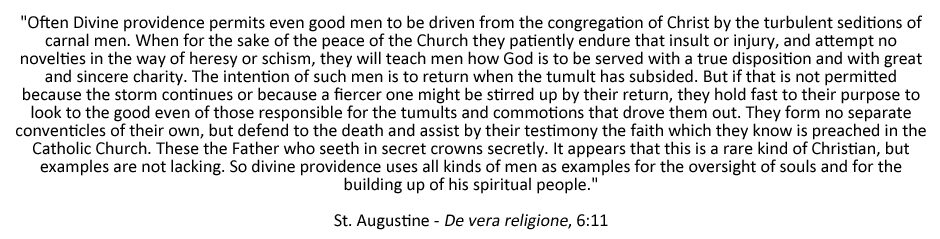
In the traditional calendar, the Feast of the Visitation, 2 July, came at the end of the long-suppressed Octave of John the Baptist. In the Novus Ordo it now falls on 31 May, between the Annunciation and the Birth of John the Baptist.
Here is something that I wrote years ago for the Patristic Rosary Project.
___
We continue our Patristic Rosary Project today with:
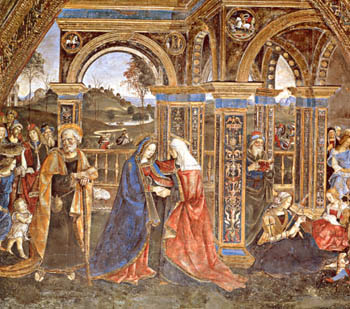 2nd Joyful Mystery: The Visitation
Commenting on Luke 1:39-45, the when Mary journeys to visit her cousin Elizabeth, St. Augustine of Hippo (+430) speaks of the infant John, to be known as the Baptist, leaping in the womb at the sound of Mary’s voice:
We see instances of leaping not only in children but even in animals, although certainly not for any faith or religion of rational recognition of someone coming. But this case stands out as utterly uncommon and new, because it tool place in the womb, and at the coming of her who was to bring forth the Savior of mankind. Therefore this leaping, this greeting, so to speak, offered to the mother of the Lord is miraculous. It is to be reckoned among the great signs. It was not effected by human means by the infant, but by divine means in the infant, as miracles are usually wrought. [ep 187.23]
God wrought something in John at that moment. What happened? We can look to the Greek writer Origen (+ c.254) for his view:
Elizabeth, who was filled with the Holy Spirit at that moment, received the Spirit on account of her son. The mother did not inherit the Holy Spirit first. First John, still enclosed in her womb, received the Holy Spirit. Then she too, after her son was sanctified, was filled with the Holy Spirit. You will be able to believe this if you also learn something similar about the Savior. (In a certain number of manuscripts, we have discovered that blessed Mary is said to prophesy. We are not aware of the fact that, according to other copies of the Gospel, Elizabeth speaks these words of prophecy.) Mary also was filled with the Holy Spirit hen she began to carry the Savior in her womb. As soon as she received the Holy Spirit, who was the creator of the Lord’s Body, and the Son of God began to exist in her womb, she too was filled with the Holy Spirit. [Homilies on the Gospel of Luke 7.3]
The concept of being “filled with the Holy Spirit” is interesting. Perhaps some of you have heard of the glosses on this phrase which compare the Blessed Virgin, John the Baptist, and St. Stephen. All were said to be filled with the Holy Spirit. Mary was prevented from ever having any stain of original sin. John was said to have been forgiven the guilt of original sin before his birth, which is the moment he leapt in the womb at the coming of the Lord. Stephen, the Protodeacon, was also “filled with the Holy Spirit”, but after his birth. In any event, the always creative and interesting Origen speaks of John’s sanctification in the womb at the coming of Mary who was bearing the Son of God.
Each of us must prepare to bear Christ and be filled with the Holy Spirit. St. Ambrose, the bishop of Milan (+397) said:
You see that Mary did not doubt, but believed and therefore obtained the fruit of faith. “Blessed … are you who have believed.” But you also are blessed who have heard and believed. For a soul that has believed has both conceived and bears the Word of God and declares His works. Let the soul of Mary be in each of you, so that it magnifies the Lord. Let the spirit of Mary be in each of you, so that it rejoices in God. She is the one mother of Christ according to the flesh, yet Christ is the Fruit of all according to faith. Every soul receives the Word of God, provided that, undefiled and unstained by vices, it guards its purity with inviolate modesty. [Exposition of the Gospel of Luke 2.26]
Our baptism should remind us every day that we are deeply woven into the fabric of the Church, a Church which in many ways can said to stretch back into the depths of our great “Family History” as God’s People. In a comment on the Magnificat, which Mary pronounced during her mysterious Visitation, Venerable Bede (+735) says:
When blessed Mary was making mention of the memory of the fathers, she properly represented them by naming Abraham in particular. Although many of the fathers and holy ones mystically brought forward testimony of the Lord’s incarnation, it was to Abraham that the hidden mysteries of this same Lord’s incarnation and of our redemption were first clearly predicted. Also, to him it was specifically said, “And in you all the tribes of the earth witll be blessed.” (Gen 12:3) None of the faithful doubts that this pertains to the Lord and Savior, who in order to give us an everlasting blessing deigned to come to us from the stock of Abraham. However, “the seed of Abraham” does not refer only to those chosen ones who were brought forth physically from Abraham’s lineage, but also to us…. Having been gathered together to Christ from the nations, we are connected by the fellowship of faith to the fathers, from whom we are far separated by the origin of our fleshly bloodline. We too are the seed and children of Abraham since we are reborn by the sacraments of our Redeemer, who assumed his flesh from the race of Abraham. [Homilies on the Gospels 1.4]
Did you catch that great phrase? “Mary was making mention of the memory of the fathers…” Perhaps we can see how the Blessed Virgin is a good model for all patristicists and, of course, patristibloggers!































Beautiful. Thank you, Father.
Respectfully, I have to disagree with Origen when he writes:
Mary also was filled with the Holy Spirit [w]hen she began to carry the Savior in her womb. As soon as she received the Holy Spirit, who was the creator of the Lord’s Body, and the Son of God began to exist in her womb, she too was filled with the Holy Spirit. [Homilies on the Gospel of Luke 7.3]
He seems to me to be confusing the action of the Holy Spirit in creating the Lord’s body with being filled with the Holy Spirit. It is, I think, true, that Elizabeth was filled with the Holy Spirit when John the Baptist quickened in her womb, but the Holy Spirit is not a substance that one may be filled with in the same way that one fills a bottle. Many Pentecostals make this mistake – after praying in tongues for about five minutes, they say they are filled with the Holy Spirit.
How shall I explain this? The Holy Spirit is the spiration that proceeds from the Father and the Son – he is the continuous generation of love between the Father and the Son. It is not wrong to say that the relationship between the Father and the Son is filled with the Holy Spirit to form the divine perichoretic* relationship within the Trinity. When humans are filled with the Holy Spirit, they participate in the Trinity, via Christ’s humanity, in a similar manner to the Divine perichoresis, only by participation, and not ontologically (much in the way that Christ’s human and divine natures can, likewise, be said to be perichoretic). As such, this presupposes a clarity of relationship that only exists after the stain of Original Sin is removed (all things being equal – God can do what He will, but I speak of the norm). Thus, one can be said to be filled with the Holy Spirit at the moment of baptism. As such, since Mary was conceived without the stain of Original Sin, she was filled with the Holy Spirit from the beginning. Elizabeth and John were freed from Original Sin at John’s quickening; when Acts speaks of St. Stephen being filled with the Holy Spirit, it doesn’t mean that at that moment he had something he didn’t have the day before. Indeed, Scripture says, (Acts 6):
And Stephen, full of faith and power [i.e., filled with the Holy Spirit], did great wonders and miracles among the people. Then there arose certain of the synagogue, which is called the synagogue of the Libertines, and Cyrenians, and Alexandrians, and of them of Cilicia and of Asia, disputing with Stephen.
And they were not able to resist the wisdom and the spirit by which he spake…
For we have heard him say, that this Jesus of Nazareth shall destroy this place, and shall change the customs which Moses delivered us.
And all that sat in the council, looking stedfastly on him, saw his face as it had been the face of an angel.
St. Peter comments (1 Pet: 4:14):
If you are reproached for the name of Christ, you are blessed, because the spirit of glory and of God rests upon you [i.e., the Holy Spirit].
To be filled with the Holy Spirit as St. Stephen was means to manifest a truthful and full relationship with the Trinity before men. That is exactly the same with Elizabeth, John, and Mary. To be filled with the Holy Spirit means, essentially, “Blessed are the pure of heart, for they shall see God.” That purity of heart is the conduit of the Divine communication, of the expression of love that exists between Father and Son and now the soul. It is the fullness of the Holy Spirit.
The Chicken
Perichoresis:
Perichoresis is a theological term that describes the mutual indwelling, co-inherence, or intimate interpenetration of the three persons of the Trinity (Father, Son, and Holy Spirit). It means the divine persons exist fully within one another and is often poetically visualized as a harmonious, dynamic “divine dance” of eternal love and unity.
If, as is properly understood, the Father is he who kisses, the Son he who is kissed, then it cannot be wrong to see in the kiss the Holy Spirit, for he is the imperturbable peace of the Father and the Son, their unshakable bond, their undivided love, their indivisible unity. – St. Bernard of Clairvaux, in Sermon 8, Sermons on the Song of Songs[15]
P. S. This is not to imply that the boundaries of the soul cannot be enlarged to contain more of the Divine love. To be filled with the Holy Spirit means to filled with nothing else, i.e., to be in a pure state. It is not a declaration of quantity, but of quality.
The Chicken
@The Masked Chicken
The issue that you are poking at can be clarified by understanding that “spirit” in the hebraic/aramaic sense is not the same thing as spirit/soul in the Greek philosophical sense. The latter tends to run our understanding of things, so we tend to think of “being possessed by the Holy Spirit” as a bottle that is filled. That is Aristotelian metaphysics or gnostic metaphysics, depending on how you slice it. That is not what is going on.
Divine Indwelling / Divinization / Theosis isn’t being filled as a bottle. Or the idea that the Spirit is like electricity that powers our circuitry. It is not the Protestant concept of Me + God such that I am still me with God just papering over myself. Rather, it is a true participation in the divine in the same manner that the Incarnation is. As the hypostatic union is to Christ, theosis (being filled with the Holy Spirit) is to us.
So when Origin says that those named individuals were “filled”, we check the greek —> pimplemi); to “fill” (literally or figuratively (imbue, influence, supply)); specially, to fulfil (time):—accomplish, full (…come), furnish. <— and notice that we don't mean "putting something inside of a container" but rather that "something is being done to the object in question".
Filled with Fullness — that is both quality and quantity.
The thing about Mary is that she was created in the perfected state to be capable of the divine indwelling of the Spirit. Everyone else, including Adam and Eve before the fall, needes perfecting — us doubly so from the fall. It is one of the reasons why Mary is the Spouse of the Holy Spirit in which the Word dwells, and everyone else is the Spouse of Christ in which the Holy Spirit dwells. It is why we call Mary Co-Redemptrix and Mediatrix. It is about her plenitude of being "filled" with the Spirit. Mary doesn't get the Holy Spirit at Pentecost — she got Him at the Annunciation. Elizabeth at the Visitation. Mary communicates the Holy Spirit inasmuch as she delivers the Word. After the Ascension, the Apostles gathered around Mary, who taught them until they were ready to receive the Spirit. Mary is "quiet," but she is not a passive actor. She is "quiet" in the same way her Spouse is "quiet" — the small "little" voice that vivifies everything.
A very late reply:
Dear Lurker 59,
You wrote:
“Rather, it is a true participation in the divine in the same manner that the Incarnation is.”
I believe that’s what I said:
“When humans are filled with the Holy Spirit, they participate in the Trinity, via Christ’s humanity, in a similar manner to the Divine perichoresis, only by participation, and not ontologically (much in the way that Christ’s human and divine natures can, likewise, be said to be perichoretic).”
We can go deeper, however. It is true that the concept of “spirit” is different between the Hebrew and Greek conceptions, but this difference does not show up in Scripture. The sense of “spirit” used in the Old and New Testament is the same: both the Old Testament, rûa?, and the New Testament, pneuma, mean about the same things: wind, breath, mind, spirit.
Pimpl?mi, or it’s synonyms (such as, pl?th? or pl?ro?), are often used in the New Testament to mean to fill physically, as in Matt 27: 48:
And one of them at once ran and took a sponge, filled [pimpl?mi] it with vinegar, and put it on a reed, and gave it to him to drink.
It can, also, have the sense of, “the fullness of time,” or a completed task [Luke 21:20-22]:
“But when you see Jerusalem surrounded by armies, then know that its desolation has come near.
Then let those who are in Judea flee to the mountains, and let those who are inside the city depart, and let not those who are out in the country enter it;
for these are days of vengeance, to fulfil [pimpl?mi] all that is written.”
This is the sense of pimplemi which means, “something is being done to the object in question,” as you say.
Pimplemi, is the translation or Greek replacement for the Hebrew word, m?l?, which, likewise, means to fill or fulfill (accomplish).
To fill: Gen 1:22:
And God blessed them, saying, “Be fruitful and multiply and fill [m?l?] the waters in the seas, and let birds multiply on the earth.”
To fulfill: Gen 25:24:
When [m?l?] her [Rebekah] days to be delivered were fulfilled [m?l?], behold, there were twins in her womb.
Like pimplemi, m?l? can be used in a pneumatological sense (1Kgs 8:10-11):
And when the priests came out of the holy place, a cloud filled the house of the LORD, so that the priests could not stand to minister because of the cloud; for the glory of the LORD filled [m?l? ]the house of the LORD.
and Micah 3:8:
But as for me, I am filled [m?l?]with power, with the Spirit of the Lord, and with justice and might, to declare to Jacob his transgression, to Israel his sin.
There are many places in the Old Testament that mimic the language of being filled with the Spirit, although the word, filled, is not used, explicitly. As some examples, one may cite:
1. 1Sam 16:13:
Then Samuel took the horn of oil, and anointed him in the midst of his brothers; and the Spirit of the LORD came mightily upon David from that day forward. And Samuel rose up, and went to Ramah.
2. Judges 13:25:
And the Spirit of the LORD began to stir him [Samson] in Ma’haneh-dan, between Zorah and Esh’ta-ol.
How to reconcile the idea of filling up something and ,”something is being done to the object in question?” Here is where the understanding of Spirit being breath makes sense. When someone takes a deep breath, it usually means that something is going to happen, that something is going to be done. When the Holy Breath fills a person, usually something of a prophetic nature is about to happen, either a speech or an action. Why?
John 3:8 has a possible answer:
“The wind blows where it wills, and you hear the sound of it, but you do not know whence it comes or whither it goes; so it is with every one who is born of the Spirit.”
The Spirit has a will, the Divine will, and when one is filled with the Spirit, indeed, in order to be filled with the Spirit, there has to be a unity of wills because there are two wills at play in the individual and the two wills cannot work together in the same soul unless they are in unity. In this sense, something is being done to the individual to conform them to the mind (another sense of the word, pneuma) of the Spirit. In Elizabeth and John, it was being freed from Original Sin. Since Mary’s will was already perfectly united to the Holy Spirit from the time of her conception, she was filled with the Holy Spirit from her conception. She is the Spouse of the Divine in all of its Trinity.
Thus, to be filled with the Holy Spirit means a type of perichoretic unity with the Trinity through Christ, which is often called the Spiritual Marriage in mystical theology.
One can be transiently filled with the Holy Spirit, as perhaps Balaam was, but generally, most people receive only touches of the Holy Spirit instead of the fullness, which, in and of itself, can effect change in the soul, although not, perhaps, enough to bring the soul into perfect union of wills.
Thus, if Origen simply meant that the Holy Spirit had to fill Mary in an operational sense in order to create Christ in her womb, then fair enough, but Mary was already filled with the Holy Spirit in the other sense used in the Old and New Testament.
The profound mistake that Evangelical Pentecostals, who are so much in the news today, make is in thinking that they are being filled with the Spirit, when, in fact, they are receiving, at most, a few drops in the bucket. Let me use this bucket analogy for a moment.
If a bucket is half-filled with marbles and you fill the bucket to the brim with water, is the bucket filled with water? Most people would say, no, because there is an admixture of substances in the bucket. If, on the other hand, the bucket is completely empty, then when it is filled with water, one can truly say the bucket is filled with water. This is why, at baptism, the soul, being freed from Original Sin, is filled with the Holy Spirit. However, because of the defects of Original Sin, crystals of sin can begin to grow in the bucket so that the Holy Spirit no longer completely fills the bucket. As one progresses in the spiritual life, God will pluck out the crystals and often enlarge the bucket, so that one can receive the Holy Spirit more fully and purely.
If a Protestant Pentecostal were to really be filled with the Holy Spirit, they would instantly convert to Catholicism. The Protestant Principle at work in them, of necessity, means that they are never being completely filled with the Spirit because there is something inimical to the Holy Spirit already present. Of course, they will disagree because they do not view the Catholic Church as being the Spouse of the Holy Spirit, but time will tell where wisdom lies. For more complicated historical reasons, far beyond this comment to explain, Catholic Charismatics have a similar defect, although not as great.
Thus, the exemplar of being filled with the Holy Spirit is Mary, who is worthy of hyperdulia (highest veneration), and to a lesser extent (smaller bucket?) the martyrs and saints are worthy of dulia (veneration). Different people have different buckets (souls), but whatever the size, it is a good prayer that God may fill it with His Spirit.
The Chicken