
For Catholics, the consequential impact of the nearly complete obliteration of the cycle of readings for Holy Mass in the Latin Church, and the imposition of an entirely novel (which the Council Fathers explicitly forbade) set of two cycles cannot be exaggerated.
Four immediate criticisms come to mind.
Putting aside the specious claim that having more Scripture at Mass must be better,
a) the introduction of a third reading from the Old Testament on Sundays and major holy days, placed a burden on priests which 90% were incapable of dealing with coherently,
b) the multiplication of Scripture on Sundays gave the first part of Mass a overly didactic atmosphere, which is not the point of liturgy,
c) the greater emphasis on Scripture served for many as a tool to deemphasize the sacrificial nature of the Mass, particularly in setting up an ambo against the altar, whereas the altar had been the privileged place for the priest to read Scripture because it, too, was a like a sacrificial offering,
d) more Scripture, great – however, under the older scheme the repeated readings every year ensured that people would remember well an importance core of readings.
Matthew Hazell has published the working papers of the groups which from Vatican II onward completely overhauled the book for readings at Mass, the Lectionary.
BTW… the great criminal Bugnini had sworn that never again would a priest be able to say Mass with just one book, so the Lectionary was massively expanded and separated from the Missal, or “Sacramentary”. An ancient idea which he archeologized into a weapon against the Roman Rite.
The amazing Matthew Hazell has in the past issued a book tool that I use almost every week.
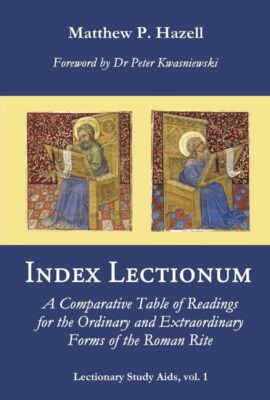 For the readings of the Vetus Ordo…
He now has another published by Os Iusti
The Post-Vatican II Reform of the Lectionary: The Schemata of Group XI
Translated, with an Introduction, by Matthew P. Hazel
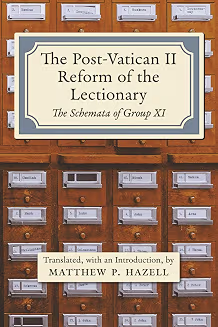
I won’t go into the weeds with this. It is an important book, but not for everyone. It isn’t light reading. However it get’s you into the mind of the engineers of the massive rupture in the post-Conciliar liturgy which we are still sorting out today.
That said, here is a little excerpt from the Introduction which caught my eye on p. xxii:
Each coetus [scholarly committee] had a relator and a secretary, along with several consultors as members, as well as advisors who worked either on a regular or occasional basis for the coetus depending on their availability. Various schemata relating to the work of each study group would be drafted, consulted on, discussed,
redrafted, and so on as necessary. When a schema was deemed to be ready, it
would be discussed at a meeting of all the relators (the coetus relatores) and,
if necessary, be sent back to the study group for redrafting or to incorporate
the suggestions of the relators. Finally, the fully-prepared schemata would be
presented to the Fathers of the Consilium for their examination and voting,
then to the Holy Father for definitive approval, promulgated, and published.
This method of working was, in principle, thorough and well-organised.
It has, however, come under some severe criticism over the decades that
followed, including from those who were themselves involved in the work
of the Consilium and came to view its secretary in particular as a deleterious
influence on the reforms. In his memoirs, Rev Fr Boniface Luykx, appointed
as a consultor in May 1964, had this to say about Bugnini:
He seemed to me very impressionable: if someone pushed him one way, he
went that way; if someone pushed him the other way, he went there instead.
But Father Bugnini was also a politician, and one who wanted power. In
order to gain power he had to appear successful, so he went along with those
who were the most vocal and apparently powerful. He was heavily influenced
by those who broke from fidelity to [Sacrosanctum Concilium]… Before long,
Bugnini stopped inviting to the meetings those “reactionary” members who
dared to adhere to the text of [the Constitution] or to sound principles
of religious anthropology. . .
[I]t became apparent that his opinion about the supremacy and normative value of modern Western man was part of his agenda —and consequently part of the agenda of the Consilium’s subcommissions he oversaw.
It is also worth noting that the Consilium’s working method was designed at the
outset to garner consensus quickly; Bugnini himself was quite open about this.
This had the clear benefit of accelerating the process, but did not encourage the
kind of careful, detailed and patient study of questions that, in hindsight, was
perhaps necessary for large parts of the liturgical reform. Luykx also questions
how much oversight and scrutiny the Fathers of the Consilium really had over the
many schemata given to them by ‘experts’ at meetings with very tight timescales.
Bugnini… arch-criminal of the post-Conciliar reform.































Tangentially, it caught my eye on the Feast of St. Pius X – which uses the Bea Psalter for its Propers – that the Graduale begins “Annuntiavi iustitiam in coetu magno” where Psalm 39:10 in both Roman and Vulgate Psalters reads “Annuntiavi justitiam tuam in ecclesia magna”.
I hope someone told Bugnini before he died that the last person out of Purgatory is supposed to sweep up all the ashes, turn off the lights, and shut the door behind him.
How long must we labor under Bugnini’s corruptions as if they were divinely inspired? How long must we keep playing the game that it’s just the interpretation that we have wrong and really everything else was wonderful? Even worse, we are repeating the same chicanery in the name of synodality.
I think only Our Lord Himself will correct what is wrong.
When one looks at the process and the grave deficiencies in the results (like the parts of Sacred Scripture that were left out of the lectionary cycles, for Reasons), one can only be filled with anger and horror.
OTOH, because God is good and His Word never goes out without effect, it cannot be denied that the current lectionary cycles have had good or even miraculous effects on many individuals.
Those experts who participated honestly, and the merits of the Church herself, have overall made the new Lectionary beautiful and useful. But it still cuts off a good chunk of the Church from the love and care put into the lectionary cycle used in the past.
And where non-Catholic groups have shifted to the new cycles and away from their own old lectionary cycles (which came from Catholicism originally), they have also been drawn away further from their Catholic roots. So even when they read literature from their own past, which references their own liturgical year, they have to deal with the same disconnection, be it good or bad.
I think a lot can be done to soften what is bad, emphasize the good, and reconnect to what remains of lectionary continuity.
For example, use of the propers helps a lot. Chant at the beginning of Mass sets the tone, and chant at Communion time is also a great thing. The Psalms sing for us and with us.
I also think that religious education needs to talk more about how personal devotion and an attitude of assisting the Sacrifice and offering our hearts, is as important to Mass as “paying attention.”
Some kids and adults naturally enter into Mass in this way, and some get in trouble for it. Yes, even now.
For those who like it, I think that studying Mass readings before Mass takes a lot of didacticism out of Mass itself. If you have already looked at the part, you can enter into the whole in a less intellectual way.
Also Latin and Greek are really helpful for anybody wanting to worship God intellectually, because the languages explain a lot of “problems” in how Mass fits together and in the readings and propers.
I also think that, with all its faults or weird changes, the Liturgy of the Hours is good where it is used and sung, even if the Divine Office is better when used and sung.
I attribute this to the mercy of God and His Sacred Scripture, as well as to the merits of the holy people used for non-Scripture readings and hymns.
The resurgence in lay use of both is a good thing, especially when we use chant.
Sorry for writing so much.
Interesting. I am not an expert as to give an opinion about lectionaries, but if someone asks me my opinion, there are things that I do not understand.
The responsorial Psalm in the Mass, since the council asked to avoid repetitions, and I do not like the way in which the Psalm is broken in pieces.
Some first readings are super super long, like the one of Susanna and others. I do not know which would be the longest reading in the vetus ordo.
SMOKE OF SATAN!
Duuuuude! The Susanna reading is the BEST! I go to church on a weekday especially for the boy detective reading! Even when I forget to check, I find myself there for it! St. Daniel and St. Susanna are awesome!
@Suburbanbanshee
Not the only one superlong reading.
I understand during ordinary time it is easier to change readings, if votive Masses are used, but for lent, not possible. But maybe for “pastoral reasons” everything is possible. I would like to read just the last paragraph of the reading, and tell the people to read the rest of the novel at home.
ordo novus = ordo temporalis
ordo vetus (antiquor) = ordo perpetuus.
The New Mass is counterfeit. Its proponents are playing keep-away to run out the clock – hoping most ordo perpetuus adherents will die off unsucceeded.
It’s startling to think that the mere re-translation of the modern missal took a solid ten years (if we date things from the issuance of Liturgiam Authenticam in 2001 to the new translation coming into effect in 2011), and the re-translation of the other liturgical books has taken far longer (we’ll finally have the new Liturgy of the Hours translation in Lent 2027).
Meanwhile, the entirety of the 1969 Missal was assembled, translated, published and put into effect within 6 years from Sacrosanctum Concilium (12/1963) to the N.O. coming into effect (Advent 1969). The new Liturgy of the Hours and most of the other books were finished within another 3 years. As you/Hazell say, Father, it speaks to the haste with which the reformers worked, to try to gather consensus quickly before too many nosy people asked too many uncomfortable questions.
Say a prayer for the good people at the two churches run by the Toronto Oratory, who *thanks to Rome* are having 1 Sunday mass a month converted to the Novus Ordo (no doubt step 1 of their gradual “accompaniment” to the new mass).
How will that work out with the lectionary and calendar? So Synodal!
Bugnini sits next to Luther in the halls of the persecutors of the Church.