
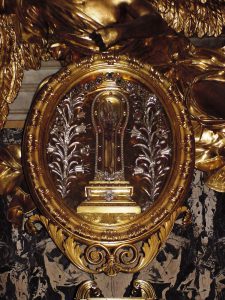
The arm of St. Francis Xavier
Today, 5 November, in our traditional liturgical calendars, we find a feast which might surprise many Catholics: the Feast of the Holy Relics.
No, this is not a special day set aside to celebrate your aging pastor, although some of them may seem to qualify.
A relic, from Latin reliquiae, “remains”, is a tangible connection with a saint or blessed. First class relics are bodily remains, such as bones, hair, blood, or ashes. Second class relics are objects personally used or worn by the saint, such as clothing, books, or instruments of martyrdom. Third class relics are objects, usually pieces of cloth or holy cards, rosaries, touched to a first class relic or a saint’s tomb. Relics of Our Lord’s Passion, such as fragments of the True Cross, occupy a special place of honor.
Authentic relics deserve reverent treatment, never commercial exploitation. Alas, one does see that.
As far as concerns this feast, look in the back of an older Missal, among the Masses pro aliquibus locis, “for certain places”. There you may find the formulary Multae tribulationes, a Mass with red vestments in honor of the sacred relics preserved in churches, dioceses and religious communities. The feast was celebrated on various dates according to local calendars, frequently on 5 November. It never belonged to the universal Roman calendar as an obligatory observance.
Some context.
During November, Holy Mother Church directs our attention to prayer for the dead and the Four Last Things. We have just celebrated All Saints and All Souls. On the former we looked toward Heaven and the glory of those who have attained their eternal reward. On the later we prayed for those who have died in God’s friendship but who still require purification. Now, with the Feast of Holy Relics, we turn our attention to the earthly remains of the saints, whose souls enjoy the Beatific Vision while their bodies await the general resurrection.
While I outlined, above, that there are different “levels” of relics, and that even among the first class relics there are different kinds, I’ll focus for a moment on… bones.
The Introit of this special Mass begins with Psalm 33 (34):
Multae tribulationes justorum, et de his omnibus liberabit eos Dominus: Dominus custodit omnia ossa eorum: unum ex his non conteretur.
Many are the afflictions of the just, and out of them all the Lord will deliver them. The Lord guards all their bones; not one of them shall be broken.
“Wait a minute”, you might be thinking, “The saints certainly suffered. Some were tortured, mutilated, burned, beheaded, exposed to wild beasts. Their bones were broken, their bodies destroyed, their ashes scattered. Yet the Psalm proclaims that God guards their bones. How can this be?”
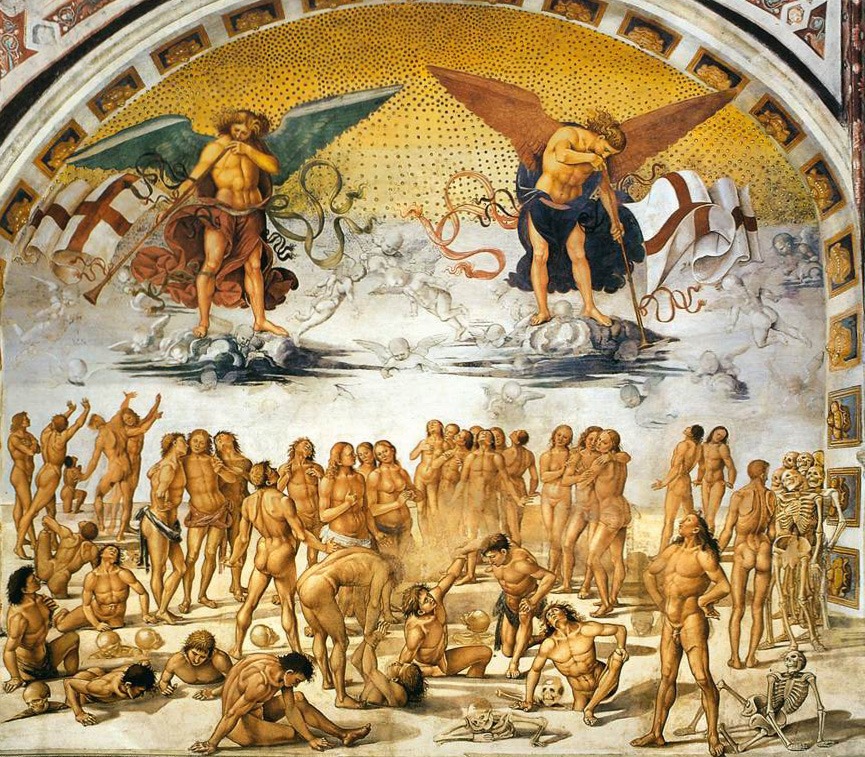
The answer is found, I think, in the resurrection of the dead. No violence done to a martyr’s body, no decomposition in the grave, no scattering of ashes can frustrate Almighty God. What men destroy, God can restore. The body which was the instrument of a saint’s fidelity, which fasted, prayed, labored, suffered and received Holy Communion, remains destined for glory. In the general Resurrection, our souls (the form) will once again inform a body (the matter). What was seemingly destroyed shall rise again. I have in mind the incredible fresco in the Cathedral of Orvieto in which Signorelli depicts the rising righteous drawing their new bodies out of a perfectly flat white plain (prime matter, waiting to be informed). They start as bones, skeletons and are enfleshed anew as perfect 33-year olds (the years of Jesus on Earth).
With that in mind, here is the…
COLLECT
Auge in nobis, Domine, resurrectionis fidem,
qui in Sanctorum tuorum reliquiis mirabilia operaris:
et fac nos immortalis gloriae participes,
cuius in eorum cineribus pignora veneramur.
LITERAL VERSION:
O Lord, increase in us faith in the resurrection,
You who work wonders through the relics of Your Saints,
and enable us to be sharers in immortal glory,
the pledges of which we venerate in their ashes.
The imperative auge is from augeo, “to increase, enlarge, augment”. Wit polite boldness we ask God to increase our faith specifically in the Resurrection. We readily profess in the Creed, “I await the Resurrection of the dead.”
That’s an article of the Creed. It might be a good idea to reflect on what it means.
The Collect gives the reason for our confidence: God is working wonders in the relics of His saints. The verb operaris is present tense. God is working. The souls of saints have departed this earthly life, but God’s power remains active. Their bodily remains can become instruments through which His goodness is manifested.
The petition of the Collect is that we ask to share in “immortal glory”, of which we venerate pignora in the ashes of the saints.
Pignus, plural pignora, means “a pledge, something given as a guarantee of future fulfillment”. A holy relic of a saint is a pledge of the Resurrection. We reverence these remains because of what God has promised to accomplish. The bones of the saints (as well as other kinds of relics) point like a pledge beyond the grave toward the glory which awaits the whole person, body and soul.
Note the contrast between cineribus, “ashes”, and immortalis gloriae, “immortal glory”. The most apparently perishable, indeed already perished things are through the eyes of faith signs of what cannot perish.
Our secularized “culture” is uncomfortable with death. We disguise it, sanitize it, remove it from ordinary sight. We prefer celebrations of life to the sober Christian recognition of death, judgment and eternity. Think about how graveside rites usually cover over the waiting dirt pile.
The Church, meanwhile, puts a bone of a dead person – sometimes the entire remains – in a golden reliquary, surrounds it with candles, incenses it, and invites us to kneel.
Which approach takes the human body more seriously?
One modern view of the body is that it is just a vehicle I ride around in, something I own, like a car. I can do what I want to the thing I own. It’s not really “me” after all. Right? The problem with that is that if your body isn’t really you and it is something you can “own” and do with as you please, then so can someone else. After all, it’s not really “you”, right? If someone wants to do terrible things to you, well… too bad. It’s not really…. “you”. No. We humans are both soul and body. I am my body, also. Hence we can never mistreat the bodies of others (at least the innocent). Bodies reflect the image of God, who works His mighty will through us.
Scripture teaches us that God works through material things. In 4 Kings 13:21 (2 Kings in modern numbering), a dead man is restored to life when his body touches the bones of the prophet Elisha. In Acts 19:11-12, cloths which had touched St. Paul were brought to the sick, who were healed. In Acts 5:15, the sick were placed where even St. Peter’s passing shadow might fall upon them.
Our religion is incarnational. God took flesh. The Eternal Word entered our material world and made use of material realities to communicate divine life. Water becomes the instrument of baptismal regeneration. Oil is used in Confirmation and Anointing. The Eucharistic Lord gives us His true Body and Blood under the appearances of bread and wine.
The veneration of relics makes perfect sense within this sacramental, incarnational framework.
The Council of Trent (25th Session), taught that the bodies of the saints, once living members of Christ and temples of the Holy Ghost, are destined to be raised and glorified. Therefore they are rightly venerated. God bestows many benefits upon men through them.
The honor given to saints and their relics is veneratio, not the latria reserved to the Most Holy Trinity. We adore God alone. Relics possess no magical power independent from God. God is the source of every grace and authentic miracle. Nor should genuine devotion be confused with indiscriminate enthusiasm for every purported relic that turns up on the internet. BEWARE of “trafficking” in relics, which, if they are real is sacrilege and if false is blasphemous. “Trafficking” creates a self-perpetuating market.
Since I write this on my last full day in Rome, there is a particularly Roman dimension to this Feast of Holy Relics.
Rome is filled with relics. Beneath its altars lie martyrs who shed their blood for Christ. In its churches we encounter the mortal remains of apostles, popes, confessors and virgins whose lives shaped Christendom. From where I sit as I write this, within a, say, 15 minute walk there are the tombs of dozens of saints, well-known, and literally thousands of reliquaries. To focus on just one aspect of church’s here, most of them have side altars. Your parish church may have as well. If consecrated, they have relics in them, sometimes whole bodies. Otherwise, there will be an altar stone for the celebration of Mass containing a relic.
The ancient custom of celebrating Mass over the tombs of martyrs, and subsequently placing relics within altars, unites the Sacrifice of Christ with the witness of those who followed Him even unto death.
Considered just from this characteristic, the altar itself is a sermon.
Which … when we see some modern altars makes you wonder what they who built it believe.
At Santissima Trinità dei Pellegrini here in Rome, The Parish™, there is a beautiful custom of solemnly exposing the relics preserved in the church around the time of All Saints. I have previously written about this and provided video of the ceremony. I have video from this year, too, but I have to wait to get back to the USA to edit it together. The relics are brought forward and presented to the faithful, with the saints identified as the reliquaries are displayed.
It is an impressive reminder of the Communion of Saints. In relics, our communion with the heavenly blessed is made more tangible, a pledge (pignus) that it is attainable.
How many parishes possess relics which have languished for decades in cupboards, sacristy drawers or forgotten cabinets? These venerable treasures should once again be displayed reverently, accompanied by sound catechesis. A parish – convent – diocese – entrusted with relics has a responsibility to preserve and honor them. If the relics are not in good repair, they can be repaired but ONLY by someone who knows what he is doing and has the backing and oversight of proper authority, such as the diocesan bishop. Do NOT fiddle around with reliquaries on your own, except, perhaps to give them a little cleaning. Do NOT open them up.
I digress.
There are some practical considerations that flow from this feast and from veneration of relics in general.
When you venerate a relic, remember that the saint whose remains are before you was once as you are now. He fought temptations. She struggled with distractions in prayer. They experienced fatigue, discouragement, fear, physical suffering and the difficulties of living faithfully their state of life in a fallen world. Their sanctity was accomplished through cooperation with grace amid the ordinary circumstances of human life. Some of them in a flash evidenced through grace heroic virtues in the moment of their martyrdom.
Their bodies were instruments of that cooperation.
Our bodies, too, are meant to serve God. The hands with which we work, the eyes with which we look upon the world, the knees upon which we pray, the tongue with which we receive the Blessed Sacrament, all are destined, if we persevere in grace, to share in the glory of the resurrection. In one of those churches near to where I sit, the Gesù, there is the arm of St. Francis Xavier, the spectacular Jesuit missionary. When you see that arm, you see beyond it also to the thousands of converts who were baptized by it. In another direction, at San Salvatore in Lauro, is the arm of the Apostle St. Jude, patron of impossible causes…again, probably not your aging relic of a pastor. All things are possible with God according to His will.
These remains preserved in reliquaries remind us that God’s promises are trustworthy.
You might ask your parish priests if your parish possesses relics. Ask if they can be exposed for veneration on an appropriate occasions. Learn about the saints whose relics are preserved there. Teach your children why we honor these sacred remains. Perhaps you might make a pilgrimage to visit the tomb of a saint or a well-known relic near where you are when you have the opportunity, and ask for his intercession.
Moreover, as the Collect for the Feast of Holy Relics prompts, pray for an increase in faith in the resurrection:
Increase in us, O Lord, faith in the Resurrection.
I wonder, in the face of all the truly alarming, sometimes horrifying things going on in the secular world but also, it must be said, in the Church, an increase precisely in belief in the Resurrection – pledged by God – might not be at least in part both a shield and a field dressing for us of the Church Militant. Those who are faithful to Christ have a future far more glorious than the grave, making less burdensome the vicissitudes of this life.



 jhogan on Germans… “for many” in the Consecration formula, rather than “for all”: “I find it curious that the German bishops are apparently not considered in schism for changing the actual form (words)…”




























