
17–23 December, at Vespers, before and after the Magnificat
The O Antiphons developed during the Church’s very first centuries. The writer Boethius (+525) mentions them. By the 8th century they were in use in Rome. There are seven of these special antiphons, and their texts spring from the Old Testament Hebrew Scriptures, the Prophetic and Wisdom Books. They are found in the Liturgy of the Hours or older Roman Breviary, which clerics, religious, consecrated virgins, and others use for daily prayer.
The O Antiphons are short prayers sung before and after the Magnificat, the great prayer of Mary in Luke 1:46-55 when coming visit to Elizabeth her cousin the Virgin praised God for His favor wondrous deeds. The Magnificat is sung during Vespers, evening prayer. The O Antiphons begin on 17 December, seven days before the Vigil of Christmas (24 December). The seventh and last antiphon is sung at Vespers on 23 December. They are called the “O Antiphons” because they all begin with the letter-word “O”: they address Jesus by one of His Old Testament titles. They are fervent prayers asking Our Lord to come to us.
Advent is about the many ways in which the Lord comes. He came historically at Bethlehem in the fullness of time. In the liturgical year he comes to us sacramentally. He will come again at the end of the world as Judge of the living and the dead. Christ comes to us also in the two-fold consecration of the Body and Blood of Christ by the priest at Holy Mass and, in a special way in a good Holy Communion. He comes in the person of the priest, who is alter Christus, another Christ. He comes in the words of Holy Scripture. He also comes in the person of our neighbor, especially those who are in need of the spiritual and corporal works of mercy.
During Advent, John the Baptist has been reminding us in the liturgy to “make straight His paths”. When we come to the Lord in death, or He comes to us in His Second Coming, He will make straight the path whether we have during our earthly lives done our best to straighten it ahead of time or not. Let us now, while we may, make straight the paths by which Christ Jesus comes.
Here are two more interesting notes about these O Antiphons.
The song “O Come, O Come, Emmanuel” is simply a reworking of the seven O Antiphons. When you sing it, you are joining yourself to a vast throng of Christians stretching back across centuries and spanning the whole of the earth who prayed as all Christians do, “Come, Lord Jesus!” (Rev 22:20)
O Sapientia
Latin
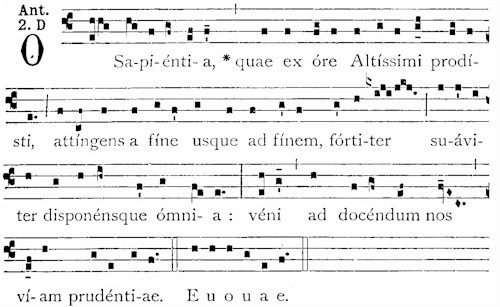
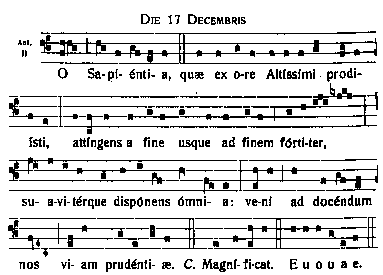
O Sapientia, quae ex ore Altissimi prodidisti, attingens a fine usque ad finem, fortiter suaviter disponensque omnia: veni ad docendum nos viam prudentiae.
English
O Wisdom, who came from the mouth of the Most High, reaching from end to end and ordering all things mightily and sweetly: come, and teach us the way of prudence.
Listen: the chant from the Liber Usualis
Scripture
Proverbs 1:20; 8; 9
I Corinthians 1:30
Veni, Veni Emmanuel
O come, O Wisdom from on high,
who orders all things mightily,
to us the path of knowledge show,
and teach us in her ways to go.
Reflection
On December 17th we enter into that final stretch of our Advent preparation. In the Church’s solemn prayer of the hours, at Vespers, the great “O Antiphons” are sung. Today we have the first.
The Son is Eternal. There was never a time when He was not. Through Him all things were made. Through Him order was given to the primal chaos. Thus, the marvelous and sweet order we observe in the universe is due to the eternal wisdom of the eternal Word. That same well-ordering eternal Word is the Word made flesh, who dwell among us beginning with His coming birth at Bethlehem.
Each of the “O Antiphons” carries Old Testament biblical figures. At the same time each one carries an element of the New Covent. These two characteristics are juxtaposed and a third dimension emerges which serves as a point of meditation when considering the Incarnate Word, the Son of God made flesh.
In today’s “O Antiphon” – “O Sapientia” – we are drawn into the Old Testament’s wisdom literature. Wisdom is a divine attribute. The divine Wisdom is personified. Wisdom is the beloved daughter who was before Creation, Wisdom is the breath of God’s power, Wisdom is the shining of God’s (transforming) glory. (See Sirach 24:3 and Wisdom 8:1.)
Wisdom is also something which we deeply desire. It is also a human attribute, not just a divine attribute, though authentic human wisdom is never separated from a relationship with God. Fear of the Lord is the beginning of wisdom, as we learn from the psalms as well as the school of personal hard-knocks. From this convergence of awesome respect for God with the experience of learning through life’s mysterious calendar, we understand (if we are wise) that wisdom is more than mere knowledge. It is something more than love. It is something more than just a special astuteness regarding how to get along in life, a certain kind of savoir faire. Rooted as it is in fear of the Lord, true human wisdom is both love and that knowledge of God that seeks to understand, the knowledge that is completed by faith.
The Prologue of John’s Gospel refers to the “Verbum caro factum...the Word made flesh”. He is the divine Logos… the eternal thought/word/reason. Through Him all things were made. Without Him nothing can be. So, the New Testament image in the Prologue of John brings to completion the imagery of Wisdom. He, the Word, is the archetype of the material universe. All things are ordered in and to Him.
Our lives, to be happy, need order. Our individual private lives and our collective lives in larger society must have structure and order. They must be disposed in such a way that the real and genuine good of all is fostered and promoted. Thus, in human governance we struggle to find the proper balance of exercise of power (without which governance and order is not possible) and gentle concern for the individual and community (without which there is mere imposition and tyranny and exploitation for some end material or ideological). Wisdom permits the balance of these.
This first “O Antiphon” shows us the Creator of all that is invisible and visible, the whole of spiritual and material creation. It is moving according to an eternally disposed plan of divine Providence toward an inexorable end: that God may be all in all. In this end the blessed elect will participate. We have had the way opened for us toward this end by the Word (divine) made flesh (human). Our humanity now sits in transformed glory at the right hand of the Father in an indestructible bond with the Son’s divinity. The risen Christ is the new Adam…the new Creation. With unspeakable sweetness He orders our salvation. With irresistible power all things exist and move according to His will. Our lives have meaning only in Him, according to His guidance, who handles us “suaviter et fortiter“.
Our Old Testament and New Testament figures and images merge into a new point of reflection for our lives which today’s “O Antiphon” underscores as “prudence” – “Come…Teach us the way of prudence!”
“Prudence” comes from the Latin “to see/look ahead”. It is one of the four “cardinal” virtues, one which other virtues depend. Prudence is a habit of the intellect that allows us to see in any circumstance what is virtuous and what is not. Prudence helps us to seek what is virtuous and avoid what is not. Prudence perfects the intellect (rather than the will) in practical decisions. It determines which course of action must be taken. It indicates what the golden mean is hic et nunc…here and now. This mean is at the core of every virtue. Without the virtue of prudence courage becomes foolhardiness… rushing in to the wrong danger in the wrong way at the wrong time. Without the governing of prudence mercy devolves into slackness and enervated weakness, spinelessness.
But this is still a kind of prudence which is merely human prudence, not looking beyond the issues of daily life. We must also look beyond this vale of tears. In addition to the prudence which grows out of the school of hard-knocks and which becomes a sound and good habit through repeated acts, there is another prudence, an “infused” prudence. This kind of prudence is a grace given us by God out of His merciful love. This greater prudence, which governs other grace-filled virtues, cannot be separated from the life of grace. It is exercised in the state of grace. Mortal sin is its enemy. This higher kind of prudence helps us to determine the proper things that help us to salvation. It helps us to avoid things that slam the door that Christ opened (mortal sin). Thus, prudence cannot be separated from charity, which is in the soul as a characteristic of sanctifying (habitual) grace.
Today in the opening “O Antiphon” we sing to Emmanuel who is coming. We plead with Him, for He orders all things “sweetly and strongly.” He teaches us how to avoid things that harm us, both in material concerns and in our pursuit of the happiness of heaven. He teaches us true prudence.
Take stock: is there something going on in my life that needs to be examined in prudence? Am I doing something which is going to be an obstacle to the happiness of heaven? Christ is coming, both at Christmas as the infant King and the end of the world as the Judge and King of fearful majesty. This is a cause to rejoice. But it is also cause to prepare prudently and well the way of the Lord and make straight His paths before He comes, as we heard about on “Gaudete” (“Rejoice!) Sunday of Advent.
O Adonai
Latin
O Adonai, et Dux domus Israel, qui Moysi in igne flammae rubi apparuisti, et ei in Sina legem dedisti: veni ad redimendum nos in brachio extento.
English
O Lord and Ruler the house of Israel, who appeared to Moses in the flame of the burning bush and gave him the law on Sinai: come, and redeem us with outstretched arms.
Listen: the chant from the Liber Usualis
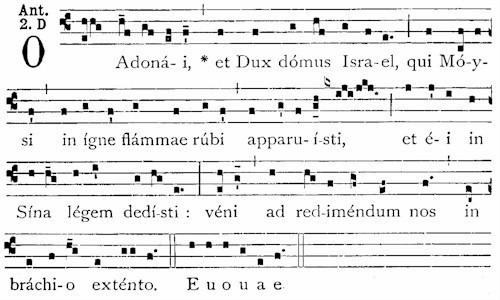
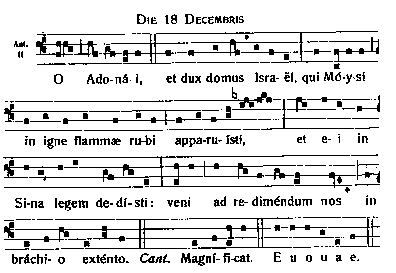
Scripture
Exodus 3
Micah 5:2
Matthew 2:6
Veni, Veni Emmanuel
O come, O come, thou Lord of might,
Who to Thy tribes on Sinai’s height
In ancient times didst give the law
In cloud and majesty, and awe.
Reflection
“Adonai” is “LORD.” It was the Hebrew word that the Jews used when they found the four-lettered word for God’s name which they held to be too sacred to pronounce aloud. Christ is Lord of Creation. We sang this yesterday in the antiphon “O Sapientia“. Christ is also Lord of the Covenant with the People He chose. The Lord made covenants with Noah, Abraham, and Moses. He guided them and all the People. He gave them Law. He protected and feed them. The Lord delivered them from bondage to Pharaoh and unending slavery. He went before them with arm outstretched.
This was all a pre-figuring of the great work of redemptions that Christ would work on the Cross. He redeemed us His People from Satan and the eternal damnation of hell. He once appeared clothed in the burning bush that was not consumed by fire. He is about to appear again clothed in flesh in our liturgical celebration of Christmas. He will appear again one day in the future to judge the living and the dead. Each day He appears to us in the person of our neighbor.
What amazing contrasts we find in our Lord! He came in thunder and lightening to give the Law on Mt. Sinai. He comes now in swaddling clothes. He will come again in glory. He comes humbly in the appearance of Bread and Wine.
He still goes before us with outstretched arm and our foes are put to flight at the sight of His banner.
O Radix Jesse
Latin
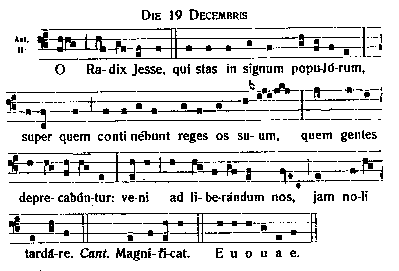
O Radix Jesse, qui stas in signum populorum, super quem continebunt reges os suum, quem gentes deprecabuntur: veni ad liberandum nos, iam noli tardare.
English
O Root of Jesse, that stands for an ensign of the people, before whom the kings keep silence and unto whom the Gentiles shall make supplication: come, to deliver us, and tarry not.
Listen: the chant from the Liber Usualis
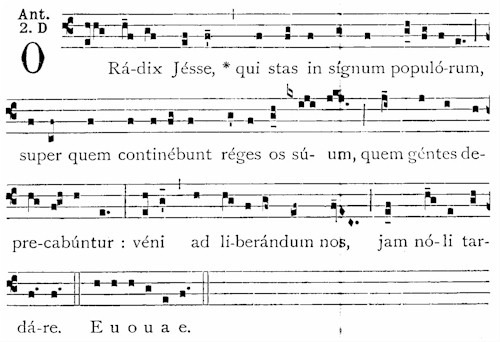
Scripture
Isaiah 11:10
Romans 15:12
Revelation 5:5
Veni, Veni Emmanuel
O come, O Rod of Jesse free,
Thine own from Satan’s tyranny;
From depths of hell Thy people save,
And give them victory o’er the grave.
Reflection
What urgency there is this antiphon. Something that lies below the earth – a root – sends out through a cloven stump, shorn to the ground, a shoot which stretches high unto the heavens like a banner! Vexilia Regis Prodeunt we sing in Lent. What is a little root during Advent becomes by Lent the Tree of our salvation. Isaiah 11:10 gives us imagery for our reflection today. The great prophet of Advent tells us that the kingdom of David would be destroyed, but not entirely destroyed. A root would remain. Jesse is David’s father. David is the shoot from Jesse’s root. David shoots through the generations to Christ. After destruction there remains a root. No matter what the exigencies of life present to us or how turbulent the vicissitudes of the passing world may be, when we cling to the root we are sure to be victorious in the end.
O Clavis David
Latin
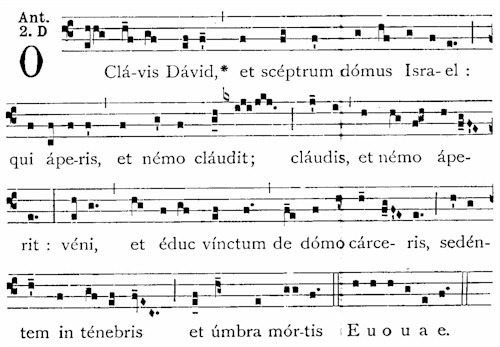
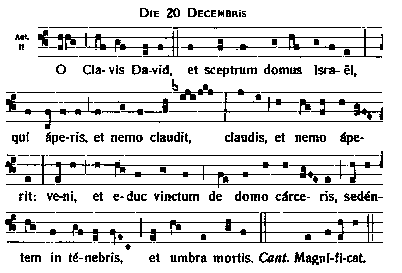
O clavis David, et sceptrum domus Israel: qui aperis, et nemo claudit; claudis, et nemo aperit: veni, et educ vinctum de domo carceris, sedentem in tenebris.
English
O Key of David, and scepter of the house of Israel, who opens and no man shuts, who shuts and no man opens: come, and lead forth the captive who sits in the shadows from his prison.
Listen: the chant from the Liber Usualis
Scripture
Isaiah 22:22
Revelation 3:7
Veni, Veni Emmanuel
O come, thou Key of David, come,
And open wide our heavenly home;
Make safe the way that leads on high,
And close the path to misery.
Reflection
What solace there is this antiphon.
In the 8th century BC King Hezekiah saw troubled times. Sargon the Assyrian invaded. Sennnacherib invaded. You might know the poem of Byron: “The Assyrian came down like the wolf on the fold, / And his cohorts were gleaming in purple and gold…”. They were saved by the Angel who smote the invaders with the plague and slew 185,000 in the night. Hezekiah instituted a religious renewal, which included the suppression of idolatry and polytheism which had grown up over time. Hezekiah, a descendent of David, is a foreshadow figure of Christ to come. Hezekiah cleansed the Temple. Hezekiah rose from a dire illness on the third day. Hezekiah gives the “key of David” to his steward Eliakim, all his authority, as an office to be handed on.
In Isaiah 22:22:
And I will lay the key of the house of David upon his shoulder: and he shall open, and none shall shut: and he shall shut, and none shall open.
Government shall be upon his shoulder.
In Matthew 6:19, when the Lord speaks to Peter near the source of the Jordan, we read:
And I will give to thee the keys of the kingdom of heaven. And whatsoever thou shalt bind upon earth, it shall be bound also in heaven: and whatsoever thou shalt loose on earth, it shall be loosed also in heaven.
David’s key is again mentioned in Revelation 3:7-8:
And to the angel of the church of Philadelphia write: These things saith the Holy One and the true one, he that hath the key of David, he that openeth and no man shutteth, shutteth and no man openeth: I know thy works. Behold, I have given before thee a door opened, which no man can shut: because thou hast a little strength and hast kept my word and hast not denied my name.
Like the Philadelphians in Revelation 3, we must never deny the Lord.
The Lord who came in history, will come again at history’s end. To point the way to His return, He gave us a visible point of reference, someone to exercise His own authority to open and to shut, to bind and to loose. He gave us His Church with a Vicar in the person of the Apostle Peter and all of Peter’s successors. The key is David’s, which means, it is the Lord’s. And that means that the one who has the keys, acts with Christ’s authority, speaks with Christ’s voice when he acts and teaches for the Church.
When the Lord died on His Cross and rose again, He fulfilled the debt incurred in the sin of the whole human race. He ransomed “captive Israel”, the new “Israel”, those who belong to Him in His new covenant. The Lord descended to the place where the faithful dead awaited His coming and set them free. This is often depicted as the “harrowing of hell”. When we are in mortal sin, we are already in an anticipation of hell. Christ can set you free through the sacramental confession of your sins to a priest, who unbinds your sins and forgives them with Christ’s own authority.
O Oriens

Latin
O Oriens, splendor lucis aeternae, et sol iustitiae: veni, et illumina sedentes in tenebris et umbra mortis.
English
O dawn of the east, brightness of light eternal, and sun of justice: come, and enlighten those who sit in darkness and in the shadow of death.
Listen: the chant from the Liber Usualis
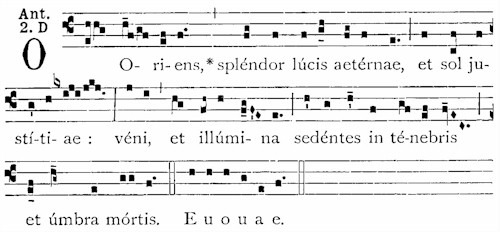
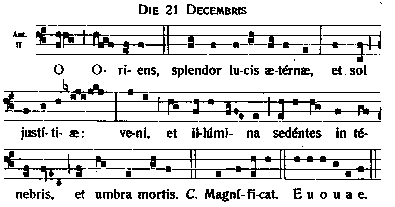
Scripture
Luke 1:78, 79
Malachi 4:2
Veni, Veni Emmanuel
O come, Thou Dayspring, come and cheer,
Our spirits by Thine advent here;
Disperse the gloomy clouds of night,
And death’s dark shadows put to flight.
Reflection
We are all desperately in need of a Savior, a Redeemer who is capable of ransoming from the darkness of our sins and from the blinding and numbing wound of ignorance from which we all suffer. In their terrible Fall, our First Parents inflicted grave wounds in the souls of every person who would live after them, except of course – by an act of singular grace – the Mother of God. Our wills are damaged. Our intellect is clouded. In Christ we have the Truth, the sure foundation of what is lasting. All else, apart from Him fails and fades into dark obscurity. He brings clarity and light back to our souls when we are baptized or when we return to Him through the sacrament of penance.
At Holy Mass of the ancient Church, Christians would face “East”, at least symbolically, so that they could greet the Coming of the Savior, both in the consecration of the bread and wine and in the expectation of the glorious return of the King of Glory. They turned to the rising sun who is Justice Itself, whose light will lay bare the truth of our every word, thought and deed in the Final Day.
This is the Solstice day, for the Northern Hemisphere the day which provides us with the least daylight of the year. From this point onward in the globe’s majestic arc about the sun, we of the north, benefit from increasing warmth and illumination. It is as if God in His Wisdom, provided within the framework of the cosmos object lessons by which we might come to grasp something of His good plan for our salvation.
Let us turn to the LIGHT, repent our evil ways and habits, and grasp onto Christ in His Holy Church, for as we read in Scripture:
“For God so loved the world that he gave his only Son, that whoever believes in him should not perish but have eternal life. For God sent the Son into the world, not to condemn the world, but that the world might be saved through him. He who believes in him is not condemned; he who does not believe is condemned already, because he has not believed in the name of the only Son of God. And this is the judgment, that the light has come into the world, and men loved darkness rather than light, because their deeds were evil. For every one who does evil hates the light, and does not come to the light, lest his deeds should be exposed.
But he who does what is true comes to the light, that it may be clearly seen that his deeds have been wrought in God.”
John 3:16-21 (RSV)
O Rex Gentium

Latin
O Rex gentium, et desideratus earum, lapisque angularis, qui facis utraque unum: veni, et salva hominem, quem de limo formasti.
English
O King of the gentiles and their desired One, the cornerstone that makes both one: come, and deliver man, whom you formed out of the dust of the earth.
Listen: the chant from the Liber Usualis
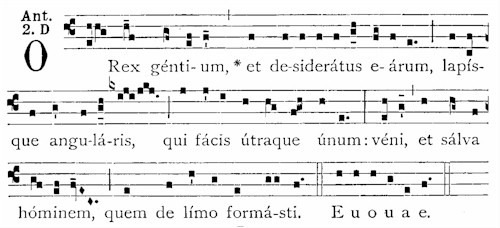
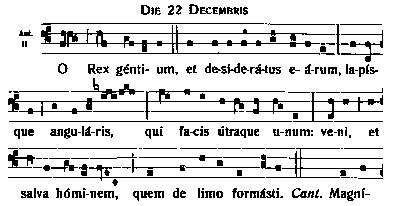
Scripture
Revelation 15:3
Psalm 118:22
Isaiah 28:16
Matthew 21:42
Mark 12:10
Luke 20:17
Acts 4:11
Ephesians 2:20
I Peter 2:6
Veni, Veni Emmanuel
O come, Desire of nations, bind,
In one the hearts of all mankind;
Bid Thou our sad divisions cease,
And be Thyself our King of peace.
Reflection
One of the reasons why Christ was so angry with the people who had set up shop in the Temple, whose tables he overturned and whom he drove out, was not just because they were doing business in the sacred place, but they had taken over the Courtyard of the Gentiles. It was where Gentiles could enter and even pray to the One God. It had been prophesied that when the Gentiles came to worship the God, that would be the hour when the Messiah would manifest. But, with the place filled with tables, the Gentiles had no place. When in John 20, Gentiles approach an Apostle with a Greek, not Jewish, name, Philip, and the Lord hears from him that they want to see Him, the Lord’s response is solemn (vv. 23-32):
“The hour has come for the Son of man to be glorified. Truly, truly, I say to you, unless a grain of wheat falls into the earth and dies, it remains alone; but if it dies, it bears much fruit. He who loves his life loses it, and he who hates his life in this world will keep it for eternal life. If any one serves me, he must follow me; and where I am, there shall my servant be also; if any one serves me, the Father will honor him. “Now is my soul troubled. And what shall I say? ‘Father, save me from this hour’? No, for this purpose I have come to this hour. Father, glorify thy name.” Then a voice came from heaven, “I have glorified it, and I will glorify it again.” The crowd standing by heard it and said that it had thundered. Others said, “An angel has spoken to him.” Jesus answered, “This voice has come for your sake, not for mine. Now is the judgment of this world, now shall the ruler of this world be cast out; and I, when I am lifted up from the earth, will draw all men to myself.”
In the Gospel of John and in the writings of Paul, Christ is the one to bring the Gentiles, the Nations, into a single thing with the Jews. He did this through the Incarnation, whereby He took our humanity into an indestructible bond with His divinity. He took our humanity, our body formed from the mire, from the Latin limus and mortared together the two groups in Himself as the connection point (Is 28:16). Above the King of the Nations (Jer 10:7), on the royal Vexilla of the Cross, what shall we read on Good Friday? That the King of the Nations is “King of the Jews”. He tore down the wall between them so as to build them anew into one.
O Emmanuel

Latin
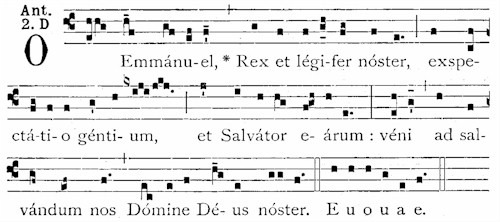
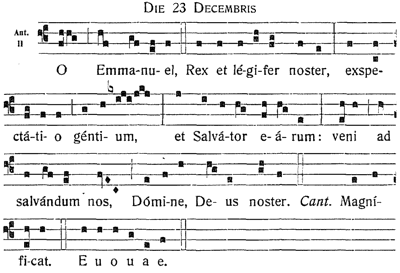
O Emmanuel, Rex et legifer noster, exspectatio gentium, et Salvator earum: veni ad salvandum nos Domine Deus noster.
English
O Emmanuel, God with us, our King and lawgiver, the expected of the nations and their Savior: come to save us, O Lord our God.
Listen: the chant from the Liber Usualis
Scripture
Isaiah 7:14; 8:8
Matthew 1:23
Haggai 2:7
Veni, Veni Emmanuel
O come, o come, Emmanuel,
And ransom captive Israel,
That mourns in lonely exile here,
Until the Son of God appear.


 revueltos67 on ROME 26/10-11 – Day 36: Ultimate: “A.S. Haley: After 1. Qf4+ black has Qxf4.”




























