
For Catholics, the consequential impact of the nearly complete obliteration of the cycle of readings for Holy Mass in the Latin Church, and the imposition of an entirely novel (which the Council Fathers explicitly forbade) set of two cycles cannot be exaggerated.
Four immediate criticisms come to mind.
Putting aside the specious claim that having more Scripture at Mass must be better,
a) the introduction of a third reading from the Old Testament on Sundays and major holy days, placed a burden on priests which 90% were incapable of dealing with coherently,
b) the multiplication of Scripture on Sundays gave the first part of Mass a overly didactic atmosphere, which is not the point of liturgy,
c) the greater emphasis on Scripture served for many as a tool to deemphasize the sacrificial nature of the Mass, particularly in setting up an ambo against the altar, whereas the altar had been the privileged place for the priest to read Scripture because it, too, was a like a sacrificial offering,
d) more Scripture, great – however, under the older scheme the repeated readings every year ensured that people would remember well an importance core of readings.
Matthew Hazell has published the working papers of the groups which from Vatican II onward completely overhauled the book for readings at Mass, the Lectionary.
BTW… the great criminal Bugnini had sworn that never again would a priest be able to say Mass with just one book, so the Lectionary was massively expanded and separated from the Missal, or “Sacramentary”. An ancient idea which he archeologized into a weapon against the Roman Rite.
The amazing Matthew Hazell has in the past issued a book tool that I use almost every week.
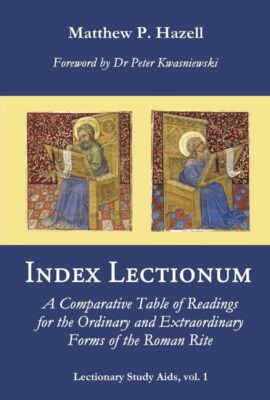 For the readings of the Vetus Ordo…
He now has another published by Os Iusti
The Post-Vatican II Reform of the Lectionary: The Schemata of Group XI
Translated, with an Introduction, by Matthew P. Hazel
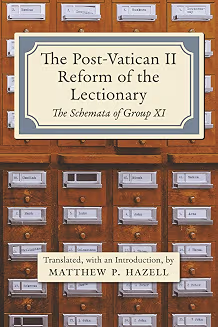
I won’t go into the weeds with this. It is an important book, but not for everyone. It isn’t light reading. However it get’s you into the mind of the engineers of the massive rupture in the post-Conciliar liturgy which we are still sorting out today.
That said, here is a little excerpt from the Introduction which caught my eye on p. xxii:
Each coetus [scholarly committee] had a relator and a secretary, along with several consultors as members, as well as advisors who worked either on a regular or occasional basis for the coetus depending on their availability. Various schemata relating to the work of each study group would be drafted, consulted on, discussed,
redrafted, and so on as necessary. When a schema was deemed to be ready, it
would be discussed at a meeting of all the relators (the coetus relatores) and,
if necessary, be sent back to the study group for redrafting or to incorporate
the suggestions of the relators. Finally, the fully-prepared schemata would be
presented to the Fathers of the Consilium for their examination and voting,
then to the Holy Father for definitive approval, promulgated, and published.
This method of working was, in principle, thorough and well-organised.
It has, however, come under some severe criticism over the decades that
followed, including from those who were themselves involved in the work
of the Consilium and came to view its secretary in particular as a deleterious
influence on the reforms. In his memoirs, Rev Fr Boniface Luykx, appointed
as a consultor in May 1964, had this to say about Bugnini:
He seemed to me very impressionable: if someone pushed him one way, he
went that way; if someone pushed him the other way, he went there instead.
But Father Bugnini was also a politician, and one who wanted power. In
order to gain power he had to appear successful, so he went along with those
who were the most vocal and apparently powerful. He was heavily influenced
by those who broke from fidelity to [Sacrosanctum Concilium]… Before long,
Bugnini stopped inviting to the meetings those “reactionary” members who
dared to adhere to the text of [the Constitution] or to sound principles
of religious anthropology. . .
[I]t became apparent that his opinion about the supremacy and normative value of modern Western man was part of his agenda —and consequently part of the agenda of the Consilium’s subcommissions he oversaw.
It is also worth noting that the Consilium’s working method was designed at the
outset to garner consensus quickly; Bugnini himself was quite open about this.
This had the clear benefit of accelerating the process, but did not encourage the
kind of careful, detailed and patient study of questions that, in hindsight, was
perhaps necessary for large parts of the liturgical reform. Luykx also questions
how much oversight and scrutiny the Fathers of the Consilium really had over the
many schemata given to them by ‘experts’ at meetings with very tight timescales.
Bugnini… arch-criminal of the post-Conciliar reform.



 Chaswjd on Daily Rome Shot 1072 – Procession: “While the Simarillion contains many great things, this has always been my favorite: “But Finrod walks with Finarfin his father…”




























