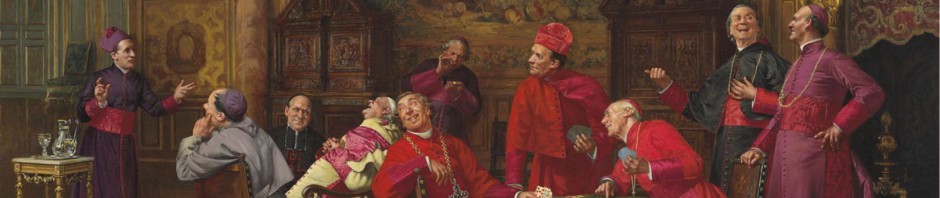
Sr. Joan’s moral equivalence between Archbp. Sartain’s view of Mary and Islamic “Fulla” doll.

When an organization needs to deflect or obfuscate or change the subject (because things are going wrong), it uses surrogates.

Does Sr. Joan Chittister speak for the LCWR? Is she one of their surrogates? Sr. Zinn at the LCWR should clarify if Sr. Joan is their surrogate.

On 30 August at Fishwrap (the National Schismatic Reporter), Sr. Joan had an attack op-ed piece – Hierarchy’s Mary is vastly differs from ours – aimed at Archbishop Sartain.

But wait! There’s more.

The piece you see at Fishwrap now is not the version that was originally posted.  After a few hours, Fishwrap replaced Sr. Joan’s piece with a bowdlerized version.

What did Sr. Joan originally write about Archbishop Sartain and Mary?

Sr. Joan suggested that Archbp. Sartain is a kind of Catholic mullah with an Islamic, repressive view of women.

She attacked Archbishop Sartain for the sermon that he gave at the LCWR assembly in which he presented an image of Mary. He described Mary as quiet and docile. Sr. Joan, on the other hand, draws a moral equivalence between Sartain’s view of the Blessed Virgin Mary with “the new Islamic Fulla doll, the Barbie doll of Islam”. I am not making this up.

The idea is that the Islamic ideal for women is reflected in the Fulla doll.  They are supposed to be docile and domestic.  Get it?

She must have been pretty angry at Archbp. Sartain to have made that Islamic comparison.  Or perhaps she had some directions from the LCWR.  In any event, NSR was originally willing to post it.  Originally.  Then the original was replaced by expurgated version that eliminated the Islamic references.

Instead, Sr. Joan presents a Mary as liberated, avoiding men, even pushy with the angel of the Annunciation.  Happily Miley Cyrus seemed to “like” the guy she embarrassed herself with the other night on TV, or Sr. Joan might have used her as her model in contrast to Archbp. Sartain’s traditional view (aka the Islamic Fulla Doll).

If you go now to the site of the NSR, you will find that her Islamic comparison has been entirely expunged from her piece.   But it was there.

CLICK FOR A LARGER VERSION

Here (right) is the screenshot from my search for the original version, which I pulled up from a cache. Click for a larger version.

Here is the text of her piece:

Hierarchy’s Mary is vastly differs from ours
Joan Chittister | Aug. 30, 2013

Two things happened in August that, though apparently unrelated, had a great deal in common. First, the new Islamic Fulla doll, the Barbie doll of Islam, was released, dressed in hijab and abaya — a clear image of the ideal Muslim woman who spends her time “mostly shopping, spending time with her friends, cooking, reading, and praying.”

The second was Seattle Archbishop J. Peter Sartain’s homily to the Leadership Conference of Women Religious’ annual assembly.

Both of these events emphasized the submission of women to the dictates of religion as defined by men, whether supported by the Scriptures of either religion or not. Both the doll and the homily communicate some clear, if indirect, points. Neither, we know now, will be inconsequential in a society where communication is the order of the day.

One of the major scientific discoveries of the 20th century, for instance, revolves around the role played by communication in stressful situations — the notion that a person’s communication style can soften or harden conflict depending on how it is used; the idea that simply the amount of information supplied in crucial situations effect the tone, the efficacy and the outcome of negotiations. As a result of those findings, whole corporations changed their processes of decision-making and dissemination of information.

So with all those things in mind, people waited for information about the progress of the Vatican visitation of the LCWR from this year’s gathering in Orlando, Fla. Given the fact that none was forthcoming, people drew their own conclusions.

I, on the other hand, went for the one piece of data the assembly managed to produce on the subject, the homily Sartain gave to the membership. And a clear piece of communication it was.

In this homily, Mary is “quiet,” “docile,” submits herself over and has no “desire or a need to figure things out … or resolve them to her own personal satisfaction.” There was, we’re told here, no “no” or “mine” in her. The Mary of this homily is a passive receptacle of what she understands to be the Word of God.

Well, maybe. But it might be good to think about all that a bit in the light of the other things we also know about Mary.

The purpose of this column is not to parse what the bishop said about Mary on the Feast of the Assumption. I prefer instead to look at what he did not say about her because, it seems to me, what he left out of that homily says just as much about what is expected of women in the Catholic church as Fulla dolls communicate the desires of many Muslims for the place of women in Islam.

For instance, Mary answers the angel’s declaration to her by questioning it. An angel! Someone of much higher rank, it would seem, than even apostolic delegates, and only then with a “Be-it-done-unto-me” response to a situation to which, apparently, “no” was a viable answer. Otherwise, why bother to have the conversation?

Even more important, perhaps, is the awareness that despite the seriousness — even the danger — of her situation, Mary did not go to any man — to the high priests of the temple, the local rabbi, her father or even Joseph — for directions about what to do next. She went to another woman for the wisdom she needed and followed that instead. No visitations here.

In another instance, at the wedding feast at Cana, Mary gives her own set of apostolic orders to no less than Jesus himself as well as to the wait staff, as in, “Go and do what he tells you.”

Mary herself questioned the propriety of what Jesus was doing in the temple with the elders and later is part of a crowd of family and friends who are even concerned that Jesus may be, as the Irish would say, “losing the run of himself.”

And finally, if anyone wants to know just how influential and important a figure Mary was to the development of the early church, the very idea of her being part of the gathering of apostles on Pentecost when each of them is anointed into discipleship by the Holy Spirit ought to be enough to dispel the notion that what we have here is a woman without a strong sense of self.

No, the Mary not mentioned in this homily on the Assumption was a woman not intimidated into the Incarnation, not beholden to male answers, not shy about giving directions about what should be done, not without a high sense of personal responsibility, and not one bit in doubt about her place in the hierarchy of the church.

Those, I think, are precisely the qualities we see in women in our own time that make for what some parts of the church are now calling “radical feminism.”

From where I stand, that is a sad misuse of language, a kind of Fulla doll theology and an even sadder case of spiritual blindness.

We know what Sr. Joan really thinks. I think we have the right to know what sort of surrogate role she is playing for the LCWR.

I’ve got to give some credit to the Fishwrap this time.  Even they had the good sense not to public that embarrassing twaddle.
Posted in Our Catholic Identity, Women Religious | Tagged , , ,
59 Comments

Two examples of music for liturgy. You decide.

A reader sent me a video which I want to pass along.

Alas, the music was recorded in a concert during a music festival rather in during a Mass or singing of the hours.  This is an Alma Redemptoris Mater for 6 voices by Diego Ortiz (+ c. 1570) performed by Cantar Lontano and Marco Mencoboni at the Poesis Festival in 2012.

YouTube thumbnailYouTube icon

By contrast, here is another piece of music often heard in a church, but also recorded (I guess) in a concert.

http://www.youtube.com/watch?v=ruaV6pmFGAM&feature=player_embedded

You decide.

Discuss.

Posted in "How To..." - Practical Notes, Liturgy Science Theatre 3000 | Tagged , ,
107 Comments

QUAERITUR: Limit on number of statues permitted in church? Wherein Fr. Z rants.

From a reader:

Is there a limit to number of statues permitted in a church or chapel?

Yes!

The first law that governs the number of statues in a church is the law of physics whereby it is evident that two tangible objects cannot occupy the same space at the same time.

The second law that governs this is the law of good taste, by which we understand that too much of a good thing really is too much.

When all the statues were being taken out of churches, it wasn’t because people were clamoring for a simpler space, or falling down and frothing in confusion because of, say, multiple images of Mary or of Our Lord.

No, it was a small number of pointy-headed liberal iconoclasts who ruined our churches.

They spent oodles of money to destroy what the people had contributed.

Those progressivist plunderers who ravaged our churches showed a particular hatred for devotional images, didn’t they?  They accomplished more damage than the Vandals dreamed of causing, and all for ridiculous ideas cooked up by a small group of so-called experts.

In a trice they defaced what several generations of wealthy and poor believers alike scrimped to build.

Think of all the money wasted.  YOUR MONEY WASTED!

The looters probably didn’t believe in the Communion of Saints in the way that true Catholics do.  Or perhaps they don’t really understand what the Council of Trent said about statues and images:

The images of Christ, the Virgin Mother of God, and of the other saints are kept and honored in churches not because it is believed that there is any divinity or power in these images, or that anything may be asked of them, or any faith put in them. The honor shown to them is really being given to the persons whom they represent. Through these images which we kiss, and before which we bow with bared heads, we worship Christ, and not the saints whose likenesses they display.

You would think that those pillaging thieves were the Mexican troops of President Plutarco Elías Calles.  Remember the scene in For Greater Glory when they sacked a church? You would think they were anti-Catholic protesants with their screwy prevarications about Catholics “worshiping” statues, or fundmentalists who claim that the 2nd Commandment forbids statues and images. (Hint: God commanded the Jews to make decorative, devotional statues – cf. Exodus 25:18–20; Numbers 21:8–91; Chronicles 28:18–19.)

Statues remind us that we are not alone in this earthly slog.  They remind us that we have friends in heaven who are pulling for us and helping us.  They remind us that we too can be holy, even in extraordinary ways.

Liberals even understand that people don’t like or want their stupid ideas.  When they have a fundraising drive, for example, they use images of older churches, with statues and stained-glass and beautiful vessels and vestments, rather than the monstrosities they cobble up.

So, in answer to your question, no, there isn’t a limit prescribed in law concerning the number of statues we can have in a church.  But it is also possible to overdo it.

Posted in "How To..." - Practical Notes, ASK FATHER Question Box, Liturgy Science Theatre 3000, Wherein Fr. Z Rants | Tagged ,
35 Comments

READERS: Help a new parish priest choose a good hymnal!

From a priest:

Can you suggest some good hymnals? I just became pastor and we are in great need of change.

Let’s help this guy.

Readers! Have at.

First: For the Extraordinary Form – HERE

Posted in "How To..." - Practical Notes, Liturgy Science Theatre 3000, Mail from priests, Priests and Priesthood | Tagged
28 Comments

7 Sept – Day of Prayer & Fasting: What Did The Pope Really Say? Fr. Z offers suggestions.

From a reader:

The Holy Father has declared that next Saturday, September 7th, will be a day of prayer and fast for peace, for the whole Church.

Do you think that, particularly as far as fast is concerned, that means only an invitation, a piece of advice, or a true and strict precept, under penalty of sin, as if it were Ash Wednesday or Good Friday?

I hope I shall be able to fast anyway, but I’d very much appreciate your help.

What did the Pope really say?  HERE

To this end, brothers and sisters, I have decided to proclaimfor the whole Church on 7 September next, the vigil of the birth of Mary, Queen of Peace, a day of fasting and prayer for peace in Syria, the Middle East, and throughout the world, and I also invite each person, including our fellow Christians, followers of other religions and all men of good will, to participate, in whatever way they can, in this initiative. On 7 September, in Saint Peter’s Square, here, from 19:00 until 24:00, we will gather in prayer and in a spirit of penance, invoking God’s great gift of peace upon the beloved nation of Syria and upon each situation of conflict and violence around the world. Humanity needs to see these gestures of peace and to hear words of hope and peace! I ask all the local churches, [That means dioceses and eparchies.] in addition to fasting, that they gather to pray for this intention.

It seems that the Pope has not done anything juridical here to bind local churches and all Catholics to some kind of action.  7 September is not like Ash Wednesday or Good Friday.

However, I watched the video of the Angelus from yesterday. He really meant business.

It strikes me that the force of this “invitation” should bring us in every parish and diocese and Catholic household to do something.  It might be good to coordinate (if your time zones allow) some action during the time frame the Pope mentioned for Rome.

For example, could there not be in a parish in, say, the Central Time Zone in these USA, Rosary at 11:45 AM and Mass at Noon (1900 Rome time), and then Exposition after Mass, and Mass again at 5 PM (Midnight Rome time).  Perhaps with confessions for some time before each Mass.  Furthermore, since this invitation from the Pope includes fasting, perhaps there could be a food drive: people could contribute to the drive what they would have otherwise eaten.

And why not make it, voluntarily, a day of fasting and abstinence like to Good Friday?

So, no, I don’t think we would sin by not participating in this in a concrete way.  However, when the Holy Father makes an appeal like this, then we should respond.

And I will add this: Those of you of the traditional stripe, by the first to take the initiative and help with whatever might be organized.  Get out there.

Just some thoughts.

PS: Too bad he didn’t call for this to coincide with the September Ember Days!

UPDATE:

Dr. Peter’s comments on this matter HERE

Posted in ASK FATHER Question Box, The Drill | Tagged , ,
43 Comments

QUAERITUR: Can you confess in Latin?

From a reader:

I know that the use of Latin is good for large international Masses (and for parish Masses, too…!), but what if, say, a priest and penitent didn’t speak the same language? Could a confession be made in Latin?

Sure!  I have done that many times, as a matter of fact.

The Latin Church’s liturgical language is Latin.  No!  Really!

A flaw in your question: If both the penitent and the confessor know Latin, then they do know the same language.


Posted in "How To..." - Practical Notes, ASK FATHER Question Box, Liturgy Science Theatre 3000, Our Catholic Identity | Tagged , , ,
19 Comments

Roman Curial appointments: a few observations

A couple things popped up on the screen today.

First, Pope Francis has finally named a Secretary of State: Archbishop Pietro Parolin, Apostolic Nuncio to Venezuela. He starts on 15 October 2013.

Also, the Holy Father assigned Spanish-born Fr. Fernando Vergez, LC, to run the Vatican City State’s Governatorato as Secretary General.  The interesting thing about this appointment is not that he is a Legionaire of Christ – which I consider unimportant – but rather than he has not been also named an archbishop.

Thus, it seems that Francis is slowing down the career escalator.

A former head of the Governatorato is now Nuncio in these USA, Archbp.  Carlo Maria Viganò, the man I hoped would become the Secretary of State.  Viganò’s successor, and the immediate predecessor of Vergez, is Bp. Giuseppe Sciacca.  Francis created a new position for Sciacca at the tribunal run by Card. Burke, the Apostolic Signatura.  That was a little odd, and it probably means that Sciacca isn’t going anywhere else soon. Some traditionalists will read this as a bad sign for them, because Sciacca is known to be interested in traditional liturgical worship.  So is Card. Burke, of course.  But Sciacca started out as a good canonist.  That, more than the liturgical reason, is probably why Sciacca went back to the Signatura.

On that note, it will be interesting to see when Francis calls a consistory for the purpose of making some new cardinals. Parolin will eventually need a red hat. That, however, is also not interesting. What will be interesting to watch is whether or not Francis confirms Archbp. Müller in his post at the CDF and give him a red hat.  Benedict XVI did not make him a cardinal, after all.


Posted in The Drill | Tagged , , , , , , , ,
26 Comments

Super Fun Video (especially for Trekkies)

Have you seen this?  It is a worthy successor of the VW Darth Vader commercial.

http://www.youtube.com/watch?v=WPkByAkAdZs&feature=player_embedded

Posted in Liberals | Tagged , , , ,
25 Comments

Note to readers about registration and commenting

This blog is under constant attack by spammers and various other internet trolls (my they roast in the deepest cinders of Hell, as Dr. Maturin would put it).

I, therefore, require that people register to comment. In the registration form there is a field in which I ask for information about you. That field helps me sort out the vile spammers from sincere registrants.

The spammers are getting cleverer, by the way. Today I had this one – which follows a standard “format” from one particular spammer:

FIRST NAME: Felipa
LASTNAME: Navarro
WEBSITE: ____
ABOUT: I\’m Felipa and I live in Dunkerque.
I\’m interested in Gender and Women\’s Studies, Scrapbooking and Vietnamese art.
I like to travel and reading fantasy.

This seemed like it could have been from one of the steering committee of the LCWR on the way to an assembly, but… no, it was a spammer.

In any event, use that “about yourself” field. You don’t need to put a biography in it, but I do need something that demonstrates to me – at a glance – that you are a real person. Adding something like your confirmation name or a favorite saint or the name of your parish some such Catholic information is helpful.

Posted in "How To..." - Practical Notes |
10 Comments

Fr. Z summoned to a Tribunal

It has finally happened.

I have at long last – for my sins – been summoned on pain of censures to appear at an ecclesiastical tribunal.

20130830-114920.jpg

Posted in Lighter fare | Tagged ,
57 Comments























