Was there a good point in the sermon you heard for your Mass of Sunday obligation?
Let us know what it was.
For my part, I stressed the importance of confession. Our sins hurt everyone. We are all in this together.

Was there a good point in the sermon you heard for your Mass of Sunday obligation?
Let us know what it was.
For my part, I stressed the importance of confession. Our sins hurt everyone. We are all in this together.
I have in the past written, just the other day as a matter of fact, about a French custom of “burying the Alleluia” on Septuagesima. On this pre-Lent Sunday, scrapped with the incept of the Novus Ordo, we wear the purple of penitence on Sundays and we already begin thinking about our Lenten discipline which will begin pretty soon.
Today at NLM I saw a great post with photos of the burying of the Alleluia at a parish of the Fraternity of St. Joseph the Guardian. Here are a couple. See the rest over there.
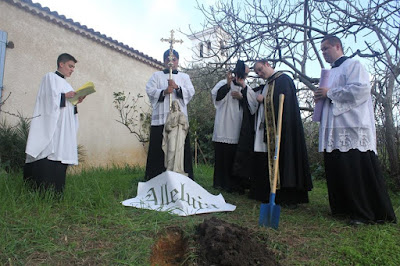
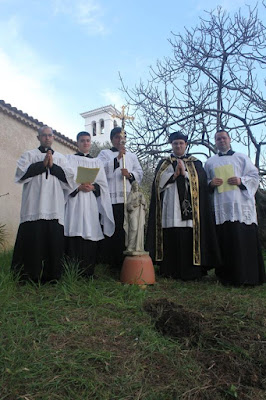
A great custom… especially if you live where the ground hasn’t yet been frozen as hard as concrete.
UPDATE:
From the magnificent Benedictines of Mary, Queen of Apostles in Missouri come images of their own farewell to the Alleluia.


I like this story. From CNA:
This sword-wielding Samurai just moved closer to sainthood!
Vatican City, Jan 23, 2016 / 04:02 am (CNA/EWTN News).- The martyrdom of a 16th-century Samurai who died for his Catholic faith was approved this week by Pope Francis, making the Japanese warrior one among nine other causes that advanced toward sainthood.
Takayama Ukon was born in 1552 in Japan during the time when Jesuit missionaries were becoming introduced within the country. By the time Takayama was 12, his father had converted to Catholicism and had his son baptized as “Justo” by the Jesuit Fr. Gaspare di Lella.
Takayama’s position in Japanese society as daimyo[a feudal lord] allowed him many benefits, such as owning grand estates and raising vast armies. As a Catholic, Takayama used his power to support and protect the short-lived missionary expansion within Japan, influencing the conversion of thousands of Japanese.
When a time of persecution set in within the country under the reign of Japan’s chancellor Toyotomi Hideyoshi in 1587, many newly-converted Catholics abandoned their beliefs.
Instead of denying their faith, Takayama and his father left their prestigious position in society and chose a life of poverty and exile. Although many of his friends tried to persuade Takayama to deny Catholicism, he remained strong in his beliefs.
Takayama “did not want to fight against other Christians, and this led him to live a poor life, because when a samurai does not obey his ‘chief,’ he loses everything he has,” Fr. Anton Witwer, a general postulator of the Society of Jesus, told CNA in 2014.
Ten years passed, and the chancellor became more fierce in his persecution against Christians. He eventually crucified 26 Catholics, and by 1614, Christianity in Japan was completely banned.
The new boycott on Christianity forced Takayama to leave Japan in exile with 300 other Catholics. They fled to the Philippines, but not long after his arrival, Takayama died on February 3, 1615.
In 2013, the Japanese bishops’ conference submitted the lengthy 400-page application for the beatification of Takayama to the Congregation for the Causes of Saints. On Jan. 22, 2016, Takayama’s advancement in the cause for canonization was further promulgated when Pope Francis approved his decree of martyrdom.
“Since Takayama died in exile because of the weaknesses caused by the maltreatments he suffered in his homeland, the process for beatification is that of a martyr,” Fr. Witwer explained.
Takayama’s life exemplifies the Christian example of “a great fidelity to the Christian vocation, persevering despite all difficulties,” Fr. Witwer continued.
[…]
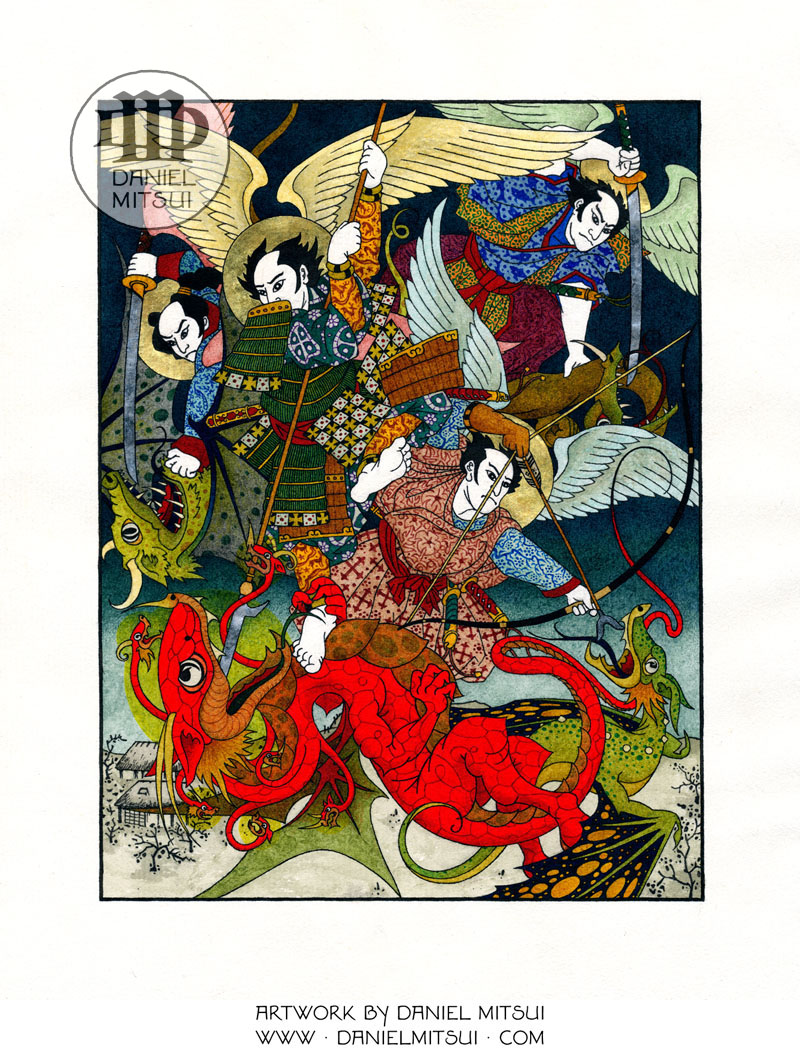
I’ll take this opportunity to remind you about the great artwork by Daniel Mitsui. Here is his marvelous battle of angels against the Enemy of the soul. HERE
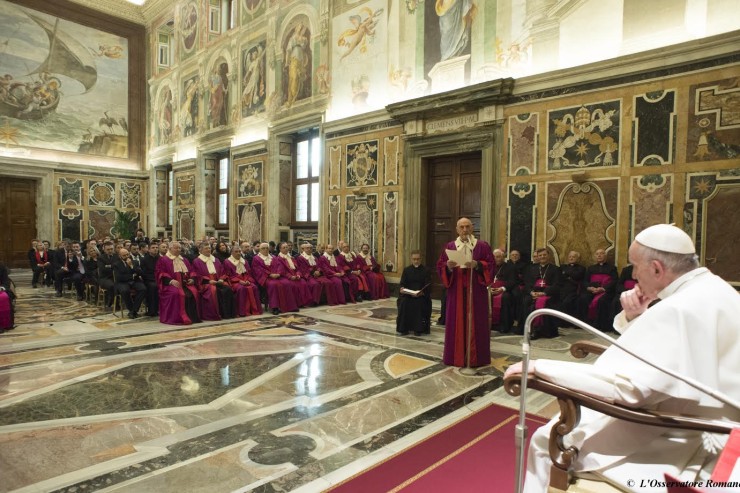 The other day His Holiness Pope Francis gave the annual address to the Roman Rota. HERE
The Rota, the Tribunal Apostolicum Rotae Romanae or Apostolic Tribunal of the Roman Rota is the Church’s highest appellate court. It takes its name from the round table that was used. A great deal of its business has to do with cases of nullity of marriages.
Here are a few excerpts of Pope Francis address in my fast translation:
[…]
The Church indicated to the world that, among other things, there cannot be confusion between the family desired by God and every other type of union.
[…]
The family, founded on indissoluble marriage….
[…]
It is good to reaffirm with clarity that the quality of faith is not an essential condition for matrimonial consent, which, according to perennial doctrine, can be undermined only at the natural level (cf CIC can 1055 § 1, 2).
[…]
The Church, therefore, with a renewed sense of responsibility, continues to propose matrimony, in its essential elements – offspring, the good of the spouses, unity, indissolubility, sacramentality – not as an idea for few, notwithstanding modern models centered on the ephemeral and transitory, but as a reality that, in the grace of Christ, can be lived by all the baptized faithful.
[…]
Those who promote homosexual relations and who undermine the indissolubility of marriage won’t be happy with this. Sorry Fishwrap.
Fr. John Hunwicke has an interesting comment about the FSSP over at his excellency blog Mutual Enrichment. This is the second of a short series. He has a penchant for chain-posts, it seems. You can find the rest over there. Meanwhile, here is what he offers in the 2nd post on “Intolerance of minorities” (his emphases and my comments):
The Priestly Fraternity of S Peter, FSSP, was erected with lightning speed after the uncanonical episcopal consecrations performed by Archbishop Lefebvre in 1988. The promise was that the participants would be given, within the canonical unity and structures of the Church, the ‘deal’ which had been agreed with Archbishop Lefebvre; the ‘deal’ which he had signed, but had thought better of overnight, and had repudiated the next morning.
Broadly, this is what the FSSP was given … although the most significant item in that package, the provision for them to have a bishop, never materialised, and, to this day, never has.
Little more than a decade later, things, apparently, were not well. In the middle of 2000, the Fraternity priests learned that their canonical election of a new superior had been suspended, a new superior was to be parachuted in, and the Rectors of the Fraternity’s seminaries were replaced. A letter referred to “a certain spirit of rebellion against the present-day Church” among the seminarians. And one (otherwise generally sympathetic) Cardinal later explained to journalists that the “Fraternity’s members must be helped in their endeavour to strike a balance between their original charism … and the outcome of their insertion within the ecclesial reality of today“. Mark that phrase!
It is not easy to see how the ecclesial reality of today can mean anything other than the prevalent ethos of Novus Ordo Catholicism. “Striking a balance” looks to me horribly like the old “Latinisation” as it used to be applied in a “uniate” context: the intolerance of the majority towards a culturally different minority, of which, for some reason, they feel dreadfully fearful. Or is the problem that Traditionalists are not humble enough? That they continue to address reasoned questions to the ecclesial reality of today?
Ecumenism is fashionable in some Catholic circles. I have long suspected that ‘liberal’ Catholics, who profess a sympathy for Ecumenism, favour it because their real desire is to change their own Church so that it conforms to the paradigms of Liberal Protestantism. [NB] Be that as it may, there is something strange about Catholics who have a professed warm ecumenical enthusiasm for ecclesial bodies which have been separated from them for half a millennium … but who yet have a visible and vocal visceral intolerance towards fellow Catholics living loyally in canonical structures confirmed by the Church.
To be continued.
See what I mean? It was a continuation and it is to be continued.
‘
I received an amusing note (and various SMS) from a friend in KC whose daughter is stuck on a bus in the snow after the March for Life. A priest on the bus said Mass. Here is a photo… grainy but good.

Also, he sent along a Parody Song which is said to have been sung on the bus. Perhaps others, monitoring this blog from their busses, might do the same. They have 4 bus-loads stranded.
Dedicated to our pilgrims stuck on the Pennsylvania Turnpike. Finally, a useful purpose for “Gather Us In”
Here in this place new snow is falling,
now is the highway vanished away;
see in this bus our friends and our chaperones
brought here to you in the light of this day.
Please dig us out, the stuck and the stranded,
Please dig us out, the young and the not-as-young;
call to us now, and we shall awaken,
we shall arise at the sound of a plow.
We are the young, our lives now in chaos,
we are the old who want to escape;
we have been stuck through night into daytime,
Now we just wait for the National Guard.
Please dig us out, the rich and the haughty,
Please dig us out, the proud and the strong;
give us a plow, so we can get going,
give us the courage to finish this song.
Here we will grow in bonding and friendship,
here we will find His love in us all,
As the snow falls, each flake brings us closer
United as one we’ll bring life to the world.
Give us to hear God’s voice in the chaos,
give us to know His great love for us;
We have been called to do something special
Once we get home and get off this damn bus
Not in the dark of busses confining,
not on some snowplow, light years away—
here in this bus a new light is shining,
That’s cause I can’t turn my iPhone light off.
Please dig us and give us a pizza,
Please dig us out, I’m losing my mind;
Please dig us out, the bathroom is filling,
Send us a plow get us out of this bind.
UPDATE:
A couple miles away, some pilgrims built an altar out of snow and a priest said Mass.

UPDATE:
More… HERE

 Now for another edition of Ham Radio Saturday.
I created a page for the List of YOUR callsigns. HERE Chime in or drop me a note if your call doesn’t appear in the list.
I’ve been really busy lately, so I haven’t been able to do much radio stuff. It has also been really cold here, and the way I have to set up my antenna involves having a door or window slightly open. Also, I have to go outside to adjust the antenna. That kills the motivation a bit.

During the upcoming week we should be able to do some work on the parish radio shack. We have the room cleared and a work list.
Meanwhile, one of our priest hams had a trip to the SW of these USA. He took his rig and set up in the middle of nowhere in NM.

I had some middle of nowhere too, but driving. Lots of that last week.

Meanwhile, I had some equipment to fix. The vertical I use has a design flaw. There is a rather flimsy plastic screw that is supposed to hold the adjustable coil in place. It broke off. Very pesky.

Otherwise, it is a good antenna for me right now. HERE Thanks to a ham reader who sent it!
So… for me it’ll be a night of college hockey, Ite Rodentes. From last night.

As of this writing, I am on 40m.
UPDATE:
20m
 In the traditional Roman calendar this Sunday is called Septuagesima, Latin for the “Seventieth” day before Easter. Already! It is quite early this year.
This number, 70, is more symbolic than arithmetical. The Sundays which follow are Sexagesima (“sixtieth”) and Quinquagesima (“fiftieth”) before Ash Wednesday brings in Lent, called in Latin Quadragesima, “Fortieth”.
These pre-Lenten Sundays prepare us for the discipline of Lent, which once was far stricter.
Septuagesima gives us a more solemn attitude for Holy Mass.
Purple is worn on Sunday rather than the green of the time after Epiphany. These Sundays have Roman stations. The station today is St. Lawrence outside the walls. St. Gregory the Great preached a fiery sermon here, which we have, and which is read in part for Matins in the traditional Office. The traditional Office also presents three figures over the three pre-Lent Sundays, all foreshadowing Christ: Adam, Noah and Abraham.
When we want to follow what Holy Church is giving us in our sacred liturgical worship we should remember that Mass is only part of the picture. We also have the Office, the “liturgy of the hours”. They mesh together and reinforce and complete each other.
Alleluia is sung for the last time at First Vespers of Septuagesima and is then excluded until Holy Saturday. There was once a tradition of “burying” the Alleluia, with a depositio ceremony, like a little funeral. A hymn of farewell was sung. There was a procession with crosses, tapers, holy water, and a coffin containing a banner with Alleluia. The coffin was sprinkled, incensed, and buried. In some places, such as Paris, a straw figure bearing an Alleluia of gold letters was burned in the churchyard. Somehow that seems very French to me.
The prayers and readings for the Masses of these pre-Lenten Sundays were compiled by St. Gregory the Great (+604), Pope in a time of great turmoil and suffering. Looking at Gregory’s time, with the massive migration of peoples, the war, the turmoil, you are reminded of our own times.
I like to imagine the Romans who were aspiring to be brought into the Church at Easter. They were brought out to St. Lawrence for today’s Mass, only to hear in the antiphons about suffering and crying out to God, and then to hear the reading in which Paul says that God wasn’t pleased with everyone who drank from the rock. “What am I getting myself into?!?” But, if throughout the Mass formulary there are grim messages, there are also signs of great hope. God does hear the cry of those who invoke him.
In the Novus Ordo of Paul VI there is no more pre-Lent.
A terrible loss.
We are grateful that with Summorum Pontificum the pre-Lent Sundays have regained something of their ancient status.
The antiphons for the first part of Mass carry a theme of affliction, war, oppression. How appropriate right now when the Obama Administration is conducting a war against the Catholic Church and against religious liberty of all Americans. We hear from 1 Corinthians on how Christians must strive on to the end of the race. The Tract (which substitutes the Gradual and Alleluia) is the De profundis.
COLLECT:
Preces populi tui, quaesumus, Domine, clementer exaudi: ut, qui iuste pro peccatis nostris affligimur, pro tui nominis gloria misericorditer liberemur.
This prayer, as well as the other two we will see, is in versions of ancient sacramentaries, such as the Gregorian. Our wonderful Lewis & Short Dictionary says ex-audio means “listen to” in the sense of “harken, perceive clearly.” There is a greater urgency to exaudi (an imperative, or command form) than in the simple audi. Clementer is an adverb from clemens, meaning among other things “Mild in respect to the faults and failures of others, i.e. forbearing, indulgent, compassionate, merciful.” We are asking God the omnipotent Creator to listen to us little finite sinful creatures in a manner that is not only attentive but also patient and indulgent.
LITERAL TRANSLATION:
We beseech You, O Lord, graciously to hark to the prayers of Your people: so that we who are justly afflicted for our sins, may mercifully be freed for the glory of Your Name.
The first thing you who attend mainly the Novus Ordo will note, is the profoundly different tone of this prayer.
It is just as succinct as most ancient Roman prayers. It has the classic structure. But the focus on our responsibility and guilt for our sins is very alien to the style of the Novus Ordo. For the most part, such direct references to our sinful state were systematically excised from the ancient prayers which survived in some form on the post-Conciliar Missale Romanum.
SECRET:
Muneribus nostris, quaesumus, Domine, precibusque susceptis: et caelestibus nos munda mysteriis, et clementer exaudi.
This ancient prayer was also in the Mass “Puer natus” for 1 January for the Octave of Christmas. The first part of the prayer is an ablative absolute. In the second part there is a standard et…et construction. The prayer is terse, elegant.
LITERAL TRANSLATION:
Our gifts and prayers having been received, we beseech You, O Lord: both cleanse us by these heavenly mysteries, and mercifully hark to us.
In the first prayer we acknowledge our sinfulness and beg God’s mercy. In this prayer we show humble confidence that God is attending to our actions and we focus on the means by which we will be cleansed from the filth of our sins, namely, the Sacrifice of Jesus on the Cross, about to be renewed upon the altar.
As the Mass develops there is a shift in tone after the Gospel parable about the man hiring day-laborers. An attitude of praise is introduced into the cries to God for help.
POSTCOMMUNIO (1962MR):
Fideles tui, Deus, per tua dona firmentur: ut éadem et percipiendo requirant, et quaerendo sine fine percipiant.
Glorious.
In an ancient variation we find per[pe]tua, turning “by means of your…” into “perpetual”. That éadem (neuter plural to go with dona, “gifts”) is the object of both of the subjunctive verbs which live in another et…et construction. Requiro means “to seek or search for; to seek to know, … with the accessory idea of need, to ask for something needed; to need, want, lack, miss, be in want of, require (synonym: desidero)”. Think of how it is used in Ps. 26(27),4: “One thing I have asked of the Lord, this will I seek after (unum petivi a Domino hoc requiram); that I may dwell in the house of the Lord all the days of my life.” Quaero is another verb for “to seek”, as well as “to think over, meditate, aim at, plan a thing.” The first meaning of the verb percipio is “to take wholly, to seize entirely” and then by extension “to perceive, feel and “to learn, know, conceive, comprehend, understand.”
Notice that these verbs all have a dimension of the search of the soul for something that must be grasped in the sense of being comprehended.
The New Roman Missal – 1945:
May Thy faithful, O God, be strengthened by Thy gifts,
that receiving them they may still desire them
and desiring them may constantly receive them.
The New Marian Missal – 1958:
May Thy faithful people, O God, be strengthened by Thy gifts;
that in receiving them, the may seek after them the more,
and in seeking them, they may receive them for ever.
Saint Andrew Bible Missal – 1962:
O Lord, may your faithful people be made strong by your gifts.
By receiving them may they desire them.
And by desiring them, may they always receive them.
Just to show you that we can steer this in another direction, let’s take those “seeking/graping/perceiving” verbs and emphasize the possible dimension of the eternal fascinating that the Beatific Vision will eventually produce.
A LITERAL ALTERNATIVE:
May Your faithful, O God, be strengthened by Your gifts: so that in grasping them they will need to seek after them and in the seeking they will know them without end.
In this life, the closest thing we have to the eternal contemplation of God is the moment of making a good Holy Communion. At this moment of Mass, which so much concerned struggling in time of oppression, we strive to grasp our lot here in terms of our fallen nature, God’s plan, and our eternal reward.
I don’t believe this prayer, like Septuagesima Sunday, made it into the Novus Ordo, to our great impoverishment.
Contrary to tweets – the Extraordinary Form Mass in honor of Nellie Gray IS GOING AHEAD!
There was word put out that it was cancelled. NO! Even the parish website (as I write) indicates that Mass was cancelled. NO! IT IS BACK ON, but as a Solemn Mass, not Pontifical.
So… A Solemn Mass (with deacon, subdeacon) will be celebrated today at 3 PM EST at Old St. Mary’s (St. Mary Mother of God) on 5th. MAP HERE
As a bonus the wonderful choir from Holy Innocents in Manhattan will sing for the Mass.
Also, after that Solemn Mass, there will be another Mass, a Low Mass.
 Each week I write an eclectic column of precisely 400 words called “Omnium Gatherum“ for the UK’s best Catholic weekly The Catholic Herald. This column, which follow my four year series on translations, is now in its second year.
For this last week’s (22 Jan) number I wrote:
In the classical, traditional Roman liturgical calendar, this week brings us on 22 January to the Feast of Sts Vincent of Saragosa and Anastasius the Persian. Vincent was a Deacon and the Proto-Martyr of Spain, killed around 304 when Diocletian was Emperor. St Augustine (d 430) preached about Vincent that he suffered torments beyond what any human could endure without the help of God. The more he suffered, the greater seemed his joy. Anastasius, a convert from Zoroastrianism, was tortured to abandon his faith in Christ by strangulation and decapitation in 628. These were gutsy men, who bore witness to the Faith in times of persecution.
Speaking of guts, when in Rome visit their church, Santi Vincenzo ed Anastasio, which faces the famous Trevi Fountain. This was once the parish church for the Quirinal Palace, which was the summer residence of Popes from 1583 until 1870. It has a beautiful baroque façade which sports the coat-of-arms of its builder and patron, the successor of Cardinal Richelieu as the French King’s chief minister, Jules Card. Mazarin (d 1661), a major character in Twenty Years After, the sequel to Alexandre Dumas’ The Three Musketeers. In this church are deposited the praecordia, the viscera, of 22 popes. Beginning with Pope Sixtus V (d 1590), when the pontiffs died their guts were extracted, jarred, preserved. Leo XIII (d 1903) is the last Pope whose innards grace the place. His body is now venerated at the Basilica of St John Lateran.
Leo XIII, famous for his 1891 encyclical on social issues Rerum novarum, was the first pope born in the 19th century and the first pope to die in the 20th. He advanced Thomistic theology, Mariology, and consecrated the world to the Sacred Heart. Leo gave us the tradition of the commonly called “Leonine Prayers” or “Prayers after Mass”. We should have the guts to revive these prayers after Masses, and say often:
O God, our refuge and our strength, look down with favor upon Thy people who cry to Thee; and by the intercession of the glorious and immaculate Virgin Mary, Mother of God, of Saint Joseph her spouse, of the blessed Apostles Peter and Paul, and of all the saints, in mercy and kindness hear our prayers which we pour forth for the conversion of sinners, and for the liberty and exaltation of Holy Mother Church. Through the same Christ Our Lord. Amen.

Coat of Arms by D Burkart









A Daily Prayer for Priests


They find you a pro-life agent in your area who commits to giving a portion of the fee to a pro-life group!

PLEASE subscribe via PayPal if it is useful. Zelle and Wise are better, but PayPal is convenient.
A monthly subscription donation means I have steady income I can plan on. I put you my list of benefactors for whom I pray and for whom I often say Holy Mass.
In view of the rapidly changing challenges I now face, I would like to add more $10/month subscribers. Will you please help?
For a one time donation...



Help Monks in Wyoming (coffee – UPDATED LINK) and Norcia (beer) and the wonderful "Soap Sisters" of Summit, NJ!


Please follow me on Twitter!










Visits tracked by Statcounter
since Sat., 25 Nov. 2006:

