27 Dec – St. John Evangelist and St. Fabiola and Card. Wiseman about the Bible

Today, being the Feast of the Evangelist John, we have a special blessing for wine and other libations.  I wrote about that HERE.  We have this blessing because of an assassination attempt.    There was an attempt on the life of St. John the Evangelist by poisoning.  He blessed the cup and the poison crawled out in the form of a serpent.  You often see St. John depicted this way in art.

St Jerome Joos van CleeveSt. Jerome says this about the Evangelist.  Priests read this in the Breviarium Romanum during Matins.

V. Grant, Lord, a blessing.
Benediction. May the Spirit’s fire Divine in our hearts enkindled shine. Amen.

Reading 6
From the Commentary upon the Epistle to the Galatians, by the same author [St. Jerome]
iii. 6.

The Blessed Evangelist John lived at Ephesus down to an extreme old age, and, at length, when he was with difficulty carried to the Church, and was not able to exhort the congregation at length, he was used simply to say at each meeting, My little children, love one another. At last the disciples and brethren were weary with hearing these words continually, and asked him, Master, wherefore ever sayest thou this only? Whereto he replied to them, worthy of John, It is the commandment of the Lord, and if this only be done, it is enough.
V. But thou, O Lord, have mercy upon us.
R. Thanks be to God.

R. In the midst of the congregation did the Lord open his mouth.
* And filled him with the spirit of wisdom and understanding.
V. He made him rich with joy and gladness.
R. And filled him with the spirit of wisdom and understanding.
V. Glory be to the Father, and to the Son, * and to the Holy Ghost.
R. And filled him with the spirit of wisdom and understanding.

This is the author of the Fourth Gospel, the visionary of Revelation, the discipline whom Jesus loved best, the one who, though he ran at first, was at the Cross, and to whom the dying Savior entrusted His Mother even as He told her that John was her son. This feast reminds us of the filial relationship priests should have with Mary, which she already has with us and would see deepened.

Fabiola_Jean_Jacques_HennerAnother connection through St. John’s Day and Jerome is that this is the feast of St. Fabiola, one of the ascetic gang of Roman matrons who were around Jerome while he was in the City and who busied themselves in works of mercy.

Fabiola eventually moved to St. Paula’s monastic house in Jerusalem to continue her work near Jerome. She was quite a wealthy widow and is a patroness of widows, divorced people, troubled marriages, victims of domestic abuse and those who suffer because of adultery.

Perhaps we can ask her today to intercede with God for enlightenment those who are confusing the People of God about the indissolubility of marriage and the sinfulness of infidelity.

There was a famous painting of Fabiola by the French painter Jean-Jacques Henner, which was copied many times before it was lost.  There are many copies.

There is a novel about Fabiola called, surprise, Fabiola by Nicholas Wiseman… Cardinal and the first Archbishop of Westminster after the restoration of the hierarchy in England in 1850.
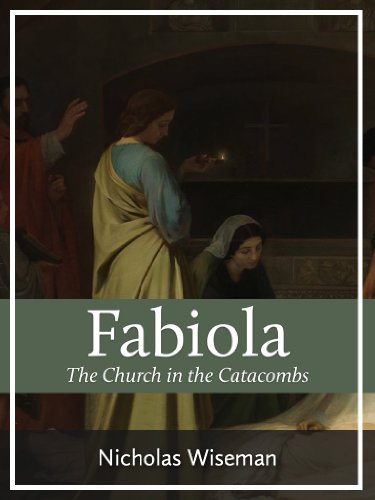
US HERE – UK HERE

I like this quote from Card. Wiseman (not in Fabiola):

“The doctrine and practice of the Church must not be allowed to be impugned by those who have no claim at all to Scripture, and who can prove neither the canon, its inspiration, nor its primary doctrines, except through that very authority which they are questioning, and through treacherous inconsistency with the principles on which they are interrogating it. When many years ago this ground was boldly adopted, it was charged with being an attempt to throw Protestants into infidelity, and sap the foundations of the Bible. Years of experience, and observation not superficial, have only strengthened our conviction, that this course must be fearlessly pursued. We must deny to Protestantism any right to use the Bible, much more to interpret it. Cruel and unfeeling it may be pronounced by those who understand the strength of our position, and the cogency of the argument; but it is much more charitable than to leave them to the repeated sin of blaspheming God’s Spouse, and trying to undermine the faith of our poor Catholics.” [The Catholic doctrine on the use of the Bible, 1853]

I’m sure that the Evangelist, Jerome and Fabiola would have all been in agreement.

Lift a libation and invoke health today for your loved ones on this Feast of St. John.

Posted in Saints: Stories & Symbols |
2 Comments

ASK FATHER: Must we do penance, abstain from meat, on Friday in the Octave of Christmas?

This is a question which comes up each year. It came up again today.

Must we do penance on Friday within the Octave of Christmas?

The short answer is YES.  This year.

According to Canon Law, Catholics are bound to do penance on Fridays of the year except when the Friday is of the liturgical rank of a “Solemnity” (a new-fangled post-Conciliar rank).

In some years, the Friday will be 1 January.  That’s another matter, because 1 January is the Solemnity of Mary, Mother of God in the new-fangled calendar, and the Solemnity removes the obligation.

This year, however, Friday is the third day after Christmas and the Feast of St. John the Apostle and Evangelist.

The Octave of Christmas does not have the same liturgical “weight” of the Octave of Easter.

Easter Friday (a Solemnity) outweighs the penance thing, but Christmas Friday does not.

Note can. 1251 in the 1983 Code.

Can. 1251 Abstinence from meat, or from some other food as determined by the Episcopal Conference, is to be observed on all Fridays, unless a solemnity should fall on a Friday. Abstinence and fasting are to be observed on Ash Wednesday and Good Friday.

Remember, you can ask your parish priest to dispense you or commute acts of penance.

Can. 1245 Without prejudice to the right of diocesan bishops mentioned in can. 87, for a just cause and according to the prescripts of the diocesan bishop, a pastor [parish priest] can grant in individual cases a dispensation from the obligation of observing a feast day or a day of penance or can grant a commutation of the obligation into other pious works. A superior of a religious institute or society of apostolic life, if they are clerical and of pontifical right, can also do this in regard to his own subjects and others living in the house day and night.

Members of religious communities and third orders should consult their own regulations and review to whom they turn for dispensations.

It may be that some local places have exceptions in their calendars.   For example, if, this year, you are a parishioner of a parish named in honor of St. John Evangelist, or perhaps the Sts. Theophanes and Theodore, martyrs (Feast 27 Dec.), your patronal feast could be a reason not to be bound by Friday penance.

Also, you can substitute another form of penance for abstaining from meat.  Make it penitential, however.  Abstinence from meat has good reasoning behind it.  For some, however, there abstinence from other things can be of greater spiritual effect.

Posted in 1983 CIC can. 915, Liturgy Science Theatre 3000, Our Catholic Identity | Tagged , ,
2 Comments

26 Dec: St. Stephen the Protomartyr, his Archconfraternity, and the Octave

In addition to Boxing Day, and the day good King Wenceslaus went out, it is the feast of St Stephen. I hope all your snow is neat and crisp and even.

St. Stephen’s feast has been celebrated this day since the earliest centuries of the Church’s life.

We are also in the Octave of Christmas. Octaves are mysterious. For Holy Church time is suspended so that we can rest in the mystery of the feast.  In her wisdom, Holy Church “stops” her clock so that we contemplate the mystery of the feast from different angles, through different lenses.

St. Stephen reminds us of the consequences of discipleship.  

He is usually depicted surrounded by people who are beating him to death with rocks.

Today, agents serving the “mystical body of Satan” – witting and unwitting – use Fishwrap, Amerika, and Twitter/X  to do that.

As I said, there are consequences of discipleship.

Are you ready for consequence in the days remaining to you?   Consequences can be more or less dramatic.  I think we need to get our heads into mental places wherein we can imagine even dire consequences.

I also congratulate all the members of the Archconfraternity of St. Stephen!  This is a guild of altar boy that started in England.  The first chapter ever outside of England was at my home parish of St. Agnes, in St. Paul.  In the sacristy there was a letter from the Archbishop of Westminster approving the chapter and each year on this day the new boys were enrolled.

I am enrolled!  Just after I entered the Church.

May all liturgical service at the altar be reverent, competent and… male.

Posted in Liturgy Science Theatre 3000, Saints: Stories & Symbols, Save The Liturgy - Save The World | Tagged
1 Comment

25 Dec 2020: Fr. Reginald Foster, OCD – RIP

In your goodness, please offer a prayer for the repose of the soul of Fr. Reginald Foster, OCD, who died on Christmas Day in 2020.

Foster was a Carmelite if Holy Hill, WI, Latinist for many Popes in Rome, and teacher/mentor for countless students.

As I wrote back in the day, I owe Reggie a terrific debt for the gift of his knowledge of the Latin language that he passed on and good years of friendship. He was a rara avis if ever there was one, simultaneously jovial and irascible. He was one of the smartest, keenest minds I’ve ever known.

He said a lot of things that shocked people and wasn’t in the least the picture of the cleric. I think that a lot of the time, he said things to shock because he was a little bored. He had 1000MHz more brain speed than any one in the room, and a virtually photographic memory. If he got on your case about something, holy angels help you. However, he was astonishingly kind. When I was studying with him in Rome during one of the really intense summer courses for advanced students I had a tumble and badly injured my ankle. Foster came to visit me every single day… bringing homework sheets – the legendary LUDI DOMESTICI.

Fr. Foster could veer from curmudgeon to Samaritan in an instant, and he could be both at the same time. Many were the times I spotted him in Rome sitting on a curb with a homeless guy or giving him his sandwich out of his briefcase. Affable and gruff. Chipper and brusque. And I found that, once you got past the first layer of the encounter and he relaxed a bit, the man truly was a priest down to his nails. He suffered at the hands of his order and ecclesiastics and he was not happy at all about certain clerical doings.

Foster was, of course, for years in Rome writing Latin for the Holy See and also teaching. Thousands of priests passed through his “experiences” and, today, when we read important documents of pontiffs past, we are often reading Reggie’s Latin.

In his last years he had physical ailments, which were not entirely not his fault.

I will pray for my old friend, whom I’d known since the early ’80s, and I commend him to Our Lady of Mount Carmel.

Posted in PRAYER REQUEST |
4 Comments

“Et verbum caro factum est”

Posted in Just Too Cool |
Comments Off on “Et verbum caro factum est”

The Burning Babe – A Christmas Day Poem by a English Martyr Saint

The Burning Babe
by St Robert Southwell, S.J., martyr (1561–1595)

As I in hoary winter’s night stood shivering in the snow,
Surpris’d I was with sudden heat which made my heart to glow;
And lifting up a fearful eye to view what fire was near,
A pretty Babe all burning bright did in the air appear;
Who, scorched with excessive heat, such floods of tears did shed
As though his floods should quench his flames which with his tears were fed.

“Alas!” quoth he, “but newly born, in fiery heats I fry,
Yet none approach to warm their hearts or feel my fire but I!
My faultless breast the furnace is, the fuel wounding thorns,
Love is the fire, and sighs the smoke, the ashes shame and scorns;
The fuel Justice layeth on, and Mercy blows the coals,
The metal in this furnace wrought are men’s defiled souls,
For which, as now on fire I am to work them to their good,
So will I melt into a bath to wash them in my blood.”

With this he vanish’d out of sight and swiftly shrunk away,
And straight I called unto mind that it was Christmas day.

Posted in Poetry, SESSIUNCULA |
3 Comments

Daily Rome Shot 1207 – Buon Natale!

Many thanks to anyone who has sent an item from my wishlist.   I try to send a note, when I am able.  Amazon has made it harder to do that.  Sometimes, they don’t include gift slips.  Once, the slips had an email.  Now they have a Q code, which doesn’t lead to a page where you can send a note.  If I have not had an email or registration from you, I am stuck.

Hence, today, thanks to KS for the nice comments about the ADVENTCAzTs and for the reliquary.  I will put your name on the base underneath so I will remember you.

Just to help you keep perspective on who is naughty and who is nice.

White BLACK to move and mate in 2.  How fast did you find it?

Posted in SESSIUNCULA |
6 Comments

PRAYERCAzT: Singing the 2024 Christmas Proclamation or Kalendas in Latin (audio), – and a hard ASK FATHER question

First, the Kalendas.

For years I’ve posted about this.  It was/is a custom for centuries before Mass begins to sing the Kalendas, the solemn announcement of the birth of the Savior at Prime.

Since Prime isn’t being sung in many places, and since we need to have these good customs in far greater use, sing it before Midnight Mass in the Vetus Ordo. The Novus Ordo too. Why not?

In the proclamation, the birth of Christ follows a list of important events, set points in history, which therefore puts the birth of Christ into the context of the history of salvation, beginning with the Creation of the world and culminating in the Nativity.

In the ancient world there was no standard calendar. One way to pinpoint events was to say what else was going on at the time according to other reckonings of time. The overlap of the dates would then give you the desired result, like a chronological Venn Diagram. The overlapping of the dates of the events cited in the Proclamation results in an accurate dating of the Nativity, that is 3/2 BC. There is good scholarship that reinforces 3/2 BC and cleans up a dating error for the year of Herod’s death.

The older Roman Martyrology has the notation for the Modus Ordinarius. It is rather like the “prophecy tone” and you raise the pitch at certain places.

There is a fancier rendering which is provided by Cappella Gregoriana Sanctæ Cæciliæ olim Xicatunensis. HERE

Here’s what the Kalendas sounds like more or less, if you can stand my singing.

The eighth Kalends of January. The 24th Moon. In the 5199th year from the creation of the world, when in the beginning God created the heavens and the earth; In the 2957th year from the flood; In the 2015th year from the birth of Abraham; In the 1510th year from the exodus of the people of Israel out of Egypt under Moses; In the 1032nd year from the anointing of David as King; In the 65th week according to the prophecy of Daniel; In the 194th Olympiad; In the 752nd year from the foundation of the city of Rome; In the 42nd year of the reign of the Emperor Octavian Augustus; In the 6th age of the world; While the whole earth was at peace, Jesus Christ, Eternal God and Son of the Eternal Father, desiring to hallow the world by His most merciful coming, having been conceived of the Holy Ghost, and once nine months passed after His conception, was born of the Virgin Mary at Bethlehem of Judah, made Man. The Birth of our Lord Jesus Christ according to the flesh.

Keep in mind there is also on Epiphany the singing of the announcement of the moveable feasts for 2023, the Noveritis, “Let y’all know”, which does change quite a bit from year to year for obvious reasons.

And now the other part.

From a priest reader…

QUAERITUR:

Dear Fr. Z,

Happy Ember Day. I suppose you are about to post the Kalendas for Christmas. I have a related question that perhaps you would like to address.

Do you know how the date for the creation of the world was derived? It is quite a bit shorter than the patriarchal timeline of the Biblical genealogy based on the Masoretic/Vulgate. And far shorter than the SP/LXX/Byzantine.

I am interested for a number of reasons. The Jews seem to have had prophecies, such as in the Talmud, that the Messiah would come after 4000 years. And also that the world would end after 6000, with prophecies of the Messiah as well. Some early Christians accepted this.

I have been very much enjoying reading the complete Ignatius Study Bible. But their notes for Genesis dismiss all the lifespans of the patriarchs. I don’t see why. Fr. Ripperger has aligned himself in the past with the Kolbe Center, which teaches young earth creationism. He seems to think it is possible anyway.

I just don’t understand how the Kalendas date could be about 600 years off. Why wouldn’t they just add up the dates from the Vulgate?

I question the motivation of the following organization, but I found this essay quite fascinating:
https://armstronginstitute.org/853-the-chronological-debate-from-adam-to-abraham-in-defense-of-the-masoretic-text

In Domino,… Fr. NA

So…

I just don’t understand how the Kalendas date could be about 600 years off. Why wouldn’t they just add up the dates from the Vulgate?

Okay.  I’m going to hand this off to the readership.  I suspect there is a Smarticus Pantsicus out there who will know something about this.

Posted in "How To..." - Practical Notes, ASK FATHER Question Box, Liturgy Science Theatre 3000, PRAYERCAzT: What Does The (Latin) Prayer Really Sound L, SESSIUNCULA | Tagged
5 Comments

Daily Rome Shot 1206 – Fishwrap’s spittle-flecked nutty

Welcome registrant:

Rick from Oregon

Thanks go out to a couple more of you who moved from Continue To Give over to Zelle for your donations.   I really appreciate it.  The sooner the better for the rest!

Yesterday’s Holy Mass was offered for my benefactors.

Please remember me when Christmas shopping online and use my affiliate links.  US HEREWHY?  This helps to pay for health insurance (massively hiked for this new year of surprises), utilities, groceries, etc..  At no extra cost, you provide help for which I am grateful.

In churchy news…

Fishwrap is having a spittle-flecked nutty about Pres. Trump’s appointment of Brian Burch (of CatholicVote) as Ambassador to the Holy See. HEH… er um… HERE. Moreover, there is a sustained whine about women “rethinking their relationship to the church” – yes, small c. TDS is clearly on display, but it’s more than that. This one exemplifies much of what is aberrant in Fishwrappery. HERE. Another, is Madame Defarge’s hissy attack on Edward Pentin and Diane Montagna for writing about papabili cardinals. HERE

Some years ago a cardinal of my acquaintance told me that because Francis didn’t call the cardinals together in consistories, they didn’t have an opportunity to get to know each other. That was a way to control and to manipulate regarding a future conclave. This piece by Sandro Magister addresses that. HERE

Fr. David Nix has an interesting round-up about whether or not Russia has been consecrated to the Immaculate Heart of Mary in the way that MARY wanted Russia to be consecrated. You can guess the conclusion. Interesting information compressed together. HERE

In chessy news… HERE

White to move and mate in 4.

Posted in SESSIUNCULA |
5 Comments

WDTPRS: Collect 4th Sunday of Advent (Vetus Ordo) – “What our sins are obstructing”.

This prayer was in the ancient Gelasian Sacramentary and other sacramentaries. It survived in edited form in the Novus Ordo on Thursday of the 1st week of Advent.

Excita, quaesumus, Domine, potentiam tuam, et veni: et magna nobis virtute succurre; ut, per auxilium gratiae tuae, quod nostra peccata praepediunt, indulgentia tuae propitiationis acceleret.

Praepedio means “to entangle the feet or other parts of the body; to shackle, bind, fetter”, and therefore “to hinder, obstruct, impede”.   Something is placed “before” (prae) the “foot” (pes), which makes you stumble.  We never stumble using the thick Lewis & Short Dictionary which shows that prae-pes means also “swift of flight, nimble, fleet, quick, rapid”.  To the Latin ear, just hearing prae-ped…sparks an interesting tension of opposing concepts. During Advent we are being constantly given images of movement, of rushing swiftly to a goal: venio (“come”), suc-curro from curro, (“run”), accelero….

A LITERAL VERSION:
Rouse up Your power, O Lord, we beseech You, and come: and hasten to aid us with your great might, so that, through the help of Your grace, what our sins are hindering the indulgence of Your merciful favor may make swift.

“What our sins are obstructing/hindering”.

I’ve written about this prayer before, and in depth.  It is striking how a jewel sparkles as you move it.  So too this prayer with repetition sparks new thoughts.

I play chess, if you haven’t noticed.  When preparing to move, chess players look for checks, captures and threats.  You look to see if pieces are hanging, if your move will weaken squares.  You check your opponents position for loose pieces. Etc.   When you a shooting pool, you might have to flick a piece of lint off the table before your shot.  Golfers will clear away a twig or leaf.  Musicians and soldiers and athletes do drills.  Competitive sailors make sure their hulls are clean and smooth.

Why?  They want a successful outcome.

A gardener prepares soil and a Christian does penance, works of mercy and prays.

Agere sequitur esse applies also to being a Christian, true Christians actually what the Christian character calls for: imitation of the Lord and of the saints in faith, hope and love.

Why?  Because it is stamped into our souls in baptism and sealed into place with the Holy Spirit.

“What our sins are obstructing/hindering”.

It was, I think – without double-checking – in the Imitation of Christ we read that if we could reform in ourselves, firstly, our principal faults and then, year by year, our other self-identified vices or defects, we would be heading toward holiness.

In curling, the sweepers remove from the passage of the stone any snow or chips and they create a slight layer of water from their friction to help the stone or turn the stone.  They want to hit their mark.  Lawyers review the evidence and arguments.  Cooks do their prep and put everything out in the right place.

As Advent comes to its close, can you sense Christ is rushing towards you?

Will we hasten him to us by clearing the path of obstacles for His rushing feet, bringing peace and reward?

Will our sins hasten His more violent coming, with correction and then separation?

We must smooth His path, remove the obstacles.

When the Lord comes, He will come by the straightest path … whether we have straightened it out or not.  Our sins make His path crooked.

“What our sins are obstructing/hindering”.

Check your parishes for their schedule and GO TO CONFESSION!

Posted in ADVENT, GO TO CONFESSION, WDTPRS |
1 Comment























