CQ CQ CQ – Ham Radio Saturday

To all you Hams out there, some news.

I decided the get the General License exam under my belt, so I am studying diligently every day.  I haven’t seen math like this since physics about 30 years ago.

Also, I received recently a Radiogram from a station, perhaps a priest ham’s, in Cincinnati.  I’m not sure what to do with this, or how to respond properly according to good ham usage.  I believe one of you mentioned responding through NTS the last time I got a radiogram, from Harrisburg, PA  Alas, I didn’t.  My bad.  Maybe you hams out there should push me a little and break it down Barney style.

Also, I haven’t yet done anything with Echolink.  Perhaps we should jump start that?

That’s that.

It still have almost no equipment, other than my little YAESU VX8-DR and a whip antenna, which one of you dear readers sent me some time ago from my wish list. I often say a prayer for the sender when I switch it on.

73

UPDATE:

Oh yes… I figured out how to pick up PSK31 with an app on my phone. Rather cool.

Posted in Ham Radio | Tagged , , ,
30 Comments

Benedict XVI 10 years ago: “Pray for me…”

My friend Fr. Rutler reminded me today that 10 years ago yesterday, 24 April, Pope Benedict XVI, during his sermon for the beginning of his too brief pontificate, said, among other:

[…]

One of the basic characteristics of a shepherd must be to love the people entrusted to him, even as he loves Christ whom he serves. “Feed my sheep”, says Christ to Peter, and now, at this moment, he says it to me as well. Feeding means loving, and loving also means being ready to suffer. Loving means giving the sheep what is truly good, the nourishment of God’s truth, of God’s word, the nourishment of his presence, which he gives us in the Blessed Sacrament. My dear friends – at this moment I can only say: pray for me, that I may learn to love the Lord more and more. Pray for me, that I may learn to love his flock more and more – in other words, you, the holy Church, each one of you and all of you together. Pray for me, that I may not flee for fear of the wolves. Let us pray for one another, that the Lord will carry us and that we will learn to carry one another.

[…]

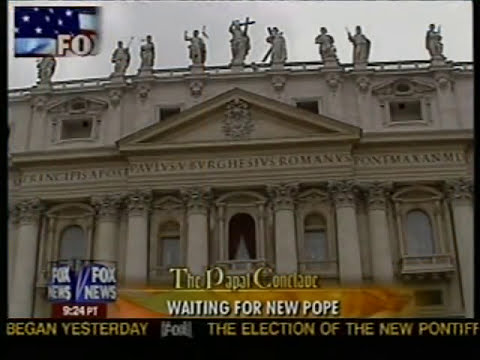
I found the FNC coverage of the election (I was on with Chris Wallace and Greg Burke):

YouTube thumbnailYouTube icon

I found the video of the Inaugural Mass:

YouTube thumbnailYouTube icon

Posted in Benedict XVI, Linking Back | Tagged
25 Comments

Wherein Fr. Z is, again, in a SciFi novel

I received a note yesterday from Catholic blogger Jeff Miller of The Curt Jester.

So I am reading through John C. Wright‘s new book and I came across this.

In a Basilica on the moon in A.D. 11049:

“A motto picked out in gold letters said in Latin: SAY THE  BLACK, DO THE RED .” A phrase from Father Z.

It’s nice to be quoted.  And in words of gold!

A sure fire way to get mentioned on a blog with nearly a million page views a month.  I’ll add it to my wish list.

I wonder if I have perhaps a second career possibility as a bit character in science fiction?

You might recall that I was a player in the rollicking fun books by Chris Kennedy.  HERE

And, I have been told, there is a chance that I might be resurrected.

Posted in Lighter fare, Linking Back | Tagged , ,
14 Comments

Feedback and a confessional story

confession-731x1024From a reader…

I went to confession! It had been 10 years. Your encouragement helped me get up the nerve to go. The hardest part was actually going to the church. I wrote down every single thing I wanted to say (including “Bless me Father…”). That helped. Your work is helping save souls.

*sniff*

My work here is done.

NOT!

Everyone…

GO TO CONFESSION!

When is the last time you heard those incredible words of absolution after a good, thorough confession of all mortal sins in kind and number?

Posted in Fr. Z KUDOS, GO TO CONFESSION, Reader Feedback | Tagged , , , ,
12 Comments

Notes on Eucharistic Prayer II

Every once in the while, when I was saying the Novus Ordo far more often than I do today (last Sunday was the first in several months, after the EF and before an EF baptism), why I used the Roman Canon and never Eucharistic Prayer II.

Well!

First, there’s the fact that the claimed origins of EP2 are thoroughly ridiculous.

And here’s a new wrinkle, from the great Fr. Hunwicke. He has a post at his place (with my emphases):

How to enjoy Eucharistic Prayer II

That charismatic writer and teacher of the 1950s and 1960s, the distinguished liturgist Fr Louis Bouyer, in his Memoires [published 2014; I am very gratefully indebted to a kind friend for these extracts], tells of his own involvement with the composition of Eucharistic Prayer II.

He [Bouyer] was summoned to join the sub-commission charged with inventing the new ‘Missal’; after seeing the drafting work aleady done, his instinct was to leave the group instantly … but Dom Bernard Botte persuaded him to stay, even if only to obtain a less dreadful result. He agreed. I give you my own probably inaccurate translation [corrections welcomed with a sigh of relief] of Bouyer’s vivid account of the early history of what has, so very sadly, become by far the most commonly used Eucharistic Prayer during this past half-century in the Western Church.

“You’ll have an idea of the deplorable conditions in which this indecently speedy reform (reforme a la sauvette) was pushed forward, when I have told you how the Second Eucharistic Prayer was tied up (ficelee). Between the fanatics who were archaeologising wildly and at random, who would have wanted to ban the Sanctus and the Intercessions from the EP, adopting the Eucharist of Hippolytus just as it was, and the others who didn’t give a damn about (qui se fichaient pas mal de) his pretended Apostolic Tradition but only wanted a botched (baclee) Mass, Dom Botte and I were charged with patching up the text so as to introduce these elements, which are certainly very ancient … in time for the very next morning! By chance, I discovered, in a writing perhaps by Hippolytus himself but certainly in his style, a happy formula on the Holy Spirit which could make a transition, of the Vere Sanctus type, leading into the brief epiclesis. Botte, for his part, fabricated an intercession more worthy of Paul Reboux [a belle epoque humourist and producer of witty pastiches] and his In the Style of … than of his own areas of academic competence. But I can never reread this weird (invraisemblable) composition without recalling the terrace of the bistro in the Trastevere where we had to work carefully at our allotted drudgery (pensum), so as to be in a position to present ourselves, with it in our hands, at the Bronze Gate at the time fixed by our bosses.” [Botte recalls in his memoires that the Pensionato in which he stayed was too full of red, purple, and cassocks; “my only break was to eat my meals in the little public restaurants on the nearby streets …”]

[… Here I’ve cut out a highly amusing chunk to force you to go over there and read the rest….]

The next paragraph begins with Bouyer informing us that the Novus Ordo Calendar was “oeuvre d’un trio de maniaques”. He also describes Archbishop Bugnini as meprisable and aussi depourvu de culture que de simple honnetete, all of which really does totally defeat either my schoolboy French or my plain old-style Anglo-Saxon sense of decency de mortuis; I’m not sure which. It’s such a terrible burden being an Englishman.

Mémoires Louis BouyerI’ll be heading to Rome in May for some research.  I must get this book.  I don’t see it yet on Amazon USA in French.  It is available at Amazon UK (HERE) and at Amazon ITALY (HERE), at Amazon CANADA (HERE) and of course Amazon FRANCE (HERE).

Let’s have a couple POLLS about the Eucharistic Prayers you usually here.

Pick the answer that best describes your situation.  Feel free to use the combox to elaborate.

Anyone can vote in both polls,  but you have to be registered to comment.

At Ordinary Form Mass on Sundays and holy days...

View Results

At Ordinary Form Mass on Sundays and holy days

View Results

Posted in Liturgy Science Theatre 3000, POLLS | Tagged , ,
57 Comments

Another morsel for #TalkLikeShakespeare Day

Today my Word of the Day from the OED is

honorificabilitudinity, n.

[‘ Honourableness.’]

Pronunciation: Brit. /ˌɒnəˌrɪfᵻkəˌbɪlᵻtjuːˈdɪnᵻti/, U.S. /ˌɑnəˌrɪfᵻkəˌbɪlᵻt(j)uˈdɪnᵻdi/

Etymology: <  post-classical Latin honorificabilitudinitas honourableness (13th cent. in British and continental sources) <  honorificabilitudin-honorificabilitudo honourableness (in a charter of 1187 in Du Cange; <  honorificabilis honourable (7th cent.; <  honorificare honorify v. + classical Latin -bilis -ble suffix) + classical Latin -t?d? -tude suffix) + classical Latin -it?s -ity suffix.

In a number of texts from the 16th and 17th centuries the Latin ablative plural honorificabilitudinitatibus is cited as an example of a very long word: compare Complaynt of Scotland (1548–9), Prolog. lf. 14 b, Shakespeare Love’s Labours Lost (1598) v. i. 41 (see quot. 1598 at head n.1 1b(a)), and Marston Dutch Courtezan (1605) v. H. The Latin form honorificabilitudinitate (ablative singular) is similarly mentioned in Dante De Vulgari Eloquentia (c1305) ii. vii.  [And we get some Dante as a bonus!]

Compare the following example of the Latin word in an English context:

1599  T. Nashe Lenten Stuffe 24 Physitions deafen our eares with the Honorificabilitudinitatibus of their heauenly Panachæa their soueraigne Guiacum. Honourableness.
Now rare in regular usage, but freq. cited as an example of an unusually long word, or (incorrectly) as the longest word in the English language. Sometimes with reference to Shakespeare’s use of the Latin word (see etymology).

1656  T. Blount GlossographiaHonorificabilitudinity, honorableness. [Also in later dictionaries].

1785  T. Holcroft Choleric Fathers ii. 38 This vast honorificabilitudinity Commands my esteem!

1800  in Spirit of Public Jrnls. (1801) 4 147 The two longest monosyllables in our language are strength and straight, and the very longest word, honorificabilitudinity.

1823  J. Lunn Horæ Jocosæ 43 No honorificabilitudinity Or wealth could suffice To content her.

1908 Denver Med. Times & Utah Med. Jrnl. Jan. 345 Long words (of which the longest is honorificabilitudinity, latinized by Shakespeare).

2005 Province (Vancouver, Brit. Columbia) (Nexis) 15 Mar. a20 Students might consider the old-fashioned spelling bee as nothing more than floccinaucinihilipilification. Well, we see it more as an act of honorificabilitudinity.

In the aforementioned play there is one of the Bard’s famous quotes, followed by the WOTD in question:

MOTH:

[Aside to COSTARD] They have been at a great feast
of languages, and stolen the scraps.

COSTARD:

O, they have lived long on the alms-basket of words.
I marvel thy master hath not eaten thee for a word;
for thou art not so long by the head as
honorificabilitudinitatibus: thou art easier
swallowed than a flap-dragon.

Talk Like Shakespeare at least once today.

Flap DragonBTW… “flap-dragon” was a game played in Shakespeare’s day. If you want to play at home, you’ll also need a fire extinguisher, ice, and ointments. Put heated brandy in a bowl with raisins and set the liquid on fire. Turn off the lights. Take turns plucking the raisins from the flaming booze! Fun for all! This game is also mentioned in Henry IV Part II (which the DVD is languishing on my wish list, as Preserved Killick would add):

FALSTAFF:

Because their legs are both of a bigness, and a’
plays at quoits well, and eats conger and fennel,
and drinks off candles’ ends for flap-dragons, and
rides the wild-mare with the boys, and jumps upon
joined-stools, and swears with a good grace, and
wears his boots very smooth, like unto the sign of
the leg, and breeds no bate with telling of discreet
stories; and such other gambol faculties a’ has,
that show a weak mind and an able body, for the
which the prince admits him: for the prince himself
is such another; the weight of a hair will turn the
scales between their avoirdupois.

Ehem.

Yes.

Posted in Just Too Cool, Lighter fare, O'Brian Tags, Preserved Killick | Tagged , ,
7 Comments

Thanks to readers, monthly donations, Mass for benefactors

A quick word of thanks to readers who have sent donations or wish list items.  I will say Mass for the intention of benefactors tomorrow Friday, 24 April.

Oremus pro benefactoribus nostris.  Retribuere dignare, Domine, omnibus nobis bona facientibus propter nomen tuum vitam aeternam.  Amen.*

I am grateful when donations come in, either ad hoc (one offs) or on a regular, monthly basis through the subscription option (at the bottom of the blog).  I keep track of everyone’s name and remember them in my prayers and in intentions for Holy Mass.  It is important that we remember our benefactors in prayer.

That said,  I note that for this day of the month, the 23rd, only 3 people were signed up.  Today there was a new subscriber, SV. He made it 4.  Thanks SV!

Some days of the month have quite a few regular subscribers signed up and other days very few.  Today is one of those “lean” days for the blog.

If you are using the blog regularly, please consider subscribing today to send a monthly donation. That way you also wind up regularly on my list of benefactors for whom I pray and for whom I periodically say Holy Mass.  This is my duty and my pleasure.

Some options


*BTW… did you know that there is an indulgence available for praying for benefactors? It is in the Enchridion Indulgentiarum conc. 24:

Preces pro benefactoribus

Partialis indulgentia conceditur christifideli qui, supernaturali grati animi affectu ductus, orationem pro benefactoribus legitime adprobatam pie recitaverit (e. g. Retribuere dignare, Domine).

Retribuere dignare, Domine, omnibus nobis bona facientibus propter nomen tuum vitam aeternam. Amen.

Posted in SESSIUNCULA |
Comments Off on Thanks to readers, monthly donations, Mass for benefactors

A curious lacuna in ‘Misericordiae vultus’, the Bull for the Holy Year of Mercy

From a reader…

QUAERITUR:

Today I was reading Misericordiae vultus and noticed that, in section 15 on the Works of Mercy, [Pope Francis] gives both full lists of 7 works, and then goes on to expand on all 7 of the Corporal Works but only 6 of the Spiritual.

The Spiritual Work he doesn’t expand on is “admonish the sinner.”

I’ve checked the English, Latin, Spanish, and Italian versions online to make sure one clause didn’t just drop out accidentally. Not there in any of them.

Thoughts on this?

Sure.  I have thoughts about this.  But I can only speculate.

It’s a no brainer, for a Year of Mercy, to urge people to practice the all the Corporal and all the Spiritual Works of Mercy.  All of them, and not just the easy ones.  Right?

Perhaps someone should ask Fr. Lombardi.

The moderation queue is ON.

Posted in Francis, The Drill | Tagged , , ,
53 Comments

A Talk Like Shakespeare Day Gift to the Fair Readership that frequenteth This Blog

It’s…

Talk Like Shakespeare Day!

#TalkLikeShakespeare
#TalkLikeShakespeareDay

Therefore,

I urge you all hence forth to speak in verse.
Pentameter iambic would be best.
Hear, O gentles! Also strive to use
in thy fair speech some homage to the Bard.

Maybe you could (ehem… Coulds’t thou not) use the word “Prithee” a few times today, or, perchance, “perchance”?

As a tribute to the Playwright, I offer to you, firstly, a hitherto unknown fragment of an epilogue to the famous play Richard III!

Some others bloggers might, I trow, say that this is an exclusive, first-here-only revelation, and you are forbidden to even think about this post, much less cite it, without credit.

I am not so self-absorbed.  Cite away.

Now, ladies and gentlemen, the long lost  epilogue to

The Tragikal History of King Richard III

ACT VI – Epilogue

RICHARD III, deceased, seated by a grave, holding a skull.

ENTER HAMLET Prince of Denmark, deceased, wearing Wayfarers.

HAMLET [singing ?]:

Brush up thy Marlowe
Start quoting him now
Brush up thy Marlowe
And the women wilt thou wow

But soft!

RICHARD:

Ay me!

HAMLET:

Whom do I see beside this gaping grave?
Why good ol’ Dicken, Blighty’s erstwhile king
unkindly hacked to bits at Bosworth Field!
Let’s draw near to find his sighings out.

RICHARD:

Ay me.

HAMLET [sneaking]:

He speaks!  O speak again chopp’d monarch!

RICHARD:

Now is the summer of our afterlife,
made somewhat gloomy by our funeral rites;
and all the clouds that lour’d upon our lot,
in the deep bosom of fair Leicester gather’d.

HAMLET:

What ho, good Richard, of that name the third
to wear fair England’s crown, too short a time.
Down seem’st thou to me, and desponding.
Thy so black mood resembleth close that garb
of inky sable I did sport as in
the halls of gloomy Elsinor I moped.
Art thou so dull and drear that thou woulds’t steal
to earthy pit, my shtick to plagiarize?
Thou must be truly vex’d to so converse
with bony chops, by grave and dirt and muck.
Tell me quickly: park you here a lot?

RICHARD:

Everyone’s a comic now, I see.
Dost thou permit thyself at my expense
a joke to craft of where my bones did lie?
Give, I pray, the rest of that silence
thou did’st prate on before thine own demise.
If not, begone, shove off, and hie the hence.

HAMLET:

Peace, good King.   I do but jest.
In earthly life I was a pill, and now
in heav’n’s joys jocund choose I to be –
and not to be as earnest as before.
In life I would have liked to be a card,
perhaps a jack o’ hearts or e’en napes,
e’en as that Yorick was, whose skull you swip’d.
Come, explain.  Tell me everything.
Why is royal Dicken in the dumps?

RICHARD:

Less didst thou annoy when in thy ebon
garb thou wert sunk in melancholy deep.
Inky Hamlet I could bear. But deign
I not to suffer Dane transform’d, in shirt
Hawaiian, cracking wise and gamboling.
But nay, stay a bit and tell me true.
Art thou not mooning still over that blond?
That swimming challeng’d girl? What was her name?
Oprah?  Something on those lines?

HAMLET:

Okay okay.  Enough.  Thy point I take.
Cheap shot. Thou art not well dispos’d.
But tell me. What’s the deal?  Get a grip.
Spill it all and list shall I sincere.

RICHARD:

Apology accepted, Prince of Danes.
If thou wilt not take thy face hence at once
I’ll unburden’d be.  You asked for it.
Yes, my tomb and long lost place of rest,
beneath that car park less than august was
for monarch royal, e’en one cast down
in wars of rosy houses, white and red.
Now they’ve found my bones and dug me up.
Alchemy scientific they employ’ed
and rituals forensic they performed
upon my matter osseous, my framework
skeletal, my lineage to spy.

HAMLET [sitting down]:

O wizardry most modern!  Tell me more!

RICHARD [holding the skull]:

Studied they my skull, my wounds and hacks,
my curvéd back did they interrogate
until, at last, my bones, renovate,
encloséd were in wooden casket fair.

HAMLET:

Much trumpeted was this in media massy.

RICHARD:

They bore me thence, a royal tomb to fill
in Martin’s Church at Leicester.

HAMLET:

And so?

RICHARD:

See’st thou not?  Shall I thee explain?
When thou didst breathe in that vale lachrymose
wert thou not a pious Catholic prince?
Surely thou dost sense the sting that thy
bones in clay encloséd are till doom,
in Denmark, once a land of faithful flock.
The Danish realm, as did the Britians’ isle,
slith’ring slid down into mischief sin
of error and schismatical protest.
Their backs they turned on Holy Peter’s smile,
in separation now circumnutate.

HAMLET [aside]:

What a ranting polysyllabic.
Something bad is eating him for sure.

RICHARD:

Woe! More woe! And woe is me!
Thou, Hamlet, royal Dane, must also feel
this piercing sting, e’en in heaven’s bliss!

HAMLET:

Hang on there!  Just a second wait!
Dicken, we’re in heaven, see….

RICHARD:

… yes I know.
Paradoxical I choose to be.
In heaven’s bliss are we and in God’s sight
replenish’ed by vision Beatific.
But this is yearly “Talk Like Shakespeare Day”.
The cleric scribe who put us side by side
must needs a post for blog readers to write.
We are therefore stuck here, players fretting.

HAMLET:

O horrible, O horrible, most horrible.

RICHARD:

Shall I say more? List, list, O list!
In course they put my corse in church bereft
of sacrament, of apostolic line,
of teachings clear which no one can suspect.
In angle of a temple Anglican
my bones now lie, far from the Presence Real
as dear to me in life as nothing else.
Entombed am I, unhousel’d evermore.

HAMLET:

Ay, there’s the rub!  For in that church
there is no Mass, no priest, no bishop true.

[aside]

Now for effect dramatic shall I droop.
Though steep’d in bliss, I’ll put on visage sad.
A pair lugubriously blissful now are we.

RICHARD:

But shall I now reveal my heart’s true wound?
Near so-called cathedra of Leicester were
my bones with some formality interr’d.
But elsewhere Catholic Mass was lifted up
before my exsequies in that lost church.

HAMLET [glancing at his watch and rising]:

Soooo, there you have it, Dick, my buried friend!
All’s well that ends well!

RICHARD:

But wait, there’s more!

HAMLET [aside]:

Who knew…

RICHARD:

Long in the past we shuffled off the coil.
Some centuries of years did pass before
a pope of name Iohanine, large of build,
did bishops call into a solemn meet,
second in the place where Peter’s bones
do faithful Christians come to venerate
upon the hill called Vatican at Rome.
There the Council Father’s would mandate
some several changes to the rites of Mass.
But woe again, and woe! For those few points
were seized upon by certain buggy clerks
who then hijackéd all commands reforming.
Though “nihil innovatur” bishops said,
the buggy clerks changed all the black and red.
An innovated ordo did they scribe
and foisted it on Catholics far and wide.
Confusion and decorum’s loss did reign
and no one did the liturgists restrain
from ravages, in power goggle-eyed.
Art did they in, and the noble shrines
builded in love from forebear’s gold and sweat.
They tore them ‘till they bled.  Everything
upon which they could work their heinous spells
they did amend, annihilating despots.
But, heark ye, friend.  I do digress.  I see
that you do stare and wonder at my rant.
Behind thine eyes can I descry the same
indignation and loss of which I speak.
But soft.  I shall be circumspect.
To make the story short, which could be long
in telling as the tale of Trojan grief,
as wending as the paths of him who yearn’d
to see belovéd Ithaca again,
the wily polytrop and trickster sly,
as lengthy as the yarn which Virgil…

[HAMLET consults his watch and looks toward the nearby pub]

To make the story short, an Ordo new,
wholly Novus did they cobble up.
This is the rite by which they prayed when near
the river Soar they offered holy Mass
my once lost bones to reinter with care,
remembrances and prayers.  This is the rite.
They did not use the book for Mass which you,
which I, knew, when we with our mortal step
trod under sun and stars and breathed in air.
They could have used our own belovéd prayer.
For behold, there came another Pope, of frame
more delicate by far, in name twice blessed,
in lore of God and ritual reknown’d.
This pope freed up again the ancient use.
This pope did liberate our hallowed rites.
Rites Roman he unchained, and op’ed the way
for enrichments organic, mutual.
Reason enough, I say, for Summorum.
But no.  The sense that’s common to us all
did stare directly in their faces wan.
I, who lived in century fifteenth,
got Ordo Novus, not tradition’s Mass!
So sit now I upon this ground to tell
the too sad tales of requia of kings.

[ENTER LEAR]

LEAR:

What ho!  Hail, fellows, and well met.
This Day is called the Feast of Shakespeare,
or something on that line.  We should find a pub.
What’s this I see?  Of somber mien?  Depressed?
What’s up?  What problem could there be in heav’n?
O Richard, of thy name the third, this white head,
which heavy wore a crown, shall hear thee out.

HAMLET [aside]

He had to say it….

RICHARD:

Thanks, Lear. But come, let us go.  Our Danish pal
impatient grows the brews at yon fair pub
completely to explore.  Let us go hence,
and there this “Talk Like Shakespeare Day”
observe with beverage apt. It’s happy hour.
And as we go I’ll tell you, celtic lord, what gives.
You see, and stop me if I’ve told you this before,
they’ve found my bones and dug me up!

HAMLET: [aside]

I should have stuck to Marlow.

RICHARD:

Alchemy scientific they employ’ed
and rituals forensic they performed
upon my matter osseous, my framework
skeletal, my lineage to spy….

LEAR:

Tech spiffy! Tell, pray, everything.

HAMLET:

Richard?  Hey!  Initial rounds on thee.

[EXEUNT OMNES]



Posted in Lighter fare | Tagged ,
28 Comments

ASK FATHER: Continuously adding tap water to Holy Water

holy water bottleFrom a reader…

QUAERITUR:

I recently discovered that a Sacristan at the NO parish I attend is filling the Holy Water tank with water taken from the public washroom tap…no priest is blessing this. The Holy Water in this tank is used to fill the fonts in the Church as well as freely available to anyone who wishes to take it home. The tank is marked as Holy Water. I believe this Sacristan is thinking it’s ok because as “normal” water is being added to the tank, it is being “blessed” or absorbed by the Holy Water in the tank already. I have heard some priests say this too: As long as you don’t add more than half of regular tap water, this is fine to do and all the water is blessed. This doesn’t sit well with me for some reason. Can you ease my mind on this matter or give me something concrete to give to our parish priest so it can be rectified?

That should be ended as soon as possible. People want Holy Water. They should not be deceived. The agents of Hell know the difference!

It is possible, in a pinch, to add a small amount of water to Holy Water or Baptismal Water if there isn’t a sufficient quality for the task for which it is needed. However, that should not be the usual practice and only a small amount, proportionally, should be added.

It is better simply to bless more Holy Water and make sure it is in sufficient supply.

It doesn’t take much time to bless Holy Water, even with the older rite in the traditional Rituale Romanum (which is the only rite which I have ever used or which I would even consider using). If the priest is too lazy to do even what the Novus Ordo indicates… well… shame on him.  Someone should kick his backside into gear.

However, it is far more likely that this problem doesn’t even pass through the priest’s radar, because he is not asked to bless Holy Water. Thus, he doesn’t think about it.

A good practice is for every sacristy to have a large card with the words “BLESS” and “BLESSED” on either side. Prop up that card with the “BLESS” side displayed near the water containers (I’ve done several buckets at a time, no problemo) and the page-marked book and the stole (and the salt). When the priest is done, he turns the card over to “BLESSED”.  Bada bing.

I am sure that Father is a diligent man who will happily bless any amount of Holy Water, even often, if the request is made and everything is laid out.

Why wouldn’t he?  This is precisely the sort of thing for which we was ordained?

Posted in "How To..." - Practical Notes, ASK FATHER Question Box, Our Catholic Identity | Tagged
36 Comments