The fruits of Anglicanorum coetibus: new Catholics join the Anglican Ordinariate

From the UK’s best Catholic weekly, the Catholic Herald. My emphases.

Ordinariate comes to life in Holy Week

By Anna Arco & Simon Caldwell

The world’s first personal ordinariate has grown dramatically during Holy Week.

New members of the Personal Ordinariate of Our Lady of Walsingham celebrated their first Easter as Catholics after the new structure expanded from 20 to almost 1,000 members after receptions and confirmations during Holy Week.

Groups of former Anglicans were received and confirmed at celebrations across the country, which began on the Monday of Holy Week. Most groups entered into full communion with the Catholic Church on Holy Thursday before or during the Mass of the Lord’s Supper though a number of groups were also received at the Easter Vigil.

Mgr Keith Newton, the Ordinary, or head, of the ordinariate, said that it was only now that the ordinariate was coming to life, although the structure was officially established in January.

He said: “This is the start of it. The lay faithful moving into the Catholic Church is really the start of the ordinariate. Until now there have been only about a dozen members, but now it is growing to between 900 and 1,000.

“It is not an enormous number of people in Catholic terms, or even for the Church of England, but it is quite significant that such a number of people are making this step together.”

The Ordinary said that the first wave of groups coming into the Catholic Church only marked the beginning of the ordinariate and that many Anglicans were watching the process carefully.

Ordinariate groups exist across England, Wales and Scotland, including in Greater London, Coventry, Cornwall, and Birmingham. The south of England was the part of Britain most strongly represented in the first wave of groups joining the ordinariate.

Fr Edwin Barnes, one of the five former Anglican bishops who have become ordinariate priests, celebrated the Easter Vigil for a group from St Barnabas in Tunbridge Wells, Kent, who had been received earlier that week. During his homily he told the group that joining the ordinariate was a kind of “resurrection moment”. The little beginnings of the different groups were “a new flowering of the Resurrection”.

“Easter is always the same, but always different,” he said. “For you the differences are very plain: no cavernous spaces of St Barnabas’s to help lift up your hearts. Until now you have been able to rely on the generosity and the prayers of those who preceded you in that place.”

The ordinariate group, Fr Barnes said, needed to “keep in touch with our former Anglican friends, to ensure by our kindness that we don’t put up barriers”. “We will be looked at by many to see just what sort of a go we can make of being ordinariate Catholics,” he said.

For James Bradley, the former curate of St John’s Sevenoaks, the Easter Triduum marked an important journey for his family. He was confirmed during the Mass of the Lord’s Supper with his former vicar, Ivan Aquilina and the Sevenoaks ordinariate group, while his sister was confirmed the day before at the Oxford Oratory. His parents were confirmed during the Easter Vigil.

Mr Bradley, who is due to be ordained as one of the ordinariate’s two transitional deacons, said: “It was wonderful to see my sister and parents received this week. Whilst they have made their own very personal journey into the full communion of the Church, it’s obviously also been something very profound for us to share.”

Archbishop Bernard Longley received three groups on Holy Thursday at St Chad’s Cathedral in?Birmingham. Ian O’Hara, who belongs to the Coventry group, said: “Maundy Thursday was a profoundly moving yet joyful and inspiring day. This was the culmination of a journey which for many of us had lasted several years.”

Speaking about the Mass of the Lord’s Supper, Mr O’Hara said: “This Mass was especially significant and poignant for us as it marked the end of our Eucharistic Fast which we had all begun on Ash Wednesday. To make our Communion for the first time as Catholics on the very day our Lord instituted the Eucharist will have a deep and lasting affect on us all.”

For Easter the group joined the parish of St Joseph the Worker in?Canley where they had received instruction.

Mr O’Hara said: “We were delighted to be able to take a full part in the Easter Vigil on Holy Saturday night and the Mass of Easter Day where we  celebrated our Lord’s Resurrection with even more joy and gusto this year.”

We would like to hear the stories of newly received members of the personal ordinariate. If you would like to share your story, please contact us at editorial@catholicherald.co.uk.

Posted in Brick by Brick, Just Too Cool, New Evangelization, Our Catholic Identity, Pope of Christian Unity, The future and our choices | Tagged ,
6 Comments

Dust up in UK over anti-Catholic legislation

From CNA:

Royal row breaks out in UK over anti-Catholic legislation

London, England, Apr 25, 2011 / 05:02 pm (CNA/EWTN News).- In the week of the Royal Wedding, a centuries-old law banning British monarchs from becoming or marrying a Catholic is sparking an international row in the United Kingdom.

London’s Daily Telegraph reported on April 25 that plans to abolish the 1701 Act of Settlement have been ditched because of “significant objections” from the Church of England. [How many former Anglicans were received into the Catholic Church in the last few week?]

Now the First Minister of Scotland, Alex Salmond, has written to the British Government asking for urgent clarification.

“I recently wrote to the Prime Minister (David Cameron) calling for the abolition of all discrimination contained in the Act of Settlement, including its blatant discrimination towards Catholics, which is completely unacceptable in a modern society. [The Last Acceptable Prejudice.] I am deeply concerned at these reports that this much-needed and long overdue reform has been shelved by the UK Government,” Salmond wrote.

There is no similar prohibition on the British royal family marrying members of other faiths such as Islam or Judaism, or those who are agnostic or athiest. Anglicanism is still the state religion in England and the monarch is called the “Supreme Governor” of the Anglican faith.

A spokesman for the British Government told the Telegraph, that the government “accepts there are provisions (in the Act) which could be discriminatory.”

However, [You knew there would be a “however”…] he added, the process of amending the law is “a complex and difficult matter that requires careful and thoughtful consideration” because it effects [or affects] succession to England’s throne. [Oh yes… that has to be thought through.]

A Church of England spokesman expressed similar concerns. He said that the anti-Catholic prohibition “inevitably” looks outdated. [“But …”,… hear it coming?]

But if the prohibition were removed the difficulty would still remain that establishment requires the monarch to join in communion with the Church of England as its Supreme Governor and that is not something that a Roman Catholic would be able to do consistently with the current rules of that Church,” the spokesman told The Telegraph. [How many Anglicans became Catholic in the last few weeks?  I still don’t have numbers.]

The Act was originally passed to prevent the descendants of the Catholic King James II from ascending the throne. He was deposed in the 1688 “glorious revolution” by supporters of the Protestant William and Mary.  Mary was the eldest Protestant daughter of James II and was married to William of Orange, who later became William III.

In recent years, the Act has effected [affected, perhaps] several members of the British royal family.

In 2001, Lord Nicholas Winsdor, the youngest son of the Duke and Duchess of Kent, permanently forfeited his right to the royal succession by converting to Catholicism.

In 2008, Autumn Kelly, the Canadian fiancee of the Queen’s grandson Peter Philips, converted from Catholicism to Anglicanism, [not good] thus preserving her husband’s chances of becoming king.

The present heir to the British throne, Prince William, will marry Kate Middleton on April 29 at a Anglican service in London’s Westminster Abbey.

The Last Acceptable Prejudice.

Posted in Our Catholic Identity, The Last Acceptable Prejudice | Tagged , , ,
57 Comments

Duck Time

We are out for Beijing Kao Ya.

20110425-083234.jpg

20110425-083251.jpg

More to come!

20110425-083705.jpg

More…

20110425-085513.jpg

It was suggested that th thing on the left was a favorite of a priest friend in St. Paul, which he dubbed “Rat On A Stick”.

20110425-085625.jpg

20110425-085635.jpg

20110425-105230.jpg

20110425-105240.jpg

20110425-105320.jpg

20110425-105336.jpg

20110425-105345.jpg

On the way home…

20110425-105353.jpg

Posted in Lighter fare, What Fr. Z is up to | Tagged , , ,
10 Comments

An Italian lesson in how to override the Pope

An unhappy story of a Diocese in Italy where, apparently, local authorities believe they have the right to override the Pope’s legislation for the whole Latin Church.
The intrepid Italian Vatican watcher Andrea Tornielli reports that in a small town named Vetrego in the Diocese of Treviso, don Pietro Mozzato, the parish priest, is celebrating his 60th jubilee of ordination.  For 1 May the parish was to have Holy Mass in the Extraordinary Form.  This is in keeping with Summorum Pontificum.  The celebrant was to be a priest visiting from the Fraternity of St. Peter who would come in from Venice.
The priest – let’s call him “don Ficcanaso” – of the next town over, Spinea – perhaps aptly named, I don’t know, griped to the Vicar General, and then the bishop let the old jubilarian know that such a Mass in his honor wasn’t to be celebrated.
I imagine they then played a game of “keep away” with the old priest’s cane.
But wait!  There’s more!
Apparently the Diocesean Curia of Treviso has squashed the rights of the people before when it comes to the older form of the Roman Rite, in a town named Mirano.
WDTPRS is certain that the Diocese of Treviso has plenty of time to eliminate the legitimate use of the Pope Benedict’s provisions in Summorum Pontificum because they have already radicated all liturgical abuses in the diocese and have thoroughly review all parish catechetical programs for doctrinal fidelity.
Posted in Liturgy Science Theatre 3000, SUMMORUM PONTIFICUM, The Drill | Tagged , ,
40 Comments

Have you ever wanted to share a new discovery?

On a lighter note:

Posted in Lighter fare | Tagged , , ,
6 Comments

WDTPRS POLL: Holy Thursday Foot Washing Rite – what happened?

mandatum, foot waashing, Pope BenedictLet’s return for a moment to your experience of the Triduum and Holy Thurday’s Mass of the Last Supper.
The rite of washing of feet, or Mandatum, is an option in the Roman Rite.  I know of a few places where it is not done.  In fact, we discussed whether or not to do it where I am in New York City.  (We did it.)

Also, the Church’s liturgical law is crystal clear: only males can be chosen for this, and they should be men: viri selectiVir means “man” and cannot, cannot – period – mean a female.

NB: I am not trying to be speciesist.  The Roman Rite still limits this to human beings.  Furthermore, I think the race is still limited to two sexes.  Therefore I edited one of the answer options from “and only males and females were chosen” to “and males and females were chosen”.  Please know that I am trying to overcome my speciesist tendencies.

So, what happened where you went to Holy Thursday’s Mass, assuming, of course, that you went.  Otherwise, if you did not go, perhaps you know what happened by word of mouth or by reading the bulletin, etc.

Chose your answer and add a comment in the combox, below.

Holy Thursday Mass I attended ...

View Results

Posted in "How To..." - Practical Notes, Liturgy Science Theatre 3000, POLLS | Tagged , , , ,
107 Comments

QUAERITUR: Use of force to defend a church from vandalism

From a reader:

Is is okay to fight in churches ? Can one shoot or punch vandals ? Can one defend the priest, or himself, or the Sacrament ?

Many who comment on destruction stories want to put up watches. Would this really work out properly ?

Thank you for your zeal.  The motto I have for my own coat-of-arms is Zelus Domus Tuae.

If there is serious concern about probable vandalism or break-ins, I would – first – hire a security service.  For example, one of my favorite parishes, Assumption Grotto in Detroit, has a service that watches the whole property, even at night.

In other words, if there are realistic concerns, perhaps professionals are the best starting point.

After that, I suppose that the usual moral considerations about the use of force are in play.  People have a right to defend themselves and their property and an obligation to defend others whose care is in their charge as well as the defenseless.  A proportionate use of force can be used in defense of self, others, and property.  That would also extend to that which is sacred.

Whatever is done, should not be done without consultation of the parish priest and also the police.  They should be advised if people are going to be around so they themselves are not taken for vandals.

Another idea: If people are going to be around the place, perhaps start Perpetual Adoration.  This would not only serve the cause of having people around and making they place a less desirable target, but it would also please the Lord and be of great spiritual benefit for the whole parish.

Perhaps some of the readers have had some experience with their own parish churches and security problems.

Posted in "How To..." - Practical Notes, ASK FATHER Question Box, Our Catholic Identity | Tagged , , , ,
29 Comments

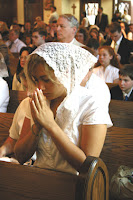
QUAERITUR: Chapel veils revisited – What color?

From a priest:

A quick question: a woman approached me wondering if there was anything inappropriate in wearing a white veil as an older, married woman.  She was told by another parishioner that white is only proper for young women who are not married.  Is there any rule or tradition that can be pointed to as a guide?

Does it really make a difference?

Okay… that was the wrong question.  What was I thinking?  All questions having to do with what women wear in church are important questions.

Leaving aside the fact that even in the day when head coverings were obligatory for women they could fulfill their obligation by wearing a hat, my understanding… and believe me when I tell you that I have made a long and deep study of this, not… is that married women tended to wear black veils.  Certainly widows would.  Unmarried women and girls – without any question virgins every one – wore white veils, white being a sign of virginity, which is proven in each and every wedding.

Of course there are any number of proofs to the contrary of both these uses of black and white.

So… as a man, I say: What difference does it make?  Wear what it pleaseth thee to wear.

I think that this custom of women wearing head coverings in church should be revived.   As it revives, if the virginal desire to wear white to signal either their nuptial availability or, in the case of consecrated virgins, their nonavailability, great!  If the espoused want to show either that they are non-nubile by using black, great!  If they want as widows to signal their continuing attitude of prayer for their late spouses, great!

What would a gray veil mean?  I wonder.  Perhaps that the woman is hoping to be a widow?  That she is divorced?

I would avoid veils that imitate liturgical colors other than white and black.  The red veil however, was used in ancient Rome for brides.  I think in China brides had red, because it called down good fortune and prosperity.  Also, avoid the use of sports or product logos, though I suppose the weave of the lace could include religious symbols, such as the … I don’t know… pelican in her piety?

And so we’re off to the races again.

Posted in "How To..." - Practical Notes, ASK FATHER Question Box, Lighter fare | Tagged , ,
63 Comments

QUAERITUR: 1st Communion denied child with cerebral palsy

Remember, if it is Easter, it is time for news stories that make the Church look bad.

I was alerted to this by a reader and it brings up a good question:

Please note this short hit piece dished out at Easter by a Texas TV
station. This little piece contains so much innuendo on proper
disposition to receive, a priest’s authority, canon law, and even
anointing of the sick that it seemed worth passing on for your
elucidation:

Child Denied First Communion
Family Of Floresville 8-Year-Old Fighting For Holy Sacrament

(Excerpt) FLORESVILLE, Texas — It was a religious milestone Irma
Castro spent months preparing her grandson Kevin for, but when it came time for his first communion, he was denied. [The way this is written makes it sound as if this happened in church, during Mass.]

“It hurts and I think it’s a form of discrimination,” Castro said.

Castro was told by Pastor, Father Phil Henning, with the Sacred Heart Catholic Church of Floresville, that because Kevin had cerebral palsy and has the mental capacity of a 6-month-old, he didn’t qualify to receive his first communion. [And the priest is right.  And this is why we need continuing catechism for adults, especially when it comes to the sacramental preparation of their children.]

“He said because he was not able to understand the meaning of receiving the body of Christ,” Castro said. [And the priest is right.]

Canon law requires that a child receiving holy communion have
sufficient knowledge” of Christ, but it doesn’t define what level of knowledge is considered sufficient. [Canon Law doesn’t say exactly, true.  But it doesn’t say nothing.]

The Code of Canon Law does not specify everything.  But, in basic, terms the person has to be able to know the difference between bread which has not been consecrated, and “bread” which has been.  Put another way, if a child can’t distinguish between ordinary food and, once told it is consecrated, a Host, then the child can’t be admitted to Communion.

Can. 97.2 there is a presumption of age of the use the reason at about 7, unless circumstances demonstrate otherwise.

Can. 913.1, says that people must be able to grasp something of what the mystery of Christ means.  They must be able to receive the Body of the Lord with faith and devotion.

Can. 913.2 the Eucharist may be administered to children in danger of death if they can distinguish it from ordinary food.

Can. 914 says that the parish priest must see to it that those who are not prepared and not sufficiently capable, should not come to Holy Communion.

In this case it sounds as it the parish priest did the right thing in the final analysis.  Of course there is nothing in the news piece about the manner in which the priest passed on this information to the parents.

It must be a terrible thing for parents to know that their child may never be able to receive the Eucharist.  But admission to the sacraments is not governed by sentimentality.  We don’t admit children who are incapable of receiving the Eucharist with faith and devotion simply for the sake of avoiding making parents feel bad.

I am frankly not sure that many of the adults going forward for Communion on Sunday could tell you what the Eucharist is, even at the level a 7 year old’s knowledge before First Communion.

Imagine my horror one day when I was asked to explain children about a week out from their First Communion what some of the things in church are.  First, they had never been taught to genuflect.  That got me to the tabernacle.  I explained why we genuflect before the tabernacle: this is where the Hosts are kept, where Jesus can be found when you come into Church, etc.  Blank stares.   Hosts… [crickets] …. Eucharist… [crickets] wafers… [crickets]…. the small round white Host people receive at Communion…  [crickets] ….

Then one little soon-to-be-First-Communicant said, and I quote, “You mean that piece of bread thing?”

Parents: Don’t assume that your children are learning anything in their sacramental preparation.

YOU are the first teachers of your children.  If you don’t instruct them properly to the best of your ability, then you will be help accountable by God for their lack of sufficient preparation.  Do your best.  The parish’s sacramental prep programs are not your surrogates.  That means that you have to know your stuff.

Posted in "How To..." - Practical Notes, Biased Media Coverage, Our Catholic Identity, Throwing a Nutty | Tagged , , , ,
63 Comments

Easter weirdness

From a reader:

My wife and I attended the Easter vigil last night and while it was
well done for a NO Mass, I still rankled at few bits. Today, Sunday
morning, I was not able to attend at our usual parish, but instead
went to Saint M______. It is a fairly small, rural, New Jersey parish in the dioceses of Trenton.

I was greeted by a 6’+ tall nun, dressed like a Roman priest, complete with stole. When I entered the church, the din was so loud that it reminded me of a sporting event. No one was paying the slightest attention to the altar, statues, or the like.

Finally, a lay person greeted everyone, told us to hug our neighbors and introduce ourselves, and then led the congregation in a round of applause for being in church. The processional hymn was a very lively number that was accompanied by piano, trumpet, and tambourine. The musicians were actually quite good and under other circumstance, would have been enjoyable; just odd to hear them in church.

I had trouble following the Mass, as it seemed pretty well “adjusted” by the priest. Not sure where some of the readings and responses came from. The homily focused on God’s love and how everyone would be saved, regardless of belief. Even the consecration was also to a large extent ad libbed and no one knelt at any point. In fact, the folding chairs were placed such that sort of pushing my neighbors out of the way, it was not possible to do so.

The Mass ended with Father calling for and receiving round after round of applause for various people and groups.

Since I’ve only been a Catholic for a year this Easter, my exposure to things like this has been limited. It certainly gave me a new
appreciation for my parish, warts and all
. It may not be perfect or even close to traditional, but it is far more “orthodox” in practice than this.

Like Joni Mitchell said, you have greater appreciation for what you have lost, even if it wasn’t perfect, after you don’t have it anymore.

Posted in Liturgy Science Theatre 3000 | Tagged ,
43 Comments
























