In his interview with the National Catholic Register, posted online in two parts on 2 and 4 October, the Prefect of the CDF, Archbishop Gerhard Müller said of the dealings of Rome and the SSPX:
“I believe that these problems will be resolved in the long term.”
Nicole Winfield of the Associated Press, however, has issued an article which distorts the SSPX situation (purposely?).
Here’s a screenshot of the headline:
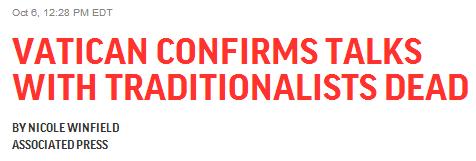
This is now all over the internet and will be in every paper and news outlet in the USA.
The problem is, she distorted the actual situation. Let’s leave aside the perennial and amateurish mistake of referring to “THE VATICAN” when it is a matter of an official of one dicastery.
By they way, the other day Winfield also wrote a cheap-shot piece about the papal butler trial. HERE.
Winfield seems to be working solely with other people’s reports about the interview Müller did with the German radio station NDR. That interview was reported on 4 October but was not aired until 6 October.
In the interview Müller said some tough things about the situation with the SSPX. He indicated that he thought the back-and-forth talks about points of Conciliar documents and doctrine were concluded. He said that the faith is not negotiable.
However, Archbp. Müller also said:
“In einem pastoralen Sinn ist die Tür immer offen… In a pastoral sense, the door is always open.”
There are also factual errors in Winfield’s piece along with the indications that she was just cribbing European coverage rather than doing her own checking.
Let’s have a look.
VATICAN CITY (AP) — The Vatican’s new doctrine czar[Note the use of political language.] says negotiations to bring back a breakaway group of traditionalist Catholics are dead and that no new talks are planned. [This doesn’t mean that the Holy See isn’t going to continue to communicate with the SSPX. Even if what Müller said was his hardened position – and ultimately the Pope gets to make these decisions – this would only point to back-and-forth discussions of doctrinal points arising from the Council’s and post-Conciliar documents. I think we have a case of a Prefect saying too much to the wrong people. We will see his position gently walked back, even though the hard-core on each end of the spectrum will have nutty in the meantime.]
Reconciling with the Society of St. Pius X – thus ending the only formal schism [It is NOT a formal schism. Some dispute that and the question is foggy, and it might look a lot like one, but there hasn’t yet been a formal statement from the Holy See that there has been a formal schism.] created since the 1962-65 Second Vatican Council – had been a priority of Pope Benedict XVI since his tenure heading the Congregation for the Doctrine of the Faith.
That office’s new chief, Monsignor[Every English-speaking writer – especially those who have worked in Rome – should know that you don’t call an Archbishop “Monsignor” when writing in English. That is an Italianism.] Gerhard Ludwig Mueller, told Germany’s Norddeutscher Rundfunk broadcaster, however, that “the talks are closed and I don’t believe there are new ones.” [He did not say “dead”.]
“We couldn’t of course expose the Catholic faith to negotiation,” he said. “There are no compromises.’ [And?]
The late Archbishop Marcel Lefebvre founded the society in 1969, opposed to Vatican II’s introduction of Mass in the vernacular and outreach to Jews. [I suppose this frivolous comment guarantees her story will be in the New York Times.] In 1988, the Vatican excommunicated Lefebvre and four bishops after he consecrated them without papal consent.
Benedict has spent nearly his entire seven-year pontificate [?!? “nearly”? She makes it sound as if he has been doing nothing else.] seeking to accommodate the society, restoring the use of the old Latin Mass favored by the society’s members, removing the bishops’ excommunications and allowing them two years of theological dialogue with the Vatican.
Aside from being sympathetic to the society’s point of view, Benedict fears the growth of a parallel church that is even more conservative than his own. [“even more”? She gets to the crux of it now: she/AP doesn’t like “conservative”. A more thought observer of the Church, however, will repost that Benedict’s church is not “conservative”. Benedict may be conservative in some ways, but it is a stretch to say that “his” “church” is.]
But the society, which boasts 550 priests and 200-plus seminarians, refused to sign off on a core set of doctrinal points required by the Vatican to come back into the fold.
“The brotherhood [German: Bruderschaft] for us is not a negotiating partner, because they don’t believe in negotiations,” Mueller said. [This quote smells bad. What did Müller actually say in his NDR interview? “This fraternity is no partner for negotiations for us, because there is no negotiating the faith.” (“Diese Bruderschaft ist für uns kein Verhandlungspartner, weil es über den Glauben keine Verhandlungen gibt.” ) Again, she didn’t check.]
Mueller is no newcomer to the issue: In 2009, he told the Catholic news agency Zenit that he wanted the society’s seminary in his diocese shut down and the four bishops to resign to live as simple priests “as part of the reparation for the damage that the schism has caused.” [Given the quote above, I wonder if that is what he actually said.]
Given Mueller’s negative view and after the talks broke down earlier this year, the pope named a trusted adviser, Monsignor[AGAIN? She cribbed European pieces.] Augustine Di Noia, to take charge of negotiations with the society. From Mueller’s comments, however, it appears there’s not much to negotiate.
The society’s most notorious member is Bishop Richard Williamson, who made headlines in 2009 when he denied that any Jews [Again with the Jews? Okay, Nicole, this will be seen by the NYT.] were killed in gas chambers during the Holocaust. His comments were a major scandal for Benedict since they were broadcast on the same day the decree lifting Williamson’s excommunication was signed.
The Simon Wiesenthal Center on Saturday welcomed the suggestion that talks with the society had broken down and said it hoped the society’s members “will eventually give up their theology of anti-Semitism and Holocaust denial.”
The society has distanced itself from Williamson.
Williams’ piece was irresponsible and hurtful.

 I get many requests by email asking for prayers. Many requests are heart-achingly grave and urgent.




 Emilio on Continue the Rome shot posts? I dunno.: “+Timothy Broglio has been seriously considered for Archbishop of Washington three times, and three times he has been passed over…”




























