8 Nov: Four Holy Crowned Martyrs: don’t fool around with demonic idols (aka Pachamama)

Today is the Feast of the Four Holy Crowned Martyrs.  They were sculptors in ancient Rome who refused to carve pagan demon idols.  Hence, they were killed by the Emperor Diocletian.

Their remains are in the Roman church of St. Marcellinus and Peter.  Greatly venerated by the Romans there is an interesting Basilica dedicated to them on the street that goes up the side of the Caelian Hill from the Colosseum to the Lateran Basilica (of which Dedication we celebrate soon).  I used to walk by this church, and San Clemente, every day on the way to university and often stopped in.   It is a Roman Station Church.

These martyrs refused to carve idols.

I wonder what they would think of Pachamama.  The garden adulation.  Setting up shop in a church.  Being carried around in St. Peter’s.  A demon idol cult bowl put on the altar of St. Peter’s.

Ponder that.

Meanwhile, these sculptors, as patron of sculptors, were highly regarded in the lofty days of Florence.  At the Church of Orsanmichele there is a statue group of them in a niche on the outer wall (the originals are inside, in a museum).  A friend in Florence sent pics:

In the museum…

In the Philadelphia Museum of Art you find a terrific Medieval collection, including a 15th c. altar piece from the same Orsanmichele.  Note that the one in charge over the torturers is being strangled by a demon.

The martyrs refused to have anything to do with idols.

Fool around with demons… you won’t win.   And if people on high fool around with demons, lots of people suffer.

Posted in Linking Back, Saints: Stories & Symbols |
8 Comments

Wherein Fr. Z apologizes

The other day I deceived you.

It wasn’t intentional, but “sorry!” nonetheless.

I had posted that St. Rita had seen the consistory list.   Well, she had, but the image I posted was not of St. Rita.

This is St. Hyacintha or Giacinta Mariscotti (+1640)

Of noble birth, she was disappointed in a marriage that didn’t happen and so entered the convent, where she lived a bad religious life with hidden food and luxuries but with a strong faith.

During an illness when a priest brought Communion to her in her cell, he saw the secret stuff and really let her have it. She changed her ways and became very ascetic, founding confraternities which helped the poor.  She died with a great reputation of holiness.

St. Hyacinta saw the consistory list.

I’ll try to find the full view of this lovely painting.

If you have a hard time living the disciplinary dimension of being an active and practical Catholic, you might ask St Hyacintha for help.


Posted in Saints: Stories & Symbols | Tagged
Comments Off on Wherein Fr. Z apologizes

Election Day Prayer

I received this via email.  Just thought I would pass it along:

Perhaps some of you priests might want to add this to your arsenal.  May a bishop or two as well.

It’s a real thing.  Exorcist friends have told me how demons can screw with electronic equipment and make it do strange things.  And then there is the their ongoing work of temptations of poll workers to do things that are wrong.

Anyone who says this isn’t real is naïve… or complicit.


Posted in SESSIUNCULA | Tagged
3 Comments

Rome/Brooklyn 22/11 – Day 39: ‘Murica

Back in Rome sunrise was at 6:49.  Sunset should be at 16:59.

The Ave Maria ought to ring at 17:30.

Today in the Basilica of St. Peter is a Feast of all the Saints and Martyrs whose relics are in the Basilica.  It is also the Feast of St. Adeodatus I (+618) and of the Four Crowned Holy Martyrs (+306), whose church is on the slope leading from the Colosseum, past San Clemente, and up toward the Lateran.  I used to walk by there everyday for university when I was a seminarian.

Before heading out to airport yesterday, I had a couple things left over in the fridge, so this was breakfast.

Behind this wall and up the street is the Casa Santa Marta a certain person lives in humility, which meant that the whole place had to be redone and the street outside the wall, pertaining to the Comune di Roma, had to be secured at the cost of, lets just say very many Euro.  But it was all for humility, so that’s okay.

The Delta planes have a new “entertainment” system, which turned out to be not very entertaining.  There is a new swoopy 3D graphical interface for flight information.   And while there are lots of movies (lookin around the cabin some of them truly fitlhy), they eliminated all the games, etc.

There were problems with the system, too, in zone all over the plane which meant that they had to reboot the system I think six times, each time requiring two things, a) 15 minutes and b) that no one touch their screens.   Imagine how well that went.   So, as we flew along we had to …

…. wait… and wait… and wait.

I never get tired of this brilliant movie, and I always enjoy the sight of Rick working a chess position with his cigarette and cocktail glass.

Someone should do a count of how many drinks were ordered in Rick’s Café Américain and then not drunk.

The flight was boring, which is how you want flights to be, and everything from the taxi at my front door to airport check-in at FCO and customs and luggage collection on the ground at JFK went without flaw.  I skipped the meals on the plane.

A friend picked me up at JFK, where everything is a half mile walk away, and we got supper.   Cheeseburger, of course, with American cheese, of course, and onion rings.

The beer had the irresistible name of Delirium Tremens.

As I glanced out the window of the guestroom in Brooklyn, I saw a sight that wove the two ends of the day: the American flag and the trees, which are plane trees, the same as line the banks of the Tiber and other boulevards in Rome.

In the following, there is material to be won.  This is easy.

WHITE to move.

NB: I may hold comments with puzzle solutions a little longer than others so there won’t be “spoilers” for others.

Interested in learning?  This guy helped my game. Try THIS.

Your use of my Amazon affiliate link is a major part of my income. It helps to pay for insurance, groceries, everything. Please remember me when shopping online. Thanks in advance.  US HERE – UK HERE


Posted in SESSIUNCULA |
9 Comments

Rome 22/11 – Day 38: Se vedemmo, Roma

Today the sun dawned upon Rome at 6:48 and it will slip below the horizon at 16:59.  Shorter.  Ever shorter.  The Ave Maria is at 17:30. Today is a dies non on the Roman calendar, and so priests do well to celebrate a Requiem Mass.

We are still in the octave during which people can obtain the plenary indulgences.  Though we remember the dead in a special way today, one could take a saint from the Roman Martyrology such as St. Willibrord.

Black to move.

White has a couple of serious threats but is overworked.  Black has options, and the bishop pair and a wicked looking Queen Rook battery.  It is important to move carefully to avoid getting checkmated.   The first move is fairly straight forward, but… then what?

Please remember me when shopping online. Thanks in advance.

US HERE – UK HERE

Thanksgiving might be more pleasant with excellent beer or wine, both made by traditional Benedictine monks.

I leave Rome today.  It has been fruitful.

I would like to return for Holy Week.

Thank you, benefactors.  You’ve had a lot of prayers and Masses here during this sojourn.

Posted in SESSIUNCULA |
2 Comments

Rome 22/11 – Day 37: Gold, Alcohol, and You

The Roman sunrise was at 6:46 and the sunset is due at 17:01.  The Ave Maria is still slated for 17:30.  It is the 22nd Sunday after Pentecost and the Feast of St. Felix, of happy memory, about whom St. Augustine wrote in his Expositions of the Psalms.

Thank you for this day, O Lord.  It is my last full day in Rome.

What to post?   People had questions about my chalice.  I had brought it back to Rome to the shop where it was made, over thirty years of wear later.

I brought my chalice with me to Rome to have it restored.  I was going to do this for my 30th anniversary but, you know, Covid and Vaxes and Masks, oh my.  I took the precious thing to the shop where it was made.

Here are a couple of photos of them working on it.

In this, the goldsmith is opening up the settings of the stones on the node do allow more light to bring out their color.

This patently is work on the paten.

A based shot.

Years ago it was determined by the Sacred Congregation for Rites that the re-gilding of a chalice required re-consecration.

I found a bishop whom I highly respect to do the honors.  I will now have the pleasure of thinking also of him when I use the chalice.  We all win!

Things laid out and ready.  I won’t show too much of the lace, because I know that it upsets some less-than-sturdy minds as being restorationizing backwardist nostalgia and therefore “YOU HATE VATICAN II!” stuff.

That’s one pretty chalice, all in all.  Fully restored it is sump’n.

After the consecration, I immediately used it for Mass for the intention of the consecrating bishop, who was so kind.

In my conversation with the goldsmith about cleaning the chalice – FATHERS! SACRISTY PEOPLE! LISTEN UP! – I was told to use only very high percentage white alcohol to clean the chalice.  Everything else will damage, “eat”, the gold.   He told me that in the shop.  I wrote a note to him to ask if anything else could be used, some sort of polish or soap and water.

His answer:

“Pulire esclusivamente con alcool puro bianco. Tutto il resto potrebbe danneggiare la doratura…  Clean exclusively with pure, white alcohol.  Anything else could damage the gilding.”

This doesn’t apply to silver, but it WOULD apply to the gilding inside the cup of a silver chalice.  It would apply to a monstrance or paten or pyx or anything else that is gilded.

So, there should be bottles of 90%+ alcohol in sacristies, and not just to make limoncello.

In the USA we have “Everclear” at 95%.  There are other brands, too.  I saw one in an Italian store the other day: 96%.   I bought it and used it to clean the chrism and smudges from the consecration. It worked like a charm.  I’ll leave this bottle with the sacristan at Ss. Trinità.  They’ll either use it for chalice or The Great Roman™ will make limoncello out of it.  Either way is a good way.

Meanwhile, I was supposed to go to see the Van Gogh exhibit in Rome at exactly the time when morons interfered.  HERE  Another one of these climate change idiocies.  They threw vegetable puree at a painting and then glued themselves to the wall while shouting slogans about carbon and climate.   The contempt I have for these nitwits is nearly complete now.   How on earth did they get that stuff in there, given what has been happening?  ANSWER: It was probably an inside job, someone on the inside letting them into the gallery with their stuff.

Here’s another kind of puzzle.

BLACK to move.  You should get this one pretty quickly.

NB: I may hold comments with puzzle solutions a little longer than others so there won’t be “spoilers” for others.

Interested in learning?  Try THIS.

Meanwhile, the mighty Robert Card. Sarah has a new book, Catechism of the Spiritual Life.

US HERE – UK HERE

Chess and Card. Sarah.  It’s a good day.

Posted in SESSIUNCULA |
18 Comments

DIEBUS SALTEM DOMINICIS – 22nd Sunday after Pentecost

A while ago, I ran into a claim that in the near future devotion to the Holy Face of Jesus would be more and more important.

Think about how our ecclesial shepherds have, through neglect and even expressions of contempt, downplayed and eroded the pious devotional practices of the faithful.  Hence, I am inclined to think that any good, traditional Catholic devotion would be better than the wide-spread near-zero we’ve got going now.

That said, we cannot go wrong with contemplation of the Holy Face of the Lord, held up before us sometimes as a portrait, sometimes as a lens, sometimes as a mirror.

In our 1980’s seminary we were inflicted with the deadly musings of Edward Schillebeeckx in his then-recent The Church With a Human Face: A New and Expanded Theology of Ministry.  The heretic priest – he eventually quit – who taught the course which was supposed to be on Holy Orders and Eucharist (but was instead about “ministry and symbol”) used this trash.  While most of us seminarians… well, some… yearned for a formation about a Church resplendent with the face of Christ for her people, we were being told to obscure, nay rather, efface that transcendent face with the merely earthly.

There’s nothing wrong with stressing the real needs of breathing and living human beings in the Church and the care she has for them.  That’s not what this seminary agenda was about.  It was a total, systematic disfigurement of the Church’s teaching on the priesthood and Eucharist.  We could say it was a radical “defacing”.   À la Rahner, sacraments only celebrate pre-existing realities.  There’s no “transubstantiation”.  When an “ordained minister” says the words of “institution” (not consecration) bread and wine become a symbol of the unity of the community gathered in that place at that moment.  À la Schillebeeckx, priests – sorry, scratch that, ministers are called forth from the community. When the community’s “face” changes, they fade back into the community for another to emerge.

My apologies. We were instructed back then not to use the “p-word”, and instead refer to ordained and non-ordained ministers.  We are all ministers, you see.

And now we are all “walking together”.  See how this progresses?

Sadly, as these heretics in the seminary crucified Christ daily in the classroom and in the chapel and in their very quarters, I often had in mind the passage in Isaiah 52:

“His appearance was so marred, beyond human semblance, and his form beyond that of the sons of men”.

This, dear reader, is the pattern we see again and again in the Church.  If Christ suffered His defacing, so must Holy Mother Church and, with Christ, many of her priests.

It isn’t a coincidence that, today, priests of a certain type are being de-faced, cancelled.

We need now to have before our eyes even painful images of the Holy Face of Christ, not only in our both beautiful and battered neighbor, but especially in the Church in the world.

Perhaps the Gospel for this Sunday can help us face up to this need.

Today’s Gospel comes from Matthew 22, which describes the Lord’s final days in Jerusalem.  The previous chapter saw His triumphant Palm Sunday entrance.  Holy Week follows, during which hostility from the high and mighty mounted and mounted against our Lord.

At this point in Matthew, we’ve just heard the parable of the Wedding Banquet, which Holy Church presented during Mass a few weeks ago.  Hard on the heels of that eschatological lesson, a group of Pharisees and Herodians oiled their way up to Jesus with flattering words to lay a trap for Him.  They asked, “Is it lawful to pay taxes to Caesar, or not?” (v. 17).  Keep in mind that at his “trial” a few days later Christ would be falsely accused of forbidding people from paying the tribute (Luke 21:2).

It is helpful to know that, in those times, the Jews had to pay two tributes, or taxes, one to the Romans and another to the Temple.  Taxation, tribute, was a sensitive issue.  Should the Lord have responded affirmatively, the Jews could have seen Him as a Roman collaborator, much as they would the hated Jewish tax collectors.  Had he answered in the negative, they could have accused him of sowing sedition against Rome.  Either way, a “yes” or a “no”, meant trouble.  Christ saw past their unctuous flattery and knew their wicked motive for asking.  He requested to see the “nomisma tou censou”, the tribute coin, a denarius, the famous standard “day wage”, sometimes translated as “a penny” as in the KJV.  There’s been some inflation since the KJV.

The Lord doesn’t deliver a parable here so much as a riddle (vv. 20-22).

Jesus said to them, “Whose likeness and inscription is this?” They said, “Caesar’s.” Then he said to them, “Render therefore to Caesar the things that are Caesar’s, and to God the things that are God’s.”  When they heard it, they marveled; and they left him and went away.

Again, context helps us to break open this nourishing bread of the Word.  The Gospel says Christ underscored not only the image on the coin, but the inscription.  His enemies responded “Caesar’s” and not some other great figure whose coins were in circulation.  It is most likely that the coin in question was a silver denarius of the adoptive son of Augustus, the Emperor Tiberius (+AD 37), which bore the image of Tiberius on the obverse with the inscription “Ti[berivs] Caesar Divi Avg[vsti] F[ilivs] Avgvstvs … “Caesar Augustus Tiberius, son of the Divine Augustus”.  In essence, “Tiberius, son of god”, for Augustus had been declared to be “divine”, like his adoptive father Julius before him.

It was a faceoff between the Son of God and the son of god, the ultimate worldly glorification of a mere mortal and the acknowledgement of the one true and living God.

Christ asked the Pharisees, “Whose likeness… is this?”  In the Greek he asks about the eikon which gives us the English “icon”.  Our Biblically oriented minds direct us back to the ancient Greek of the Old Testament, the Septuagint, and Genesis 1:27 where the same word eikon describes the creation of man in God’s image.

Putting aside controversy over Christian cooperation with or resistance to secular authority, “the state”, which over the centuries has been rooted in part in this encounter of Christ and the Pharisees, we are presented with what Paul later frames in terms of putting off the earthly man and putting on Christ, in whose image we are.  The more we are like Him in word and deed and inner orientation, the more we are good images of Him.

St. Ambrose of Milan (+397) wrote in his Commentary on Luke (9.34):

“Questioned concerning the penny, [Christ] asks about the image, for there is one image of God, another image of the world.  Therefore, the Apostle, also, admonishes us, ‘As we have borne the image of the earthly, let us bear also the image of the heavenly.’  Christ does not have the image of Caesar, because He is the image of God.”

In other words, the coin and its image of the Emperor with the false “son of god” stands for the world and its allurements.  We must detach ourselves from that image to see after the truer image.  In De officiis, the great Bishop of Milan says of the incident of the coin:

“You are laying aside the image of the eternal Emperor and setting up within yourself the image of death. Instead, cast out the image of the devil from the kingdom of your soul, and raise up the image of Christ.  This is the image that should shine in you, that should be resplendent in your kingdom, or your soul, the one which effaces all the images of evil vices.”

The Second Vatican Council’s document Gaudium et spes is not without its puzzles and its legitimate critics.  However, in the Christological section 22, we find, and please have patience with the extended quote:

The truth is that only in the mystery of the incarnate Word does the mystery of man take on light. For Adam, the first man, was a figure of Him Who was to come, namely Christ the Lord. Christ, the final Adam, by the revelation of the mystery of the Father and His love, fully reveals man to man himself and makes his supreme calling clear. …

He Who is “the image of the invisible God” (Col. 1:15), is Himself the perfect man. To the sons of Adam He restores the divine likeness which had been disfigured from the first sin onward. …

As an innocent lamb He merited for us life by the free shedding of His own blood. In Him God reconciled us to Himself and among ourselves; from bondage to the devil and sin He delivered us, so that each one of us can say with the Apostle: The Son of God “loved me and gave Himself up for me” (Gal. 2:20). By suffering for us He not only provided us with an example for our imitation, He blazed a trail, and if we follow it, life and death are made holy and take on a new meaning.

Christ, in whose image we are made, reveals man more fully to himself.  By gazing at Christ, risen and glorious, battered and defaced beyond recognition of man, we find ourselves revealed.

Jesus paid the tax for our sins with the coin of His face.

Shall we, in this time of dreadful and anxious need for our clearly struggling Church, turn away our faces?   We must look our challenges square in the face, remembering that concealed within them are the perennial enemies of our soul: the world, the flesh and the Devil.

Now is the time to pay tribute to the King, whom a week ago we celebrated as such in our traditionally oriented churches and chapels.

If not in churches, if it gets to that point, then on rocks in the forest and in people’s homes.

Posted in Liturgy Science Theatre 3000, Save The Liturgy - Save The World, WDTPRS |
10 Comments

YOUR URGENT PRAYER REQUESTS

PLEASE use the sharing buttons! Thanks!

In your charity would you please take a moment look at the requests and to pray for the people about whom you read?

Continued from THESE.

Let’s remember all who are ill, who will die soon, who have lost their jobs, and who are afraid.

I get many requests by email asking for prayers. Some are heart-achingly grave and urgent.

As long as my blog reaches so many readers in so many places, let’s give each other a hand. We should support each other in works of mercy.

If you have some prayer requests, feel free to post them below.

You have to be registered here to be able to post.

I ask a prayer for myself.  I’m dealing with a particular challenge right now.   I also want to thank all of you who pray for me.

Posted in PRAYER REQUEST |
15 Comments

ASK FATHER: Should priests wear the biretta when preaching? Wherein Fr. Z rants.

From a priestly reader…

QUAERITUR:

I cannot find when to use the Biretta at the Homily, should it be worn, if so, then does one wear at for the Epistle & Gospel readings in the vernacular/English?
Thank you for your precious time.

Use of the biretta! Finally something important, instead of all these questions I get about whether or not X is a mortal sin, or why some in the Church seem determined to commit ecclesial mass-murder and suicide. Refreshing.

A long time I ago, I coined a term “birettaquette” for this critical dimension of clerical comportment.  It has made the rounds, I think. I have some other posts about birettas, and berettas, in the archive.   Gosh, I’m getting nostalgic.  That’s a bad thing, right?

Ad ramos.

Should the biretta be worn when preaching?

This is covered by local and community custom these days. I don’t believe there are specific rubrics or responses from the old Sacred Congregation for Rites that cover this. Pun intended. No, wait. There is one: if memory serves The Pontificale Romanum (that governs ceremonies of bishops) instructs the priest to wear the biretta when preaching. However, that is in a pontifical ceremony. I’m not sure it applies “downward” to the Masses of merely mortal priests.

Fortescue, again if memory serves, opines that it should be worn when preaching, but I think Wapelhorst does not.  It makes no nevermind.  Auctores scinduntur and we can make up our own minds.

I believe that the SSPX priests do not use the biretta when preaching. As a matter of fact their biretta use seems quite limited, perhaps because when they were formed Archbp. Lefevbre, who had been a religious, deemphasized it. The FSSP, influenced in its origins from the SSPX has greater use by far, as does the Institute of Christ the King, whose members I believe may also eat and sleep wearing birettas.  A legit choice, by the way.  Before central heating people used sleeping caps and the biretta is not strictly liturgical.  Priests wore and can still wear the biretta when out and around in the cassock.

It is daily wear, as you might see in the movie Going My Way, when the old Irish priest is strolling outside around the grounds.

And then there are the authoritative don Camillo movies!

We could also get into the removal of the maniple and, in some places, the chasuble for preaching.

The idea is that at that moment the priest steps out of Mass, as the sermon was not perceived as part of the Mass, and then puts them back on when finished and Mass “resumes”, like halting and restarting a clock. In the post-Conciliar view, the sermon is part of the Mass, not a-part.

This usage view reveals something about readings as perceived by the Novus mind or the Vetus mind.

In celebrations of the Novus Ordo you often get the sense that you are in a didactic setting, where things are being described, related, explained, taught. Versus populum orientation of the altar magnifies this as does the vernacular.

In the Vetus Ordo the readings are also sacrificial in nature. This is why in the traditional Roman Rite the readings are always read by the priest celebrant at the altar, which is the place par excellence of sacrifice. In 1962 there was a daft shift in this in regard to the Epistle and Gospel which dopey changes are fit only to be entirely ignored. The main point is that even the uttering of the words of Sacred Scripture in the Mass is the raising of a sacrifice, as incense rises heavenward, and so forth.  Therefore, the readings have to be read by the priest even if they are then sung or read by someone else (subdeacon, deacon, layperson in some places).

It occurs to me as I write that the Novus Ordo practitioner emphasis of the separation of elements underscores how the dimension of sacrifice was obscured in the Novus Ordo regarding readings.

Firstly, in the Novus Ordo there are two books, a Missal and a Lectionary.  Bugnini back in the day wanted to make sure that the priest could never say Mass from one book ever again.  The use of a second book isn’t just because the number of readings was multiplied.  It was a separation of word from sacrifice. In the Vetus Ordo, all the readings are in the same book as all the elements for the Sacrifice.  The use of a separate book for the singing of the readings by subdeacon and deacon is purely a matter of utility and not a theological statement.

Next, in the Novus Ordo design of some churches and sanctuaries there is such an emphasis on the word, that the ambo is given just as much emphasis as the altar, sometimes even being placed in such a way that they have equal positions next to each other.   I’m sure you’ve seen that in places.

I’m digressing, but you see how all of these things are interlaced.

The biretta doesn’t carry nearly the significance as sacred vestments or altars and ambos. However, it did develop from the scholar’s doctoral cap. Therefore, from its origin it seems not unreasonable to wear it while preaching.

That said, some reflection on these matters could provide a priest with a sort of “examination of conscience” about his preaching.  It is not for nothing that the Council of Trent took the matter of quality of preaching (and therefore formation) in hand and called for a book for priests to guide their sermon and instruction, the Roman Catechism.

I do not see an absolute conflict between the idea of “stepping out of Mass” to preach and the sermon being “part of Mass”.  Here is a real point of “mutual enrichment” that Benedict XVI wrote about.  The two views of the sermon seem on the surface to be antitheses.  But are they really?  The priest has choices to make about his preaching.  These two ways of thinking about the sermon could provide some orientating course corrections.

To the point about birettas, there is no hard and fast rule, authors are divided, and local custom and the preference of the priest governs this all important question.

Now back to the lesser stuff, like is it really necessary to go to confession (yes), is is eating alligator permitted on Fridays of Lent (yes), and whether certain acts are mortal sins even in marriage (of course).

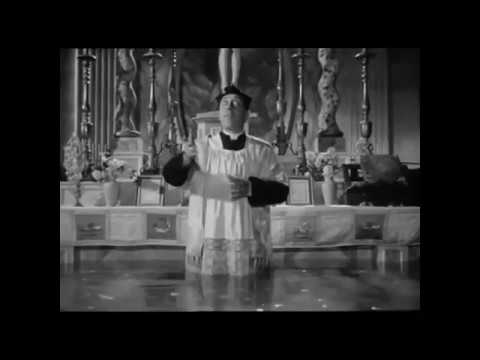
I’ll conclude with this, in Italian, but authoritative and thematically and visually apt for our sad days, when a flood of what can only be called persecution has driven many of the faithful who desire traditional worship out of their “homes”, their churches and chapels.  Don Camillo stays at the altar and, unable to say Mass because of the flood, and reminds people that one day the flood water will subside, the sun will return to shine, sorrow will diminish and divisions will be healed.

Amen.

YouTube thumbnailYouTube icon

A REMINDER of the old BIRETTAS FOR SEMINARIANS PROJECT.

Posted in "How To..." - Practical Notes, ASK FATHER Question Box, Hard-Identity Catholicism, Liturgy Science Theatre 3000, Mail from priests, Save The Liturgy - Save The World, SUMMORUM PONTIFICUM, Wherein Fr. Z Rants | Tagged , ,
17 Comments

Rome 22/11 – Day 36: Stressed and blessed

I had a stress-filled day.  I made it to the end thanks to a prince of the church, for one thing, and a new good friend, for another.

The day was also good in a way that I can only describe as heavenly intervention.  I can’t share the issue involved, but I think I have evidence.

St Thérèse was active in my vocation once before, at its beginning.  I believe I recounted that elsewhere: I had received her classic sign of roses in huge abundance when I asked her intercession at a critical moment.   This is why I have a wreath of roses on the node of the chalice I just had refurbished and, this morning, reconsecrated.

I think she just got involved again.  After I had spoken of her intercession earlier in the day, this was spontaneously given to me in the evening when I was getting groceries for supper at the shops around the Campo de Fiori (apt).

The ambient.  Workers are taking down the stalls and cleaning up after the day.  Massive street sweepers are roaring around.  It was so windy that things were being blow over, garbage is whirling.

What I received out of the blue in this chaos.

What’s really amusing about this is that, just the other day I had a thought about my relics of St Thérèse during the Exposition of Relics at Santissima Trinità dei Pellegrini.  I have two 1st class relics which are impossible to get now.  I considered bringing one to Rome for the parish, to which I am so very much attached.

On what day in the Church’s traditional calendar did I have this tough but good day, and when I received this rose out of the blue?

5 November – The Feast of the Holy Relics.

I would like to post a chess puzzle and some promotions but I am at last a puddle.

I am so grateful for you who have prayed for me.


Mary, Queen of Clergy… St Thérèse….

Thank you, Lord, for this day.

The sun had risen in Rome at 6:45.  It set at 17:02.

The Ave Maria was supposed to be at 17:30.


Posted in SESSIUNCULA |
1 Comment