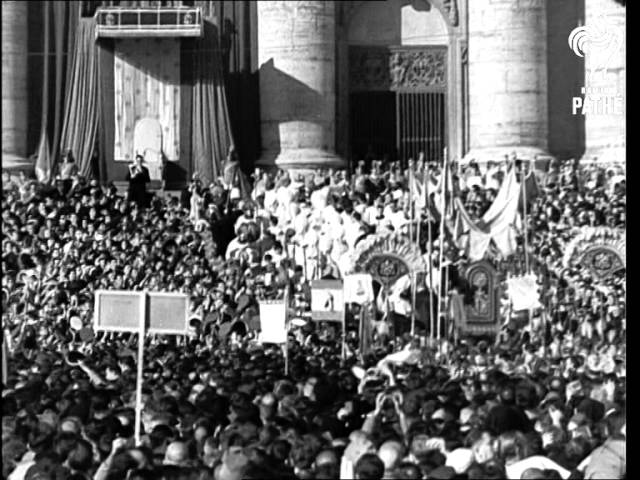
NB: Today, the Feast of the Assumption of the Blessed Virgin Mary, we can begin a 54 Day Novena!
Remembering to pray for Card. Burke, who is ill, we might pray a 54 Day Novena using the Memorare, the Rosary, or another Marian prayer, for the mitigation of the cruel Motu Proprio Traditionis custodes. My sources suggest that Traditionis is not the only thing to be coming down the line. Things can get worse, especially for the so-called “Ecclesia Dei” communities, who are now under the hammer of the Congregation for Religious (think: Franciscan Friars of the Immaculate).
Here is something I posted back in 2006 for my “Patristic Rosary Project”. I drill into into the Mysteries we reflect on during recitation of the Rosary using the lens of texts from the Fathers of the Church. I will have to return to that PRP one day and do some editing and expanding. In the meantime, … here is the post relevant to today’s beautiful feast.
_____
4th Glorious Mystery: The Assumption
 Although Ven. Pius XII refers carefully to Mary having completed the course of her life, rather than explicitly to her death in the document whereby he declared infallibly the dogma of the Assumption, and St. John Paul II adverts to the end of Mary’s life in a General Audience in 1997 – as do other saintly writers – we do not have from the Church a definitive or infallible teaching beyond a shadow of a doubt whether Mary died and then was assumed body and soul into heaven at that moment or if she was assumed without dying. That said, it was certainly fitting that, if her Divine Son tasted death, then she would as well. On the other hand, it is possible that in some manner like to perhaps what unfallen man might have been able to do, Mary’s love for God could no longer be contained and so she went to God by loving choice rather than through the punishment of the Original Sin she did not have.
Even in the Eastern tradition, which speaks of the Dormition, the Sleeping, of Mary we have a sub-current of death. Sleep is certainly a euphemism for death and they are closely related. Greek κοίμησις gives us κοιμητήριον or Latin coemeterium, whence English “cemetery”, which is a “sleeping place”. Traditions are divided about her last earthly breaths. Some authors hold that she did not die before her Assumption. There is also a strong tradition that she was buried. That said, no one really knows where, though the cult of the burial places of the holy has always been strong, even in the days before Christ.
Perhaps a good explanation is that Our Blessed Mother, desiring to be like her Son, who did die, chose herself to die though Satan had no hold on her. It was fitting that she, the daughter of her Son and disciple of Her Lord, should be as He was. So, after a brief interval during which no corruption touched her, her soul and body were reunited in heaven in the presence of God.
In any event, we know with our Catholic faith, and by infallible authority, that at the end of her earthly life, the Mother of God was assumed into heaven and no stain of the corruption of the grave touched her.
Our humanity is seated at the right hand of the Father in the divine Person of our Lord, but now also in the human person of our Lady.
Christ is consubstantial with the Father. Christ is consubstantial with His Mother.
Mary is Mother of a divine Person with two natures. She is not Mother of part of Christ, but Mother of all of Christ in His integrity. And so, we can call her Mother of God and Mother of the Church. Her heavenly Assumption was fitting.
There are not elaborate reflections in the writings of the Fathers on the Assumption, because it was not a main point of theological interest for them. Still, we can find their thoughts on some passages of Scripture which help us to understand Mary’s role in the plan of our salvation.
As a perfect model for our own Christian discipleship, we can consider, among many texts, Proverbs 8:
And now, my sons, listen to me: happy are those who keep my ways. Hear instruction and be wise, and do not neglect it. Happy is the man who listens to me, watching daily at my gates, waiting beside my doors. For he who finds me finds life and obtains favor from the LORD; but he who misses me injures himself; all who hate me love death.
While this concerns Wisdom, in a sense it harks to Mary, Wisdom’s seat. Here is the reflection of Athenagoras on this section of Proverbs:
[The Son] is the first offspring of the Father, I do not mean that He was created, for, since God is eternal mind, He had His Word within Himself from the beginning, being eternally wise. Rather did the Son come forth from God to give form and actuality to all material things, which essentially have a sort of formless nature and inert quality, the heavier particles being mixed up with the lighter. The prophetic Spirit agrees with this opinion when He says, “The Lord created me as the first of His ways, for His works.” Indeed we say that the Holy Spirit Himself, who inspires those who utter prophecies, is an effluence from God, flowing from Him, and returning like ray of the sun. Who, then, would not be astonished to hear those called atheists who admit God the Father, God the Son, and the Holy Spirit, and who teach their unity of power and their distinction in rank? … We affirm, too, a crowd of angels and ministers, whom God, the maker and creator of the world, appointed to their several tasks through His Word, He gave them charge over the good order of the universe, over the elements, the heavens, the world, and all it contains. [A plea regarding Christians 10]
This fellow sounds a bit like a subordinationist, but he is fascinating. This passage is interesting also for its hints at the cosmology and physics of late antiquity. Also, it aims at the spiritual hierarchy in which our wondrous Lady has a privileged place.
Consider that the reward of assumption into the beatific vision stems as well from her perfect act of free will when she gave her “Fiat” to God’s will as expressed by the angel. Here is St. Augustine speaking of the impact of free will:
Man in paradise was capable of self-destruction by abandoning justice by an act of will; yet if the life of justice was to be maintained, his will alone would not have sufficed, unless He who made Him glad had given him aid. But, after the fall, God’s mercy was even more abundant, for then the will itself had to be freed from the bondage in which sin and death are the masters. There is no way at all by which it can be freed by itself, but only though God’s grace, which is made effectual in the faith of Christ. Thus, as it is written, even the will by which “the will itself is prepared by the Lord” so that we may receive the other gifts of God through which we come to the Gift eternal – this too comes from God. [Enchiridion 28.106]
God’s grace and Mary’s “Fiat” which was by grace. Mary was drawn with love into God’s plan and, later, into God’s presence. The Fathers made frequent use of the Song of Songs. St. Gregory the Great writes about the exchanges of heaven and earth which marked the plan of salvation:
The Church speaks through Solomon: “See how he comes leaping on the mountains, bounding over the hill!” … By coming for our redemption the Lord leaped! My friends, do you want to become acquainted with these leaps of His? From heaven He came to the womb, from the womb to the manger, from the manger to the Cross, from the Cross to the sepulcher, and from the sepulcher He returned to heaven. You see how Truth, having made Himself known in the flesh, leaped for us to make us run after Him. [Forty Gospel Homilies 29]
Our Lady, who would feel Christ leap beneath her heart, herself leapt after Christ in her heart by her “Fiat”. She leapt to begin His public ministry when she said at Cana “Do whatever He tell you.” She leapt up Calvary with Him when the Blood and water flowed down. Her motherly and Christian heart leapt in joy in seeing Him gloriously risen. She leapt to Him in heaven when her earthly life was concluded.
In heaven Mary shines with the glory God shares with her. In the book of Revelation we have a description chapter 12 of the woman clothed with the sun. The Fathers speak about this image. They will mostly consider the woman as an image of the Church. We cannot reduce the Church to Mary. Nor in talking of the Church as Christ’s Body reduce Christ to the Church. But the three, Christ, Mary and Church are intimately associated. Hippolytus (+245) writes:
By the “woman clothed with the sun”, he meant most manifestly the Church, endued with the Father’s Word, whose brightness is above the sun. And by “the moon under her feet,” he referred to [the Church] being adorned, like the moon, with heavenly glory. And the words “upon her head a crowd of twelve stars” refer to the twelve apostles by whom the Church was founded.
Of course Christ founded the Church on the Apostles, and chiefly upon the Rock who is Peter. The description of the woman, however, fits Mary the Mother of the Church as well as the Church herself. Here is an extended piece by someone not too many in the West may read, Oecumenius (6th c.) called the “Rhetor” who wrote the earliest Greek commentary on Revelation:
The vision intends to describe more completely to us the circumstances concerning the antichrist…. However, since the incarnation of the Lord, which made the world his possession and subjected it, provided a pretext for Satan to raise this one up and to choose him [as his instrument] – for the antichrist will be raised to cause the world again to fall from Christ and to persuade it to desert to Satan – and since moreover His fleshly conception and birth was the beginning of the incarnation of the Lord, the vision gives a certain order and sequence to the material that it is going to discuss and begins the discussion from the fleshly conception of the Lord by portraying for us the mother of God. What does he say? “And a sign appeared in heaven, a woman clothed with the sum and the moon was under her feet.” As we said, it is peaking about the mother of our Savior. The vision appropriately depicts her as in heaven and not on the earth, for she is pure in soul and body, equal to an angel and a citizen of heaven. She possesses God who rests in heaven – “for heaven is my throne” – it says yet she is flesh, although she has nothing in common with the earth nor is there any evil in her. Rather, she is exalted, wholly worthy of heaven, even though she possesses our human nature and substance. For the Virgin is consubstantial with us. Let the impious teaching of Eutyches, which make the fanciful claim that the Virgin is of another substance than we, be excluded from the belief of the holy courts together with his other opinions. And what does it mean that she was clothed with the sun and the moon was under her feet? The holy prophet Habakkuk, prophesied concerning the Lord, saying, “The sun was lifted up, and the moon stood still in its place for light.” calling Christ our Savior, or at least the proclamation of the gospel, the “sun of righteousness”. When He was exalted and increased, the moon – that is, the law of Moses – “stood still” and no longer received any addition. For after the appearance of Christ, it no longer received proselytes from the nations as before but endured diminution and cessation. You will, therefore, observe this with me, that also the holy Virgin is covered by the spiritual sun. For this is what the prophet calls the Lord when concerning Israel he says, “Fire fell upon them, and they did not see the sun.” But the moon, that is, the worship and citizenship according to the law, being subdued and become much less than itself, is under her feet, for it has been conquered by the brightness of the gospel. And rightly does he call the things of the law by the word “moon”, for they have been given light by the sun, that is, Christ just as the physical moon is given its light by the physical sun. The point would have been better made had it said not that the woman was clothed with the sun but that the woman enclothed the sun, which was enclosed in her womb. However, that the vision might show that the Lord, who was being carried in the womb, was the shelter of His own mother and the whole creation, it says that He was enclothing the woman. Indeed, the holy angel said something similar to the holy Virgin: “The Spirit of the Lord will come upon you, and the power of the Most High will overshadow you.” For to overshadow is to protect, and to enclothe is the same according to power. [Commentary on the Apocalypse 12.1-2]
Take careful note of the image drawn on by the interesting Oecumenius, which also speaks to the cosmology of late antiquity. First, Oecumenius either knew that the sun gave light to the moon, as it does, or he extrapolates this from the glory that Christ gives to Mary.
All our Marian feasts, all our reflection, to keep the sunlight and moon theme going, always must draw us back to the Person of the Lord. We reflect on the face of the Lord who is reflected in the face of His Mother.
Our recitation of the Rosary brings us to know the Lord more and more and, in turn, know ourselves better.
We reflect His image and likeness and He came into the word to reveal us more fully to ourselves.
 I see that the LCWR recently had their annual confab, but alas by Zoom or some such. They’ve had some meetings that were so weird that you would think they were all smoking hash. You can see what they are up to at the Fishwrap (aka National Sodomitical Reporter)… right after you read about their advancements of – I am not making this up – TAROT CARD spirituality.
 From a reader…
 Today in the traditional Roman calendar is the Feast of St. Joachim, father of the Blessed Virgin Mary.

 Although Ven. Pius XII refers carefully to Mary having completed the course of her life, rather than explicitly to her death in the document whereby he declared infallibly the dogma of the Assumption, and St. John Paul II adverts to the end of Mary’s life in a General Audience in 1997 – as do other saintly writers – we do not have from the Church a definitive or infallible teaching beyond a shadow of a doubt whether Mary died and then was assumed body and soul into heaven at that moment or if she was assumed without dying. That said, it was certainly fitting that, if her Divine Son tasted death, then she would as well. On the other hand, it is possible that in some manner like to perhaps what unfallen man might have been able to do, Mary’s love for God could no longer be contained and so she went to God by loving choice rather than through the punishment of the Original Sin she did not have.
 Christ is consubstantial with the Father. Christ is consubstantial with His Mother.
 There are not elaborate reflections in the writings of the Fathers on the Assumption, because it was not a main point of theological interest for them. Still, we can find their thoughts on some passages of Scripture which help us to understand Mary’s role in the plan of our salvation.
 While this concerns Wisdom, in a sense it harks to Mary, Wisdom’s seat. Here is the reflection of Athenagoras on this section of Proverbs:
 This fellow sounds a bit like a subordinationist, but he is fascinating. This passage is interesting also for its hints at the cosmology and physics of late antiquity. Also, it aims at the spiritual hierarchy in which our wondrous Lady has a privileged place.
 Our Lady, who would feel Christ leap beneath her heart, herself leapt after Christ in her heart by her “Fiat”. She leapt to begin His public ministry when she said at Cana “Do whatever He tell you.” She leapt up Calvary with Him when the Blood and water flowed down. Her motherly and Christian heart leapt in joy in seeing Him gloriously risen. She leapt to Him in heaven when her earthly life was concluded.
 Of course Christ founded the Church on the Apostles, and chiefly upon the Rock who is Peter. The description of the woman, however, fits Mary the Mother of the Church as well as the Church herself. Here is an extended piece by someone not too many in the West may read, Oecumenius (6th c.) called the “Rhetor” who wrote the earliest Greek commentary on Revelation:
 being carried in the womb, was the shelter of His own mother and the whole creation, it says that He was enclothing the woman. Indeed, the holy angel said something similar to the holy Virgin: “The Spirit of the Lord will come upon you, and the power of the Most High will overshadow you.” For to overshadow is to protect, and to enclothe is the same according to power. [Commentary on the Apocalypse 12.1-2]