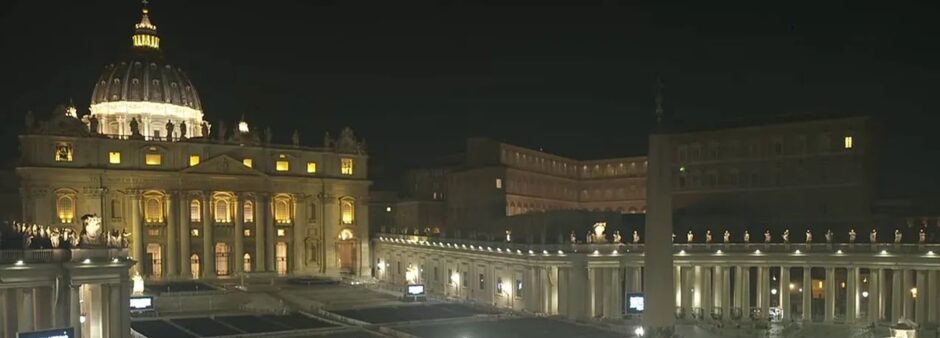
Daily Rome Shot 175

Photo by The Great Roman™

None of you are going to know where this is.  It is in a side room of Ss. Trinità dei Pellegrini.  It had been at a chapel built on the place – near St. Paul’s outside-the-walls, where, according to legend, Sts. Peter and Paul fleeing the Mamertine Prison went their separate ways.  The chapel was called Cappella della Separazione.  It was moved in the 16th c. and then demolished in 1910.   As the story goes, Peter fled toward the via Appia and lost a foot binding, which is supposed to be kept at Ss. Nereo e Achilleo called “in fascicola”.  Peter went on, as they say, to meet Christ … “Domine!  Quo vadis?”


Posted in SESSIUNCULA | Tagged
1 Comment

Ummm…. a little glitch in the new Apostolic Constitution “Pascite gregem Dei”

At the end of the Apostolic Constitution which promulgates a new Book VI of the 1983 CIC we find in the version released via the Bolletino…

Ooops.

It’s FRANCISCUS.

At the top of the document, his name is spelled correctly.

I’ve heard his Latin.  I wonder if the error in the website for the signature reflects the actual signature.

Nah!  Couldn’t be.

It’s always something these days when Latin comes forth from the Holy See.

However, to be fair, in the vatican.va site it is this way.  Properly spelled but without the “PP.”  There is “PP.” at the top, but not at the signature location.  At the signature location in the Bolletino version someone added the “P.P.”

So, what’s it gonna be?  Did he sign his name “Franciscus” or “Franciscus PP”?

Posted in Latin, Lighter fare | Tagged
1 Comment

Holy See now a participant in the World Health Organization

Meanwhile, as the release of Book VI dominates churchy news, this item is also in the Bolletino:

On Monday, 31 May 2021, the World Health Assembly adopted, by consensus, Resolution Participation of the Holy See in the World Health Organization presented by Italy, which formalizes the participation of the Holy See in the work of the World Health Organization as a non-Member State Observer. This decision reflects the relationship that the Holy See has continuously maintained with this Organization since 1953 and it bears witness to the commitment of the family of nations in addressing, through dialogue and international solidarity, the global health challenges that afflict humanity.

What could possible go wrong with that?

Posted in ¡Hagan lío! | Tagged
9 Comments

The Code of Canon Law has a new section about penal law, offences and punishments. There are new things.

Today the Code of Canon Law was updated in a dramatic way.  An entire Book (major section) was chopped out and replaced with a new version.  This is Book VI which deals with “penal law”, that is, offences and punishments.  It takes effect on 8 December.

I am still absorbing the text.   It seems that quite a bit has been rearranged without wholesale change to the canons.  For example, I note that can. 1367, which concerns mistreatment of the Eucharist is now can. 1382.  It is moved from a section called “Delicts against religion and the unity of the Church” to a new section called “Offences against the sacraments”.

Can. 1388, which deals with the Seal of Confession, had two articles.  It is now can. 1386 and it has a third, which species making recordings or using tech to divulge what is said in sacramental confession.

Here’s a good one, not in the previous (still current until December) Book VI:

Can. 1379 § 3. Both a person who attempts to confer a sacred order on a woman, and the woman who attempts to receive the sacred order, incur a latae sententiae excommunication reserved to the Apostolic See; a cleric, moreover, may be punished by dismissal from the clerical state.

Diaconate is a sacred order.  Sorry, deaconette wannabes, this doesn’t look too good for your cause.  If there were any serious notion of a possible ordination of women to the diaconate, this would not have been included in the new Book VI.

The previous corresponding canons said that anyone who simulates the administration of a sacrament was to be punished with a just penalty.  Any attempt to ordain a woman to any sacred order would be simulation of a sacrament.   However, this new canon makes it explicit: women cannot be ordained – end of sentence.

There are canons that concern sexual “grooming” of minors or the vulnerable (qui sibi devincit aut inducit minorem aut personam) and use of pornography.  An interesting way to describe “groom” in Latin.

I see that can. 1357, which every confessor needs to know about, is still numbered the same and remains the same.

Can. 1321, which deals with who can be punished, now explicitly states that “§ 1. Any person is considered innocent until the contrary is proved.”  That wasn’t in old Book VI.

The section about “prescription” is expanded.  “Prescription” is a kind of “statute of limitation”.  Some crimes have to be dealt with in a certain period of time.  Some crimes have a longer period, for example, clerics who abuse minors, have 20 years whereas, a person who steals ecclesiastical goods, has 7 years.  There is also now to be, if I understand this rightly, a period of time in which the canonical process must be completed.  I need to look at this more, but my initial reading suggests that people can’t just twist in canonical limbo forever.  Their cases have to be dealt with in a certain period (NEW can. 1362 § 3).   I’m sure this will be made clearer.

ADDENDUM:  
Canonist Ed Condon at the new and engaging Pillar had this to say about can. 1362.  It seems I was right.  The rest of his observations are quite interesting too.

The new text of canon 1362 is a shot clock.

The canon allows a window of only three years from the beginning of a formal canonical process for the prosecution to conclude its case, before the clock on the statute of limitations starts running again.

Clerics in lingering canonical processes can now demand a resolution to their status, and eventually make a legal claim that the case against them has expired. Alleged victims can remind the Church’s canonical prosecutors, called “promoters of justice,” that the opportunity for justice can be thwarted by a running game clock.

Here’s something interesting.   The Apostolic Constitution (the highest form of papal document) promulgating this new Book, named Pascite gregem Dei, was issued today via the Bolletino in Latin (first), and Italian, German, and Spanish, but not in English.  I note with interest that a lot of things coming out of the Holy See don’t have Latin versions, at least at the beginning.  This does.  Of course it must be in Latin, since the Church’s official language and the necessary language in all things judicial is Latin.   Hence, if anyone should say that Latin isn’t really necessary anymore for the governance of the Church, just have a look at THIS.

And here is a key paragraph:

Elapsis temporibus, multa mala secuta sunt ex defectu perceptionis intimi nexus in Ecclesia exsistentis inter exercitium caritatis et poenalis disciplinae usum, quoties adiuncta id requirunt. Hic cogitandi modus – ut experientia docet – periculum secum fert degendi vitam iuxta mores disciplinae contrarios, ad quorum remedium solae exhortationes vel suasiones non sufficiunt. Huiusmodi rerum status frequenter secum fert periculum ne progrediente tempore talis modus sese gerendi ita inveterascat ut difficiliorem reddat emendationem multaque scandala et confusionem inter fideles disseminet. Hanc ob causam poenarum inflictio ex parte Pastorum ac Superiorum evenit necessaria. Pastoris neglegentia in recurrendo ad systema poenale manifestum reddit ipsum recte et fideliter officium suum non adimplere, uti expresse animadvertimus in recentibus documentis, cuiusmodi sunt Litterae Apostolicae Motu Proprio datae (Come una Madre amorevole diei IV mensis Iunii anni MMXVI et Vos estis lux mundi diei VII mensis Maii anni MMXIX).

LITERALLY…

In times past, many ills have resulted from a defect of perception of the intimate tie existing in the Church between the exercise of charity and the use of a disciplinary penalty as often as circumstances require.  This way of thinking – as experience teaches – brings the risk of enduring life according to mores contrary to discipline, for whose remedy exhortations or suggestions alone do not suffice.  This state of affairs often brings with it the danger that, as time passes, such a way of comporting oneself becomes engrained with the result that it renders correction more difficult and spreads many scandals and confusion among the faithful.  For this reason the laying on on the part of Pastors and Superiors becomes necessary. The negligence of a Pastor in having recourse to the penal system makes it clear that is not fulfilling his office correctly and faithfully, as we are expressly drawing attention to in recent documents, of the sort like the Apostolic Letters given Motu Proprio (Come una Madre amorevole of 4 June 2016 and Vos estis lux mundi of 7 May 2019).

What is he saying?

He is saying that it is wrong to invoke charity and, thereby, to neglect imposing medicinal censures.  He is saying that, as experience proves, not imposing censures, and allowing a person to go on sinning winds up making it harder to correct the person and this negligence spreads scandal among the faithful precisely because the person is not being corrected by those whose job it is to apply the correction.  Bishops and religious Superiors who do not use censures to correct are not fulfilling their offices.

Does this have bearing on those bishops who refuse to follow what is clearly, obviously prescribed in can. 915 when it comes to obstinate Catholic politicians who, after having been informed and admonished, still carry on with manifest, public acts that promote sins?

Of course it does.  Admonishing does not work in some highly visible cases.  It’s time for action.

And yet there are dozens of U.S. bishops who don’t want to talk about “Eucharistic coherence” at their upcoming meetings.   Kick the can down the road.  Go along to get along.   Don’t be mean about Communion.  Use the “loving” approach rather than correction.

It doesn’t work and it is obvious that it doesn’t work.

Click me.

ADDENDUM:

Distinguished canonist Ed Peters HERE

Posted in "How To..." - Practical Notes, 1983 CIC can. 915, Canon Law | Tagged , , ,
3 Comments

JUNE: Recite an Act of Reparation is for “the sins that continue to plague our world”.

The District Superior of the SSPX, Fr. John Fullerton, has asked in a newsletter that people pray an Act of Reparation to the Sacred Heart during the month of June.

The Act of Reparation is for “the sins that continue to plague our world”.

This is a good thing.  Will you join me?

Act of Reparation to the Sacred Heart of Jesus

(A partial indulgence is granted to those who recite this prayer. A plenary indulgence is granted if it is publicly recited on the feast of the Most Sacred Heart of Jesus. This prayer was prescribed to be recited on this feast by Pope Pius XI).

Download a printable card of this prayer

Most sweet Jesus, whose overflowing charity for men is requited by so much forgetfulness, negligence and contempt, behold us prostrate before Thee, eager to repair by a special act of homage the cruel indifference and injuries to which Thy loving Heart is everywhere subject.

Mindful, alas! that we ourselves have had a share in such great indignities, which we now deplore from the depths of our hearts, we humbly ask Thy pardon and declare our readiness to atone by voluntary expiation, not only for our own personal offenses, but also for the sins of those, who, straying far from the path of salvation, refuse in their obstinate infidelity to follow Thee, their Shepherd and Leader, or, renouncing the promises of their baptism, have cast off the sweet yoke of Thy law.

We are now resolved to expiate each and every deplorable outrage committed against Thee; we are now determined to make amends for the manifold offenses against Christian modesty in unbecoming dress and behavior, for all the foul seductions laid to ensnare the feet of the innocent, for the frequent violations of Sundays and holydays, and the shocking blasphemies uttered against Thee and Thy Saints.

We wish also to make amends for the insults to which Thy Vicar on earth and Thy priests are subjected, for the profanation, by conscious neglect or terrible acts of sacrilege, of very the Sacrament of Thy Divine love; and lastly for the public crimes of nations who resist the rights and teaching authority of the Church which Thou hast founded.

Would that we were able to wash away such abominations with our blood. We now offer, in reparation for these violations of Thy divine honor, the satisfaction Thou once made to Thy Eternal Father on the cross and which Thou continuest to renew daily on our altars; we offer it in union with the acts of atonement of Thy Virgin Mother and all the Saints and of the pious faithful on earth; and we sincerely promise to make recompense, as far as we can with the help of Thy grace, for all neglect of Thy great love and for the sins we and others have committed in the past.

Henceforth, we will live a life of unswerving faith, of purity of conduct, of perfect observance of the precepts of the Gospel and especially that of charity. We promise to the best of our power to prevent others from offending Thee and to bring as many as possible to follow Thee.

O loving Jesus, through the intercession of the Blessed Virgin Mother, our model in reparation, deign to receive the voluntary offering we make of this act of expiation; and by the crowning gift of perseverance keep us faithful unto death in our duty and the allegiance we owe to Thee, so that we may all one day come to that happy home, where with the Father and the Holy Spirit Thou livest and reignest, God, forever and ever. Amen.

Fr. Fullerton’s message with my emphases:

Dear friends,

2020 was a challenging year for the Catholic Church and society as a whole. Many found themselves deprived of the sacraments, including Holy Mass, due to restrictions brought about by the COVID-19 pandemic. Many more have suffered practical difficulties, including social unrest, joblessness, and the stinging isolation of being away from friends and family. 2021 continues to be a difficult time with far too many perennial problems rearing their ugly head.

In the Church, for instance, those charged with leading Christ’s flock continue to embrace ideas antithetical to the Faith. In Germany, the Catholic Church, infected by false teachings, is on the brink of schism, and there is a risk other local churches may head down the same path. Rumors continue to swirl about new restrictions being placed on the traditional Latin Mass. There are sincere worries that many Catholics may never return to church even after local governments remove their restrictions on public gatherings.

American society remains deeply fractured along ideological lines. Moral positions that most of the country considered normative only a half-century ago involving marriage, abortion, and parenting are now considered “reactionary” or “extreme.” Millions of Americans suffered dire financial consequences in the past year.

Against this sorrowful backdrop, I invite all Catholics to use the month of June, the month the Church has dedicated to the Sacred Heart of Jesus, to make reparations for the sins that continue to plague our world. I encourage all of you to recite daily the Act of Reparation to the Sacred Heart of Jesus, perhaps adding it to the end of your rosaries. (Please also remember that the Litany of the Sacred Heart is traditionally recited in our houses during the month of June, which I similarly encourage you to adopt.) Additionally, following your own conscience, I ask that you find a special penance you and your family can perform as part of this reparation. For some, it may be adding in additional days of fasting and abstinence throughout the month. For others, it could be spending an extra 15 minutes in prayer or meditation. As always, I encourage you to speak to your priest for specific guidance.

During the next month, please keep the Society of Saint Pius X in your prayers. Pray that the Sacred Heart of Our Lord continues to pour graces on our apostolate. Rest assured, our priests and religious, I included, will continue to pray for you.

In the Sacred Heart of Jesus,

Fr. John Fullerton
U.S. District Superior of the Society of Saint Pius X
Posted in Hard-Identity Catholicism, Our Catholic Identity, Save The Liturgy - Save The World, Si vis pacem para bellum!, SSPX, The Coming Storm, The future and our choices | Tagged ,
2 Comments

PARIS: Attack on a procession honoring Catholics martyred by the Commune

In Paris a couple of days ago there was a procession to honor the Catholic martyrs of the Commune, who were slain 150 years ago on 26 May 1871. Among those killed was the Archbishop of Paris Georges Darboy.

The procession was to go to the Church of Notre-Dame-des-Otages (“hostages”), built in honor of the martyrs. It was not to be.

The procession was attacked by left-wingers who threw things and assaulted people.

The story is at CNA:

[…]

The May 29 procession started from the square de la Roquette, where Darboy was killed on May 24, 1871, and made its way toward Notre-Dame-des-Otages.

As soon as the group left the square, those in the procession were subjected to jeers and whistles, reported the French weekly Famille Chrétienne.

A few minutes later, a group of around 10 men physically attacked the procession, tearing down flags and throwing projectiles.

video posted on social media showed black-clad, far-left demonstrators punching and kicking participants in the procession.

Two elderly people were reportedly knocked to the ground, with one later requiring stitches for a head injury.

Around 50 demonstrators then blocked the procession near the Church of Notre-Dame de la Croix de Ménilmontant. Organizers asked those taking part in the procession to take refuge in the church, where Paris auxiliary Bishop Denis Jachiet decided that the procession should not proceed to Notre-Dame-des-Otages.

“We waited and prayed until the police extracted us,” the event’s organizer told Le Figaro newspaper, adding that mothers and children were “in shock.”

[…]

How many attacks on churches have there been in France in the last couple of years?

If you don’t think that this sort of thing could happen where you are, guess again.

BTW… on the sidebar of the blog, I have an image of Paris burning while Archbp. Darboy is being shot by the Commune as Our Lord’s Sacred Heart and His Mother are pained over the outrages being carried out.

Posted in Modern Martyrs, Religious Liberty, The Coming Storm, The future and our choices | Tagged ,
8 Comments

Daily Rome Shot 174


Posted in SESSIUNCULA | Tagged
1 Comment

31 May: Mary’s Queenship, and yet “more Mother than Queen”

31 May is liturgically complicated.  In the traditional calendar it is the Feast of the Queenship of Mary.  In the Novus Ordo, it is the Feast of the Visitation.  Again in the Novus Ordo, Queenship of Mary is on 22 August, which in the TLM calendar is Immaculate Heart.

These mysteries and feasts seem all tangled together, and for good reason.

When the angel Gabriel came to Mary he told her that her Son would have the throne of David and that His kingdom would have no end (Luke 1:32-33).

If our Lord is our King, then His Mother is our Queen.

In ancient Israel, the mothers of the House of David’s kings were crowned, addressed as Gebirah, “Great Lady”. They sat beside the throne of their royal sons.

Mary’s Queenship is intimately tied to the Kingship of her Son just as Her Immaculate Heart beats in harmony with His Sacred Heart.

Mary conceived her King within her Heart, before she carried Him below her Heart, and Her Queenship rests not on her own merits alone, but rather it rests upon the majesty of her divine Son.  At the conclusion of Dante’s Divina Commedia St Bernard sings of Heaven’s Queen that she is the “daughter of her Son”.

And of course, as we remember from the Davidic Kings, of whom Christ is the fulfillment, it was the Mother of the King, not his wife, who was Queen, sat by the King and interceded.  But she will always remain, as Saint Thérèse observed, “more Mother than Queen”.

Speaking of addressing Mary, we name her Queen in many prayers, such as the Salve, Regina. We invoke her in the Litany of Loreto as Queen of Angels, Patriarchs, Prophets, Apostles, Martyrs, Confessors, Virgins, All Saints and, so important these days, Families.  St John Paul, taking stock of our times, added that last title to the Litany in 1995.  She is the Queen conceived without original sin, assumed into Heaven, Queen of the Most Holy Rosary and Queen of Peace.

May I suggest, dear readers, that you offer your day to the King of Fearful Majesty through our Queen’s intercession?  I ask also a prayer for myself.

O my God, in union with the Immaculate Heart of Mary, I offer Thee the Precious Blood of Jesus from all the altars throughout the world, joining with It the offering of my every thought, word, and action of this day. O my Jesus, I desire today to gain every indulgence and merit I can and I offer them, together with myself, to Mary Immaculate, that she may best apply them in the interests of Thy Most Sacred Heart. Precious Blood of Jesus, save us! Immaculate Heart of Mary, pray for us! Sacred Heart of Jesus, have mercy on us!


Posted in Liturgy Science Theatre 3000, Our Solitary Boast |
5 Comments

ASK FATHER: Golf on Sundays

From a reader…

QUAERITUR:

As long as a person fulfills their Sunday Obligation, and sanctifies the day with prayer and time with family, can a person go golfing even though that would require someone to work on Sunday?

GUEST PRIEST RESPONSE: Fr. Tim Ferguson

One is obliged, on Sundays and Holy Days, to “abstain from such work or business that would inhibit the worship to be given to God, the joy proper to the Lord’s Day, or the due relaxation of mind and body.”

It has long been a question of whether one should forgo any leisure activity which might cause another to have to work on Sunday. The Orthodox Jews tend to take a very strict interpretation of the rest required of the Sabbath. My oven came programmed with a “Sabbath setting” for such persons, which would allow the delayed cooking of a brisket without the owner having to push a button or turn a knob on Saturday. In some places, Jews would hire a “shabbas goy” – a non-Jewish neighbor who would come to turn the lights on and off. We are not Orthodox Jews.

Still, we should be mindful not only of avoiding servile labor on the Lord’s day, but also how our leisure activities might require others to labor. Not changing the oil in one’s car (unless one considers tinkering to be a relaxation, especially when a father uses it to spend time with his sons) might be virtuous, but taking one’s car to a dealership for them to change the oil while one sits in the vehicle feeling virtuous about one’s avoidance of servile labor would seem to be beyond the pale.

Perhaps the most common question involves eating in a restaurant on a Sunday. Eating out can be an enjoyable leisure activity. But it also requires others to work. We could all wax eloquent about the good old days when all restaurants – and pretty much everything else – were closed on Sundays. We don’t live in those times. We have to make choices and decisions. I think a decision to forgo eating out on Sundays can be a wonderful thing, but I would be loathe to ascribe sin to those who choose to go for a brunch with friends and family after Sunday Mass (to further discuss the important parts of Father’s insightful homily, and the choir’s rhapsodic take on Tallis). Hopefully, those who dine out on Sunday are overly generous with their tips.

Almost all leisure activities outside the home require others to work. Even driving on the road requires the presence of our brave police officers. A walk through a park necessitates the labor of park attendants. And yes, getting to the point of the question (finally), golfing requires the services of greenskeepers, attendants, perhaps a caddy, and various and sundry other workers.

The catechism states, “Sanctifying Sundays and holy days requires a common effort. Every Christian should avoid making unnecessary demands on others that would hinder them from observing the Lord’s Day. Traditional activities (sport, restaurants, etc.), and social necessities (public services, etc.), require some people to work on Sundays, but everyone should still take care to set aside sufficient time for leisure. With temperance and charity the faithful will see to it that they avoid the excesses and violence sometimes associated with popular leisure activities. In spite of economic constraints, public authorities should ensure citizens a time intended for rest and divine worship. Employers have a similar obligation toward their employees (CCC 2187).” So it seems that the Church permits that eating out, engaging in some sports or other leisure activity is not necessarily sinful on Sunday, as long as efforts are made to ensure that laws provide reasonable rest and time for worship and employers safeguard their employees right to get in some leisure and the worship of God.

Posted in "How To..." - Practical Notes, ASK FATHER Question Box, HONORED GUESTS | Tagged ,
5 Comments

An important note to those of you who order Mystic Monk Coffee

May I make a suggestion?

First, order some Mystic Monk Coffee or Tea.  The Wyoming Carmelites are building their amazing monastery.

NB: If you are using a bookmarked link from my blog to order your Mystic Monk Coffee – which, by the way, is swell – please UPDATE your link.

Or if you once subscribed (save up to 16%) using an old link, please update!

Why do I post this?   Quite a few of the orders are not being credited to my link.  I’ve written to the Wyoming Carmelites about this once before and I got back a note about “cookies” – not the kind you dunk in your Coffee of the Month (which during May has been Rwanda Kivubelt Murundo, by the way).

About half the orders are not being credited to my link.

Here’s the proper link.

>>HERE<<

To be clear: if you use my link, you get the same coffee or tea or other items at the same price as you would by using their site, but I get a small percentage of the sale. Everyone wins.  Let’s call it “mutual enrichment”.

One can hardly get rich off the sales of their rich coffee and tea, but, in my position, every little bit helps… and half the little bits are not being very mutual right now.

So, friends, please CLICK and get some coffee and tea and update your links.

ALSO, on my older posts if there are links to Mystic Monk Coffee, remember that that link itself might be old.  The new link is always easily found on my side bar.

Thanks for your attention.  We now return to our regularly scheduled programming.

Posted in "How To..." - Practical Notes | Tagged
1 Comment
























