


 From a seminarian…
QUAERITUR:
I am a new seminarian in search of a biretta without a pom. I don’t mind buying my own, but I have yet to find a site that sells a biretta without a pom. Could you or any of your followers point me in the direction of some online options?
Thank you for all that you do. I have followed your blog for about 8 years and learned to love the traditional liturgy in large part because of your work and influence. If you could please keep my name anonymous, I’m early on in seminary and don’t want funny looks for getting a biretta already. But I’m in a friendly-to-tradition diocese, and hopefully will sit in choir as a seminarian at a newly ordained’s first Solemn High Mass later this summer.
Thank you once again. Prayers for you in your time of transition.
Firstly, if there is any chance at all that those in charge at the seminary will look cross-eyed at you because you have a biretta, then don’t have it at the seminary, or keep it out of sight. It’s not worth it.
Biretta without a pom or tuft.
Sure. Some easy steps.
Otherwise, the “Oratory” or “Filipo Neri” style biretta (being Roman) doesn’t have a pom. Neither do those of Cardinals (being Roman). Also, certain canons such as Norbertines have pom-less birettas.
And for you others reading out there, don’t forget…
 Today is the feast of St. Aurea of Ostia, a martyr from the 2nd century about whom we know nothing for sure, except that she worked miracles, refused to sacrifice to the gods and was murdered in the 3rd c.
St. Aurea of Ostia figures in the ongoing story of St. Augustine of Hippo and his mother St. Monnica.
To find out why St. Aurea or “Golden Girl” figures in the history of this saintly N. African family, read this excerpt from an article I wrote for Inside the Vatican when St. Augustine’s relics were brought to Rome and, for a brief few days, reunited with his mother.
Most visitors to the Eternal City find it puzzling and wondrous that Monnica’s remains would be in Rome and even more so that Augustine’s should be in northern Italy, or that we have them at all.
How did this come to pass?
Monnica died at age 56 of a malarial fever at Ostia, Rome’s port city, not far from where modern Rome’s port, DaVinci airport, is situated. After Augustine’s baptism in 386 by Milan’s bishop St. Ambrose (+ AD 397), Monnica and Augustine together with his brother Navigius, Adeodatus the future bishop’s son by his concubine of many years whom Monnica had forced Augustine to put aside, and friends Nebridius, Alypius and the former Imperial secret service agent (agens in rebus) Evodius were all waiting at Ostia to return home to Africa by ship. They were stuck there for some time because the port was blockaded during a period of civil strife.
As she lay dying near Rome, Monnica told Augustine (conf. 9): “Lay this body anywhere, let not the care for it trouble you at all. This only I ask, that you will remember me at the Lord’s altar, wherever you be.” She was buried there in Ostia.
In the 6th century she was moved to a little church named for St. Aurea, an early martyr of the city, and there she remained until 1430 when her remains were translated by Pope Martin V to the Roman Basilica of St. Augustine built in 1420 by the famous Guillaume Card. D’Estouteville of Rouen, then Camerlengo under Pope Sixtus IV.
As fate or God’s directing have would have it, in December 1945, some children were digging a hole in the courtyard of the little church of St. Aurea next to the ruins of ancient Ostia. They wanted to put up a basketball hoop, probably having been taught the exciting new game – so different from soccer – by American GIs. While digging they discovered the broken marble epitaph which had marked Monnica’s ancient grave.
Scholars were able to authenticate the inscription, the text of which had been preserved in a medieval manuscript.
The epitaph had been composed during Augustine’s lifetime by no less then a former Consul of AD 408 and resident at Ostia, Anicius Auchenius Bassus, perhaps Augustine’s host during their sojourn. It is possible that Anicius Bassus placed the epitaph there after 410 which saw the ravages of Alaric the Visigoth and the sacking of Rome and its environs.
One can almost feel behind these traces of ancient evidence Augustine’s plea to his old friend sent by letter from the port of Hippo Regius over the waves to Ostia. Hearing of the devastation to the area, far more shocking to the ancients than the events of 11 September were for us, did Augustine, now a renowned bishop, ask his old friend to tend the grave of the mother whom he had so loved and who in her time had wept for her son’s sins and rejoiced in his conversion?
The inscription reads:
HIC POSVIT CINERES GENETRIX CASTISSIMA PROLIS
AVGVSTINE TVI(s) ALTERA LUX MERITI(s)
QVI SERVANS PACIS CAELESTIA IVRA SACERDOS
COMMISSOS POPVLOS MORIBVS INSTITVIS
GLORIA VOS MAIOR GESTORVM LAVDE CORONAT
VIRTVTVM MATER FELICIOR SVBOLE
I’m sure you can provide your own perfect and yet smooth version.

ADDENDUM:
I recently read an article which argued that the inscription was created quite a bit later, as an attempt to spruce up possible pilgrimages to Ostia to see things associated with saints. I dunno.
 From a reader…
QUAERITUR:
Was the excommunication of Archbishop LeFebvre lifted? Is it possible to do so posthumously?
The excommunication imposed on Archbp. Lefebvre by the law itself (latae sententiae) and also declared by the Congregation for Bishops was not lifted before he died.
There are those who claim that Lefebvre was not ever really excommunicated because there were attenuating circumstances as described in can. 1323, §4, that is, if a person commits an act that incurs the censure was acting out of fear or out of necessity. Lefebvre clearly feared that his work and vision would end with his death because there were no other bishops to carry on and he clearly thought it was necessary to consecrate bishops. Others would argue that those weren’t adequate. But it seems that it’s what Lefebvre was thinking that matters and canon law has to be interpreted in a way that favors the person in question.
In any event, the Congregation for Bishops issued a decree stating that all the bishops involved in the 1988 consecration had incurred the excommunication that results from consecrating bishops without the mandate of the Holy See.
Is it possible to lift the excommunication posthumously?
Yes.
As a matter of fact, a modern example of this occurred in 1965. At the time of the Great Schism back in 1054, in super complicated circumstances, there were mutual excommunications between Westerners and Easterners, Latins and Byzantines. At the time of Vatican II, the Orthodox Patriarch Athenagoras I of Constantinople and Paul VI mutually lifted the excommunications.
If Paul VI could lift the excommunications from the time of the 11th century, then a Pope could lift Lefebvre’s excommunication posthumously. It could be a good, healing gesture as a matter of fact.
 A friend of mine sent me a link to an interview with Card. Burke published in French by the excellent folks at Paix Liturgique. When His Eminence was asked about the high awareness of Americans about the Traditional Latin Mass – you – we – this blog – received an honorable mention along with a couple others. It is not yet on the English version of their site.
Here’s my English version of that question and answer. If you read French, do go over there and see the rest of the interview.
[…]
Paix Liturgique – The survey we commissioned tells us that the number of practicing American Catholics who know about the Motu Proprio [Summorum Pontificum] is over 72%, which is very important.
Cardinal Raymond Leo Burke – I would say that in the USA the awareness that there now exist two forms of the rite of Mass is quite high. This is explained by the fact that at the time that the Motu Proprio Summorum Pontificum was published in 2007 the document was widely presented and commented on in the press. What is more, there are many Catholic blogs with very large audiences in the United States. I am thinking of Rorate Cœli, Father Z, or OnePeterFive. These quite effective blogs are very favorable toward traditional liturgy, which played a great role in the popularization of the old liturgy even outside the “traditionalist” circles. So, I am not surprised that 72% of practicing [Catholics] know about the existence of the Motu Proprio Summorum Pontificum.
[…]
Paix Liturgique – Le sondage que nous avons commandité nous indique que le nombre de catholiques américains pratiquants qui connaissent le motu proprio est supérieur à 72 % ce qui est très important
Cardinal Raymond Leo Burke – Je dirais qu’aux USA la conscience qu’il existe désormais deux formes du rite de la messe est assez élevée. Cela s’explique par le fait que lors de la publication du motu proprio Summorum Pontificum en 2007 ce document a été très largement présenté et commenté dans la presse. De plus, il existe aux États-Unis de nombreux blogs catholiques à l’audience très importante. Je pense à Rorate Cœli, au Father Z, ou à OnePeterFive. Ces blogs très actifs sont très favorables à la liturgie traditionnelle ce qui a eu une grande importance dans la popularisation de la liturgie ancienne même en dehors des cercles « traditionnalistes ». Dès lors je ne suis pas surpris que 72% des pratiquants connaissent l’existence du motu proprio Summorum Pontificum.
[…]
It is nice to be mentioned. Thank you, Your Eminence.
However, the true importance of the mention is, because many different sites worked on a common cause, to make our Traditional Roman Rite both known and loved, there is consequently a high awareness that it is – that it can be – available.
Many factors have, over time, helped the growth of the TLM in these USA. One of them is the demographic sink hole opening up under the Church into which the “beige” are plunging rapidly. The committed want something more than “beige” and, therefore, market forces, as it were, are driving the proliferation of the TLM. Couple that with the fact that many younger priests are now being made pastors of parishes. They don’t have the baggage of the previous generation, as it were. Moreover, COVID time allowed a lot of these younger priests both to learn and to celebrate with some frequency the TLM, which led to more and more people experiencing it and, as a result, wanting it available regularly. In one US diocese, in one year, 5 new locations for the Traditional Latin Mass were quietly added.
The blogs mentioned by Card. Burke will continue to play a role in the expansion of the Traditional Roman Rite.
However, we should also begin working to help the integration of the various groups of committed, practicing Catholics who will be left after the demographic sink hole swallows large numbers. These different groups will inevitable, out of necessity, find each other and will have to coexist and be together. There will be some frictions. It’s all going to work out over time, and I am confident that the Traditional Roman Rite will play an increasingly important role in the wider life of the Church, precisely because the congregations are swelling with young and growing families. These are solid, committed and happy Catholics, many of whom did not get all beaten up in the horrible desert years before Summorum and before Ecclesia Dei adflicta. Their solid Catholic living and their joy at being able to participate in Masses that are just Catholic, will be infectious.
We all need to work together to present an increasingly positive and hope-filled horizon.
Times will in many ways be pretty tough, but these are the times into which God called us all according to His plan. We are His team, right now. If we work hard, and stick close to the sacraments, and remain faithful, and perform works of mercy with zeal and joy, many will be attracted to that which we have. People recognize what works. What we have works. And we can improve it, too. We can improve newcomers’ experience.
I’ll stop now. You get it.
From a deacon…
QUAERITUR:
Is there a resource containing the readings, especially the gospels, for the TLM and where those same readings occur in the Ordinary Form.
YES! There is!
Every priest needs this book.
Matthew Hazell did us an incredible service when he put together his:
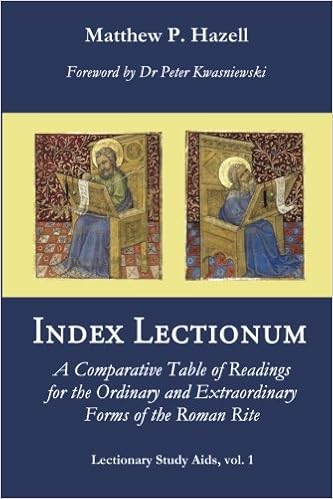
 At The Catholic Thing my good friend Fr. Murray has an exemplary piece about the FACT of public scandal created by Joe Biden and the FACT that the bishops of these USA haven’t given him the pastoral care that their vocations demand.
Can. 915 and can. 916 exist not for kicks but for the sake of souls.
That’s my summary. Fr. Murray expresses it his way.
My emphases and comments.
President Biden and Public Scandal
Should President Joseph Biden be admitted to Holy Communion when he attends Mass? The simple answer is, “No,” owing to his public and unwavering support for legalized abortion. [NB: “public and unwavering”] Canon 915 of the Code of Canon Law states: “Those. . .obstinately persevering in manifest grave sin are not to be admitted to holy communion.” Abortion, the killing of innocent unborn children, is a grave sin, as is the legalization and promotion of this heinous practice. It’s a criminal violation of an unborn person’s right to life. [What it Biden were publicly promoting, say, harsh child labor or even slavery. Would there be a hew and cry?]
In the 2002 Doctrinal Note on some questions regarding the Participation of Catholics in Political Life, Cardinal Ratzinger, then Prefect of the Congregation for the Doctrine of the Faith (CDF), stated: “John Paul II, continuing the constant teaching of the Church, has reiterated many times that those who are directly involved in lawmaking bodies have a ‘grave and clear obligation to oppose’ any law that attacks human life. For them, as for every Catholic, it is impossible to promote such laws or to vote for them.” [emphasis in original]
In the 2004 Worthiness to Receive Holy Communion: General Principles Ratzinger specifically instructed the U.S. bishops that a Catholic politician engages in formal cooperation with the sin of abortion when he consistently campaigns and votes for permissive abortion laws. President Biden obviously promotes the abortion license and has directed that taxpayers’ dollars pay for abortions. He’s an unapologetic and determined promoter of this immoral attack on human life. This is an indisputable fact. Just ask his supporters at Planned Parenthood and NARAL.
Ratzinger told the U.S. bishops that, dealing with such a politician, “his Pastor should meet with him, instructing him about the Church’s teaching, informing him that he is not to present himself for Holy Communion until he brings to an end the objective situation of sin, and warning him that he will otherwise be denied the Eucharist.” He also cited a 2002 Declaration from the Pontifical Council for Legislative Texts: “When ‘these precautionary measures have not had their effect or in which they were not possible,’ and the person in question, with obstinate persistence, still presents himself to receive the Holy Eucharist, ‘the minster of Holy Communion must refuse to distribute it.’” (Emphasis in original)
The Declaration explains: “The decision, properly speaking, is not a sanction or a penalty. Nor is the minister of Holy Communion passing judgment on the person’s subjective guilt, but rather is reacting to the person’s public unworthiness to receive Holy Communion due to an objective situation of sin.” [And it is NOT POLITICAL. What IS political, and cynically so, is for a catholic politician who knows what the Church teaches, defies the Church, and presents herself for Communion, like Pelosi and Biden do. THAT’s political.]
An objective situation of sin is scandalous in this case because such a Catholic politician who consistently promotes abortion by that very conduct actively encourages others to fall into the same sin. [That’s the point of scandal: Your sinful action leads someone else to sin. You become a “stumbling block” someone else trips on and then falls.] In Biden’s case, his well-known campaign promises to keep abortion legal and federally funded is clear evidence of his rejection of Catholic moral teaching. He plainly intended to convince other Catholics to join him in gravely sinful behavior. Such conduct renders him publicly unworthy to receive Holy Communion. [Again, this isn’t a matter of having special insight about the state of Biden’s soul… whatever that might be in his case these days. His OUTWARD ACTIONS that we don’t have to guess about are the point. Outward actions hint at the interior, the soul, but the outward actions are what we have to go by in this matter.]
The facts, and the applicability of canon 915 to those facts, are indisputable. [And yet here were are with another article trying to explain this to the mostly willingly obtuse, such as those who don’t accept that human personhood begins at conception.]
For this reason, the recent Letter of the CDF Prefect, Cardinal Ladaria, to the American bishops is disappointing, even confounding. Remarkably, he never mentions canon 915. He calls for dialogue among the bishops “so that they could agree as a Conference that support of pro-choice legislation is not compatible with Catholic teaching.” But the matter is already beyond question. Any bishop who does not agree “that support of pro-choice legislation is not compatible with Catholic teaching” should change his mind or his job. [And there’s also the Bux Protocol.]
Ladaria then calls for dialogue with Catholic politicians “who adopt a pro-choice position. . .as a means of understanding their positions and their comprehension of Catholic teaching.” Really? After almost 50 years of legalized abortion, the “pro-choice” position needs no further study. Let alone “dialogue.” It is hard to imagine that President Biden and other Catholic advocates of legalized abortion are unaware of what the Church teaches about the sanctity of human life. They just don’t follow it. [Dear Father, what we are dealing with here, as you well know, is sheer cowardice. Plain and simple.]
Ladaria calls for further dialogue among the bishops, with other episcopal conferences, and further consultation with his office. How long would this process take? It’s a needless delay in tackling a major scandal.
The Church has a duty to teach God’s law and to sanction members who egregiously and continuously exempt themselves from obedience to that law – and encourage others to do the same. Depriving them of Holy Communion, we may hope, will jar them into reforming their conduct and their opposition to God’s binding law for all mankind. [That’s the point of censures: to jar… to awaken, and not in the sense of “woke”. Censures have the purpose of slapping a person into consciousness, to get their attention and make them address the problem they’ve gotten themselves into. The Church has the obligation to do this for the sake of that person’s soul, for the sake of protecting other who might be scandalized (lured into sinning in a similar way because of the bad example that was set), and for the sake of defending the doctrine or important discipline the Church is bound to uphold.]
Public [PUBLIC] defiance of God’s prohibition of unjust killing is an attack upon the faith and unity of the Church. The Church has a responsibility before God to lead the flock away from diabolical disobedience and into grace-filled obedience.
A Catholic who falls into immoral behavior, knowing that the Church has condemned it, should be presumed by his pastor to be imperiling his soul and the souls of those he is influencing. He needs to be told that his objectively sinful behavior constitutes a culpable offense for which he needs to seek pardon after repenting. [The pastor who does NOT tell a member of his flock that he is in peril is himself at risk of GOING TO HELL.]
The American bishops should act as a group, and individually in their dioceses, to end the scandal of the continued administration of Our Lord’s Most Holy Body and Blood to the highest public official in our land. To fail to do so amounts to a refusal to uphold the Church’s canon law, to the grave harms of souls. It would be a negligent passivity, a failure to defend the sanctity of the Christ’s greatest gift to his Church.
And it would communicate to all the message that God may be mocked without consequence when an important Catholic public figure decides to support, not God’s law, but rather the gruesome linchpin of the sexual revolution, unfettered legal abortion.
I am reminded of St. Augustine’s mighty sermon about Ezekiel on bad shepherds.
Augustine, in s. 17, spoke about the heavy responsibility of teaching a message that was hard for people to hear and accept. He invoked the stern warning in Ezekiel 3 about negligent pastors, and forged ahead. Finally, Augustine began to explain himself, tell his people why he was teaching and being so tough.
Here is some of s. 17.2.
I am saying this to you and I am saving my soul. If I will have kept silent, I won’t be in great danger, I’ll be rather in utter ruin. But when I will have spoken, and when I will have fulfilled my duty, pay attention then to your own danger. What, after all, do I want? What do I desire? What do I long for? Why am I talking? Why am I sitting here? Why am I even alive, except for this intention: in order that we may live together with Christ. That’s my desire, that’s my honor, that’s my treasured possession, this is my joy, that’s my glory. But if you will not listen to me and if I haven’t been silent, I will save my soul. But I don’t want to be saved without you (Sed nolo esse salvus sine vobis.)
Sometimes, nay rather, more and more often priests and especially bishops are called on to stand up in the public square as well as their pulpits and teach the truth as the Church and nature instruct us.
If they don’t, there are eternal consequences for those priests and bishops, because they have endangered their flocks either by lack of instruction or by false instruction.
Priests and bishops who don’t teach the truth are in danger of eternal damnation.
They have to preach the truth, whether people listen or not, for their own sake if for no other reason.
In the case of catholic politicians who manifestly and consistently promote abortion, even in the face of clear teaching, the Church’s can. 915 must be applied.

click

Coat of Arms by D Burkart









A Daily Prayer for Priests


They find you a pro-life agent in your area who commits to giving a portion of the fee to a pro-life group!

PLEASE subscribe via PayPal if it is useful. Zelle and Wise are better, but PayPal is convenient.
A monthly subscription donation means I have steady income I can plan on. I put you my list of benefactors for whom I pray and for whom I often say Holy Mass.
In view of the rapidly changing challenges I now face, I would like to add more $10/month subscribers. Will you please help?
For a one time donation...



Help Monks in Wyoming (coffee – UPDATED LINK) and Norcia (beer) and the wonderful "Soap Sisters" of Summit, NJ!


Please follow me on Twitter!










Visits tracked by Statcounter
since Sat., 25 Nov. 2006:


