Looking At Danger: Justice Kennedy, SCOTUS, and Masterpiece Cakeshop v. Colorado Civil Rights Commission

Today at Crisis there is a good summary piece about the complicity of catholic Justice Anthony Kennedy with the secularist Left and about the recent SCOTUS decision in the matter of Masterpiece Cakeshop, LTD v. Colorado Civil Rights Commission, which probably left Jesuits weeping into their Cosmopolitans.

The writer points out some of Justice Kennedy’s landmark achievements: Planned Parenthood of Southeastern Pennsylvania v. Casey (1992); Lawrence v. Texas (2003); Obergefell v. Hodges (2015).  What a guy.

The writer, Bob Sullivan, takes us back to Pres. Kennedy’s traitorous 1960 speech to the Greater Houston Ministerial Association, which thereafter gave cover to coward catholics to be “devout” but pro-abortion, etc., and which foreshadowed the Obama Administration’s assault on freedom of religion with freedom of worship.

The writer makes a scary point:

The other problem with Justice Kennedy’s decision is that he sidestepped Mr. Phillips’s arguments about freedom of speech and focused on the obvious anti-religious bias of the Colorado Civil Rights Commission. [NB] If the Civil Right Commissioners had been more polite in their comments and had not exhibited such a blatant hostility toward Christianity in other similar cases, might the Supreme Court have upheld the penalties imposed on Mr. Phillips? Justice Kennedy believes it could have. He wrote: “…it must be concluded that the State’s interest could have been weighed against Phillips’s sincere religious objections in a way consistent with the requisite religious neutrality that must be strictly observed.” He also wrote: “The outcome of cases like this in other circumstances must await further elaboration in the courts, all in the context of recognizing that these disputes must be resolved with tolerance, without undue disrespect to sincere religious beliefs, and without subjecting gay persons to indignities when they seek goods and services in an open market.”

It seems that the judgement of the SCOTUS could have been determined on the basis of the thin thread of tone.

He concludes:

Let’s start electing and appointing Catholics who actually know and live their faith. Let’s start calling on those Catholics currently in office to be courageous in defending truth.

Before we can elect them, we have to raise them and get them to run.

Posted in Liberals, Religious Liberty, Sin That Cries To Heaven, The Coming Storm, The Drill, The future and our choices, The Last Acceptable Prejudice | Tagged , ,
5 Comments

ASK FATHER: First Eucharist or First Communion?

From a reader…

QUAERITUR:

I have noticed an uptake lately in referring to first communion as first Eucharist, usually by people who insist on referring to extraordinary ministers of holy communion as Eucharistic ministers. The uptake seems frequent and widespread enough that it seems deliberate and not accidental, careless or due to ignorance. It does not seem right to refer to first communion as first Eucharist. For one thing it seems to me that this over identifies participating in Mass with receiving communion. For another it implies that children who have not yet received communion have not attended Mass or been present for, or at, the Eucharistic celebration. Either that or, again, the importance of being present at Mass is being minimized or slighted when communion is not received. Am I wrong to find this trend troubling?

Words have meanings which, over time, can drift around.  For example, “nice” once meant “foolish, silly”.  “Girl” could once indicate either sex (and, come to think of it, it still does).  Lexicographers have to make choices when creating dictionaries to determine if their definitions are going to be descriptive (this is how the word is being used) or prescriptive (this is how the word must be used.

In the Church terms drift around or they are used in sloppy ways.  Also, we can call one thing by many different names or terms.  Think, for example, of how we say “Sacrament of Penance” or “Reconciliation” or “Confession”.   In the sloppy department, we hear people say “liturgy” when they mean “Mass”.  Liturgy is more than just the Mass.

“Eucharist” can describe both the Blessed Sacrament Itself as well as the liturgical rite of Mass wherein the Eucharist is consecrated.   “Communion” can describe reception of the Eucharist.  However, Communion can be received within the context of Mass or outside the context of Mass.

When I hear or read “First Eucharist”, I get what is meant, but to my ear and eye that seems like going to Mass for the first time.   It could, I suppose mean going to Exposition for the first time, though I’m stretching.  “First Communion” more clearly describes what is happening: the person is received Holy Communion, the Eucharist, for the first time.

I suppose that “First Eucharist” came from someone – one of those Good Idea Fairies – who had an “idea” after attending a liturgy workshop.

Let’s continue to use clear and precise terms.  You brought up the confusion of Extraordinary Ministers of Communion or of the Eucharist.  These are two different roles.

Heck, even the word “Extraordinary” these days isn’t well understood.  After all, “extraordinary” can mean quite a few things, depending on the context.  For example, upon hearing “First Eucharist” for “First Communion” a British friend of mine would respond, “How extraordinary!”

Posted in "How To..." - Practical Notes, ASK FATHER Question Box, Liturgy Science Theatre 3000 | Tagged , ,
7 Comments

ASK FATHER: How to convince a priest to learn the Traditional Latin Mass?

From a reader….

QUAERITUR:

Our vicar is a very devout priest from Poland but today I heard him saying “the ordinary form is enough for me”. What do you suggest to do in order to convince him to offer the Holy Mass in the extraordinary form of the roman rite?

GUEST PRIEST RESPONSE: Fr. Tim Ferguson

How to convince a priest to embrace the extraordinary form. Hmmm.

First, recognize that most priests are busier than they would like to be. The demands of the office are huge in the best of times – and there are always those things that priests wish they could attend to, but just don’t have time. Few priests go to bed at the end of a day thinking, “Yep, I’ve pretty much done everything I wanted to today.” I suppose that could be said of just about everyone.

If a priest looks at the extraordinary form of the Holy Mass as “one more thing to do,” it can be daunting. If he can look at it, however, as “this will enrich my priesthood,” then you might be on to something.

First he’ll need exposure to the extraordinary form. Is there one celebrated regularly nearby? At a convenient time? Could there be an opportunity for you to say, “Father, Ss. Processus and Martinian is offering a High Mass for the feast of St. Cuthbert next month on a Tuesday evening. We’d love to take you – you can sit in choir, and not have to do anything – then we’ll take you out for a nice dinner at Ruth’s Chris Steakhouse. There are six of us going, and we’d love to have you join us.”

Don’t be pushy. If he says no, or digs his heels in, then back off – and pray. Pray for him.

Would it be possible to bring in a priest from outside to offer the extraordinary form at your church? Or maybe even invite in a priest familiar with the EF to have a chat with your priest? Nothing confrontational, just a chat. Sometimes priests, depending on their formation, get some wild ideas about what “those priests” are like. Meeting them, and coming to know them as just men, as good men, as normal men can wear down some of the misconceptions. Of course, make sure that the priest in question IS  a good and normal man.

Unless he expresses an interest, don’t flood him with books, DVD’s, articles – the flood of material a priest receives is often overwhelming and it can be easy to just simply ignore unsolicited literature rather than engage it. Speak to him openly and honestly about your love for the EF, and what it has done for your relationship with God and your faith life.

And pray. Keep praying for him, even if he digs his heels in. Prayer can truly move mountains.

Posted in "How To..." - Practical Notes, ASK FATHER Question Box, Liturgy Science Theatre 3000, Priests and Priesthood, SUMMORUM PONTIFICUM |
4 Comments

UPDATED – LONDON: Corpus Christi in Maiden Lane – Beauty and faith in the streets

UPDATE:

ACK!  I posted the wrong photos.  Corrections below.

Speaking of Corpus Christi and processions, you might recall that some months ago I suggested to the readership that it would be a good gesture to help Corpus Christi parish in London, on Maiden Lane near Covent Garden, to buy a new procession canopy.  You responded well and they were able to raise the funds.

Yesterday, they had a big day at that central London parish.   Cardinal Nichols made their church the Westminster Diocesan Shrine of the Blessed Sacrament.  At the conclusion of 40 Hours Devotion, the Cardinal was celebrant for the Pontifical Mass and procession.

This is an impressive place, in the heart of London.  It was established by Card. Manning in 1874 and was the first church in England named for the Body and Blood of the Lord. The parish priest has undertaken a beautiful project of renewal of the interior.  The before and after photos are striking.  Also, this is where, even in the very dark years, the TLM was maintained with the help of the Latin Mass Society (if you don’t belong, please think about joining). They also have a Sodality of the Blessed Sacrament.

The photos from our Mass with Cardinal Nichols and procession around Covent Garden can be seen HERE. And HERE Samples:

See what can happen with imagination and elbow grease and cooperation of different parties?

This is New Evangelization.

And here are some shots from their photo album of the Extraordinary Form Mass HERE.

They also have new Stations of the Cross.  HERE

And a video from the Cardinal Archbishop with great images:

YouTube thumbnailYouTube icon

Posted in ¡Hagan lío!, "How To..." - Practical Notes, Fr. Z KUDOS, Just Too Cool, Liturgy Science Theatre 3000, New Evangelization | Tagged
4 Comments

Sort of good news from SCOTUS and from the CDF and Pope Francis.

UPDATE:

Apparently, Card. Marx is “überrascht… surprised” by the letter from Rome. HERE

What’s next? Will they play the money card?

Did they play the money card yet?

I’d bet that would wear pretty thin pretty quickly with this Pope.

Meanwhile, Card. Woelki gave a strong fervorino about this issue for Corpus Christ at the Cologne cathedral.  HERE   and an English account HERE.

“There has been much discussion about the Eucharist in recent weeks. Some people said ‘What is this all about? This is nonsense!’, others even said ‘This is a Punch and Judy show!’. I say – this is about life and death… This is fundamental! And that is why we have to fight and look for the right way. Not just any way, but the Lord’s way.”

[…]

“Once again, we in Germany do not live on an ‘Island of the blessed’, we are not a national Church,” the cardinal said. “We are part of the great Universal Church and all of our German dioceses are members of the global whole, united under the head, the Holy Father.”

The congregation – quite rightly in this matter – applauded him.

___

Originally Published on: Jun 4, 2018 @ 10:59

Today we have some good news.

First, sort of good news.  SCOTUS ruled 7-2 that the Colorado Civil Rights Commission violated baker Jack Phillips’ civil rights under the 1st Amendment. The Colorado baker refused to make a wedding cake for a homosexual couple. However, But the court did not rule on the larger issue: can a business invoke religious objections and refuse service to homosexuals on the grounds that they are homosexuals?

Next, Pope Francis blocked the document that the wacky German bishops wanted to issue in favor of inter-communion. You might recall that a majority of German bishops proposed to admit to Communion the non-believing, non-Catholic spouses of Catholics. A few bishops objected.

On one side was the usual suspect Card. Marx and his crew, and on the other Card. Woelki and 7 seven other bishops.

At first, the Pope sent them back to Germany to work it out. That prompted Card Eijk of Utrecht to say that not not providing an answer to such a clear issue was inexplicable. HERE.

In any event, today, on the very day that Francis received a group of German Lutherans, a letter to the German bishops dated 25 May from the Prefect of the CDF, Card.-Elect Ladaria was released that nailed things down… with the explicit support of the Pope.

Sandro Magister has the text in Italian (from the German original) HERE. CNA has a story in English HERE.

In a nutshell, Ladaria says that the German document should not be issued. He gave three reasons:

First, Ladaria stressed that admission to Communion of Protestant spouses in inter-confessional marriages “is a topic that touches the faith of the Church and has relevance for the universal Church.”  [As Archbp. Chaput so ably pointed out the other day!]

Allowing non-Catholics to receive the Eucharist, even in certain limited conditions, would also have an impact on ecumenical relations with other Churches and ecclesial communities “which should not be underestimated.”

Finally, he said the question of Communion is a matter of Church law, and cited canon 844 of the Code of Canon Law, which deals with access to the Sacraments of the Catholic Church.

Specifically, canon 844 states that “Catholic ministers administer the sacraments licitly to Catholic members of the Christian faithful alone, who likewise receive them licitly from Catholic ministers alone,” apart from a number of exceptions spelled out in the canon.

These exceptions include allowing non-Catholic Christians to receive the sacraments of Confession, the Eucharist, and the Anointing of the Sick by non-Catholic ministers in churches where these sacraments are valid “whenever necessity requires it or true spiritual advantage suggests it, and provided that danger of error or of indifferentism is avoided.”  [One is forced to ask what those German bishops believe about the Eucharist.  What a horrifying thing to wonder about.]

Catholic ministers, the canon says, can also administer these sacraments licitly on members of Eastern Churches that are not in full communion with Rome, “if they seek such on their own accord and are properly disposed.”

The canon says this is also valid “for members of other Churches which in the judgment of the Apostolic See are in the same condition in regard to the sacraments as these Eastern Churches.”

For non-Catholic Christians unable to approach a minister from their own confession, the canon says they are able to receive these sacraments only “if the danger of death is present or if, in the judgment of the diocesan bishop or conference of bishops, some other grave necessity urges it.”

However, to receive the sacraments they must seek reception “on their own accord, provided that they manifest Catholic faith in respect to these sacraments and are properly disposed.”

The canon concludes underlining that in the case of the exceptions, “the diocesan bishop or conference of bishops is not to issue general norms except after consultation at least with the local competent authority of the interested non-Catholic Church or community.”

In his letter to Cardinal Marx, Ladaria noted that while there are “open questions” in some sectors of the Church in regards to the interpretation of canon 844, “the competent dicasteries of the Holy See have already been charged with producing a timely clarification of these questions at the level of the universal Church.”

However, he said it would be left up to diocesan bishops to judge when there is a “grave impending need” regarding the reception of the sacraments.

So, SCOTUS didn’t definitively solve the problem and neither did the CDF and Pope Francis, since the Curia still has to deal with the larger question for the whole Church.

However, this shows that SCOTUS isn’t entirely insane and the Curia has not been completely stripped of authority, even though it seems that Francis wants to devolve authority to bishops conferences.

Each case point in a direction.

The first amendment still applies.

When bishops conferences do their own thing, chaos and confusion result.

We got an injection of common sense today.

Still, I am left a little melancholy.  We are in a sad situation when these two bits of sort of good news make this into a good Monday.

Posted in Our Catholic Identity, Sin That Cries To Heaven, The Coming Storm, The future and our choices | Tagged , , ,
16 Comments

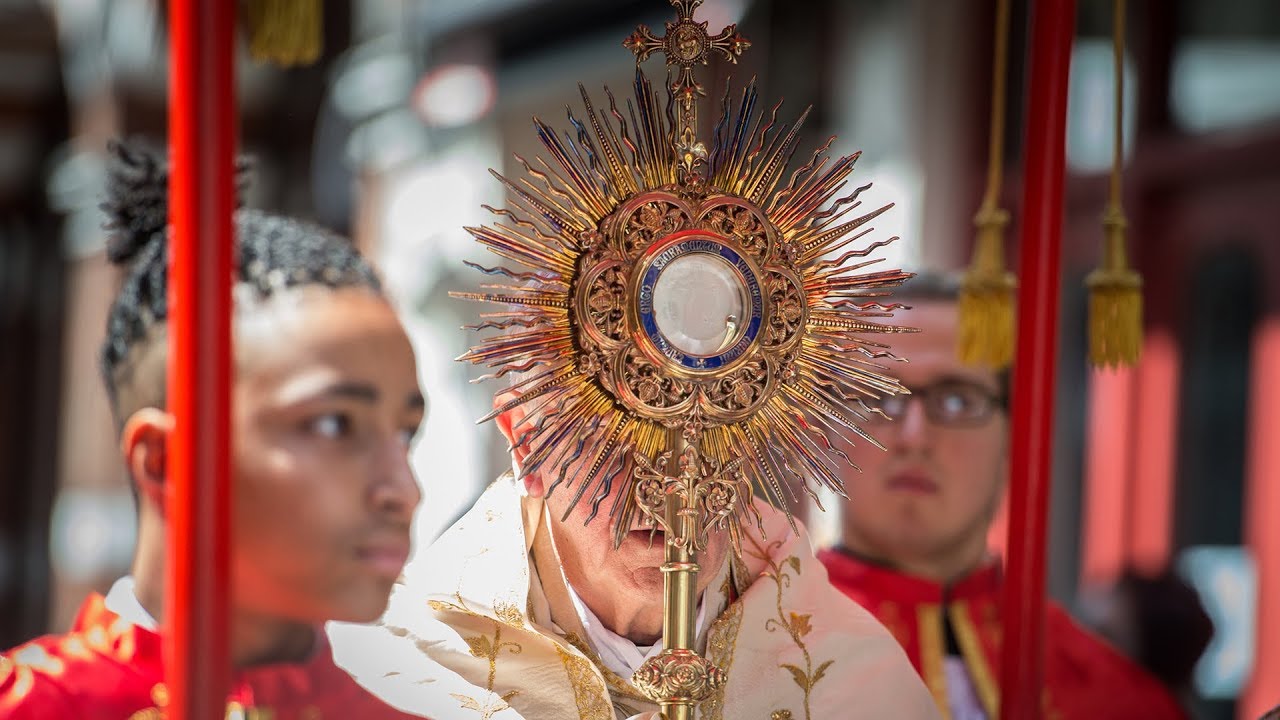
Francis’ Corpus Christi Eucharistic procession. Wherein Fr. Z rants.

Here is a really sad tweet about this year’s Corpus Christi procession moved from Rome to Ostia. (Not a great idea, but, hey, they didn’t ask me.) There is a link to a video of the whole thing. Click ahead and watch the crowd.  WARNING: The music is horrific.  Once you hear it, you can’t unhear it.

None of this should surprise us after the last, say, 50 years or so.

We can grant, that getting a procession together can be a little chaotic and distracting, and it can be distracting to have the Pope in your neighborhood.  We can grant that people who are truly wicked can kneel and put on a pious but empty show.  What you see through the streets in the video is something else entirely.   It seems to be a lack of comprehension, rather than of indifference.

Were there no signs of faith or reverence?  Of course there were.  But watch extended moments and get a sense of it.

And this started a long time before Pope Francis was Pope.  On the other hand, I don’t think I am being entirely unfair to remind people of Benedict XVI in Hyde Park, London – HERE (try 40:00 on).    Also, lest I be unfair, you can find youtube videos of Corpus Christi processions of yesteryear and not everyone kneels.  1925 HERE – 1941 HERE  1947 HERE  There is an entirely different ethos.   We also must adjust our minds for cultural differences and locations: cathedrals of major cities are different from parishes in small towns.  Nevertheless…

We all understand the concept quantum potes tantum aude, but the quantum and the tantum and the posse and the audere have been nearly reduced to zero.   I refer the readership to my rants about milk and goop v. steak and cabernet.  We also know that in most places, if there is even cultural Catholicism left, it’s a surprise.  We have to be patient and realistic.

Above all, however, we have to examine ourselves and what we are doing.

All the more reason for our own truly devout relationship with Christ in the Eucharist and efforts to initiate, foster and promote worthy sacred liturgical worship.

I often have written in these electronic pages of the connections between our identity as Catholics, our impact in the public square, and our sacred liturgical worship. This is what Benedict XVI’s “Marshall Plan” (as I called it) was all about.

You might recall what the Marshall Plan was.

After World War II many regions of Europe were devastated, especially its large cities and manufacturing. These USA helped rebuild Europe through the Marshall Plan so as to foster good trading partners and, through prosperity, stand as a bulwark against Communism.

After Vatican II many spheres of the Church were devastated, especially its liturgical and catechetical life. We need to rebuild our Catholic identity so that we can stand, for ourselves as members of the Church and in the public square for the good of society, as a bulwark – indeed a remedy – against the dictatorship of relativism.

If we don’t know who we are as Catholics, if we don’t know what we believe or pray as Catholics, then the world has no reason to listen to anything we have to say as Catholics. We will be all the more easily driven from the public square.

In that procession, with the Holy Father and Eucharistic Lord, people just stared – like passive observers. They were exactly as libs falsely accuse people of being at the Traditional Roman Rite.

We need a Church wide “Marshall Plan”. No renewal of the Church can take place without a revitalization of our Catholic worship. Without a renewal of worship, all our other efforts will be lacking.

We are beset from within and from without. At the same time, our obligations to strive for greater holiness and fidelity within the Church, and to bring the Good News and Christ to the rest of the world, both remain. We must be renewed internally, so as to be effective externally. This is an ad intra imperative (Catholics considered as Catholics among themselves) and also an ad extra mission (Catholics considered in relation to the wider world).

Catholics, as Catholics, have been shoved out of the public square. They are more often than not excluded from contributing to discussion of the burning questions of our day. This is usually because Catholics themselves, as Catholics, excluded themselves from contributing a genuinely Catholic voice because they are either dissenters or because they are weak or because they are ignorant or because they are cowardly.

Catholics must contribute to the discussion in the public square, or as Pope Benedict called this phenomenon the “digital continent”.

We have an obligation, each of us according to our vocations, to shape the world around us to the extent we can. Holy Church has a God-given mission to teach both ad intra and – of course – ad extra.

The ad intra dimension entails Catholics knowing who they are and what they believe. If we don’t know who we are as Catholics, we will never be able to articulate anything clearly about the burning questions of our day and make a contribution as Catholics according to our vocations. If we don’t know these things, if we are not firm in them, then we are vulnerable to every manner of marginalization and, don’t doubt it, persecution.

We will be marginalized and persecuted anyway. We may as well strive for holiness and salvation within the hardships we will inevitably face as living signs of contradiction.

There is an incremental erosion of human, common sense values taking place. At a certain point, the erosion will pick up speed and, suddenly, we will wake up in a new kind of world.

Good grief… it already is.

The process of revitalizing our identity and our Church will take time. Our gains will be slow and incremental. Brick by brick. And, in worldly terms, we may make no discernible progress in our lifetimes.

Do we have time? When the Lord returns, will He find faith? Shall we be judged for not having done our part?

Are we passive observers?

For the near future, we must not be complacent or one day soon we will find we are living a nightmare. Our judgment will follow.

I firmly believe that in Benedict XVI’s Motu Proprio Summorum Pontificum, the emancipation proclamation for the older Extraordinary Form of the Roman Rite, we have a mighty gift and tool to help us revitalize our Catholic worship, to reconnect with our tradition and identity as worshiping Catholics. Summorum Pontificum, clearly one of the important achievements of Pope Benedict’s pontificate, is slowly being implemented. We need more.

No renewal of Holy Church and our identity, our ability to contribute to and shape the world around us as Catholics, is possible without a renewal of our liturgical worship.

The older form of Holy Mass of the Roman Rite, the Usus Antiquior, must return in strength. Recovery of the older form will exert a “gravitational pull” on the way the Novus Ordo is celebrated. As priests learn or relearn the older form, they change the way the say the newer form. The deepening of their ars celebrandi will have a knock-on effect in their congregations.

A good example of what I mean is the impact that ad orientem worship has when it is restored.

This is not for the sake of aesthetics or nostalgia. I think we are in a fight for our spiritual lives.

Revitalized worship of God is a necessary element of a New Evangelization.

The Biological Solution continues is scything work. New priests, free from the dominating hermeneutic of the 60’s-80’s, are rising up. In the next few years, we should see a more rapid increase in the number and places where the older form is used.

To save our world we must save our liturgy.

And even if the world is slipping beyond our reach, we must nevertheless relentlessly seek through grace and elbow grease the salvation of our souls and those of our loved ones and as many as will come with us.


Posted in ¡Hagan lío!, "How To..." - Practical Notes, Cri de Coeur, Hard-Identity Catholicism, Liturgy Science Theatre 3000, New Evangelization, Si vis pacem para bellum!, The Coming Storm, The future and our choices, Turn Towards The Lord, Wherein Fr. Z Rants | Tagged , , ,
31 Comments

JUST TOO COOL – Fly Over video of The Moon

Because today is the 2nd Sunday after Pentecost, it’s time for a trip to your planet’s largest satellite!

Everyone should check out the amazing “Tour of The Moon” 4K “fly over” video, provided by the folks at NASA.  HERE

It makes me want to watch The Martian again.  US HERE – UK HERE


Posted in Just Too Cool, Look! Up in the sky! | Tagged
Comments Off on JUST TOO COOL – Fly Over video of The Moon

Your Sunday Sermon Notes – Corpus Christi and POLL

Was there a good point made in the sermon you heard at the Mass to fulfill your Sunday obligation?  Let us know!

Many people will have celebrated Corpus Christi today (even though it was, properly, last Thursday).    Others may have had the 2nd Sunday after Pentecost, and green vestments.

If you had Corpus Christi today, Sunday, did you have a Eucharistic Procession?

Let us know.  Anyone can vote.  Registered participants are encouraged also to comment.  Tell us what you saw.

For Corpus Christi 2018 we had...

View Results

Posted in Liturgy Science Theatre 3000, POLLS | Tagged
27 Comments

ASK FATHER: Can lay people baptize?

From a reader…

QUAERITUR:

May a lay natural father baptize his own child? As an expectant father, I have heard conflicting views on this practice. Obviously, the priest is the proper and ordinary authority for this, I was simply curious. (P.S. I appreciate any anonymity you can provide).

I’d happily provide anonymity for you, but I don’t know who you are.

First, congratulations.

That said, your question is a little puzzling.

If you are not trapped in a hunting lodge surrounded by wolves 30 miles from the road during the winter when your wife gives birth, I’d wait for the baptism to be in church by the priest.  If you are trapped, however, by all means, administer baptism right away.

Lay people can baptize.  In fact, non-Catholic and non-believers can baptize, provided they use water and intend to do what the Church intends by using the proper Trinitarian form.

Sometimes lay people must baptize, as in the your case of being trapped in the hunting lodge.

May lay people baptize?  That’s more complicated.  Sometimes, in the absence of ordinary ministers of the sacrament, the Church will provide that some appointed person, such as the village catechist, should do the baptisms.   Otherwise, while still understanding that “can” and “must” and “emergencies”, etc., in general lay people may not baptize.  That is what bishops, priests, and deacons – the ordained – do.

This is particularly important in when the traditional Roman rite of baptism is used, because of the additional elements in the rite.  Those additional elements of the exorcisms and so forth are considered important enough that, after emergency baptisms, they were ritually “supplied” after the fact.

And let’s not forget the importance of witnesses: baptisms need to be done properly and documented in the parish register.

And let’s not forget the important of godparents, who aren’t in the hunting lodge with you… unless your child is to be raised by the circling wolves.

I am glad you are concerned for your child’s baptism.   I warmly recommend having the priest do it, without much delay.

Posted in "How To..." - Practical Notes, ASK FATHER Question Box, Liturgy Science Theatre 3000 | Tagged
9 Comments

ASK FATHER: Do I have to say “Amen” for weird Prayers of the Faithful at Mass?

From a reader…

QUAERITUR:

Are we required to join in the prayers of the faithful at Mass?

Sometimes these can be excruciatingly political and occasionally downright wrong.

For instance, on the recent solemnity of Our Lady Help of Christians (I’m Australian and she is one of our national principal patrons), my wife and I attended Mass. During the prayers of the faithful, most were in keeping with the feast and had a Marian slant as you would expect, however one said (paraphrased, but not exaggerating) “We pray for Muslims, that we can come to value their understanding, faith and courage”[Huh?  “for Muslims…. that WE…”.  Stupid.]

Given the whole Our Lady of Victories thing, surely this is not just out of place, but offensive on such a feast. Which brings me to my point. My wife and I both said nothing during the response, but is this licit? Are we required to join in a prayer that is obviously out of keeping with the faith? What should we do? Our parish is the cathedral for our diocese, by the way.

Thanks as always – my wife loves your answers, particularly the regular GO TO CONFESSION refrain. We need it!

Prayers of the faithful…. oh boy.

When I’ve been at a church as a visitor and the prayers of the faithful are coming at us, as inescapable as a train in a tunnel, I invariably think: “How bad is this going to be?”  If I don’t hear something inept, or dumb, or just plain strange, I’m relieved.

We’ve all heard weird prayers of the faithful during Masses.  Some of them are head-pounding-on-the-pew stupid.  The spontaneous ones are The Worst™.

There are, I believe, templates provided for prayers of the faithful.  While not “handcrafted” for this community, they tend to be a) brief and b) not heretical.

The recommended order for intentions given in the Missal is as follows.

  1. For the needs of the Church
  2. For the world
  3. For those in need
  4. For the local community

It doesn’t have to be complicated.

Heck, I’d consider saying, “For the needs of the Church, we pray to the Lord… Lord, hear our prayer.  For the world, we pray to the Lord…” and so forth.

Do you have to say “Amen!” to something that you know is off the wall?

No.

However, if the prayer is in the least reasonable, as the first part of the prayer you mentioned was reasonable, then you probably should say “Amen” and sincerely mean it.

It seems that a lot of these prayers start with something or someone worthy of prayer.  For the …. X…. the poor, dying, sick, our nation, the Pope, vocations, travelers, elected politicians, etc.  It is in the second part that the writer can often go to the zoo.

Let’s have a POLL.

There are many possible options, but pick the one that best fits your situation.  Anyone can vote.  Registered users can comment… and I hope you will.

Prayers of the Faithful during Novus Ordo Masses

View Results

And let me just say: GO TO CONFESSION!

Do I hear and “Amen!”?

Posted in "How To..." - Practical Notes, ASK FATHER Question Box, Liturgy Science Theatre 3000, POLLS | Tagged
36 Comments