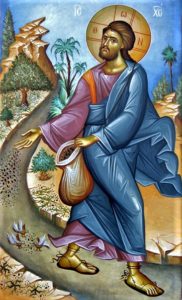
Your Sunday Sermon Notes – Sexagesima Sunday (NO – 5th Ordinary) 2021

Was there a GOOD point made in the sermon you heard at the Mass for your Sunday (obligation or none), either live or on the internet? Let us know what it was.

Too many people today are without good, strong preaching, to the detriment of all. Share the good stuff.

Also, are your churches opening up? What was attendance like?

Posted in SESSIUNCULA | Tagged
9 Comments

Daily Rome Shot 70

Posted in SESSIUNCULA | Tagged
9 Comments

Sammons: “Will Catholic Ever Return to Mass?”

At Crisis there is a piece by Eric Sammons from January which echoes what I have been writing about, what I call the “demographic sinkhole” that has been opening up under the Church for some time now.  The “beige” will fall through this sinkhole and vanish from our churches.   As a matter of fact, our churches will disappear as well.  COVID-1984, which I am convinced is also literally cursed, has accelerated the opening of this sinkhole.  And don’t rule out open persecution.

I have a sense that only the stronger identity groups will remain practicing and vibrant and they will find their source of strength in traditional worship.

Sammons’ piece is entitled “Will Catholic Ever Return to Mass?”

His prognostication is less than rosy.   As he points out, in the 70’s 55% of Catholics in these USA went to Sunday Mass.  In 2019 that dropped to about 20%.  Now… around 5%, given that virtually all dioceses forbade going to Mass for some time.   Once things open back up again… if they are ever allowed to…

From Sammons:

The question that currently hovers over every chancery and rectory in America is this: will they ever come back? Will the Catholic Church in America see a return to pre-2020 numbers, which were already quite dreadful, but weren’t as catastrophic as now? No one knows the answer to that question, but I don’t think Church leaders should have high hopes.

As I’ve detailed elsewhere, the Catholic Church in America was facing a demographic collapse before the Age of Covid. Since 2000, the number of infant baptisms—one of the best indicators of the health of the Church—has plummeted more than 40% after it had remained relatively steady from 1975-2000. And there were no signs that this trend was reversing before 2020. Now add to that the following realities: (1) our bishops, whether intentionally or unintentionally, have signaled to the world that attending Mass is “non-essential;” (2) lifelong Mass-going habits have now been broken; and (3) many parishes are so vigorous in their COVID-19-restrictions that they’ve become less welcoming than an East German Stasi house call. Add it all up, and you’ve got a recipe for empty churches.

A recipe for empty churches.

And yet, where Tradition is tried, things look a lot brighter.

But don’t worry, dear readers, our inventive and committed leaders will find the right combinations of programs and pamphlets and reassuring declarations which will inspire all those lapsed Catholics to return and will win over new flocks of converts. The key will be to make the Church more attractive to the secularized by secularizing the Church. That’ll do it. We have to make sure people know how committed we are to saving the planet from climate change, diminishing the differences between world faiths, and, you know, making sure we don’t discriminate based on our many genders.

You might check out Sammons’ suggestions. They are grim, but they may be realistic.

Orrrr… we can keep doing what we are doing.

Maybe it’s time to stop marginalizing and persecuting those who desire traditional expressions of the faith.

Posted in The Coming Storm, The future and our choices | Tagged ,
20 Comments

ASK FATHER: Projector screens installed in church

From a reader…

QUAERITUR:

I was wondering if you have any ammunition one might use to argue against the installation of projector screens in a church. My son, in seminary, just learned that a fellow seminarian’s home parish has ‘voted’ to install projector screens, with the support of the pastor. Naturally this is disappointing to a seminarian, but also to those of us in general who have truly hoped this kind of thing was in the past. I was just wondering if you had any information that might be useful for the prevention of this sort of things. The pastor has argued since they do it at St. Peters for a papal Mass that it is good enough for them.

GUEST PRIEST RESPONSE: Fr. T. Ferguson

Firstly, the seminarian’s response should be (to the pastor, or anyone on the parish staff or council), “Oh really? Well that’s interesting. I hope that works out well for everyone. I am so excited about one day working in ministry and getting involved in exciting projects like that, to ensure that more people come to know and love Jesus. In the meantime, I really, really, really love these cookies!” Accompanied by a big smile (as authentic as possible).

To anyone who appears disgruntled by this, the seminarian’s response should be, “Oh, I’m so sorry you’re going through that. You should know that I pray for (St. X parish) all the time. I just hope I can become holy enough to be pastor some day and help clean up some of these messes. Please keep me in your prayers. In the meantime, these cookies are really, really, really delicious!” (Accompanied by a concerned look with a slight tilt of the head, followed by a big smile).

Seminarians – avoid getting drawn into these conflicts. They seldom end well for you, and can end up eliciting comments that make it onto written evaluations that redound with negative repercussions years later.

Onto the meat of the issue. Screens in church are silly, and distracting. They play into the notion that the Holy Mass is primarily a didactic event and if we don’t read and understand absolutely everything on a verbal level, we’re not “getting out” of it what we should. They contribute to the myth that participation requires us uttering as many syllables as possible, preferably in unison. Further, the notion that everything has to be seen as clearly and closely as possible to be meaningful is drilled into our highly visual and digital society.

If the church is as large as St. Peter’s Square and gets as many congregants on a regular basis, perhaps there might be some slim justification (though I can’t say I’m a fan of screens even at St. Peter’s).

Fr. Z adds:

I endorse what Fr. Ferguson wrote about seminarians not getting involved in those matters.   I add… don’t try to involve them!

Aim your phone’s camera

As far as the screen thing is concerned… I agree again.  I will add the observation of the late Marshall McLuhan that “the medium is the message”.  This is why sometimes a well-placed, well-chosen photo has more impact than a 1000 words, or why McLuhan could argue that it was the genesis of the microphone and electric amplification that killed Latin and liturgy in the Church.

In 1974 he wrote in The Medium and the Light: Reflection on Religion:

Latin wasn’t the victim of Vatican II; it was done in by introducing the microphone. A lot of people, the Church hierarchy included, have been lamenting the disappearance of Latin without understanding that it was the result of introducing a piece of technology that they accepted so enthusiastically. Latin is a very ‘cool’ language, in which whispers and murmurs play an important role. A microphone, however, makes an indistinct mumble intolerable; it accentuates and intensifies the sounds of Latin to the point where it loses all of its power. But Latin wasn’t the mike’s only victim. It also made vehement preaching unbearable. For a public that finds itself immersed in a completely acoustic situation thanks to electric amplification, hi-fi speakers bring the preacher’s voice from several directions at once. So the structure of our churches were obsolesced by multi-directional amplification. The multiple speakers simply bypassed the traditional distance between preacher and audience. The two were suddenly in immediate relation with each other, which compelled the priest to face the congregation.

The microphone killed Latin, enervated preaching and paved the way for Mass “facing the people”, innovations all.  Microphones were in use long before the Council.  But their cumulative effect, with the liturgical changes, were deadly.  There are times when we should simply turn them off… and go ad orientem and use Latin.

When everything is made plain, apparent, immediate, visible, audible, etc., then there is no effort to find the Mystery in the hard elements of worship.  Immediacy strips out the transcendent.  That makes participation at Mass … something else.

Finally, back in the days of Benedict XVI did that pastor argue for Latin and a chanted Gradual instead of a responsorial psalm because that’s what they use at St. Peter’s?  Who wants to bet?

Posted in "How To..." - Practical Notes, ASK FATHER Question Box, HONORED GUESTS, Liturgy Science Theatre 3000, Save The Liturgy - Save The World | Tagged ,
19 Comments

Rome Shot 69

Posted in SESSIUNCULA | Tagged
5 Comments

WDTPRS – Sexagesima Sunday: Some will make it but many will not

In the traditional Roman calendar, last week was the first of the pre-Lenten Sundays, Septuagesima or “Seventieth” before Easter. This Sunday is called Sexagesima, “Sixtieth”.  This number is more symbolic than arithmetical. For a fuller explanation, HERE.

Pre-Lent Sundays have Roman Station churches.  The Roman Station is at St. Paul’s outside-the-walls.

The Fore-Lent or Pre-Lent Sundays prepare us for the discipline of Lent, which once was far stricter. Purple is worn rather than the green of the season after Epiphany and there is a Tract instead of an Alleluia.

The prayers and readings for the pre-Lent Sundays were compiled by St. Gregory the Great (+604).

In the Novus Ordo of Paul VI there is no more pre-Lent, which was a real loss.  Yet another reason to be grateful for Summorum Pontificum.

This Collect was in the 8th c. Liber sacramentorum Engolismensis.

COLLECT:

Deus, qui conspicis, quia ex nulla nostra actione confidimus: concede propitius; ut, contra adversa omnia, Doctoris gentium protectione muniamur.

I don’t think this prayer in any form survived to live in the Novus Ordo.  The jam-packed Lewis & Short Dictionary informs us that conspicio means “to look at attentively”.  In the passive, it is “to attract attention, to be conspicuous”.  Conspicio is a compound of “cum…with” and *specio. The asterisk indicates a theoretical form which has to do with perception. The useful French dictionary of liturgical Latin we call Blaise/Dumas says that conspicio refers to God’s “regard”, presumably because God “sees” all things “together”.

The last word here is from munio, which is “to build a wall around, to fortify, …protect, secure, put in a state of defense; to guard, secure, strengthen, support”.

LITERAL TRANSLATION:

O God, You who perceive that we trust in no action of our own: propitiously grant; that we may be fortified against every adverse thing by the protection of the Doctor of the Gentiles.

This ancient prayer makes explicit reference to St. Paul, the Doctor of the Gentiles.

Remember: the Roman Station today is the Major Basilica of St. Paul “outside the walls”.  Few prayers of the Roman Missal display such an intimate connection with the place where the Mass was celebrated in Rome and with the readings.

In 2 Cor 11 and 12 St. Paul presents a portrait of how we must live, the battle we face as Christians, and the suffering we may be called to endure.  It is an apt reading before Lent, to inspire us to consider the discipline of our Christian life.

The Gospel is the Lord’s parable about the sower of seeds.  Some seeds make it but many do not.  Some people hear the Word of God and it bears fruit. Many hear it and fail.  It is our own disposition that makes the difference, not the seed that the Sower sows in us.

Consider the context of the prayer: Holy Mass.

The Eucharist, the Host we dare to receive, is the seed Christ the High Priest sows in us.

St. Paul teaches us a stern lesson about the reception of the Eucharist by the worthy and by the unworthy.  We are in control of our disposition to receive what God offers.  Our Lenten discipline, which these pre-Lent Sundays remind us of ahead of time, provides terrain for God’s grace.  We must till and tend the terrain, take better control of that over which we can exercise control so that God can do the rest.

Paul actually told the Corinthians that some people among them were sick and dying because of unworthy reception of the Eucharist.

If they were….

SECRET:

Oblatum tibi, Domine, sacrificium vivificet nos semper et muniat.

An oblatum is a thing that is “offered”.  This is from offero, “to bring before; to present, offer” and in Church Latin, “to offer to God, to consecrate, dedicate; sacrifice”.  An “oblation” is something sacrificed to the divinity.  An “oblate” is someone consecrated to God.  The sacrificium oblatum here is what has been placed on the altar for the Sacrifice: bread and wine.

LITERAL TRANSLATION:

May the sacrifice which is offered up to You, O Lord, quicken us always and secure us.

This prayer, concise as it is, has layers of meaning.  First, we have the concept of “vivify… give life” which is also “restore”.  This is coupled with “defend… strengthen… protect”.  There is the positive, but also the dire.  If we need protection, that means there is something out there which is dangerous.  There is also something within us that is dangerous as well which needs to be “restored… brought to life”.  The oblatum sacrificium on the altar must not only be the bread and wine, but also our own aspirations and our weaknesses.

Again, consider the context: the priest just prepared the chalice moments before.  A tiny amount of water, symbolizing our humanity is joined to the wine, representing Christ’s divinity.  The water is taken in and transformed in to what the wine is.

POSTCOMMUNIO:

Supplices te rogamus, omnipotens Deus, ut, quos tuis reficis sacramentis, tibi etiam placitis moribus dignanter deservire concedas.

This prayer survived and made it into the Novus Ordo as the Post communionem of the 1st Week in Ordinary Time.  It is also, if I am not mistaken, used for the 2nd Sunday of Lent in the older Missal.  Here is a question for you Latin students. Quaeritur – There are four instances of the ending is: How are they different/similar?

LITERAL VERSION 

Humbly we beseech You, Almighty God, that You may grant that those whom You refresh with Your sacramental mysteries, may also serve You worthily in pleasing moral conduct of life.

Here we pick up on what is implied in the invocation of St. Paul at the beginning of Mass. Without a proper Christian conduct of life, there is no proper disposition for reception of the Blessed Sacrament, or admission to the Beatific Vision.  Good works, which are good through the merits of Christ, along with the graces we are given in the sacraments make us worthy of eternal life.

This time of Pre-Lent, Fore-Lent, reminds us that our season of penance is coming.

If you are paying attention to the traditional calendar, Lent cannot sneak up on you.

Posted in Liturgy Science Theatre 3000 | Tagged
5 Comments

Fathers! Votive options on Tuesday and Thursday after Sexagesima: Passion of the Lord and Reparation for Insults against the Eucharist

Tuesday after Sexagesima Sunday (which, as I write is in two day), there was a tradition of saying a Votive Mass of the Passion of the Lord.

There were once various Votive Masses available focusing on the arma Christi, the instruments of the Passion (e.g., nails, crown of thorns, etc.).   They were suppressed in 1961.

However, this custom has continued in various places.

Moreover, Thursday after Sexagesima Sunday priests offered Holy Mass in Reparation for Insults Offered to the Most Holy Sacrament.

I think that is a terrific intention.  Think about how many sacrilegious Communions there have been since the decline of the Sacrament of Penance, the rise of contraception and then online pornography, etc.

The Benedictines of Silverstream (I warmly recommend their wonderful Way of the Cross for Priests), created a PDF of the Mass formulary: HERE


Posted in "How To..." - Practical Notes, Hard-Identity Catholicism, Liturgy Science Theatre 3000, Save The Liturgy - Save The World |
1 Comment

5 Feb: St. Agatha, Virgin and Martyr

Today is the feast of St. Agatha, a virgin martyr and saint of the Roman Canon.
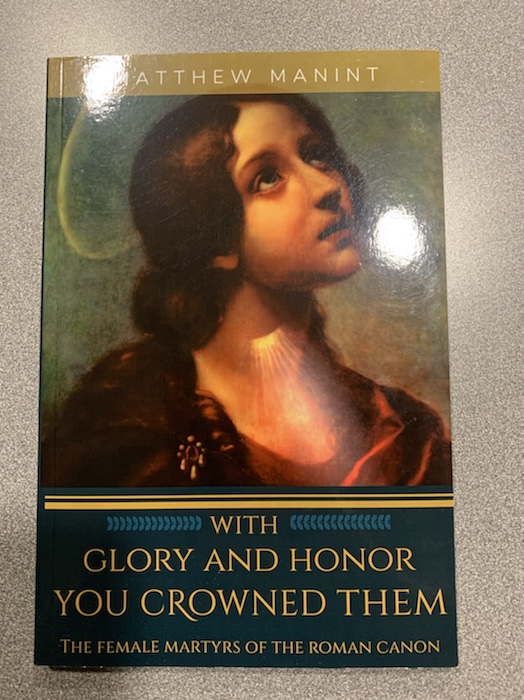
Agatha was martyred in Sicily in about 251 during the time of the Emperor Decius and her tomb is at Catania.  In Rome there is a lovely church dedicated to her, Sant’Agatha dei Goti in the Suburra zone, which is the titular church of Card. Burke.

Holy legend says that, despite her vow of virginity, she was pursued by a powerful man and eventually subjected to humiliations and tortures, including the cutting off of her breasts.   She is a patroness of women who have been abused and also for breast cancer patients.

There is a beautiful little book available…

With Glory and Honor You Crowned Them: The Female Martyrs of the Roman Canon by Matthew Manint

US HERE – UK HERE

We should probably increase our devotion to the martyrs, especially those of the Roman Canon.

We should probably increase our USE of the Roman Canon.

These are going to be hard days ahead.

Oremus.
Deus, qui inter cétera poténtiæ tuæ mirácula étiam in sexu frágili victóriam martýrii contulísti: concéde propítius; ut, qui beátæ Agathæ Vírginis et Mártyris tuæ natalítia cólimus, per eius ad te exémpla gradiámur.

Let us pray.
O God, Who among other wonders of Your power have given the victory of martyrdom even to the gentler sex, graciously grant that we who commemorate the anniversary of the death of blessed Agatha, Your Virgin and Martyr, may come to You by following her example.  Through Jesus Christ, thy Son our Lord, Who liveth and reigneth with thee, in the unity of the Holy Ghost, ever one God, world without end.  Amen.


Posted in Saints: Stories & Symbols |
2 Comments

Some necessary reading

Necessary reads today..

At National Catholic Register…  Ed Pentin’s piece “‘Great Reset’ Plan Parallels Some of Pope’s Initiatives — But There’s a Crucial Difference”.

Lot’s of links in that.  And a description of the Great Reset.

The Great Reset.  The concept makes my flesh crawl in a “signs of the times” sort of way.

Come!  Lord Jesus!

At Crisis, there are two pieces, one by Janet Smith and one by Eric Sammons.  No, wait, three pieces.  There is also a good piece about the need to restore the minor orders by Bp. Athanasius Schneider.  HERE

About the undersigned, you might want to check out a piece by Fr. Finigan and another by Fr. Hunwicke.

Posted in The Campus Telephone Pole |
7 Comments

Daily Rome Shot 68

Photo by Bree Dail.

Posted in SESSIUNCULA | Tagged
2 Comments