Asteroid 2012 TC4 will NOT strike your planet… they say.

That’s not the sun. That’s the fireball that blew up over Russia.

From SPACEWEATHER:

ASTEROID TO BUZZ EARTH THIS WEEK: When the sun rose over Chelyabinsk, Russia, on Feb. 15, 2013, at first it seemed like an ordinary day. Then the space rock hit. Without warning, the morning sky lit up with a second sun as shock waves shattered windows in hundreds of buildings around the wakening city.

The impactor flew out of the blue, literally from the direction of the sun where no telescope could see it, and took everyone by surprise. Years later, meteorite hunters are still finding pieces of the “Chelyabinsk asteroid” that rained down after its 17m-wide body disintegrated in the atmosphere.

A similar asteroid is approaching Earth this week, but this time NASA knows its coming. 2012 TC4 measures somewhere between 10 m and 30 m wide, and on Oct. 12th it will pass 43,500 km above our planet’s surface, about 1/8th the distance to the Moon. The flyby is so close, Earth’s gravity will significantly alter the asteroid’s trajectory before it exits the Earth-Moon system.

“We know the orbit of 2012 TC4 well enough to be absolutely certain that it won’t hit Earth,” says Paul Chodas, manager of the Center for Near-Earth Object Studies (CNEOS) at JPL,”but we haven’t established its exact path just yet.”

To get a better handle on the asteroid’s orbit (and possible future encounters), an international network of telescopes will monitor 2012 TC4 as it goes by. Pinging the asteroid with its Goldstone radar, NASA hopes to learn much about the space rock’s physical properties. The space agency will even exercise some aspects of its planetary defense systems.

This asteroid is too small to see with the naked eye. However, skilled amateur astronomers using 8+ inch telescopes will be able to observe it. At peak brightness, 2012 TC4 will shine like a 13th magnitude star as it zips through the constellations Capricornus and Sagittarius, according to AstroBob, who has detailed observing tips.

asteroid_Earth_impact


Posted in Look! Up in the sky!, TEOTWAWKI | Tagged
7 Comments

A great book for your celebration of Martin Luther!

As we approach LutherFest, I’d like to remind you all of a truly informative and engaging book.  This collection of essays is helpful.

Luther and His Progeny: 500 Years of Protestantism and Its Consequences for Church, State, and Society

US HERE – UK HERE

IMG_1917

To give you a sense of the thrust of the book, the Introduction is entitled: “Half a Millennium of Total Depravity (1517-2017): A Critique of Luther’s Impact in the Year of His ‘Catholic’ Apotheosis”.

In other words, this is not an unqualified “RAH! RAH! FOR THE REFORMATION!”

I wish that I had had 30 copies of this, to give to the seminarians and deacons of the diocese back in August.  Instead I chose Tracey Rowland’s terrific new book Catholic Theology.  

US HERE – UK HERE

But I digress.

The moderation queue is ON.

Posted in The Campus Telephone Pole | Tagged
17 Comments

Concerning rumors of dramatic changes to the Extraordinary Form

I have had some questions about a rumor going around that dramatic changes are going to be imposed on the older, traditional Form of Roman Rite.  Someone thinks that the new Lectionary and calendar will be imposed on the 1962 Missale sometime in 2018.

I respond: Piffle.   Even, bull piffle!

No.  Won’t happen.

In addition, I checked with my various peeps.  No.  Won’t happen.  Can’t happen.

So, you can relax and stop sending me mail about this.

The moderation queue is ON.

Posted in Liturgy Science Theatre 3000, You must be joking! | Tagged
23 Comments

The recent Jesuit-run Boston College conference on ‘Amoris Laetitia’

The recent Jesuit-run Boston College conference on the reception of Amoris Laetitia in these USA seems to have been intended as a closed workshop on how to “struggle” (in the Cultural Revolution sense) against the Four Olds (in this case, Familiaris Consortio, Veritatis splendor, Humanae vitae, and the Principle of Non-Contradiction).  As a confirmation of same, I noted at LifeSite‘s article about it:

The dissident news service National Catholic Reporter (NCR) [aka Fishwrap aka National Schismatic Reporter] appears to have been given the exclusive privilege of covering the conference. Links about the event on Boston College’s website refer to articles on NCR’s website. On its website, NCR states that a “handful of press outlets have been invited to report on the proceedings, including NCR.”

Look at the line up of cadres and commissars who spoke.  Look at the Jesuit-run location.  Look at the planned and controlled coverage.  What could go wrong?

Now we see the lib catholic equivalent of Big Letter Posters from Fishwrap.  They have received their caps and booklets. It’ll be a constant harangue now of “Down with the Cow Demons!  Down with the Snake Spirits!  Down with Dubia Askers!”  Soon we will see their version of the Four Pests Campaign rev up against, “Converts who Have Opinions, Lovers of Tradition, Signers of Filial Letters, Upholders of Law”.

Let us go Down To The Countryside of “Lived Experience”.

We must now force the legalist Cow Demons to learn the wisdom of El Pueblo and their “lived experience” which overcomes the Four Olds.

Criticize!  RECTIFY!

Then again, how many people attended this workshop?

Here is a photo from Fishwrap of “participants”.

Tens of people!

Perhaps that was just the speakers and organizers.

Wait…. that was the attendance.  According to Fishwrap: “These panel presentations were stimulating and prompted an extraordinary amount of discourse among all 40 participants”.

I suppose some will question my choice of imagery.

Get back to me after the Struggle Sessions begin.


struggle session li-zhensheng

Posted in The Coming Storm, The future and our choices | Tagged
41 Comments

A “cri de coeur”: Fr Z responds with a strong suggestion.

I had a note, really a cri de coeur, from a reader who said that she feels as if she and other good and innocent people in the Church today are undergoing one terror attack after another against our Catholic identity, one mass shooting or bus bombing or renegade truck smashing after another.

While I can try to calm and talk people off of ledges, I am not going to say that we are in a good situation right now.

When natural or man made disasters loom or occur, I often post about preparedness.  Take steps and make plans while things are relatively calm so that you don’t have to scramble for the basics when the moment comes to ACT.

When spiritual man-made disasters loom or occur, I must now post about preparedness.  Take steps and make plans.

What sorts of things might you do?

Of course, make a regular examination of your conscience and GO TO CONFESSION!

That, of course, means that you have to take steps to form your conscience properly.  And this is precisely the problem today, when it comes to increasingly frequent attacks on our Catholic identity.

These days there are strong, loud voices shouting down those who teach about the proper role of conscience and the formation of a Catholic conscience and instead are imposing by fiat a dangerous variation of the role of conscience.  Moreover, you might be in a parish or a school where you are being subjected to this twisting of conscience.

We must struggle against this oncoming tide and lose not spirit, trust in God, nor TIME.  We have to start now.   

As part of your spiritual prepping, you need to get your hands on trustworthy sources for your Catholic identity and even form small support and study groups.

One source that everyone can and should have is…

The Catechism of the Catholic Church.

US HERE – UK HERE (There are many editions.  Look around.)

I am a huge fan of Kindles (US HERE – UK HERE), but you should also have the BOOK, the material volume which you can hold in your hand and write in.  Get the book, which you can flip around in and hold spots in with a couple fingers as you cross check.

Read it.  Pick it up. Read portions every day.   Form a reading group with other Catholics.

St. John Paul II called the CCC, “a sure reference point”.   It is precisely the Magisterium of  John Paul that the present days powers are trying to obscure and, eventually, obliterate.

Possession of a copy of the CCC, and a solid familiarity with it, can be both shield and sword in the defense of your Catholic Faith.

Ignorance of the Faith makes you a potential victim of the predations of the libs.

When you hear from the pulpit or some other place a dubious notion that rings an alarm bell, check your CCC.   Then you can decide to ask Bp. McButterpants or Fr. Hugalot what gives.  “You said X, but the Catechism says Y.  [Then, with a smile…] What’s with that?”

Along with the Catechism of the Catholic Church you can review the always dependable Roman Catechism, the The Roman Catechism: The Catechism of the Council of Trent for Parish Priests.  Fathers… note the title.  Do you have a copy?  You should.  You should know this stuff like a mathematician knows his tables.  It’s basic.  And it’s not optional.

US HERE – UK HERE (There are many editions.  Look around.)

Also, make use of volumes of the wonderful Baltimore Catechism, which has different volumes for different ages (US HERE – UK HERE).  It’s so useful, in its Q&A format.   The Catechism of Pius X is also great.  (US HERE – UK HERE).  There are many good resources available.

However, make sure you have the Catechism of the Catholic Church.  


Posted in "How To..." - Practical Notes, Cri de Coeur, Semper Paratus, The Coming Storm, The future and our choices | Tagged , ,
8 Comments

Boston College Amoris Laetitia Agitprop Workshop and Schrödinger’s Cat

SchrödingersCatI wrote about the first installment of coverage of the agitprop workshop going on at Boston College about issues concenring Amoris Laetitia.  HERE

It seems to me, having read something about the second round (including the talk about Jesuit Fr. Antonio “2+2=5” Spadaro) that this is a practical workshop for agents wherein they are giving them marching orders and talking points for how to attack those who disagree with their interpretations.

That said, I am at present in Napa Valley, speaking at a Men’s conference.  We are on a break right now.

I just had a great conversation with a fellow who is a physicist.  We were talking about the work of another physicist who was part of the gravity team which was awarded the Nobel Prize.  He is trying to reunite physics and physika, Aristotelean principles properly understood. In any event, in the course of our chat the classic case of Schrödinger’s Cat came up.  Also, in our chat, in reference to the BC agitprop workshop I observed that, right now, those who are undermining Catholic teaching with ambiguity and chatter about “lived experience” have jettisoned the principle of non-contradiction.

Something hit me.

The people who are saying, in effect, that people who are in the state of sin can go to Communion without confession and a firm purpose of amendment, are like those who stand in front of the box containing Schrödinger’s Cat.  Except, they refuse to open it in order to find out what’s inside.   So long as they never have to open the box, the cat is both alive and dead at the same time.

It strikes me that that is what is going on when questions are asked (“Is the cat dead or alive inside that box, Prof. Schrödinger?”) and, instead of opening the box to find out, the key is squirreled away in a place no one can access.   Hence, you can have one bishops conference interpreting Amoris one way while another conference goes another way, in blatant violation of the principle of non-contradiction.

Refuse to look and you can have it anyway you want.

That’s fine when it’s just a cat in a box.

It’s not fine when we are talking about the salvation of souls.

Posted in The Drill | Tagged ,
35 Comments

PODCAzT 157: Pius XII – Ingruentium malorum – On reciting the Rosary

Pius XII RosaryNational Catholic Register on 1 Oct 2017 had a terrific article which brought to my attention again an 1951 Encyclical of Pius XII 1951, Ingruentium malorum, on the recitation of the Rosary.

The article by Joseph Pronechen is rightly called prophetic. As it so often happens when we read these old encyclicals it is as if they were directed to our very days.

Today I read it for you.

As you listen, tune your ears for he description of their times, in the post war. He could be describing our situation.

One of the things he drives hard is the importance of the family.  He also has a powerful description of the Rosary, when challenges loom, as if it were David’s sling against the huge enemy Goliath.d confusing for the Church and no little trouble for me as well.

So as we come to the Feast of Our Lady of Victory, the Feast of the Holy Rosary, here is a reflection to help strengthen your resolve and joy and to inspire new personal and family practices.

You might hear along the way, something by Heinrich Ignaz Franz von Biber’s The Mystery Sonatas

US HERE – UK HERE

Also, the Dominican Sisters of Mary, Mother of the Eucharist

US HERE – UK HERE

Posted in "How To..." - Practical Notes, Our Catholic Identity, Our Solitary Boast, PODCAzT | Tagged , ,
4 Comments

Fishwrap on Jesuit Boston College conference on Amoris Laetitia

Fishwrap (akfishwrapa National Schismatic Reporter) has a post about a conference about Amoris Laetitia held at Jesuit-run Boston College.  The report has an aggressively tendentious title: Conference weighs how ‘Amoris Laetitia’ rejects ‘infantilization of laity’

Infantalization?

First, consider some of the speakers: Cardinal Blase Cupich, Atlanta Archbishop Wilton Gregory, Malta Archbishop Charles Scicluna and San Diego Bishop Robert McElroy, Natalia Imperatori-Lee, a theologian at Manhattan College, Jesuit Fr. James Keenan, Jesuit Antonio “2+2=5” Spadaro, C. Vanessa White, a theologian at Catholic Theological Union, etc. Great, right? What could go wrong?

Everything, apparently.

It is hard to assess the usefulness of conference from a news piece written by someone with a clear agenda, but we can glean a few things from the quotes.

One thing that emerged is that they are pushing the primacy of “experience”.  This means that if your experience prompts you to do X, well, that must be okay even though the Church teaches that X might even be intrinsically evil.  Your “experience” authorizes you to do X.  Furthermore, the clergy’s role must then be to affirm your choice and accompany you as you pursue it.  I think I got that right.

Leaving aside completely Cupich’s talk, …

Natalia Imperatori-Lee, a theologian at Manhattan College, said Latino reception of Amoris Laetitia “cannot be understood” outside the historical legacy of the colonial system in the Americas. “

Oh, Sure. Right!

She also said:

Imperatori-Lee said that in Francis’ call for better respect of decisions laypeople make in their lives, Latinos see the pope “pointing to the infantilization of laypeople and families that is so commonly a feature of colonization.” [colonization?]

“The infantilization of the laity has its historical roots in a view of laypeople as objects of clerical control: pay, pray and obey, or as Pius X notes in [the 1906 encyclical] Vehementer Nos, ‘the right of the laity is to allow itself to be led,’ ” she said.

Imperatori-Lee said Francis, however, sees the family as “the protagonist of its own destiny.

“Couples become the subjects of their history, even as pastors and confessors retain a role of accompaniment and listening,” she said.

I’m pretty sure that this is code for: You don’t have to listen to the Church if you don’t want to.

“The replacement of conscience is an act of domination, again colonization,” she said, paraphrasing Peruvian theologian Gregorio Pérez. [I wonder what theological school he could be aligned with.] “It is an abuse of power. The formation of conscience, on the other hand, is life-giving ministry.” [I’m not quite sure who that Gregorio Pérez is, but I suspect it could be this guy.]

I think this means that if a priest or bishop teaches something clear about what the Church teaches concerning faith and morals, that is an attempt to “replace” the conscience and is, therefore, a symptom domination, like colonization (which must, I guess, be really bad… colonization must be evil).  I’ll bet that the speaker thinks that “formation” of conscience means something like affirming whatever people think with your fingers crossed that they’ll get it right on their own… but if they don’t, affirm them anyway.  You don’t, after all, want to be a colonizer.

And this….

C. Vanessa White, a theologian at Catholic Theological Union, focused on how the black Catholic community has understood the exhortation. To prepare for her talk, she sought input from other black Catholic theologians and lay ministers on how the document had affected their parishes.
“Sad to say, most of those who responded say there has been little impact,” said White.
One lay minister told her: “When Amoris Laetitia first came out it was discussed briefly … but there wasn’t an overall interest from the parish to read the document in its entirety.

That’s more like it!

And there’s this.  What to make of this?

Cathleen Kaveny, a theologian and civil lawyer at Boston College, spoke about how the church considers people who have been divorced and remarried without first obtaining annulments.

Kaveny used her dual professional background to examine how the church might turn to U.S. civil law as a resource for a re-evaluation of how it sees remarriage as a continuing kind of adultery.  [US civil law as resource… Does that mean theological locus?  What about laws that permit abortion?  Aren’t there still some sodomy laws on the books?  What about the Ohio law that it is illegal for five women to live in the same house?]

She cited a case in which the Supreme Court decided that prosecutors pursuing a case against polygamists could not charge them with separate counts for each year they were married because the crime had to align with the “lived experience” of the people at question.  [There it is.  “lived experience”.  But wait!  The good stuff is coming up!]

Jesus clearly disfavored adultery,” Kaveny concluded. [Disfavored.  Interesting word choice.  I can picture Christ now, biting his lower lip like Bill Clinton and then accompanying the adulterers with a hug and smile.] “It’s clear that he rejects divorce and remarriage as contrary to the original will of God. [Get ready for the poison…] But nothing in Jesus’ words or conduct demand that the sin involved in divorce and remarriage must be conceptualized as a sin that continues indefinitely, without the possibility of effective repentance.”  [What this means, I think, is that at a certain point the adulterous union ceases to be a sin without any changes or amendment of life.  I think that what she meant.]

“To impose such a requirement in every case is not merciful,” she said. “And mercy is the ultimate touchstone for the divine lawgiver.” [Mercy means never having to say “I’m sorry.”]

We do not need to disturb Jesus’ teaching in order to refine and develop it in these ways, in ways that moral theologians and canon lawyers have always done,” she said.  [Because we now have US civil law to help us out!]

Look.  This is a biased report in the worst excuse for a catholic source you can find.  It is hard to know what really happened there from this mishmash of quotes.  However, I’ll bet you all the money in your pocket that it was help to promote a specific agenda and that no one walked out wondering what it was.

The moderation queue is ON.
Posted in Biased Media Coverage, Liberals, One Man & One Woman, Our Catholic Identity, The Coming Storm, What are they REALLY saying? | Tagged ,
48 Comments

An avant-garde Bishop raises an English church to new life

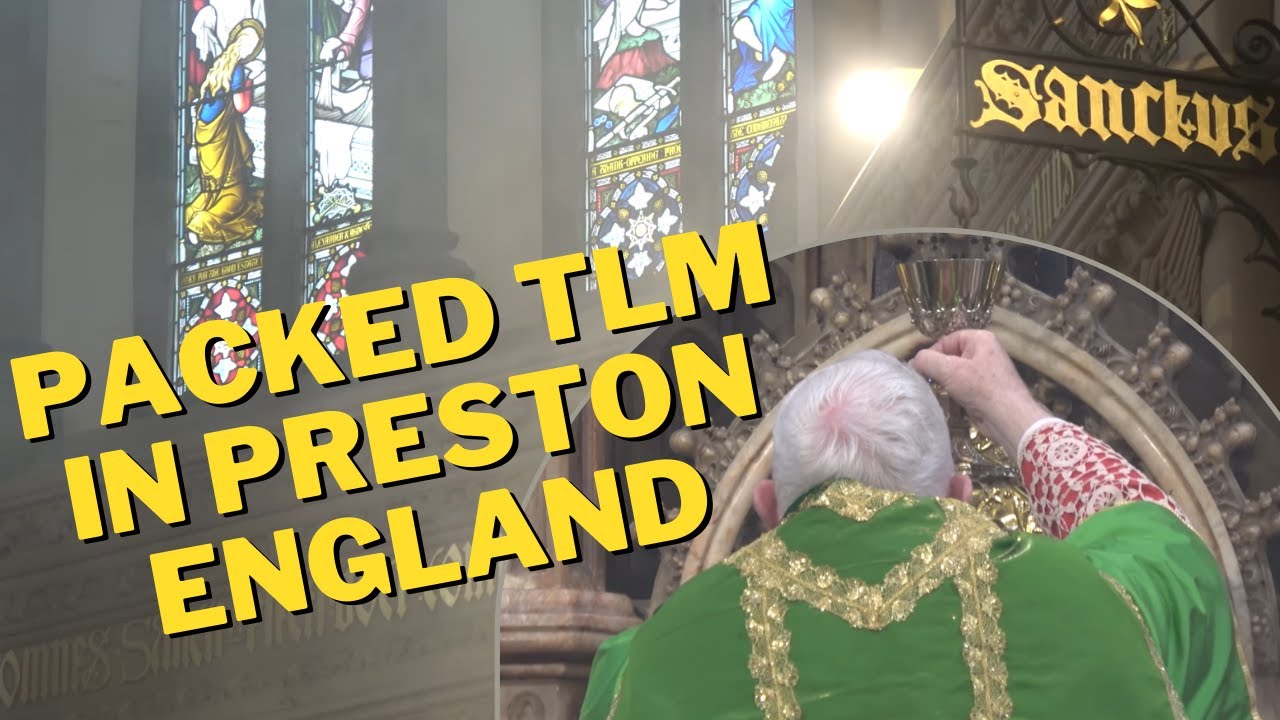
The Bishop of Lancaster, England, Most Rev. Michael Campbell, OSA, posted on his blog about celebrating a Pontifical Mass at the Throne.  The church was recently entrusted to the Institute of Christ the King, which is raising it to new life.

I was struck by this observation. The bishop wrote:

It seemed to me as if this venerable place of worship was once more breathing fully in both lungs, and through its splendid liturgy praise and worship were offered to Almighty God.

He didn’t let the church die.  Instead, he thought so far inside the box that what he did was outside the box, it was avant-garde: he returned the church to the purpose for which it was made.

YouTube thumbnailYouTube icon

Yes, I think this is avant-garde, which implies that more bishops will do the same as they wake up to the possibilities.

Fr. Z kudos to all!

Posted in Fr. Z KUDOS, Just Too Cool, Liturgy Science Theatre 3000 | Tagged ,
15 Comments

Well-prepared Catholics raise questions. Responses? “Shut up!”, they explain.

17_06_27_AAS_AmorisPeople are swift these days to talk about their “rights”.  I sometimes get a little nervous when “rights” are invoked in the Church, because often “rights” means “I didn’t get what I wanted”.  Clarity is needed regarding “rights”.


At his excellent, daily-check blog, canonist Ed Peters looks at arguments over the Filial Correction.  He lays it out well.  My emphases  and comments.

On arguments that may be, and sometimes must be, made

I have taken no position on the Correctio Filialis. I know and respect some of its signatories as I do some of its critics but, as the document itself seems to fall within the boundaries of Canon 212, [§1 “Conscious of their own responsibility, the Christian faithful are bound to follow with Christian obedience those things which the sacred pastors, inasmuch as they represent Christ, declare as teachers of the faith or establish as rulers of the Church.”] I say, ‘Have at it folks and may the better arguments prevail’. That said, some recent arguments against the Correctio are, in my view, subtly deficient and, time permitting, I will reply to them.

But even before that, I wish to reply to an attitude I perceive emerging against the Correctio,[Leveled by some also at the Five Dubia™.] one that attempts to dissuade Correctio supporters from their position by alleging a disastrous— but supposedly logical —consequence of their being right, [ironic, no?] something along these lines: If Amoris laetita and/or Pope Francis and/or his Vatican allies are really as bad as the authors of the Correctio seem to believe, then all petitions, Dubia, and corrections will do no good. Prayer and fasting would be more advisable.

Hmmm.

Setting aside that several of these scenarios are not asserted in the Correctio and that the evidence concerning some others is not yet in, underlying this doomsday-like retort of the Correctio is, I think, a certain despair about the importance of argument itself in this matter. At the very least, such a bleak conclusion disregards the duty of certain Catholics[NB: He did not say, “Catholics”, but rather “certain Catholics”.] precisely to engage in such debates.

Canon 212 § 3 has been invoked by those supporting the Correctio to point out that the Church herself recognizes [here we go] the right of certain persons “to manifest to sacred pastors their opinion on matters which pertain to the good of the Church and to make their opinion known to the rest of the Christian faithful”, namely, those persons who possess “knowledge, competence, and prestige” in regard to the matter under discussion. Indeed. But Canon 212 § 3 says something more.

Canon 212 § 3 states in regard to persons with special knowledge, competence, and prestige in regard to ecclesiastical matters, that they “have the right and even at times the duty” to express their views on matters impacting the well-being of the Church (my emphasis). The duty. Not just the right. [Get that?]

Thus to the extent that some qualified signatories and/or supporters of the Correctio have realized a duty (expressed in law) to address these matters, they are not simply acting under the protection of law (as are those exercising a right), they are acting in accord with its directives (as do those under an obligation). Now, to be sure, Canon 212 is not self-interpreting and several prudential considerations must be considered when applying it. But in its very terms is the expression of a duty incumbent upon certain Catholics who are qualified by their education, experience, and Church positions to make serious arguments on matters impacting the Church. And I see no exception in the law for those whose positions might imply the existence of other problems for the Church or for those who arguments seem unlikely to be acted upon.

Cdl. Caffara said “only a blind man could deny there’s great confusion, uncertainty, and insecurity in the Church.” Much of that confusion turns, obviously, on the meaning of technical terms and on the content of intellectual assertions. Those blessed with advanced training in such technical terms and intellectual assertions may be, and at times should be, at the forefront of these debates.

And, yes, all participants in these debates should be engaged in extra prayer and fasting.

Amen.

So, some well-prepared Catholics sense their duty to raise questions.  The responses from authorities and critics?

“Shut up!”, they explain.

The moderation queue is ON.

Posted in Canon Law, The Coming Storm, The Drill | Tagged , ,
17 Comments