Identity Crisis of Catholic Priests. Wherein Fr. Z rants.

At Crisis, there is a piece about the crisis in the Catholic priesthood.

No, this was not penned by a bishop.  Nor by a priest.  Nor even by a seminarian.  Constance T. Hull wrote it, wife, mother, homeschooler who has some philosophy and theology.  She has written for several publications.

She nails this.  My emphases:

For decades, priests have been formed in a manner that has reduced them to glorified social workers, social justice warriors, administrators, and fundraisers, and it shows. This same formation is what has led many priests and bishops to ignore health and safety protocols and laws for public demonstrations while at the same time cutting off the faithful from the Sacraments and the public celebration of the Mass— the “source and summit of the Christian life”—during the holiest season of the year. These priests have inverted the goods of this world and put them over and above spiritual goods. They have replaced the City of God with the City of Man.

What these well-meaning priests and bishops have failed to see in their desire to attend demonstrations is that they are actually aiding in the growing alienation of the Church from public life. They have accepted that the Mass and the Sacraments are non-essential, but that protests and demonstrations are worth defying social distancing requirements during this pandemic.

And…

The crisis facing the priesthood is not a matter of human sexuality, as so many want to argue. This is not about priestly celibacy and pent-up sexual frustration. The clergy sex abuse scandal is a symptom of a much deeper problem. Clericalism is also only a symptom of a much deeper problem. The real issue is the priesthood has become separated from its Eucharistic identity and its calling to be crucified with Christ for the salvation of souls.

“A long long time ago”, February, PRE-COVID-1984 – remember before Coronavirus? – Card. Sarah and Pope Benedict issued a book about the crisis in the priesthood.  Sarah and Benedict both wrote about the flawed formation priests are getting.

And it’s not just formation.   It is also, has been for a while but now in an accelerating fashion, the trampling of priests from within the Church herself, and not just from without.

What to do?

FATHERS. LEARN THE TRADITIONAL LATIN MASS AND CELEBRATE IT.

A compelling reason to learn it, Fathers, is because, clerical and lay alike, we are our rites.   Who is the Roman Catholic priest if he doesn’t know his own Rite?  Who is he?  If you don’t know your Traditional Roman Rite, then you don’t know the Roman Rite.

You don’t know who you are.

Fathers, you don’t need permission to learn the TLM.  You don’t need permission or approval to learn it and to say it.

Time and again, priests have told me that learning the TLM changed them profoundly.  They began to grasp aspects of their priesthood which they hadn’t gleaned before.  In turn, that produces a knock on effect in other aspects of their work, in particular how they celebrate the Novus Ordo.  Congregations note the differences.  The knock on effect continues to knock.

For some of you priests out there, learning the TLM will be difficult.   Things that are worth pursuing are usually hard.

One thing that will be hard to overcome is the lack of Latin.

Ohhhh how the Enemy our souls brilliantly maneuvered his agents when Latin was eradicated from schools and seminaries!

The Enemy doesn’t want you to learn the TLM.  At all cost, the treasury door – nay rather, armory door! – must remain slammed and barred against you.   The Enemy will not easily let you claim your armor and weapons.  You must be denied your priestly patrimony!  A thousand distractions will assail you.  Doubts will pop up.  The demonically oppressed, even your pastors or bishops and other clergy, will undermine you or persecute you or bully you into giving up.

This will happen to many of you.   When it does, invoke your angels and Mary, Queen of the Clergy, to protect you.

You can do this.  Latin isn’t a mystical Eldorado that only a few can attain.  As my old mentor Fr. Foster, famous Latinist, used to quip facetiously but factually, “In ancient Rome even the dogs and prostitutes knew Latin.”  Over the centuries, countless priests of room temperature IQ learned Latin for the Mass.   They didn’t have to dissertate with the eloquence of Leo the Great.  If St. John Vianney could do it, so can you.  And most of you may wind up being good at it.

Remember: Latin is a language, not multivariable calculus.

No project which we undertake in the Church will succeed unless it flows from, is connected to, and returns to our sacred liturgical worship.

By the virtue of Religion, we have to order our acts rightly.  This means pleasing worship of God.  Benedict XVI’s gift to the Church in Summorum Pontificum, was precisely intended to bring about a healing and renewal of the whole Church through a renewal and healing of her worship, such that we can create a bulwark in the face of future tumult.

Fathers.  You can do this.   It will be hard.  It has to be done.

One way to respond to what Card. Sarah and Benedict XVI wrote, and to respond to The Present Crisis in the Church, and to give something beautiful to God and his people is to…

… learn the Traditional Latin Mass.

Give it to yourselves.

When you give it to yourselves, you are really giving it to the whole Church.  The knock on effect you will initiate will reap many good fruits.

The problems that were emerging more slowly before COVID-1984 are now manifesting with astonishing speed.

We don’t have a lot of time.  Get to work!

Posted in Hard-Identity Catholicism, Priests and Priesthood, The Coming Storm, The future and our choices, Wherein Fr. Z Rants | Tagged , , , ,
15 Comments

Concerning statues and absolute INSANITY

In these USA lib mob participants have reverted to their reptilian brain stems – I know, I know, its not unusual – and are committing massive vandalism in the destruction of public and private property by tearing down statues the don’t like, or they brain-stem “think” they don’t  like.

Meanwhile, as a commentator pointed out under another post, in Germany in a town name Gelsenkirchen, a statue has been erected in honor or… wait for it…

Vladimir Ilyich Ulyanov – aka

LENIN.

Check out the story at Deutsche Welle

Folks, if you don’t think that things could go sideways in these USA really fast, think again.

We are at a crossroad. This upcoming Presidential election is of critical importance. If the Left wins, this nation will never be the same.

Living in lockdown, with an economy spinning into the void, was a mere taste of what it would be like to live under socialism.

Posted in Latin, Pò sì jiù, Si vis pacem para bellum!, You must be joking! | Tagged

14 Comments

New titles for Mary added as invocations in the Litany of Loreto

Here’s some news.

As reported by CNA, Francis added three titles as invocations to the Litany of Loreto, the Litany of the Blessed Virgin Mary.

Card. Sarah, Prefect of the Congregation for the Divine Liturgy and the Discipline of the Sacraments, said the invocations to be inserted into the Litany are:

Mater misericordiae – Mother of mercy – inserted after Mater Ecclesiae

Mater spei – Mother of hope – inserted after Mater divinae gratiae

Solacium migrantium – Solace of migrants – inserted after Refugium peccatorum

At a certain point the Litany is going to have to be trimmed if this keeps going!

The Congregation’s Letter is HERE


Posted in "How To..." - Practical Notes, Liturgy Science Theatre 3000, Our Solitary Boast | Tagged ,
10 Comments

Your Sacred Heart Sermon notes 2020 & church openings

It is the Feast of the Sacred Heart!   Were you able to go to church today?

It may be that you went to church for Mass.  It may be that you heard a sermon via the internet.

Was there a good point made in the sermon you heard at the Mass for this wonderful feast, either live or on the internet? Let us know what it was.

Also, let us know about church openings and Masses in your area.

For my part…

Posted in SESSIUNCULA |
7 Comments

ACTION ITEM: PRAYERS FOR THE RATZINGER BROTHERS!!

The brother of Benedict XVI, Georg Ratzinger, is very ill.

Benedict XVI left Vatican City and went to Regensburg to be with his brother.

They are very close. I remember many times in Rome seeing them walking together and greeting them. We would talk about sacred music, since George, musician, knew my pastor, Msgr. Schuler. Before everything went sideways for Joseph, they were going to have a house near Velletri, where the Cardinal was Cardinal Bishop.

The brothers are very close, as they were with their sister Maria, who died in 1991.

There is an article in German HERE

Posted in Benedict XVI | Tagged
8 Comments

ACTION ITEM! Special vigilance at churches because of satanic activity before and on Sunday, 21 June. SERIOUS.

This is something that pastors of churches and rectors of chapels must attend to.

There is increased satanic activity these days, on the part of demons and on the part of their human puppets.   Some of these dupes just think they are being cool or rebellious, without knowing that getting into this satanic garbage is real.  Others know that its real.

This week we have a confluence of the Feast of the Sacred Heart of Jesus, and the Immaculate Heart of Mary, and the Summer Solstice and a rare Annular Solar Eclipse.

The satanists are going to be at it.

I read of the theft of a tabernacle from a church. You get me drift.

I read also of a – I am not making this up – Luciferian March for a One World Government to be held in some – at this point – 9 cities in these USA, during the Solar Eclipse (visible mostly on the other side of the world in India HERE).  The demonstrators will attempt to set up satanic monuments.  HERE

The cities include:

  • Jacksonville, Florida
  • Raleigh, North Carolina
  • Cincinnati, Ohio
  • Columbus, Ohio
  • Washington, DC
  • Madison, WI
  • Buffalo, New York
  • Niagara Falls, NY
  • Salem, OR

It may be that more have been added.   These people, with the network they have with the anarchists, have the potential to organize already activated cells of chaos, as we have seen over the last few weeks.

NB: It could be that this blithering idiots and their demon-driven organizers will attempt to break into churches to steal Hosts.

NB: If could be that plants will be sent to Masses to steal Hosts through Communion on the hand.

Be vigilant.

And, BISHOPS AND PRIESTS… for the love of God, get over whatever reservations you have about using or asking permission to say Title XI Chapter 3 from the Rituale Romanum!  This is the longer St. Michael Prayer.   Powerful stuff and exactly what we need right now in the spiritual war that is now hot and deadly.

BISHOPS AND PRIESTS… I will send you recordings in Latin of the Exorcism.

Write to me HERE

Put – exactly – in the subject line: LATIN EXORCISM RECORDING

Please CAPITALIZE and write only that.

Please tell me what your present assignment is.

If you are not a priest or a bishop, don’t bother asking.

Posted in ACTION ITEM!, Hard-Identity Catholicism, Semper Paratus, Si vis pacem para bellum!, The Coming Storm, The future and our choices |
16 Comments

ASK FATHER: Confirmation using an instrument. Tradition says “NO!”, but the CDW said “YES”.

From a reader…

QUAERITUR:

In a May 14, 2020 dubium to the Holy See, the USCCB asked if an instrument such as a cotton ball may be used for the anointing with sacred Chrism during the celebration of the sacrament of Confirmation, much as the law allows for “an instrument” to be used for the anointing during the Anointing of the Sick. The Congregation for Divine Worship and the Discipline of the Sacraments replied on June 2, 2020 that “The use by the minister of an instrument (gloves, cotton swab…) does not affect the validity of the Sacrament.” A cotton ball or cotton swab may therefore be used—one for each candidate—and then disposed of by burning afterward. Were a glove to be used, it would need to be changed between each anointing. If no cotton ball, cotton swab, or glove is used, priests must wash or sanitize hands between each anointing so that the Sacred Chrism is not contaminated nor is contagion spread between candidates.

How can that be? What about the “imposition” of the hand which in the NO was reduced to the contact in the anointing itself. Now even that is gone.

Can we say The response of the Vatican is “wrong”?

The CDW responded that an instrument may be used for the administration of the Oil of the Infirm in the Sacrament of Anointing.

That is disturbing.   It directly contradicts previous teaching and tradition.

Who am I to question the CDW in these matters?  After all, I am just an Unreconstructed Ossified Manualist.  So let’s check on our sources.

Mind you… what I am about to write applies to the TRADITIONAL manner of administering the Sacrament of Confirmation.   By no means can the CDW response be applied to the TRADITIONAL celebration of the sacrament.

Also, as far as the Novus Ordo goes, the Church gets to decide about the matter and form of the sacraments, provided that their divine institution is not violated.  The Church cannot, for example say that rice cakes can be used for the Eucharist.  But the Church can, for example, change the form, the essential words, for the Sacrament of Confirmation or of Holy Orders, and what instruments are used, such as the traditio instrumentorum in the rite of ordination.

His scriptis, there are still important principles to deal with.  If we believe that sacraments have matter and form (and we do) then we have to figure out if the use of an instrument for the anointing with Chrism in Confirmation is permissible.  Theologians in the past have always… always… answer NO.  The hand must be used without and instrument, because the hand of the minister is connected to the matter of the sacrament.

Turning to Sabetti-Barrett’s 1919 edition of Compendium Theologiae Moralis, I read (in Latin):

669.  Query. – Question 2.  How is the anointing to be done?

Response. It must be done with the right thumb of the Bishop in the manner of a cross on the forehead of the one confirmed.  However, the anointing would be valid if it were done by a different digit of the Bishop, and even if it were a digit of the left hand, because it would be an imposition of the bishop’s hand.  But a Bishop would sin, were he to do that without necessity, because he would be departing from the universal praxis of the Church; albeit it does not seem that an inversion of the aforementioned ceremony would reach the level of grave guilt. – Cf. S. Alphons. n. 165

Question 3.  Whether anointing can be done validly by means of an instrument?

Response. NEGATIVE., and the reason is, that the immediate imposition of the hand of the Minister would be lacking, which is absolutely required from what has been said.  On this in the new Code (1917):
§2. Anointing is not to be done with any instrument, but it is imposed properly by the hand of the minister on the head of the confirmand.

Prümmer in the 1953 Manulae Theologiae Moralis says:

156. 3. The anointing must be done with the thumb of the right hand, and not with a stylus or another instrument, as has already been said.  If, however, the bishop has a bad thumb, he can licitly anoint with the thumb of his left hand or with another digit.

We must grant that THE CHURCH gets to determine how the sacraments are to be administered.   However, the 2020 CDW response seems to ignore the opinions of theologians which the Church has, hitherto, rested on for a contrary opinion.  I don’t think they can simply be left aside.

We still need to have distinctions such as proximate and remote material, if we still believe in matter and form.

Let’s go another step.

Is the imposition of the hand hitherto required accomplished if a glove is worn?

The answer is surely YES.

I would you to the imposition of hands to the rite of ordination of priests.

It seems that an essential imposition of hands, when required, is accomplished with the use of gloves.

Could one say that the gloves are instruments.   Not really.  They do not significantly distance the hand from the head.  An instrument does (which is the point of using it).

Hence, in the administration of the Sacrament of Confirmation, the bishop can anoint using a gloved hand, but he cannot use an instrument to anoint.  I think the Congregation’s response is wrong and that it is highly likely that the use of an instrument to anoint with Chrism for Confirmation (not Anointing) is invalid.

A bishop or priest can use an instrument to anoint in the Sacrament of Anointing, because imposition of the hand is not required for the administration of the sacrament.  However, our best theologians, with St. Alphonsus, are firm on this point: the bishop must confirm with his hand, not an instrument.  His hand can be gloved, but the Chrism must be applied with a finger of his hand and not through an instrument.

In any event, I hope this gives any priest (with permission to confirm) and any bishop serious pause in the matter of using an instrument to apply Chrism.  DON’T DO IT.

I think this needs greater clarification.

Meanwhile, allow me to muddy the waters a little.   In the 15th c. Rogier van der Weyden – a painter with a sharp eye – thought bishops could confirm using an instrument.   This is from his amazing Seven Sacraments Altarpiece.

First, the bishop is clearly confirming.

And for Ordination to the Priesthood and for Extreme Unction.

Again, the Church gets to decide how sacraments are celebrated, what the matter is and what the form is.  If, however, this constitutes a departure from previous theology, the Congregation should be clear about that.

Salvo meliore iudicio, of course.   But I would ask that this be reviewed and clarified by the same Congregation.

Comment moderation is ON.

Posted in "How To..." - Practical Notes, ASK FATHER Question Box, Liturgy Science Theatre 3000, Our Catholic Identity |
4 Comments

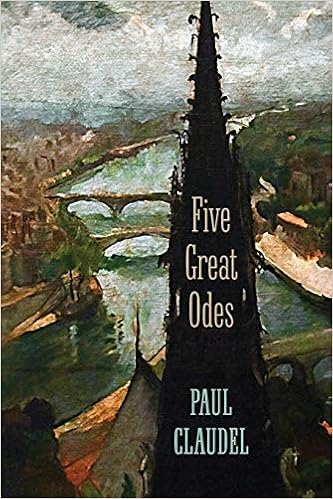
NEW BOOK: Paul Claudel: Five Great Odes from Angelico Press

Introductions and Prefaces are important when looking at books. Never skip over them. In the introduction by the translator Jonathan Geltner to this wonderful new book from the ever more valuable Angelico Press I found a first key to grasping the topic.

“Paul Claudel was among the last artists of the Christian civilization of Western Europe: an artist who wrote from the heart of that civilization, not as an isolated survivor of it living on in an altered world.”

Paul Claudel: Five Great Odes.

US HERE – UK HERE

Claudel, fascinating man.  Contemplative, but active as a diplomat, with his own checkered past that fueled his writing with auto-referential authenticity.  You might know of the story of his conversion.  The young Claudel had an epiphany moment in Notre-Dame during the singing of the Magnificat during Vespers of Christmas

“In that moment an event happened that dominates my whole life. In an instant my heart was touched and I believed. I believed with a force of adhesion so great, with such a lifting of all my being, with a conviction so powerful, in a certainty that would not leave room for any kind of doubt that, from that point onward, no reasoning, no circumstance of my agitated life could either shake my faith or touch it.”

Back to the introduction:

“With the poetry of Claudel’s cogenerationist and coreligionist Charles Péguy, the Odes have little in common superficially, though they share much in the way of a feeling that is uniquely both French and Catholic. I would call that feeling fierce and con?dent, with an eye to the etymology of those words connoting, respectively, legitimate pride or bravery, and faithfulness. There is a certain swagger to the Odes, something brazen yet Christian insofar as rooted in humility conceived as a virtue, the paradoxical strength of weakness.”

And…

“I will return to Claudel as man of religion/desire in a particular and infamous respect, but I wish first to draw a better comparison with our French writer than any of the foregoing. Of all twentieth-century literary artists I believe it was J.R.R. Tolkien who would, after Claudel, most embody a sacramental poetics in his work. … It is perhaps worth noting that both Claudel and Tolkien produced their literary work on the side while fulfilling the duties of family life and careers as a diplomat and a philologist. But the affinity between the two artists is no doubt difficult to perceive, so disparate are their efforts, one in a lyric mode going back to the Hebrew Scriptures (at least in the Odes) and the other in a mode—high fantasy—so new that he had largely to invent it for himself. Yet the affinity is there: they were both catholic. I intend the aural and typographical pun, for both men were members of the Roman Catholic Christian communion and their work was obviously and thoroughly governed by that membership.”

You might see what I am getting at.

Once there were men who, when they wrote, wrote from the Christian Catholic viewpoint because they were still in a Christian and Catholic milieu. At least Christian. At least something like the Western Civilization born from Hellenistic, Roman and Judeo-Christian roots. At from the vestiges or the embers of Western Civilization.

I wonder if in our day the viewpoint has finally become the large graffiti vulgarities spray-painted the walls of downtown Seattle… er… CHAZ… er… more ironic… CHOP. Those graffiti being to the large character posters of the Cultural Revolution what the cave-flickerings are to Plato’s forms… or to keep with the Tolkien line, what Peter Jackson’s movies are to the real thing.

Translation of poetry run the risk of being only shadows of the original too. But I’m not going to let that stop me from enjoying this book.

I was rather surprised to Tolkien as a reference through the whole introduction. He had such such a foundational influence on my whole like. But I get with the commentator, Claudel’s translator is driving at, which is precisely why I am eager to settle slowly and patiently into Claudel’s poetry, which I have never read. O, that I could first read it in French without a hesitation of vocabulary or idiom! But in French read it also I will, but I’ll be riding this pony as I do.

We need to read and rest in Christian Catholic minds. Now more than ever are their books like salves for the soul.

In a time wherein more and more people seem to – for real – take themselves as the arbiter of truth not just for themselves in their own little fantasy world, but now also for everyone else… “OR ELSE!”… how refreshing to read:

“I believe without changing one point / what my fathers believed before my time.” (p. 118)


Posted in REVIEWS | Tagged
3 Comments

SHOPPING ONLINE? Please, come here first!

Your use of my Amazon link is a major part of my income. It helps to pay for insurance, groceries, everything. Please remember me when shopping online. Thanks in advance.

US HERE – UK HERE

These links are always on the right side bar of the blog.
Once you use one of those links to enter Amazon, I’ll get a small percentage of what you purchase during that session.  I can’t see what you buy.
Also, I regularly pray for and say Masses for my regular and occasional donors. It is my pleasure and duty to do so,
Posted in ¡Hagan lío! |
Comments Off on SHOPPING ONLINE? Please, come here first!

Fr. Z’s Kitchen and Sacristy: Starching a linen corporal to a glassy finish

A project.

Recently, at Corpus Christi, I recalled the story of the Eucharistic miracle at Bolsena during which a Host bled on a corporal, which spurred the institution of the feast.  I got to thinking about corporals.  A little light bulb went on.

Some of you might recall that, a couple years ago when I was in Rome, I posted about the wonderful corporals we have for Mass in many of the churches, for example, St. Peter’s Basilica (where I said daily Mass for many years) and at my adoptive Roman parish Ss. Trinità dei Pelegrini.

The corporals are hard starched, so much so that they have a glassy shine and are very stiff.  This means that it is extremely easy to spot particles of the Host and lift them with the edge of the paten.

Here are a couple of photos of such a corporal in Rome.

Notice that it doesn’t yet want to lie flat.

Note the shine of the starch.

Folded.

I determined that I wanted to make corporals like this.

First, what is a corporal?

A corporal (from Latin corpus “body”) is a square white cloth of linen upon which the chalice with its paten and host, and also ciboria containing the smaller hosts are placed during the celebration of Holy Mass.   The corporal is used whenever the Blessed Sacrament is taken out of the tabernacle, for example for exposition.  If vessels are to be purified even – in the Novus Ordo – blech – at the credence table (i.e., not on the altar) a corporal is to be used.   Hear that you priests out there?  Redemptionis Sacramentum 119 we also see the importance of using the corporal.

Practical use.  The first thing has to do with the priest’s intention at Mass to consecrate the Eucharist.  Priests are to have the intention to consecrate the matter they know they want to consecrate.  The usual way to help with this intention, to help make it explicit, is to place the matter to be consecrated on the corporal which is spread on the altar.  If the priest has the intention to consecrate everything on the corporal, he’s good to go.  He doesn’t have then to try to hold the specific intention for all the hosts in the ciborium as well.  And if there are hosts nearby, but not on the corporal, in a storage box or vessel for another Mass, no problem.

The old De defectibus, section on defects, which was part and parcel of the Roman priest’s knowledge for centuries is helpful in this regard.  There is a description of defects of intention:

“For that reason every priest should always have such an intention, namely the intention of consecrating all the hosts that have been Placed on the corporal before him for consecration.”

This is a priest’s moral intention.

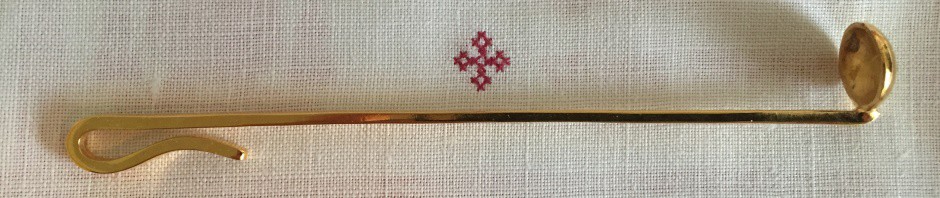
Corporals shouldn’t be embroidered.  These days they tent to have a little cross, supposedly because the priest is so dopey that he can’t figure out where to put the Host.   Well.. these days… hmmm.   It also could be there to help the priest get oriented for refolding the corporal properly.   No, the corporal should not even have that little cross, but most do.  As a matter of fact, the one I worked with for this project has the little cross.

Why don’t I like the little cross?  Because in the TLM we place the consecrated Host directly on the corporal and only later slide the paten under it.  Particles of the Host could be caught in the fibers of the embroidered cross.  So, NO… no cross.   When I have a corporal with a cross, I tend to turn it around so that it is at the top, and I place the chalice there.

The corporal’s main purpose, however, along with indicating what is to be consecrated, is to prevent the loss of particles from the Host.  Should one fall, as sometimes happens because of it is dry or during the fractio rite, when it is broken, and the priest misses it, the way the corporal is folded will contain the host, as if with a little envelope… ne pereant.    Folding the corporal correctly is important.    So is way it is placed on the altar.   To that end, preserving particles, the corporal is always gently scraped with the edge paten just before the Precious Blood is consumed, or perhaps if necessary at the time of the purification of vessels.

These people, for example, at a traditional web site GOT IT WRONG.

It’s upside down.

Then there are  those who – I have seen this – leave the corporal on the altar.   Even worse – I’ve seen this – some person preparing or tidying up – picks the unfolded corporal up and moves it or even shakes it.    This is bad.

Another important discipline regarding the corporal pertains to all linens for Mass, including altar cloths.  Linens should first be rinsed a few times by a priest and the water should go down the sacrarium on onto the ground.

Once you figure out what linens do, practically, these things naturally follow from our love.

Back to my project.

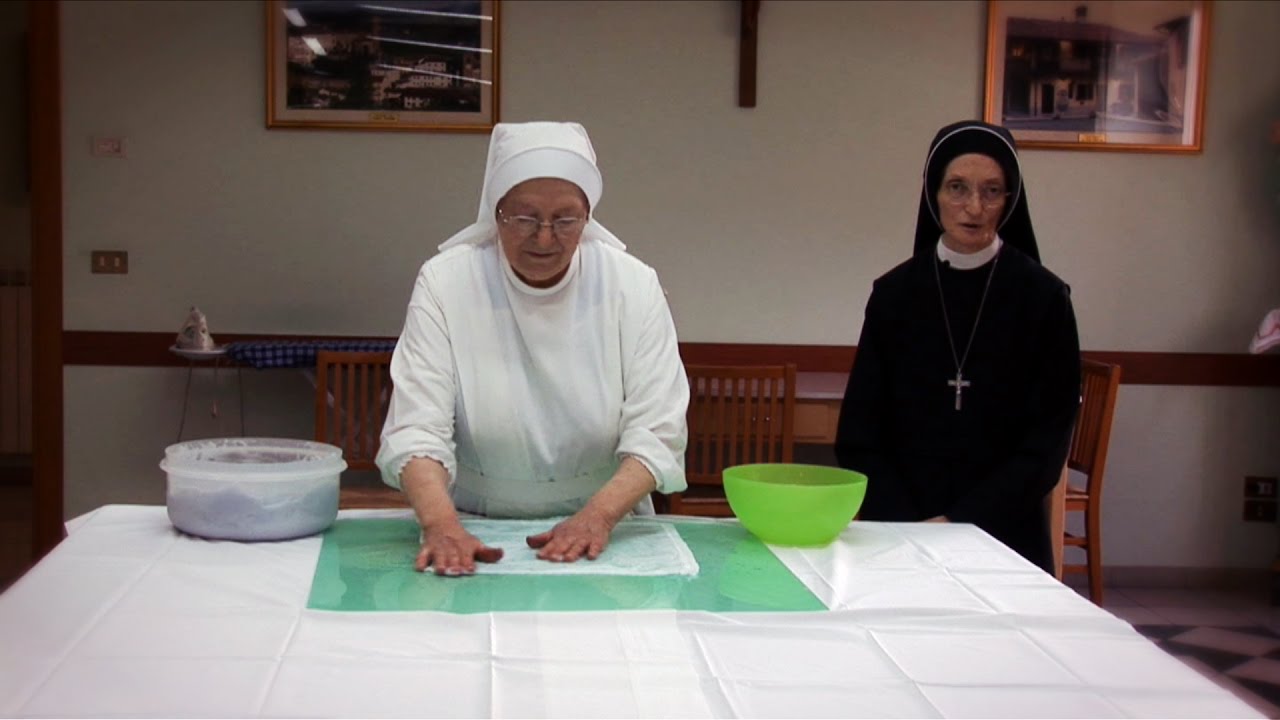
Year and years and years ago, I asked the Giuseppine nuns along the Tiber (who, by the way, to the linens for Ss. Trinità and San Pietro) how they accomplished the shine.   Memory served.  They use rice starch and Marseilles soap.  They spread the corporal, imbued with the same, on glass or the equivalent, and let it dry.  The oil in the soap helps to set the starch and allows you to peel the corporal off when dry.

So, my mise en place.   The soap is 80% olive oil.  Alas, there was only lavender scented at the store.  And I was worried about the green coloring… but… this was an experiment to figure out the proportions to use.

Starch.

Shave soap.

Into simmering water.

Start to add the starch in increments.  It will eventually thicken.

Yep… a little green.

I bought a sheet of clear acrylic.  Eventually I need a LOT more water on the right.

Get it really in there.  Pick it up and do both sides well.   Remember to put the business side DOWN.  That’s the side that will have the desired glassy finish.

Set up to dry.

Next day… when dry… get out your Dremel tool.

Just kidding.  I didn’t use my Dremmel.

Peal it off.

Ta daaah!  Success the first time.

It has a slight green tint when compared to another corporal.

I will now be on the hunt for high percentage olive oil soap which is both without fragrance and coloring.

Now that I’ve done this once, it will be easy to do again.

I have a bunch more of the starch/soap paste in the fridge.  However, I really want a new batch without coloring.

I am extremely pleased with the result and I will, tomorrow, use the corporal for Mass.

UPDATE:

Well look at this!  A commentator alerted us about this video from the very Giuseppine I mentioned above. Italian. But it is clear. It looks like the soap they used was blue!

YouTube thumbnailYouTube icon

Posted in "How To..." - Practical Notes, Fr. Z's Kitchen, Liturgy Science Theatre 3000, Save The Liturgy - Save The World, What Fr. Z is up to | Tagged , ,
22 Comments