We have to support our good religious orders, especially the newer communities.
Today I read about a solemn profession at Norcia, in Italy, where there is a great foundation of Benedictines (including not a few Americans). You might recall that they a) are very traditional and faithful, b) they suffered the loss of buildings and their beautiful ancient church to terrible earthquakes a couple years ago, and c) they make spectacular beer.
Please click and visit their site. HERE And learn about their terrific BEER.
Here is a bit of their recent mailing. Forgive me if the formatting isn’t quite right, I copied and pasted:
Dear family and friends,
Even though health and wellness professionals are making daily discoveries that claim to improve and extend life, a vague “fear of missing out” seems to be affecting more and more people. Fear of “missing out” feeds an unwillingness to commit to marriage, to family, or even to work for more than a few years at one job.
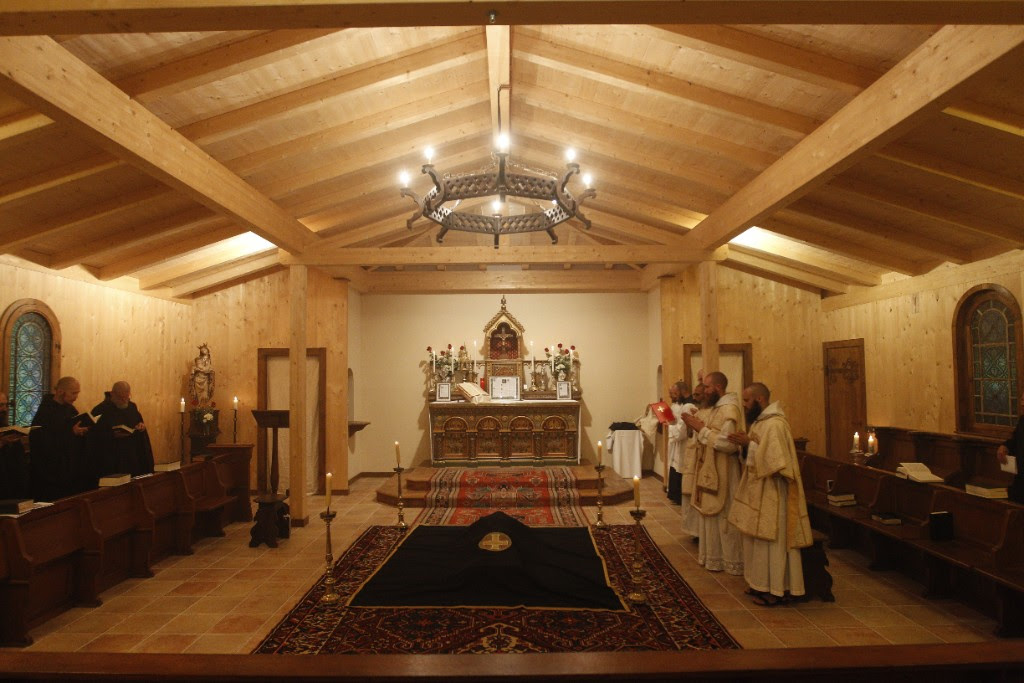
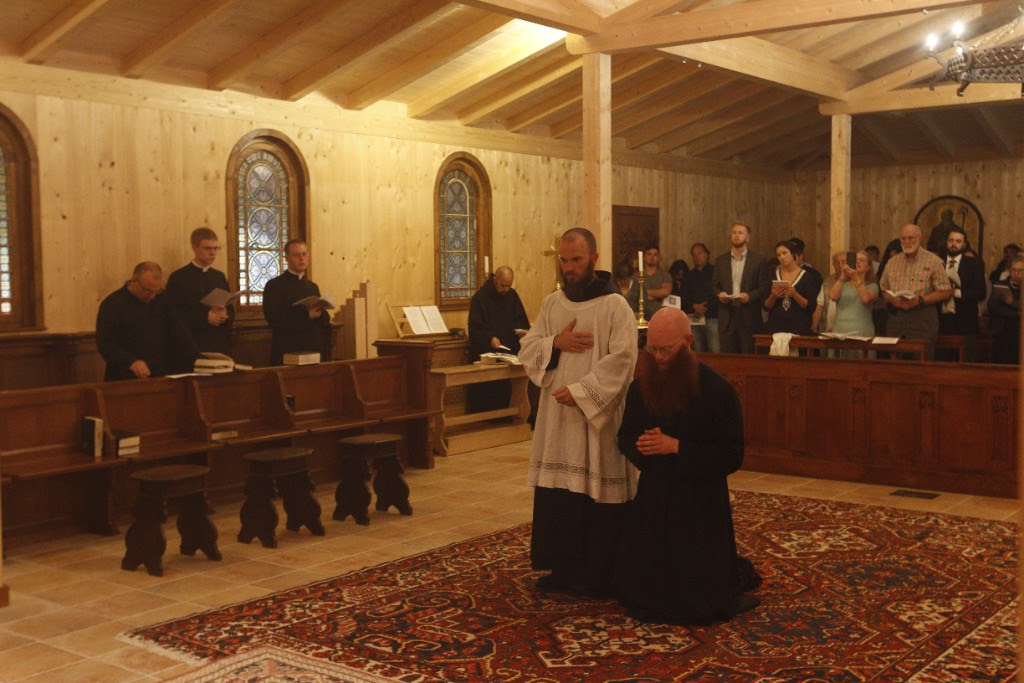
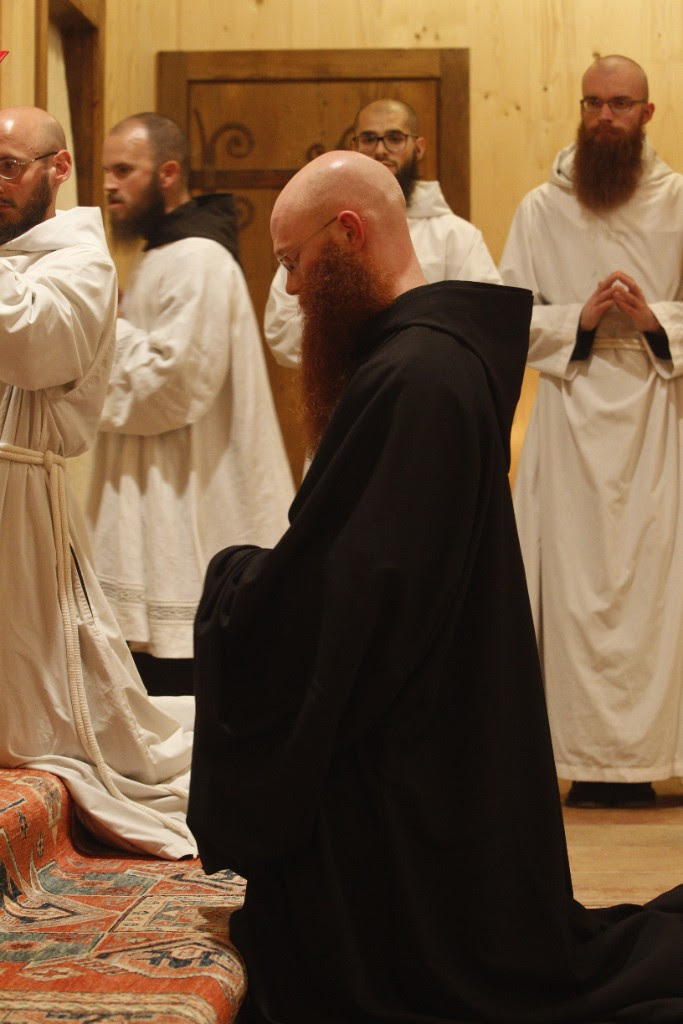
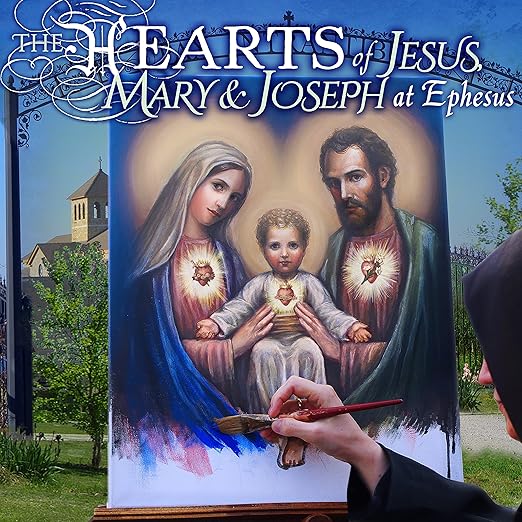
But when Br. Augustine Wilmeth of South Carolina made his Solemn Vows on the feast of the Sacred Heart this last Friday, promising to live as a monk until the day of his death, he gave us not only reason to rejoice for his decision, but hope that all of us — married or monks — can make the sacrifices necessary to live this short time we have on earth entirely for God.
Joined by family and friends from the United States and Italy and his brother monks, our little wooden chapel sheltered those present from the thundering storm outside, providing a dramatic contrast to the ancient chants and exhortations of the ritual:
May he be “far from the pomps of the secular world, distant from the web of life’s dangers, may he not fear adversity, may he bare injury willingly, love and care for friends and enemies alike, his deeds and heart filled with chastity, may his heart and mouth be surrounded and filled with the love of the Omnipotent God.”
These guys are great.
You can join a beer club and receive monthly shipments. It is Belgian in style and comes in larger bottles, a dark and a blond. It is a little more expensive that some other beers, but those other beers don’t also help the monks of Norcia!
I’m in a process of downsizing. You know how this goes. You have it in your head that, if you haven’t opened that box of stuff for a couple years, you don’t need it and you won’t miss it. Right?
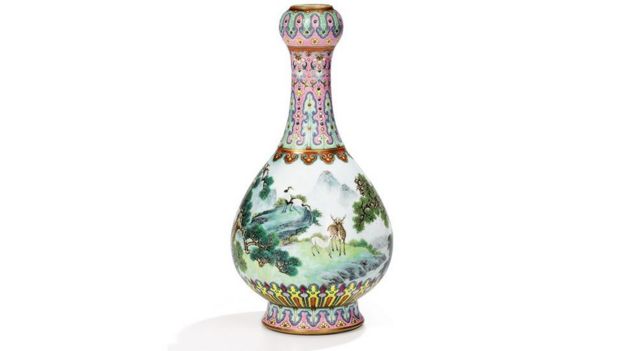
An 18th Century Chinese vase, left for decades in a shoebox in France, has sold for 16.2m euros (£14.2m).
The vase was auctioned at Sotheby’s in Paris on Tuesday and sold for more than 20 times its estimated guide price – 500,000 to 700,000 euros.
It’s the highest price ever reached for a single item sold by Sotheby’s in France.
The vase formed part of a family inheritance and was recently discovered in an attic.
Sotheby’s Asian arts expert, Olivier Valmier, said the seller “took the train, then the metro and walked on foot through the doors of Sotheby’s and into my office with the vase in a shoebox protected by newspaper.
“When she put the box on my desk and we opened it, we were all stunned by the beauty of the piece.
“This is a major work of art,” Valmier continued. “It is as if we had just discovered a Caravaggio.”
The 30 cm, bulb-shaped vase, painted in shades of green, blue, yellow and purple, was described as an exceptionally well-preserved porcelain vessel made for an emperor of the Qing dynasty.
It depicts deer, birds and other animals in a wood and includes gold embroidery around its neck. The vase bears a mark of the Qianlong Emperor who ruled China from 1736 to 1795.
The vase, which was in perfect condition, “is the only known example in the world bearing such detail,” said Valmier.
“We didn’t like the vase too much, and my grandparents didn’t like it either,” said the owner of the piece, who only got in touch with Sotheby’s in March.
A Sotheby’s spokeswoman said: “They knew it had some value but nothing like that, nor that it was from the Qian dynasty.”
The auction lasted some 20 minutes, a long time by usual standards, with multiple bidders battling for the vase.
Sotheby’s has not revealed the name or nationality of the Asian buyer.
Can a Pastor/Religious Superior mandate that the Associate Pastor/other Religious priests use only particular options in celebrating Mass with the congregation. Of course, saying Holy Mass ad Orientem is one matter. But what about the Pastor/Superior saying it is the custom here to NOT use, e.g: bells (even for the Consecration), the Chalice Veil and Burse, any Latin, chanting by the celebrant at certain parts, chasubles for concelebrants, the Roman Canon for Daily Mass, a Communion Paten, wine for the Ablution, an altar cross, the Sign of Peace, the Universal Prayer, etc.
Basically, how much say does the Celebrant have on Mass options over the Pastor/Superior saying “that’s not the way we do it here.”
GUEST PRIEST RESPONSE: Fr. Tim Ferguson
Can a pastor or superior mandate certain options within the Holy Mass.
Well, if you’re asking canonically – according to liturgical law, a priest with the faculties to offer the Holy Sacrifice has the full right to offer that Sacrifice in the manner he sees fit – following the mandates of the rubrics, of course. The rubrics give to the celebrant several options (one of the quirks of the Ordinary Form) – sometimes which optional memorial to choose, which form of the penitential rite to use, whether or not to utilize the optional sign of peace.
In addition, there are options that are, if you will, praeter legem – whether to wear a Gothic or a Roman chasuble, whether to wear a biretta, whether to give a 5- or a 25-minute homily.
All of these options are laid at the feet of the celebrant, who has presumably passed his seminary courses with flying colors, has the interest of God and His holy people at heart, is mindful of the eternal verities, and is at least sanus in mente, and hopefully, in corpore as well.
That’s the law.
Human nature being what it is, and the law being what it is, we may need to now discuss the lived reality of pastoral and liturgical practice.
Pastors, religious superiors, bishops, and the like, often have an inflated (and not necessarily insincere) notion of their own importance and their own authority. Hopefully, they are operating, just as our hapless priest celebrant is, with the best interest of God and His holy people at heart. Even though the priest celebrant has received the same (or sometimes more) formation before ordination as they, the superior can have the attitude that he knows best. He may. He may not.
Yet, Holy Mother Church has placed in his hands certain authority which ought not be dismissed, even if it, sometimes, is exaggerated in the mind of that pastor or superior.
So, if the pastor of St. Wilgefortis parish mandates that, in his parish, bells not be rung at the elevation, even if he doesn’t really have that authority, it is often best to tolerate his exaggeration of his own authority. Or if the Provincial Superior of the Fathers of Divine Wrath requires that all priests subject to him wear birettas (unless this sort of thing is specifically codified in the Constitutions of the Order), only a foolish Wrathite would obstinately refuse to do so.
One must pick one’s battles carefully.
Prudence is the Queen of Virtues – and when coupled with the virtue of fortitude, makes a formidable force for moral good. Prudence tells us when to act or speak – and when to be still or silent. Fortitude gives us the courage to act, or the stamina to endure our own inaction.
My proposal would be that, in this month, which many places have given over to celebrations of the capital sin of pride, we Catholics (already spending the month devoted to the Sacred Heart of Jesus) link to the virtue of prudence.
Perhaps we could even hold Prudence Parades, led by modestly dressed young men and women carrying banners showing saintly acts of prudence – St. John Nepomucene refusing to violate the seal of the confessional, Bl. Clemens von Galen standing up to the Nazis, St. Bernadette Soubirous keeping silent within her religious community about her status as the visionary of Our Lady of Lourdes.
The parish band could follow, playing stately march music at a reasonable level.
The revitalization of our Catholic identity will be an opus magnum et arduum.
Most of us reading this will not see but the first fruits.
We have to be smart and persistent, using all the tools at our disposal. I am mindful of the ends of rhetoric: teach, delight, persuade. We have to know clearly what it is we wish to accomplish. We must figure out the issues and organize our thoughts. Also, whom do we wish to teach, delight and/or persuade? Our audience determines a great deal for us. With what level of “tone” do we address them? What vocabulary and examples do we use?
Moreover, in our opus we must also be mindful that, in our human endeavors, we can fall into the trap of making the perfect into the enemy of the good. That is to say, if I can’t have my ideal now, I don’t want anything at all. Achievement of the good need not be a settling for the good, in lieu of the better or the best.
Is The Best attainable in this life? That’s a rhetorical question.
This leads me to a piece at NLM by Peter Kwasniewski.
Peter laments the fact that, at the end of the Chartres Pilgrimage, during the splendid Mass with Card. Sarah in the Usus Antiquior, the Subdeacon faced the people instead of ad orientem, and spoke (didn’t sing) the Epistle in French. The Deacon spoke the Gospel in French. Some video: Epistle HERE – Gospel HERE.
Peter rightly implores that we avoid these “pastoral adaptations”. Rightly.
As I have argued before, we need a long period of stability in the recovery of the Usus Antiquor. We have to learn it again and let it become part of the weft and warp of our worship. Once it is well rooted, the organic process of development foreseen by Benedict XVI will inexorably take place, but in a proper way, not an artificial way that comes through tinkeritis. It seems like people these days can’t leave anything alone. What a contrast to our forebears. Hence, Martin Mosebach’s description of how a rock probably feels resentment for centuries after it has been moved.
But I digress.
It could be that those pastoral adaptations were imposed from above upon the organizers of the Mass. That’s my guess. I suspect that the local bishop set a condition or the celebrant Card. Sarah opted for these changes (note that the Cardinal didn’t use gloves).
Hence, the pilgrims wound up with a Really Good™ experience rather than an Even Better™, The Best™ being reserved to the celestial realm.
However, Prof. K doesn’t just lament and implore. He explains why the Latin chanting of the readings – with the proper orientation – ought to be respected without the desire to tinker that so many clerics have now in their liturgical marrow. It isn’t merely for the sake of observing the rules and rubrics (what they did in Chartres was, frankly, contrary to an explicit norm in Summorum Pontificum). It goes beyond saying the black and doing the red for the sake of saying the black and doing the red.
It goes to the heart of why we must respect the rite.
Which also goes to the heart of why so many are interested in the pre-55 Holy Week, without the tinkerings of the “Bugnini abattoir”.
But I digress.
Here is Kwasniewski’s explanation for why the readings ought to be sung in Latin and with the proper orientation (East for the Epistle and North for the Gospel). My emphases and comments.
[…]
A major difference between the theology of the classical Roman Rite and that of Paul VI’s modern rite is the difference in how lections are understood. The lections at Mass are not merely instructional or didactic. They are an integral part of the seamless act of worship offered to God in the Holy Sacrifice. The clergy chant the divine words in the presence of their Author as part of the logike latreia, the rational worship, we owe to our Creator and Redeemer. These words are a making-present of the covenant with God, an enactment of their meaning in the sacramental context for which they were intended, a grateful and humble recitation in the sight of God of the truths He has spoken and the good things He has promised….
[…]
The chanted Latin lection is an expression of adoring love directed to God before it is a communication of knowledge to the people, and the form in which it is done should reflect this primacy. [I have written many times over the years of what, in our liturgical worship and liturgical choices for music, architecture, etc. (inculturation), must be given logical priority. What God and the Church have to give must be given primary consideration over and above what the world gives or provides. The chanting of the readings in the manner prescribed underscores first that they are from God. Properly understood that enriches and transforms the experience of those who participate in them as they hear. Yes, the texts are instruction, but the instruction is so much more instructive, and in a deeper way, if they are, first, intended as worship. I am reminded of the phrase “Nisi credideritis non intelligetis... You will not understand unless you will have first believed.” There is a sapientia beyond the scientia. My point: those things having to do with GOD in worship must have logical priority and, hence, we sing the readings firstly as acts of worship. That attitude affects how the sing them (and dictates even that we sing them, for, as the Doctor of Grace said, cantare amantis est.] In the ancient liturgy, always and everywhere God enjoys primacy. Nothing is done “simply” for the people. …
[…]
click
Vernacularization and recitation of the lessons at High Mass betrays the rationalism and utilitarianism of the Synod of Pistoia. The chanting of the Word of God is not just for instruction but also a quasi-sacramental action in and of itself (as Martin Mosebach argues with regard to the use of incense, candles, and the prayer “Per evangelica dicta, deleantur nostra delicta”). [YES! Great point!] It is part of the activity of worship, and like the other prayers of the Mass, it should be set apart by words of a sacral register, hallowed by tradition. [And a practical point.] No one will complain [Pace Peter, there’s always someone who will complain about something.] if this formal liturgical chant, which takes only a few minutes in any case, is followed up with a recitation of the vernacular texts before the homily. But the latter should never be substituted for the former.
[…]
That point about what the priest says at the end of reading or chanting the Gospel is important.
The priest kisses the book wherefrom the Word of God is read. The sacred minister’s poor human vox is raised mysteriously by God, through baptism and orders, to a be new means of encounter with His presence. An encounter with the presence of God in mystery is transforming, as Moses’ encounters were, with the People, when the presence cloud descended and God spoke.
At the end of the Gospel, the priest kisses the book and says: “Per evangelica dicta deleantur nostra delicta… May our sins be blotted out by the words of the Gospel (lit. the gospelish things said)!” That goes way beyond instruction, moral or otherwise.
If that is true for that moment during Holy Mass, it is true for every moment during Holy Mass. Every word and gesture of Mass is really being carried out by the Divine Actor, Christ the Hight Priest, in whose priesthood we share in different modes through sacraments. When we sing and gesture, Christ is singing and gesturing. His words and deeds, dicta et acta, are not merely moral instruction or intellectual enrichment.
Hence, chanting the Epistle “to the East” and the Gospel “to the North” means something that must be respected.
I was sent the link to a short film that, apparently, won and award at the International Catholic Film Festival in 2017.
Fail.
It starts with some good point. Never mind that the priest is not wearing a purple stole: validity of absolution doesn’t depend on a stole or its color. Fluctus in simpulo. There are some good moments in the short.
That said, there are some disturbing elements in this film.
I know that it is a short film and that short means that not every possible angle can be resolved.
The priest lies to the guy, a couple of times, in telling the penitent that he didn’t commit murder. However, even if “murder” isn’t quite the right technical term for what happened, even if the lie that the priest told was true, the guy would still have committed a horrible sin, several, in fact.
As to the penance, it isn’t always possible to “compensate” a victim. However, giving something to someone who is not the victim doesn’t strictly satisfy justice. There is a twist in this case, but that remains.
What I am afraid happened here is that sentimentality trumped reason and, once again, we saw the exaltation of false mercy which betrays truth. A “mercy” which is apart from the truth is no mercy at all.
Moreover, the film seems to make the the point of the priest’s mercy, rather than God’s mercy. It is, essentially, about the priest, not God.
I am reminded of my feeling after I read the jesuitical horror Silence by Shusaku Endo. It’s a story of a missionary Jesuit in Japan who commits apostasy to save the lives of others who are being tortured. The book and the recent film from the book are much the same as this short.
Silence was simply dreadful. Of course it was fostered by a certain Jesuit homosexualist activist as a consultant. Hence…
False mercy leads some in the Church to say that
people in an objectively adulterous state and who do not intend to chance can go to Communion if they discern that they can.
non-Catholics, who don’t believe what the Church teaches, can admit themselves to Holy Communion if they discern that they want to, and without correction from bishops and priests.
People…
GO TO CONFESSION!
And I hate to have to write this, but… don’t let bishops and priests lie to you.
You must must must get with your copies of the Catechism of the Catholic Church and other great resources and learn your Faith well. Learn it and love it enough not to lie about it and not to accept lies about it.
Seeing that, in the Novus Ordo calendar, today is the memorial of the Immaculate Heart of Mary (the day after the Sacred Heart of Jesus), I point once again your attention to the wonderful Benedictines of Mary, Queen of Apostles whose most recent music CD is:
Enjoy this video! You can hear music from the new disc and see shots of the new church they are building.
Also, I’ve been exchanging some emails with them about a project I have in mind. In the last note I received Mother wrote:
We are doing a last fundraiser for the final three months of our church construction, and one of the ways people can help is to honor a priest they know and love. Or, for a priest himself to donate in thanksgiving for his priesthood – with names and ordination dates to be engraved on a plaque in the vestibule of our church. Since the holiness of our priests is the primary concern of our community, this only seemed fitting. I’ll bet we’d get lots of people who want to donate in your honor! … We will have a link up on our website soon.
This is interesting from the UK’s best Catholic weekly, the Catholic Herald:
Philippine Church resists calls to arm priests
Church leaders in the Philippines criticised a proposal to arm priests as a protective measure in the wake of recent attacks on clergy members.
Calls have come from several quarters[I wonder who they are.] for priests to take advantage of a 2014 law allowing journalists, priests, lawyers, doctors, nurses, accountants and engineers to carry firearms outside their homes. [An interesting selection of professions/vocations. Could it be that they are perceived to be so valuable to society at large that they should have additional protection? It would be interesting to see the list that the law gives.]
The calls come after three recent shooting incidents involving priests.
In the most recent case June 6, Fr Rey Urmeneta, 64, who serves at a parish in Calamba City about 25 miles north of Manila, survived a gun attack by two assailants.
He was the third priest to have been shot since December.
In April, Fr Mark Ventura from Gattaran in the northern Philippines died after being shot by a lone gunman shortly after celebrating Sunday Mass and in December Fr Marcelito Paez was shot dead in Jaen, about 75 miles north of Manila.
The Catholic Bishops’ Conference of the Philippines, however, expressed strong opposition to the idea of arming priests.
“Arming priests is not a solution to crimes against them,” said Fr Jerome Secillano, executive secretary of the bishops’ Public Affairs Committee. [I’m not sure how he knows that. Would fewer priests be attacked if their would-be assailants had to wonder if they were armed? It seems to me that these cowards pick victims whom they think are easy to victimize. But read on!]
He said there is no need for priests to arm themselves because, like any ordinary citizen, they are also entitled to protection from the government. [Ahhh yes. The government! Because, when seconds count, the police are only minutes away!]
“If (priests) antagonise other people, killing them is unnecessarily excessive and brutal,” [?!?] said Fr Secillano, adding that priests should never be considered as “enemies.” [I sense that something is missing.]
Bishop Arturo Bastes of Sorsogon said priests get their protection from “angels, not weapons.” [Except when they don’t, at least in the physical sense.]
“I am for a gunless society. We priests are not afraid of dangers. If the public, especially the poor, are exposed to dangers, we cannot be less,” said retired Archbishop Ramon Arguelles of Lipa. [On the other hand, if the ranks of priests decline because they are easy-targets to be robbed and shot, how does that work for the people of God?]
Bishop Honesto Ongtioco of Cubao said a priest’s “vocation and role in the transformation of society” is different from other people.
“Our security is more on what we do, how we interact and live with people,” he said. [True enough. However, it only take one nut job to screw up that scenario.]
Meanwhile, Secretary of Justice Menardo Guevarra said he intended to include in next year’s proposed budget for his department funding for the purchase of firearms for prosecutors.
Guevarra said the move is in response to the killing of prosecutors in recent months, especially in the provinces.
He made the announcement following the killing of a prosecutor during a robbery incident in Quezon City June 4.
At least seven prosecutors have been killed in the past two years, according to police.
Prior to the 2014 law, people such as priests and prosecutors, like any other citizen, were required to prove they were “under actual threat” before being issued a special permit to carry firearms.
Now all that is required is that a person passes drug and psychiatric tests, prove they have no pending criminal case punishable by two or more years in jail and have no prior criminal convictions.
An interesting story developing in the Philippines.
When listening to a Collect (or any similar prayer) in Latin, whether OF or EF, I notice that the priest tends to “punctuate” the final phrase as such:
“in unitate Spiritus Sancti Deus, per omnia saecula saeculorum.”
But in English, the same is rendered:
“…in the unity of the Holy Spirit, One God forever and ever.”
Is there a significant difference here, or am I overthinking it?
Interesting. This got me thinking about how I usually say or sing this conclusion.
The placement of the comma. On which side of “God”. Hmmm.
First, “one” is not in the Latin, as it is in English.
Literally, the “per omnia saecula saeculorum. Amen.” is “through all the ages of the ages. Amen.”, in other words “forever”. This probably has its origin in the Greek New Testament, in phrases like Philippians 4:20 wherein “doxa… glory is given to God as His proper attribute, “eis tous aionas ton aionon, amen… unto the ages of the ages, amen”. It occurs in Revelation quite a few times in the heavenly liturgy seen by John. Hence, it seems like a pretty good thing to say in our liturgical worship.
In the Latin Missale Romanum there is usually placed a period or comma (depending on the moment) between Deus and per. Punctuation in the Missale tends to indicate how the prayer is to be sung. As far as the English is concerned, it seems to me that there should probably be a comma also after God.
By the way, there is another punctuation issue in the Sanctus. In the Latin Missale we find it:
Sanctus, Sanctus, Sanctus Dominus Deus Sabbaoth.
The last part, Sanctus Dominus Deus Sabbaoth, goes together.
In the obsolete ICEL we suffered with for so long, and which some people seem to want back:
Holy, holy, holy Lord, God of power and might.
In the current ICEL:
Holy, Holy, Holy Lord God of hosts.
Commas matter. Is there is a difference between:
Let’s eat grandpa.
Let’s eat, grandpa.
Consider the series or “Oxford comma”. Say I wanted to dedicate my upcoming novel …
… to my parents, Card. Sarah, and Card. Burke.
… to my parents, Card. Sarah and Card. Burke.
Commas matter.
Lawsuits have been won and lost over the absence or the position of a comma. If memory serves millions of dollars exchanged hands not too long ago over a comma.
Ah, the Oxford comma! Discussion abounds, per omnia saecula saeculorum.
Please remember me when shopping online. Your use of my Amazon affiliate link is a major part of my income. It helps to pay for insurance, groceries, everything. Thanks in advance.
“This blog is like a fusion of the Baroque ‘salon’ with its well-tuned harpsichord around which polite society gathered for entertainment and edification and, on the other hand, a Wild West “saloon” with its out-of-tune piano and swinging doors, where everyone has a gun and something to say. Nevertheless, we try to point our discussions back to what it is to be Catholic in this increasingly difficult age, to love God, and how to get to heaven.” – Fr. Z
The most evident mark of God’s anger and the most terrible castigation He can inflict upon the world are manifested when He permits His people to fall into the hands of clerics who are priests more in name than in deed, priests who practice the cruelty of ravening wolves rather than the charity and affection of devoted shepherds.
Federated Computer… your safe and private alternative to big biz corporations that hate us while taking our money and mining our data. Have an online presence large or small? Catholic DIOCESE? Cottage industry? See what Federated has to offer. Save money and gain peace of mind.
“Until the Lord be pleased to settle, through the instrumentality of the princes of the Church and the lawful ministers of His justice, the trouble aroused by the pride of a few and the ignorance of some others, let us with the help of God endeavor with calm and humble patience to render love for hatred, to avoid disputes with the silly, to keep to the truth and not fight with the weapons of falsehood, and to beg of God at all times that in all our thoughts and desires, in all our words and actions, He may hold the first place who calls Himself the origin of all things.”
Everyone, work to get this into your parish bulletins and diocesan papers.
Your support is important. Thanks in advance.
To donate monthly I prefer Zelle because it doesn't extract fees. Use
frz AT wdtprs DOT com
Donate using VENMO
GREAT BEER from Traditional Benedictine Monks in Italy
Good coffee and tea. Help monks.
CLICK and say your daily offerings!
A Daily Prayer for Priests
I use this when I travel both in these USA and abroad. Very useful. Fast enough for Zoom. I connect my DMR (ham radio) through it. If you use my link, they give me more data. A GREAT back up.
Help support Fr. Z’s Gospel of Life work at no cost to you. Do you need a Real Estate Agent? Calling these people is the FIRST thing you should do!
They find you a pro-life agent in your area who commits to giving a portion of the fee to a pro-life group!
Don’t rely on popes, bishops and priests.
“He [Satan] will set up a counter-Church which will be the ape of the Church because, he the devil, is the ape of God. It will have all the notes and characteristics of the Church, but in reverse and emptied of its divine content. It will be a mystical body of the anti-Christ that will in all externals resemble the mystical body of Christ. In desperate need for God, whom he nevertheless refuses to adore, modern man in his loneliness and frustration will hunger more and more for membership in a community that will give him enlargement of purpose, but at the cost of losing himself in some vague collectivity.”
“Who is going to save our Church? Not our bishops, not our priests and religious. It is up to you, the people. You have the minds, the eyes, and the ears to save the Church. Your mission is to see that your priests act like priests, your bishops act like bishops.”
“The modern habit of doing ceremonial things unceremoniously is no proof of humility; rather it proves the offender's inability to forget himself in the rite, and his readiness to spoil for every one else the proper pleasure of ritual.”
- C.S. Lewis
This blog has to earn its keep!
PLEASE subscribe via PayPal if it is useful. Zelle and Wise are better, but PayPal is convenient.
A monthly subscription donation means I have steady income I can plan on. I put you my list of benefactors for whom I pray and for whom I often say Holy Mass.
In view of the rapidly changing challenges I now face, I would like to add more $10/month subscribers. Will you please help?
For a one time donation...
To donate monthly I prefer Zelle because it doesn't extract fees. Use
frz AT wdtprs DOT com
As for Latin…
"But if, in any layman who is indeed imbued with literature, ignorance of the Latin language, which we can truly call the 'catholic' language, indicates a certain sluggishness in his love toward the Church, how much more fitting it is that each and every cleric should be adequately practiced and skilled in that language!" - Pius XI
"Let us realize that this remark of Cicero (Brutus 37, 140) can be in a certain way referred to [young lay people]: 'It is not so much a matter of distinction to know Latin as it is disgraceful not to know it.'" - St. John Paul II
Grant unto thy Church, we beseech Thee, O merciful God, that She, being gathered together by the Holy Ghost, may be in no wise troubled by attack from her foes. O God, who by sin art offended and by penance pacified, mercifully regard the prayers of Thy people making supplication unto Thee,and turn away the scourges of Thine anger which we deserve for our sins. Almighty and Everlasting God, in whose Hand are the power and the government of every realm: look down upon and help the Christian people that the heathen nations who trust in the fierceness of their own might may be crushed by the power of thine Arm. Through our Lord Jesus Christ, Thy Son, who liveth and reigneth with Thee in the unity of the Holy Ghost, God, world without end. R. Amen.


 An 18th Century Chinese vase, left for decades in a shoebox in France, has sold for 16.2m euros (£14.2m).

 From a reader…

 This is interesting from the UK’s best Catholic weekly, the
  From a reader…




























