Last night we enjoyed some homemade Meat Pies. It is clear from even 5 minutes in Natchitoches that Meat Pies are thing here.


Last night we enjoyed some homemade Meat Pies. It is clear from even 5 minutes in Natchitoches that Meat Pies are thing here.
 From a reader…
QUAERITUR:
Our priest is giving us liturgical direction every Sunday during lent. Last Sunday he said we should not cross ourselves after the confiteor when he says the prayer of absolution. He said this was an abuse and the only time we should cross ourselves was at the beginning and the end of the mass. He also said that no sins were being forgiven. I was under the impression that venial sins were forgiven at mass. Is this an abuse? Should I continue to cross myself if not, or should I obey my priest.
Why do some priests have to make other priest’s lives so hard?
First, I would like to know if Father has obeyed Sacrosanctum Concilium 54. Has he taken care that his flock can respond both signing and speaking in both Latin and their mother tongue to the parts of Mass that pertain to them?
Look, Father ought to unclench his thingy and stop micro-managing.
NB: People do this in the Extraordinary Form in imitation of the priest and the altar serves or sacred ministers, who made the Sign of the Cross at that point, while the priest traces the Cross over everyone. This is a good Catholic instinct. It just seems right.
Father! Don’t quench the Spirit! The Spirit is moving people to feel sorrow for even their lesser sins before daring to participate in the awesome sacred mysteries.
And, yes, venial sins are forgiven. Father might refresh his memory about the difference between mortal sins and venial sins. Hey! Repetita iuvant, right? We should all review our basics from time to time, no matter what our role is in the Church.
It would be an abuse to tell people that they must make the sign of the Cross at that point. It would be an abuse to require people to hold hands during the Our Father, too. However, if people want to hold hands or make the Sign of the Cross, fine. If they want to hold hands, and that doesn’t create a disturbance, big deal, right? How does making the Sign of the Cross constitute an abuse?
When did the sign of the Cross become wrong?
We sign ourselves with it at the Gospel. Many sign themselves with it at Communion time.
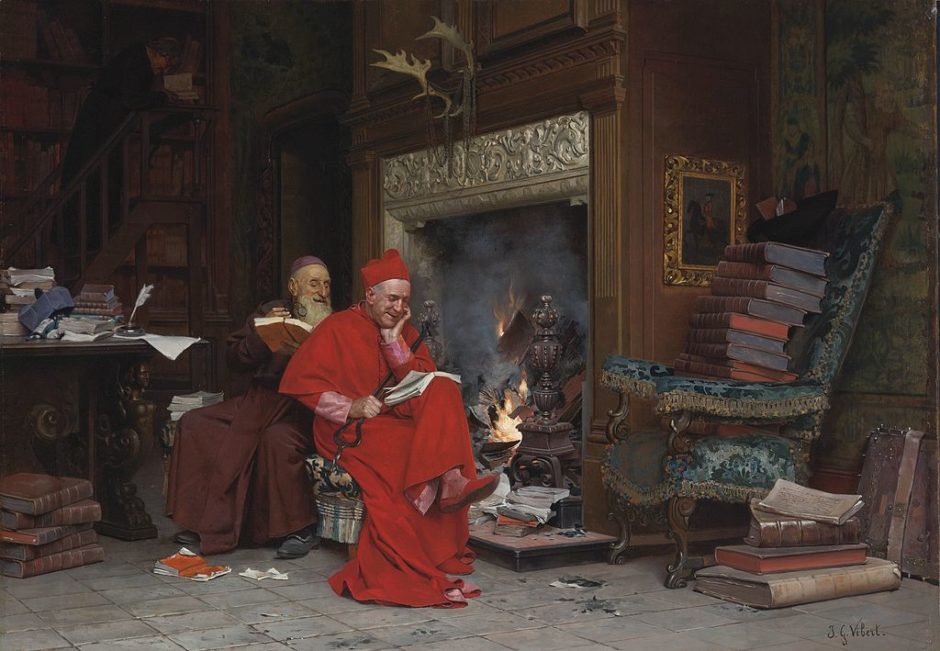
How is this bad? Should they stop? It’s enough to make the little girl in the graphic, above, burst into tears.
I am pretty sure he isn’t being malicious… but… sheesh!
I would listen politely to Father, smile indulgently, and then make the Sign of the Cross whenever it pleaseth thee to make it.
The next step should be to get a large group of people organized and petition for Holy Mass according to the 1962 Missale Romanum in keeping with Summorum Pontificum.
And if you do the 2nd Confiteor then you could all multiply your Signs of the Cross after the absolution!
A priest friend forwarded this from Pat Archbold at the National Catholic Register:
The Seven Stages Of Heresy
Stage 1.
Immoral practice is clearly condemned and anathematized. The eternal salvation of souls is at stake. Some people still do it, but they are understood to be sinners and sometimes socially ostracized.
Stage 2.
Immoral practice is still clearly condemned but nobody really talks about it. More people do it, but not considered ideal.
Stage 3.
Immoral practice is formally condemned, but such condemnation is rarely taught. Many more people do it, it is just the way life is sometimes.
Stage 4.
Immoral practice is still formally condemned, but most clergy look the other way and some even encourage it. Most people do it, what is the big deal?
Stage 5.
Immoral practice is still formally condemned, but we must find a way to act pastorally toward all those who engage in practice. Church is seen to be unnecessarily hurting those with its outdated intolerance. To be more pastoral, we encourage more of the immoral practice because our growth has taught us that people’s feelings are more important than their souls.
Stage 6.
Immoral practice is still immoral, but those charged with the care of souls and safeguarding the truth say things like “that ship has sailed” or “not that important” or “not relevant” or “we are not obsessed with such matters” or “we need to encounter people where they are” or ultimately “the sensus fidelium has spoken.” Those who don’t do it are considered obsessed wild-eyed intolerant freaks who are ultimately harming the Church’s outreach.
Stage 7.
Immoral practice is still immoral and Church still formally condemns it, but the ubiquitous immoral practice has spawned worse ones, so we now have bigger fish to fry. Congratulations! You have a full-blown heresy!!
One of you readers sent me this photo of Z-Swag, in the wild! It was posted on Twitter as well.
After washing, my @fatherz travel mug makes a worthy beer glass (pictured with libation, breviary, etc., on the road)
A beer in your insulated coffee device. The other breakfast drink.

Do you have some Z-Swag?
Click HERE
Someone sent me a PDF of a flyer from the Diocese of St. Petersburg in Florida promoting a series of talks on Sacrosanctum Concilium.
Hopefully the talks will be great.
The flyer, however, isn’t so great. There are a series of statements which perpetuate goofy notions that have been circulated for a long time. Let’s have a look with my emphases and comments:
- Did you know that before the Constitution on the Sacred Liturgy we did not always have Old and New Testament readings at Mass? (Chapter 2, #51) [This is a false statement. There are Old Testament readings in Extraordinary Form. Furthermore, every Mass includes texts from the Psalms. The Antiphon are mostly Old Testament.]
- Did you know that reception of the Eucharist under both kinds for the people came into practice after the Constitution on the Sacred Liturgy? Before the document, people did not receive the Eucharist at every Mass and did not receive the blood of Christ at all. (Chapter 2, #55) [This is a misleading statement. Frequent Communion was strongly promoted by St. Pope Pius X. However, people still understood before the depredations that took place in the wake of and name of the Council that if you are not in the state of grace, you shouldn’t go to Communion. Furthermore, this statement makes it seem that if people are not receiving the Precious Blood, they are somehow being deprived of receiving the Eucharist.]
- Did you know that before the Constitution on the Sacred Liturgy, Mass was only offered in Latin – not in the multiple languages allowed today? (Chapter 1, #36) [This is a manipulative statement that also hides the truth of what the Council commanded. First, it is not entirely desirable that multiple languages be used, because the multiplication of languages has fractured our unity, both across borders and across centuries. The illicit elimination of Latin also slammed the doors of our treasury of Sacred Music. Moreover, the Fathers of the Council commanded that Latin be retained! They allowed for some limited use of the vernacular on occasions.]
- Did you know that the Constitution on the Sacred Liturgy reestablished the adult catechumenate? The RCIA process was developed to bring adults (and children age 7 and above) into the Church. (Chapter 3, #64) [This statement is much ado about nothing. Adult converts and children above 7 were constantly being brought into the Church before the Council, and not in a one-sized mainstreams all method. Additionally, I can’t tell you how many people I have spoken to who wished they had had the opportunity of private instruction rather than the silly RCIA stuff they had to endure.]
- Did you know that prior to the Constitution on the Sacred Liturgy, people were not expected to actively participate in Mass by responding, praying, or singing – people were there just to “hear” the Mass? (Chapter 2, #48) [This is a falsehood. Of course people were expected to participate actively at Mass, but actively in its most authentic sense of interiorly receptive activity. Furthermore, Popes throughout the 20th century urged people to make responses during Mass and clarified which parts they could participate in also with outward, vocal participation.]
- Did you know that the Constitution on the Sacred Liturgy calls for conscious and active participation in Mass and affairs of the Church by all the faithful by reason of our baptism? It set in motion the ability for lay people, including women, who were previously not even allowed in the sanctuary, to be lectors, Eucharistic Ministers, [No!] altar servers, [altar girls were promoted contrary to the law] and hold leadership positions. (Chapter 2, #14) [This is incorrect. Before the Council began, during the Pontificate of Pius XII there was an important document on Sacred Music which promoted congregational singing and gave a clear, strong definition of “active participation”. Also, lay people cannot be “Eucharistic Ministers”. They can be ministers of “Holy Communion”. Only the ordained are truly Eucharistic Ministers.]
These statements are misleading. They reflect an attitude of, “Before the Council, bad. After the Council, good.” It is not uncommon among people of a certain age to find a view that the Church really began with Vatican II. They want you simply to accept their premises (e.g., women being allowed into the sanctuary is a good thing).
Keep in mind that Vatican II’s importance is mainly in their own imaginations. It occurred in living memory, which makes it seems more important that it was. Vatican II was one Council among many, in the Church’s history. Furthermore, it wasn’t even among the more important Councils. Nicea… Chalcedon… Trent… Those were truly important Councils.
Look. The Council had its effects. But let’s look at the Council with some sobriety for a change.
 Today’s Collect was in the pre-Conciliar Missale for Thursday (not Wednesday) of the 1st Week of Lent, but slightly different. In the Novus Ordo it is somewhat softened. Are you getting used to that now?
Devotionem populi tui, quaesumus, Domine, benignus intende, ut, qui per abstinentiam temperantur in corpore, per fructum boni operis reficiantur in mente.
By contrast:
Devotionem populi tui, quaesumus, Domine, benignus intende : ut, qui per abstinentiam macerantur in corpore, per fructum boni operis reficiantur in mente.
The complicated term mens figures in this prayer. It pops up as a theme, a thread to follow in the maze of Lenten orations. Mens is set in contrast to corpus. In some prayers, as in yesterday’s, mens is contrasted with caro, flesh.
The interesting macero appears here. In yesterday’s Collect moderato was substituted for maceratio. Let’s look at that. Maceratio is a “softening up”. Sounds strange, right? You would think we want to toughen, not soften. Think of the cooking term maceration.
We macerate things by immersing them in some substance in order to break them down. This is done with meat, tenderize it, to break down the fibers of muscle so that when heat is applied they will not contract and make the meat tough. We do the same thing by pounding flesh with a spiky hammer. Maceratio means “tenderize”. Think of softening up an entrenched position of the enemy by hammering it with artillery. That is what maceratio means. That is what mortifications of the flesh, penitential practices that involve fleshly things, not just mental, do to us and it why it is important to undertake them.
Today, however, in the Novus Ordo, redactors eliminated that harsher image of being pounded, tenderized, and substituted tempero, related to temperatio.
Tempero is “to observe proper measure; to moderate or restrain one’s self; to forbear, abstain; to be moderate or temperate”. We can also use this word to indicate the mixing of liquids, such as when water is added to wine in a cup, according to ancient usage. Horace in Ode 1.20 talks about this is a poem dedicated to his patron Maecenas:
Vile potabis modicis Sabinum
cantharis, Graeca quod ego ipse testa
conditum levi, datus in theatro
cum tibi plausus,
care Maecenas eques, ut paterni
fluminis ripae simul et iocosa
redderet laudes tibi Vaticani
montis imago.
Caecubum et prelo domitam Caleno
tu bibes uvam; mea nec Falernae
temperant vites neque Formiani
pocula colles.
The parts below in parenthesis I added to make this clearer to those who don’t know much about Horace.
(When you visit me in the country at my farm)
You will quaff from simple drinking cups
the lowly Sabine which I laid down with the
Greek style seal, in the year when the applause
was given to you in the theater,
dear knight Maecenas, so loud that
the Vatican hill together with the banks of
the fatherly river Tiber sent the praises
back to you.
(At home) you will be drinking Caecuban and the grape
crushed in the Calenean press; my vines
and not Falernian or Formian vines will
blend in your cups
(when you visit my Sabine farm house in the country).
A long time ago, one of my Latin profs told me that as I got older I would appreciate Horace more and more. He was right. Not only do I appreciate him more and more, my life is beginning to resemble his more an more, oddly enough.
In any event, tempero also means, “to forbear, abstain, or refrain from; to spare, be indulgent to any thing”. Think of the virtue temperance, akin to the virtue moderatio we saw yesterday. In both cases, curiously the concept macero was taken out. However, whereas yesterday the mens/caro contrast was obscured by the change, today mens and corpus are pretty firmly underscored by the structure of the prayer.
LITERAL STAB:
We beg You, O Lord, kindly look upon the devotion of Your people, with the result that they who by means of abstinence are being sparing in due measure in respect to the body may by means of the fruit of good work be refreshed in respect to the mind.
The prayers this 1st week of Lent present those who follow the Novus Ordo with different of different virtues to think about: devotio, moderatio, temperatio.
Are you pursuing them?
I am in the south, where people eat grits. They really do.
I am in a town called “Nákatish”, Louisiana, although it is spelled, Natchitoches. It really is.
There is a lovely Minor Basilica here, of the Immaculate Conception.

This used to be the cathedral of a diocese that was suppressed in 1910, though it is still a titular diocese.

The basilica’s umbraculum, one of the important symbols of its status.
Note the altar cards on the side altar. This is a clue as to the way things are done here.

Here is a memorial stone.

Another stone.

The old seminary has been preserved.

I am giving a series of talks here as part of a parish retreat. My first talk was tonight. I spoke about “Active Participation: a matter of life and death”. I was asked to speak on matters liturgical. On Thursday we are to have a Solemn Mass in the Extraordinary Form. It will be the first Solemn Mass here nearly 50 years.
The young priests I am meeting here are great. The people of Nakatish are very fortunate.
A view of the basilica this evening after the first talk.

 Remember the 60’s throw-back deacon in Milwaukee? Deacon Sandy? Refresh your memory HERE.
Because it’s Lent, and because this guy shouldn’t get a pass, here is a recent video of him in action, reading the Gospel and “preaching”.
I am going to keep the combox closed, for reasons that will be obvious as soon as you start to watch.
He even takes a nasty, supremely tacky swipe at Pope Benedict after 9:45.
Happily, it appears that there are very few people in church for this … thing he did.
http://www.youtube.com/watch?v=zo9A7vVtDhU&feature=player_embedded
UPDATE:
Over at CMR, Pat Archbold posted a response he received from Deacon Sandy. I am not kidding:
After we posted last night a link to Deacon Sandy’s homily of last week in which he disgracefully insulted and put forth for ridicule Pope Benedict, Deacon Sandy tried to remove the video.
He wrote to me this morning and made the following claim about the picture:
“I ask you to understand that I did not in fact know that the image used was Pope Benedict. (I am still not sure it is – I am curious – how do you know it is?) I got the picture from an image library as a result of searching for “fine vestments”. I chose the image because it was cropped and did not reveal who was in the vestments shown.”
[…]
Ummm…
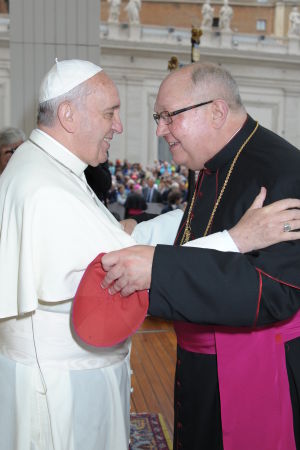 The the Wisconsin State Journal there is a long interview with His Excellency Most Rev. Robert C. Morlino, Bishop of Madison (aka “The Extraordinary Ordinary”), occasioned by the approaching 1st anniversary of the election of Pope Francis. Full transcript HERE
Many excerpts are worth teasing out, but I thought this one to be especially good:
State Journal: In December, you gave an interview to the website Real Clear Religion in which you suggested Pope Francis has actually helped make you a stronger culture warrior.
Morlino: Yes, Oh, yeah.
State Journal: Can you explain a little more how that is?
Morlino: Well, in order to meet Christ, we have to stand up for the whole Christ. Standing up for the whole Christ — How do you do that? What are the aspects of Christ and of his work that need work in that vicinity or this region? That’s the judgment the bishop has to make. So I have to see kind of which aspects of the truth of Christ need work here, and when I see that, I kind of end up right back where I was. I have to speak up forcibly about these issues. But I have never failed to teach also about God’s mercy. Never. It’s one of my major themes. It always has been. But God’s mercy is always balanced with his judgment, and we have to think that through and work that out. It is unfortunate that some people, especially in your profession, have taken the occasion to widely misinterpret Francis, particularly with that statement, “Who am I to judge?” I have had to explain away what the mass media have said about that far more times than I’d like to count.
State Journal: In a recent Catholic Herald column, you said that comment has been “outrageously misinterpreted.” Tell us how.
Morlino: When Francis was telling us about that, he was talking about a particular bishop whom he had just given a job in the Vatican, and it was found out that in South America where this bishop had been, he had been charged with certain misconduct. So the question came to Francis, “How could you bring him in?” And Francis said, “The man has admitted he did wrong, he is sorry, and he has changed his life through the grace of Jesus Christ. Who am I to judge him now?” That is hardly a statement that somehow justifies homosexual behavior. This is another thing: When he says, “What do you want from me, I am the son of the church?” From an Argentinean background, that’s a very strong statement. In the United States of America, that’s a very generic statement that could mean anything, because Nancy Pelosi thinks she’s a loyal daughter of the church, so she doesn’t know what church is and she doesn’t know what loyal is. This man knows what loyalty to the church is, he was surrounded by it, there was a strong cultural Catholicism in Argentina which we lost in the United States long ago. So that statement has to be taken very seriously, and it’s kind of passed over. The pope made another statement at Mass this last week. I’m sure it was some kind of a slip on his part, because again, he’s worried about bringing people closer to Christ. He’s not watching every word, and you can’t do that when you’re trying to connect with people. He was talking about how the Holy Spirit is at work in our lives, that he gives us gifts, that he’s present in his gifts. And he was giving all kinds of examples of how the Holy Spirit works through the gifts of each one of us every day and he does this for everyone. So he said the Holy Spirit is a real worker, the Holy Spirit is a hard worker, and then he said, “Not like trade union workers.” I didn’t see that in the press anywhere, that he said that. But he says, “Who am I to judge?” and it’s all over the world. The mass media are trying to create a spirit of Pope Francis, just as they created a spirit of Vatican II. Many Catholics fell for that the first time. I hope they won’t fall for that again.
State Journal: As to the initial quote aboard the papal airplane, the pope said, “If someone is gay and he searches for the Lord and has good will, who am I to judge?” He said “good will” — two words, not one word — which is critical in this context, correct?
Morlino: Right. Good will, meaning the will to obey the teaching of the church and the natural law that comes from our humanity. Sure. That kind of good will.
State Journal: And that’s what seems to have been lost in some interpretations, right?
Morlino: Right, right.
There is a lot more red meat in the interview, which I urge you to read.
I applaud the outstanding Bp. Morlino for his willingness to go into the lion’s den and talk to the lions.
Let us not be afraid to be happy – happy – culture warriors of this stripe.
It isn’t gray to travel when not feeling 100% but, ceteris paribus, I’m in pretty good shape.
Small aircraft today, which always leads to that cramped feeling.

It is a melancholy day when on FourSquare you become “mayor” of your local airport.
UPDATE:
Leg 2.
We were endlessly harassed to volunteer to give up our seats. They were over-booked by 7! How does that even happen? I almost took the deal but then remembered the dump of a hotel they put me in last time I did this in Atlanta. And you never know what disaster they will concoct tomorrow morning, in innocence thinly feigned.


Coat of Arms by D Burkart









A Daily Prayer for Priests


They find you a pro-life agent in your area who commits to giving a portion of the fee to a pro-life group!

PLEASE subscribe via PayPal if it is useful. Zelle and Wise are better, but PayPal is convenient.
A monthly subscription donation means I have steady income I can plan on. I put you my list of benefactors for whom I pray and for whom I often say Holy Mass.
In view of the rapidly changing challenges I now face, I would like to add more $10/month subscribers. Will you please help?
For a one time donation...



Help Monks in Wyoming (coffee – UPDATED LINK) and Norcia (beer) and the wonderful "Soap Sisters" of Summit, NJ!


Please follow me on Twitter!










Visits tracked by Statcounter
since Sat., 25 Nov. 2006:

