There is a controversial paragraph in Evangelii gaudium in which the Pope seems to be attacking “trickle-down” economics.
54. In this context, some people continue to defend trickle-down theories which assume that economic growth, encouraged by a free market, will inevitably succeed in bringing about greater justice and inclusiveness in the world. [En este contexto, algunos todavía defienden las teorías del «derrame», que suponen que todo crecimiento económico, favorecido por la libertad de mercado, logra provocar por sí mismo mayor equidad e inclusión social en el mundo.] This opinion, which has never been confirmed by the facts, expresses a crude and naïve trust in the goodness of those wielding economic power and in the sacralized workings of the prevailing economic system. Meanwhile, the excluded are still waiting. To sustain a lifestyle which excludes others, or to sustain enthusiasm for that selfish ideal, a globalization of indifference has developed. Almost without being aware of it, we end up being incapable of feeling compassion at the outcry of the poor, weeping for other people’s pain, and feeling a need to help them, as though all this were someone else’s responsibility and not our own. The culture of prosperity deadens us; we are thrilled if the market offers us something new to purchase; and in the meantime all those lives stunted for lack of opportunity seem a mere spectacle; they fail to move us.
What are we working with here? Supposing this was composed in Spanish, how do we translate:
En este contexto, algunos todavía defienden las teorías del «derrame», que suponen que todo crecimiento económico, favorecido por la libertad de mercado, logra provocar por sí mismo mayor equidad e inclusión social en el mundo.
Here is what I do with it:
In this context, some still defend theories of “spill” [trickle-down economics], which suppose that all economic growth, favored by the freedom of the market, succeeds in bring about greater equity and social inclusion in the world.
My Spanish is nowhere near my Italian and Latin, but it seems to me from my searching around on the interwebs that “derrame” is precisely what is used in Spanish to describe “trickle-down” economics.
I bring this up because some have suggested to me that “derrame” or “spill” theories might mean something else.
I invite some Spanish speakers to chime in.
Also, I am watching reactions to EG 54.
 One of the best is that of Samuel Gregg at National Review. Here is part of his reaction to this paragraph:
There are several problems with this line of reasoning. First, opening up markets throughout the world has helped to reduce poverty in many developing nations. East Asia is a living testimony to that reality — a testimony routinely ignored by many Catholics in Western Europe (who tend to complain rather self-centeredly about the competition it creates for protected Western European businesses and other recipients of corporate welfare) and a reality about which I have found many Latin American Catholics simply have nothing to say.
Click to buy
Second, it has never been the argument of most of those who favor markets that economic freedom and free exchange are somehow sufficient to reduce poverty. These things are certainly indispensable (witness the failure of planned economies to solve the problem of scarcity), but they’re not enough. Among other things, stable governments that provide infrastructure, property arrangements that identify clearly who owns what, and, above all, the rule of law are just as essential. It hardly need be said that rule of law (mentioned not once in Evangelii Gaudium) is, to put it mildly, a “challenge” in most developing nations. The lack of rule of law not only ranks among the biggest obstacles to their ability to generate wealth on a sustainable basis, but also hampers their capacity to address economic issues in a just manner. Instead, what one finds is crony capitalism, rampant protectionism, and the corruption that has become a way of life in much of Africa and Latin America.
Fishwrap (aka National Schismatic Reporter) hates what Gregg wrote, of course. Their Michael Sean Winters called Gregg’s piece “a shameful and pathetic response.” Therefore, we can suppose without hesitation that Gregg’s response is dead on right.
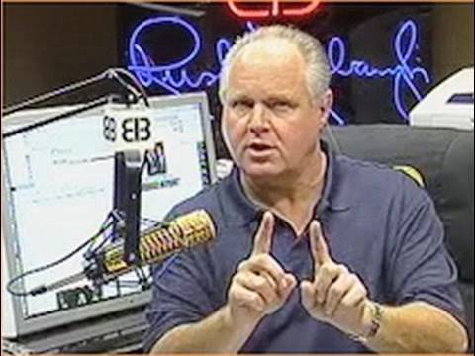
Another reaction which I found was that of Rush Limbaugh, who pretty much blew up yesterday. This caught my special attention because, at his site, there is an entry entitled:
It’s Sad How Wrong Pope Francis Is (Unless It’s a Deliberate Mistranslation By Leftists)
Rush said on the air:
RUSH: I was doing show prep last night, usual routine, and I ran across this — I don’t even know what it’s called, the latest papal offering, statement from Pope Francis. Now, I’m not Catholic. Up until this, I have to tell you, I was admiring the man. I thought he was going a little overboard on the common-man touch, and I thought there might have been a little bit of PR involved there. But nevertheless I was willing to cut him some slack. I mean, if he wants to portray himself as still from the streets where he came from and is not anything special, not aristocratic. If he wants to eschew the physical trappings of the Vatican, okay, cool, fine. But this that I came across last night totally befuddled me. If it weren’t for capitalism, I don’t know where the Catholic Church would be.
Now, as I mentioned before, I’m not Catholic. I admire it profoundly, and I’ve been tempted a number of times to delve deeper into it. But the pope here has now gone beyond Catholicism here, and this is pure political. I want to share with you some of this stuff.
“Pope Francis attacked unfettered capitalism as ‘a new tyranny’ and beseeched global leaders to fight poverty and growing inequality, in a document on Tuesday setting out a platform for his papacy and calling for a renewal of the Catholic Church. … In it, Francis went further than previous comments criticizing the global economic system, attacking the ‘idolatry of money.'”
I gotta be very careful. I have been numerous times to the Vatican. It wouldn’t exist without tons of money. But regardless, what this is, somebody has either written this for him or gotten to him. This is just pure Marxism coming out of the mouth of the pope. Unfettered capitalism? That doesn’t exist anywhere. Unfettered capitalism is a liberal socialist phrase to describe the United States. Unfettered, unregulated.
Folks, in recent weeks I have endeavored to try to make you understand how it is that people like modern-age Democrats look at small business and business at large. They do not, in the terms of small business, understand how fragile it is. Their view of business is that people who own them or run them cheat their customers, abuse their employees, hoard all the money, and have tons of it. They take it and keep it for themselves. They deny their employees a livable wage. They deny them health care. They deny them benefits. They produce products that kill and maim and sicken, or they produce products that destroy the planet, destroy the environment, or what have you.
I mean, it’s a litany. This is their view and it is why they claim that they must take it over and control it, because it’s inherently unfair that a select few capitalists rip everybody off. Rip off their employees, rip off their customers, and that’s how you have unequal incomes, and this vast gap between wealth and poverty. It’s all because of capitalism. They claim that as socialists or reformers or progressives, that they are fair and compassionate, and they will make that gap between the wealthy and the poor narrower, and they will make life more equitable, and they will engage in equality of outcomes and so forth, and wherever they’ve tried, they’ve failed.
[…]
There is a LOT more from Rush’s blast, but that gives you a sense of it.
Rush is right, of course, in the main.
I think Rush is wrong when he says that what Francis promulgated is “pure Marxism”.
It seems to me that the key to understanding what Francis is lashing out at is influenced by his experience of Peronism. Argentina’s economy has been a complete disaster. That would explain a lot about Francis.
I admit that I don’t know much about Peronism, but I am reading about it.
Furthermore, I suspect that whomever Francis relied on for help in writing this section, about economics, is pretty much a statist (centralized government control over economic planning and policy). There is no lack of statists (and socialists) in the Vatican, that’s for sure.
We need to drill into Peronism, friends, and try to figure out Francis’ hermeneutic for economics.




 One of the best is that of
 Rush said on the air: